
テ・デウム
Te Deum
シャルパンティエ・c. 1688–1698
パンパカパーン!ヨーロッパのテレビの幕開けを飾ってきた、ごうかな前奏曲。
テ・デウム ニ長調のページへ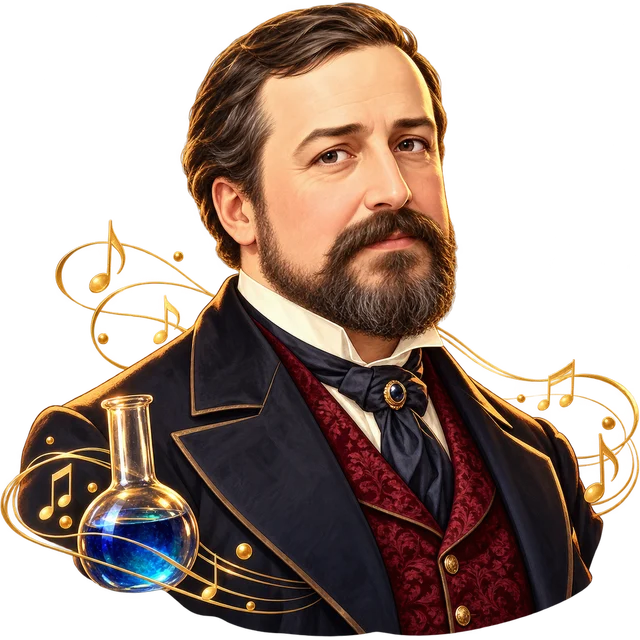
Symphony · · 1869–1876
アレクサンドル・ボロディン(1833–1887)
ドン!と大地をふみしめる。ロシアの勇士たちの交響曲。Stamp! The ground shakes in a symphony of Russian heroes.
WATCH ON YOUTUBE
この曲は、権利の切れた高音質の録音がまだ見つからないため、YouTube の公式チャンネルなどの名演でお楽しみください(ダウンロードはできません)。YouTube でほかの演奏もさがす ↗
 Alexander Borodin: Symphony No 2 'Scherzo: Molto vivo' // Gianandrea Noseda & LSO
London Symphony Orchestra(YouTube) YouTube で開く ↗
Borodin: Symphony No. 2 in B minor, IAB 18 / Remastered (reference recording: Ernest Ansermet)
Classical Music/ /Reference Recording(YouTube) YouTube で開く ↗
Borodin: Second Symphony - Royal Concertgebouw Orchestra - Concert HD
AVROTROS Klassiek(YouTube) YouTube で開く ↗
ホー!ボロディンの本業は化学者。大学で教えながら、この曲を書いたんだ。
 この曲のおはなし The Story
ボロディンの交響曲第2番は、ロシアの作曲家アレクサンドル・ボロディンが1869年から1876年にかけて書いた交響曲です。冒頭、弦楽器がいっせいに力強いメロディーを鳴らし、まるで大地をふみしめる勇士の足音のよう。そのため「ボガトィーリ(勇士)」という愛称でも呼ばれます。The Russian composer Alexander Borodin wrote his Symphony No. 2 between 1869 and 1876. At the start, the strings play a powerful melody all together, like the heavy footsteps of a hero stamping on the ground. That is why it is also called the 'Bogatyr', or 'Heroic', Symphony.
ボロディンの本業は化学者で、医学校の教授として研究と教育に追われていました。作曲は限られた時間で進めるしかなく、完成まで7年ほどかかりました。批評家スターソフによれば、ボロディンは第1楽章で古いロシアの勇士たちの集まりを、第3楽章で吟遊詩人の歌を、終楽章で勇士たちの宴を描こうとしたそうです。Borodin's main job was chemistry. As a professor at a medical school, he was always busy with research and teaching. He could compose only in his limited free time, so the symphony took about seven years to finish. According to the critic Vladimir Stasov, Borodin wanted the first movement to show a gathering of old Russian heroes, the third movement the song of a bard, and the finale a heroes' feast.
1877年の初演はあまり評判になりませんでしたが、ボロディンは楽譜を見直し、1879年にリムスキー=コルサコフの指揮で再演されると、成功をおさめました。今ではロシア国民楽派(ロシアらしい音楽をめざした作曲家たち)を代表する交響曲のひとつとして、世界中で演奏されています。The first performance in 1877 did not make much of an impression. But Borodin went back over the score, and when it was played again in 1879, conducted by Rimsky-Korsakov, it was a success. Today it is played around the world as one of the great symphonies of the Russian nationalist school, the composers who aimed for a truly Russian sound.
This symphony is by Borodin. He was a chemist, too! The music starts with a big, strong melody. It sounds like old Russian heroes. It took him about seven years to finish it.この交響曲はボロディンの作品です。彼は化学者でもありました!音楽は、大きくて力強いメロディーで始まります。ロシアの昔の勇士たちのように聞こえます。完成までに7年ほどかかりました。
 聴きどころ Listening Guide
 えっ!?ネタ Surprising Facts
 タップすると答えが開きます
ボロディンはサンクトペテルブルクの医学校で化学を教える教授で、化学の研究者としても名前が残っています。作曲は、いそがしい仕事のあいまにしか進められませんでした。そのため新しい曲がなかなか完成せず、仲間の作曲家たちをやきもきさせたと伝えられています。
Borodin was a professor who taught chemistry at a medical school in St. Petersburg, and his name is also remembered in the history of chemistry. He could compose only in the gaps between his busy work. It is said that his new pieces took so long that his composer friends grew very impatient.
この交響曲を書いていたころ、ボロディンはオペラ「イーゴリ公」にも取り組んでいました。オペラのために考えたアイデアのいくつかが、交響曲にまわされたとも言われています。どちらにも、古いロシアの英雄の時代を思わせる、たくましい響きがあります。
While writing this symphony, Borodin was also working on his opera Prince Igor. It is said that some ideas he had planned for the opera were moved into the symphony. Both works share a strong, sturdy sound that recalls the age of old Russian heroes.
1877年の初演は、あまり成功しませんでした。ボロディンは楽譜を見直し、1879年に友人リムスキー=コルサコフの指揮で再演されると、今度は好評を得ました。今では名曲として知られるこの交響曲も、最初からすんなり受け入れられたわけではなかったのです。
The first performance in 1877 was not very successful. Borodin went back over the score, and when it was played again in 1879, conducted by his friend Rimsky-Korsakov, it was well received. Even this famous symphony was not welcomed right from the start.
ゆったりした第3楽章は、クラリネットとハープによる短い前奏のあと、ホルンが長いソロを歌い出します。スターソフによれば、これは古いロシアの吟遊詩人の歌を描いたもの。ハープの音は、ロシアの古い弦楽器グースリのひびきを思わせます。
The slow third movement begins with a short introduction by clarinet and harp, and then the horn sings a long solo. According to Stasov, this movement shows the song of an old Russian bard. The harp reminds us of the gusli, an old Russian string instrument.
ENGLISH × MASTERPIECE
 主にイギリス英語。アメリカでは third time's the charm(3度目の正直)もよく使います。
 この曲で覚える英単語 Words
 クイズに挑戦 Quiz
 著作権について Credits
MORE MASTERPIECES
シャルパンティエ・c. 1688–1698
パンパカパーン!ヨーロッパのテレビの幕開けを飾ってきた、ごうかな前奏曲。
テ・デウム ニ長調のページへ
パーセル・1695
ブリテンが「オーケストラ入門」のテーマに選んだ、かっこいいメロディー。
劇音楽「アブデラザール」より ロンドのページへ
バッハ・c. 1704 (?)
タラリ〜!一度聴いたら忘れない、オルガンの大迫力の幕開け。
トッカータとフーガ ニ短調のページへバッハ・c. 1706–1713
足が弾く低いテーマが21回!重くて壮大な、オルガンの大建築。
パッサカリアとフーガ ハ短調のページへバッハ・c. 1707–1710 (?)
キラキラの駆け上がりで幕開け!若きバッハのはなやかな鍵盤ショー。
トッカータ ニ長調のページへ
ヴィヴァルディ・published 1711
2本のヴァイオリンが火花を散らす!バッハも編曲した熱い協奏曲。
協奏曲集『調和の霊感』第8番 イ短調(2つのヴァイオリンのための協奏曲)のページへヴィヴァルディ・c. 1715
オクターブがぴょんぴょん跳ねる!喜びがはじける合唱の名曲。
グローリア ニ長調のページへ
テレマン・c. 1710–1720 (?)
バルブのないラッパで高音をきらり!バロックのトランペットの晴れ舞台。
トランペット協奏曲 ニ長調のページへ
 MP3