
パッヘルベルのジーグ
Pachelbel's Gigue
パッヘルベル・c. 1680–1706
あの「カノン」には、はずむ相棒がいた!知られざる後半戦。
カノンとジーグ ニ長調 より「ジーグ」のページへ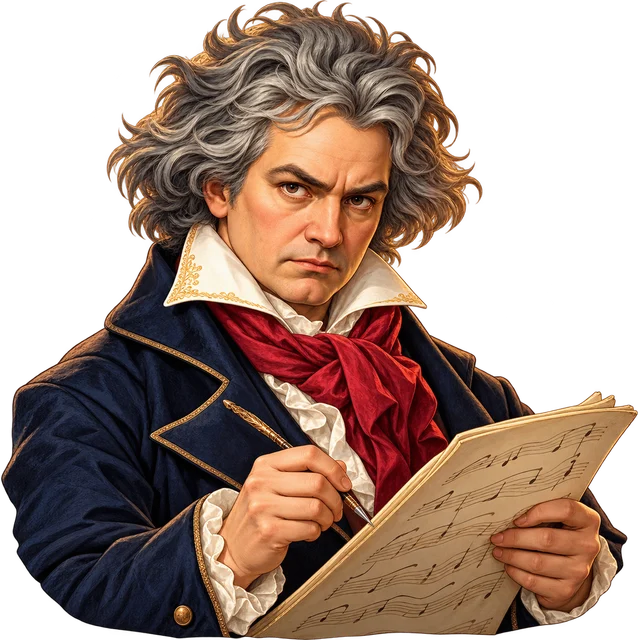
Symphony · Op. 93 · 1812
ルートヴィヒ・ヴァン・ベートーヴェン(1770–1827)
「小さな交響曲」なのに、弟子によれば本人は「こっちのほうがずっといい」!A 'little symphony' that, according to his pupil, he called 'much better'.
PUBLIC DOMAIN RECORDING
PD / CC0 無料でダウンロードOK
 別の演奏で聴く 1:Eric Xi Xin Liang
ANOTHER RECORDING 1
CC BY-SA 4.0WATCH ON YOUTUBE
 Zubin Mehta: Beethoven - Symphony No. 8 in F major, Op. 93 (Tel Aviv, 2011)
EuroArtsChannel(YouTube) YouTube で開く ↗
Beethoven: 8. Sinfonie ∙ hr-Sinfonieorchester ∙ Andrés Orozco-Estrada
hr-Sinfonieorchester – Frankfurt Radio Symphony(YouTube) YouTube で開く ↗
左の音源は権利が切れた録音なのでダウンロードできます。右の動画は YouTube の公式の埋め込みで見るもので、ダウンロードはできません(動画の権利は各チャンネルにあります)。
 もっと名演を観る YouTube で何百万回も再生された人気の演奏
Beethoven: Symphony No. 8 | Fabian Müller & The Trinity Sinfonia
DW Classical Music(YouTube) YouTube で開く ↗
Beethoven - 8th Symphony (Complete) ♫*
obtica(YouTube) YouTube で開く ↗

ホー!ベートーヴェンはこの曲を「ヘ長調の小さな交響曲」と呼んでいたんだよ。
 この曲のおはなし The Story
「交響曲第8番 ヘ長調」は、ベートーヴェンが1812年に書いた交響曲です。9つの交響曲の中でも短く、明るくユーモアたっぷりの曲です。ベートーヴェンは手紙の中で、この曲を「ヘ長調の小さな交響曲」と呼び、直前の第7番を「イ長調の大きな交響曲」と呼びました。でも中身は、しかけとおどろきがぎっしりつまっています。Symphony No. 8 in F major was written by Beethoven in 1812. It is one of the shortest of his nine symphonies, and it is bright and full of humor. In a letter, Beethoven called it his 'little symphony in F', and the Seventh his 'grand symphony in A'. But inside, it is packed with tricks and surprises.
この曲は、第7番を書き上げたすぐあとに作曲されました。ふつう交響曲にはゆっくりした楽章がありますが、この曲にはありません。第2楽章は、時計がチクタクと時をきざむような軽いリズムで進みます。第3楽章には、ハイドンやモーツァルトの時代に好まれた、少し古風な「メヌエット」をあえて使っています。昔のスタイルを楽しくからかっているようにも聞こえます。Beethoven wrote this symphony right after finishing his Seventh. Most symphonies have a slow movement, but this one does not. The second movement moves along with a light rhythm like a ticking clock. For the third movement, he chose a slightly old-fashioned minuet, a type loved in the days of Haydn and Mozart. It almost sounds as if he is teasing the old style.
初演は1814年2月27日、ウィーンのレドゥーテンザールで、第7番などといっしょに行われました。しかし、聴衆の拍手は大人気の第7番ほどではありませんでした。弟子のツェルニーによると、そのことを聞いたベートーヴェンは「それはこっちのほうがずっとよいからだ」と答えたそうです。小さくても、作曲者にとっては自信作だったのです。The premiere took place on February 27, 1814, in the Redoutensaal in Vienna, together with the Seventh Symphony and other works. But the audience did not cheer for it as much as for the very popular Seventh. According to his pupil Carl Czerny, when Beethoven heard this, he said it was because the Eighth was much better. Small as it is, he was very proud of it.
This is a short and happy symphony. Beethoven called it his 'little symphony'. The second part sounds like a ticking clock. People liked his Seventh Symphony more. But his pupil said that Beethoven called this one 'much better'!これは短くて楽しい交響曲です。ベートーヴェンはこの曲を「小さな交響曲」と呼びました。2番目の部分は、チクタク鳴る時計のように聞こえます。人々は第7番のほうが好きでした。でも弟子によると、ベートーヴェンは「こっちのほうがずっといい」と言ったそうです!
 聴きどころ Listening Guide
 えっ!?ネタ Surprising Facts
 タップすると答えが開きます
弟子のツェルニーが伝えるところでは、第8番が第7番ほど受けなかったことについて、ベートーヴェンは「それは、こっちのほうがずっとよいからだ」と答えたそうです。聴衆にすぐには伝わらなくても、自分の作品のよさに強い自信をもっていたことがわかります。
According to his pupil Czerny, when the Eighth was less popular than the Seventh, Beethoven answered that it was because the Eighth was much better. This shows his strong confidence in the quality of his work, even when audiences did not understand it right away.
第2楽章のチクタクというリズムは、メトロノームを改良したメルツェルのために書いたカノン(輪唱)がもとだ、という話が長く信じられてきました。でも今では、そのカノンも話も、伝記作家シンドラーがあとから作ったものだろうと考えられています。
For a long time, people believed that the ticking rhythm of the second movement came from a canon Beethoven wrote for Johann Maelzel, who developed the metronome. But today, scholars think the canon and the story were probably made up later by the biographer Anton Schindler.
ふつうティンパニは2台を別々の音に合わせますが、この曲の最終楽章では、2台を同じ「ファ」の音の高いほうと低いほうに合わせています。当時としてはめずらしい使い方で、ポンポンとはずむようなティンパニの音が、楽しいユーモアをそえています。
Two timpani are usually tuned to different notes, but in the finale of this symphony, they are both tuned to F, one high and one low. This was unusual at the time, and the bouncing timpani add fun and humor to the music.
ヘ長調の交響曲は、第6番「田園」に続いて2曲目です。ただ、ベートーヴェンが手紙でこの曲を「ヘ長調の小さな交響曲」と呼んだとき、くらべていたのは「田園」ではなく、「イ長調の大きな交響曲」と呼んだ第7番でした。同じ調でも、のどかな「田園」と、いたずら好きの第8番では、まるで雰囲気がちがいます。
This is Beethoven's second symphony in F major, after the 'Pastoral'. But when he called it his 'little symphony in F' in a letter, he was comparing it not with the 'Pastoral' but with the Seventh, his 'grand symphony in A'. Even in the same key, the peaceful 'Pastoral' and the playful Eighth sound completely different.
ENGLISH × MASTERPIECE
 crack は「パチンと鳴らす」。じょうだんをぽんと言うときに使います。
 この曲で覚える英単語 Words
 クイズに挑戦 Quiz
 この録音について(著作権・出典) Credits
MORE MASTERPIECES
パッヘルベル・c. 1680–1706
あの「カノン」には、はずむ相棒がいた!知られざる後半戦。
カノンとジーグ ニ長調 より「ジーグ」のページへシャルパンティエ・c. 1688–1698
パンパカパーン!ヨーロッパのテレビの幕開けを飾ってきた、ごうかな前奏曲。
テ・デウム ニ長調のページへクラーク・c. 1700
結婚式の大定番。でも作曲者は長いあいだ取りちがえられていた!
トランペット・ヴォランタリー(デンマーク王子の行進)のページへ
バッハ・c. 1707–1710 (?)
キラキラの駆け上がりで幕開け!若きバッハのはなやかな鍵盤ショー。
トッカータ ニ長調のページへ
ヴィヴァルディ・published 1711
2本のヴァイオリンが火花を散らす!バッハも編曲した熱い協奏曲。
協奏曲集『調和の霊感』第8番 イ短調(2つのヴァイオリンのための協奏曲)のページへヴィヴァルディ・c. 1715
オクターブがぴょんぴょん跳ねる!喜びがはじける合唱の名曲。
グローリア ニ長調のページへ
テレマン・c. 1710–1720 (?)
バルブのないラッパで高音をきらり!バロックのトランペットの晴れ舞台。
トランペット協奏曲 ニ長調のページへ
ヘンデル・1717
テムズ川の船の上で国王のために!夏の夜の水上コンサート。
水上の音楽のページへ MP3