New Year's Day
元日(世界のお正月)の英語の授業アイデアとワークシート
印刷してすぐ使えるワークシート(PDF・Word・解答つき)と、授業の手順書。
🖨️Worksheetsワークシート(無料・A4)
① 「中身を見る・印刷」で全ページを確認 → ② そのページ上の 🖨️ 印刷する でそのまま印刷できます。A4・無料。
🍎Lesson Ideas元日(世界のお正月)を使った英語の授業アイデア
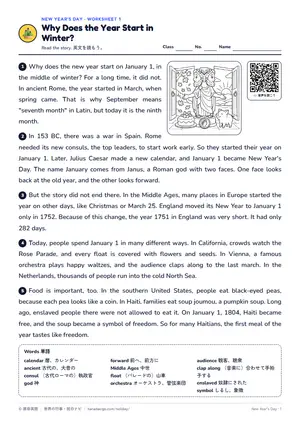
月の名前探偵:September はなぜ9月?
🎯 英語の月名の語源から、暦の歴史に気づく。
- 黒板に September / October / November / December を書き、「sept・oct・nov・dec はどんな数?」と聞く(octopus=8本足、decade=10年をヒントに)。
- 「では、なぜ9月が7番目?」とペアで予想を話し合う。
- ローマの1年が3月から始まったことを説明し、指で3月から数えて確かめる。
- January の語源ヤヌスを紹介し、2つの顔の絵を描かせて終わる。
詳細版を開く(時間配分・Teacher Talk・板書)
黒板に September / October / November / December を縦に書き、全員で発音する。前半の sept・oct・nov・dec に色チョークで下線を引き、「この部分は数を表している」とだけ伝える。タコの絵を見せ、足の数を聞いて oct=8 に気づかせる。decade=10年もヒントに出す。
🗣️ Let's read these four months together. / Look at the first part of each word. It is a number. / How many legs does an octopus have? Yes, eight. So oct means eight. / A decade is ten years. So what is dec?
sept=7、oct=8、nov=9、dec=10 を板書し、「September は7番目という意味なのに、今は9月。なぜ?」と問う。ペアで1分間、理由を予想させる(日本語でよい)。2〜3組に発表させ、出た予想を板書の横にメモする。
🗣️ September means seven. But it is the ninth month. Why? / Talk with your partner for one minute. Japanese is OK. / Any ideas? Tell us your guess. / Good guess. Let's check.
「古代ローマでは、1年は春の3月から始まった」と説明し、全員で指を折りながら March から英語で数える。September で7本目になることを確かめる。英語ページ本文の第1段落を音声で聞かせ、That is why September means "seventh month" の文を指で追わせる。
🗣️ In ancient Rome, the year started in March, in spring. / Let's count with your fingers. March, one. April, two. May, three. / September is number seven. Now you can see why! / Listen to the story and find the word "seventh."
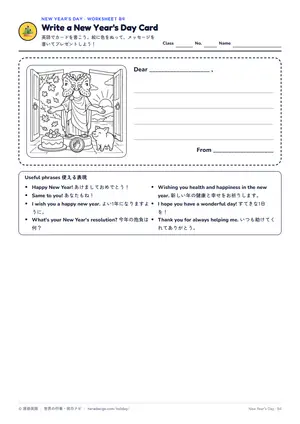
January の語源がローマの神ヤヌスであることを紹介し、絵を見せる。「1つの顔は去年を、もう1つの顔は新しい年を見ている」と説明し、ノートの端に2つの顔のヤヌスを描かせて終わる。
🗣️ January comes from Janus. He is a Roman god. / He has two faces. One face looks back. The other face looks forward. / Draw Janus in your notebook. You have one minute.
September  sept = 7
October  oct = 8(octopus 🐙)
November  nov = 9
December  dec = 10(decade = 10年)

Q. September は「7番目」なのに、なぜ9月?
古代ローマ:1年は March から始まった
March(1) April(2) May(3) June(4) July(5) August(6) September(7)

January ← Janus(2つの顔の神:後ろ=去年/前=今年)
ヤヌスの2つの顔:ふり返りと抱負カード
🎯 過去形と未来の表現を使い、1年のふり返りと抱負を英語で書く。
- 紙を半分に折り、左に後ろ向き、右に前向きの顔を描く。
- 左に Last year, I ~. を1文、右に This year, I will ~. を1文書く。
- グループで見せ合い、Good luck! / You can do it! と声をかける。
- 教室に掲示し、学期末にもう一度読み返す。
詳細版を開く(時間配分・Teacher Talk・板書)
ヤヌスの絵を見せ、「この神さまの顔はいくつ?」と聞く。1つの顔は後ろ(去年)、もう1つは前(今年)を見ていること、January の名前がこの神さまから来たことを話す。先生の見本カードを見せ、自分の例文を読む。
🗣️ Look at this god. How many faces does he have? / Yes, two! His name is Janus. January comes from his name. / This face looks back at last year. This face looks forward to this year. / Here is my card. Last year, I went to Okinawa. This year, I will run every morning.
紙を半分に折らせ、左に後ろ向きの顔、右に前向きの顔を描かせる。顔は簡単でよいと伝え、時間を区切る(3分)。
🗣️ Fold your paper in half, like this. / On the left, draw a face looking back. / On the right, draw a face looking forward. / Simple faces are OK. You have three minutes.
左の顔の下に Last year, I 〜. を、右の顔の下に This year, I will 〜. を1文ずつ書かせる。黒板に動詞のことばカードをはり、言いたいことが英語にならない子は先生に日本語で聞いてよいと伝える。机間指導で1人ずつ読んで確かめる。
🗣️ Now write one sentence on each side. / Left side: Last year, I went to the sea. Last year, I played soccer. / Right side: This year, I will try swimming. This year, I will read ten books. / If you need a word, ask me. You can do it!
4人グループでカードを見せ合い、1人ずつ2文を読む。聞いた人は Good luck! か You can do it! と声をかける。最後に教室に掲示し、「学期の終わりに、もう一度読もう」と伝える。
🗣️ Show your card to your group and read it. / After your friend reads, say "Good luck!" or "You can do it!" / Let's put your cards on the wall. / We will read them again at the end of the term.
January ← Janus(2つの顔の神さま)

← 後ろの顔(去年)  Last year, I went to __.
                    Last year, I played __.
→ 前の顔(今年)    This year, I will try __.
                    This year, I will practice __.

友だちに:Good luck!  You can do it!
世界の縁起物フードフェア
🎯 国名・食べ物・意味を英語で紹介し、日本のおせちと比べる。
- 6つの縁起物(ホッピン・ジョン、マジパンのブタ、レンズ豆、ヴァシロピタ、スープ・ジュムー、トックク)のカードを配る。
- 各グループが In ~, people eat ~ because it means ~. の形で紹介文を作る。
- ほかのグループに発表し、聞き手は「日本ならどのおせち料理が近い?」をメモする。
- 黒豆・数の子など日本の縁起物を英語で1つ説明して終わる。
詳細版を開く(時間配分・Teacher Talk・板書)
おせちの黒豆の写真を見せ、「なぜ黒豆を食べる?」と聞き、「まめに働けるように」という願いを確認する。「海外の元日にも、願いをこめた料理がある」と言い、ホッピン・ジョンの写真を見せて「豆はコインの意味」と例を示す。
🗣️ Do you eat black beans at New Year? Why? / In the southern United States, people eat Hoppin' John. It has black-eyed peas. / Each pea looks like a coin. So it means money. / Today, you will introduce a lucky food from another country.
6グループに縁起物カードを1枚ずつ配る。裏のメモを読み、In 〜, people eat 〜 because it means 〜. の形で紹介文を2〜3文作らせる。トックク(白いもち=清らかな新しい始まり)、スープ・ジュムー(1804年1月1日の独立=自由)など、意味の部分を正しく英語にできているか見て回る。
🗣️ Read the back of your card. Then make two or three sentences. / Use this pattern: In Greece, people eat vasilopita because it means good luck. / Practice together. Everyone in your group says one sentence. / You have six minutes.
各グループが前に出て1分で発表する。聞き手はメモ用紙に食べ物・国・意味を書き、最後の列に「日本ならどのおせち料理が近いか」を書き入れる。発表ごとに1人を指名し、近いと思うおせち料理を言わせる。
🗣️ Group one, please come to the front. / Listeners, write the food, the country, and the meaning. / Which Japanese New Year food is similar? Why do you think so? / Give them a big hand!
おせちの写真を見せ、黒豆・数の子などから1つ選んで、同じ形で英語の説明を1文書かせる。2〜3人に発表させて終わる。
🗣️ Now it's Japan's turn. Choose one osechi food. / For example: In Japan, people eat kuromame because it means hard work and good health. / Write one sentence. Who wants to read?
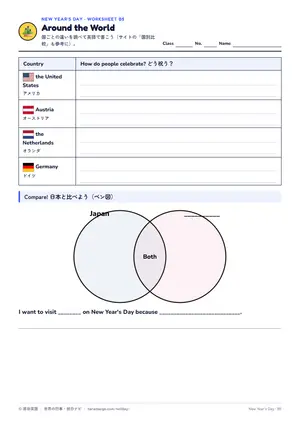
In __, people eat __ because it means __.

🫘 Hoppin' John(アメリカ南部)peas → coins(お金)
🐖 marzipan pig(ドイツなど)pig → good luck
🥣 lentils(イタリア・大みそか)coin shape → money
🎂 vasilopita(ギリシャ)a hidden coin → good luck
🎃 soup joumou(ハイチ)→ freedom(1804年1月1日)
🍲 tteokguk(韓国)white rice cake → a clean new start

日本は? kuromame(黒豆) kazunoko(数の子)
自然の材料だけで山車をデザイン
🎯 ローズパレードのルールを読み取り、条件つきのデザインを英語でプレゼンする。
- 「表面はすべて花・種・木の皮など自然の材料」というルールを英文で読む。
- グループで、自分の町を紹介する山車をデザインし、どの色をどの植物で出すか決める。
- The float shows ~. We use ~ for the color ~. の形で発表原稿を作る。
- 1分ずつ発表し、投票でいちばん行ってみたくなる山車を選ぶ。
詳細版を開く(時間配分・Teacher Talk・板書)
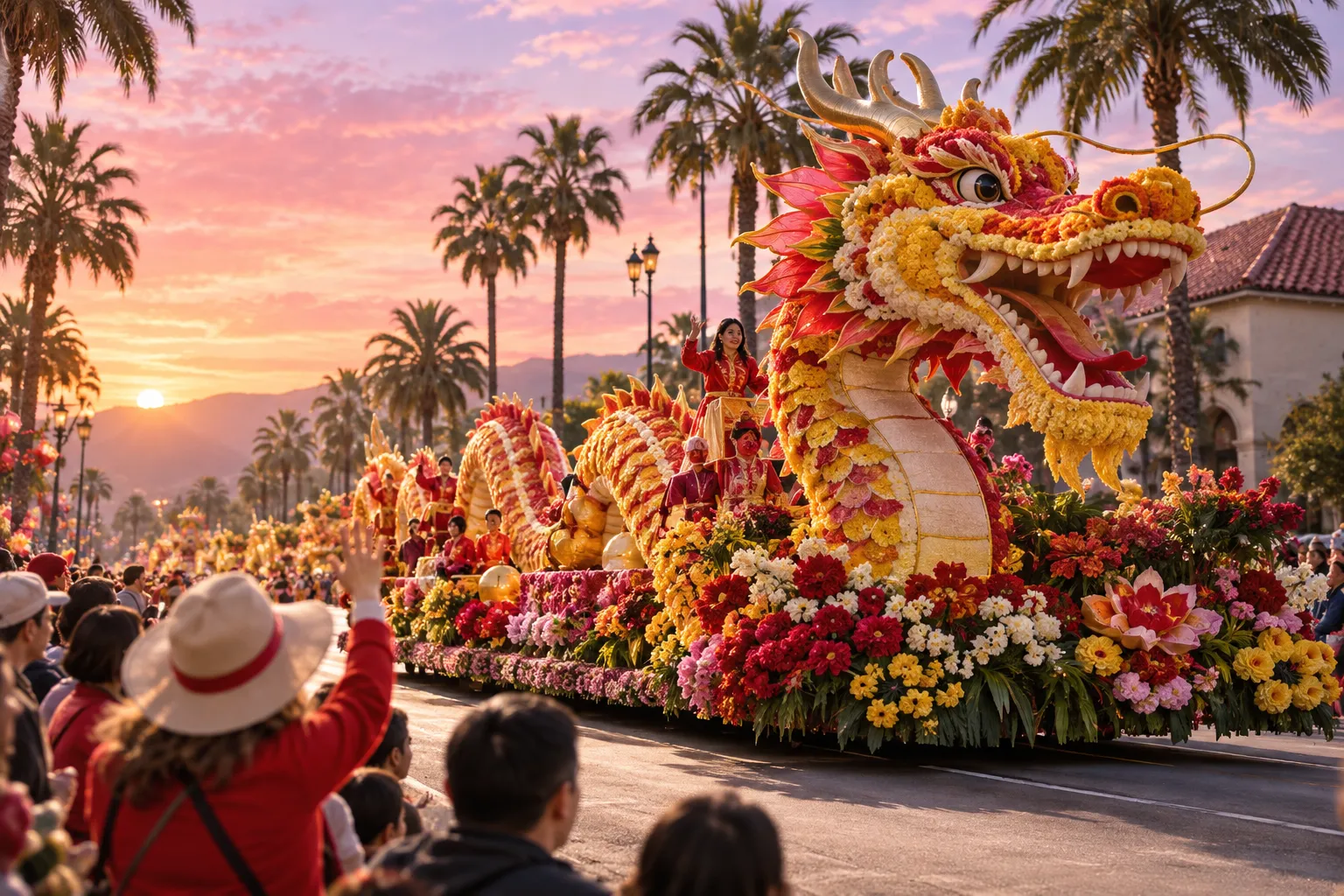
山車の写真を見せ、「これは何でできている?」と聞く。英語ページの会話を音声で聞かせ、ルールの英文と「黒い目にはペンキではなくタマネギの種などを使ってきた」という部分を確かめる。1890年に「東部の人に冬でも花が咲いていると見せるため」に始まったことも伝える。
🗣️ Look at this float. What is it made of? / Listen to Haruto and Olivia. Find the rule. / Every part of a float must be covered with natural things. No paint at all. / For black, people have used things like onion seeds.
4人グループで「自分の町を紹介する山車」をデザインさせる。テーマを決め、絵を描き、どの色をどの植物(花・種・葉・木の皮・豆・米など)で出すか、絵の横に英語で書きこませる。ペンキ・プラスチックは使えないことを再確認する。
🗣️ Design a float about our town. / Decide the theme first. What is our town famous for? / Then choose a natural material for each color. Red roses? Brown bark? White rice? / Remember the rule. No paint and no plastic.
The float shows 〜. We use 〜 for the color 〜. の型を板書し、1分間の発表原稿を作らせる。役割分担(テーマ説明・材料説明・おすすめポイント)を決めさせ、1回通して練習させる。
🗣️ Now write a one-minute speech. / Start with: Our float shows our town's festival. / Then explain the materials: We use red roses for the color red. / Practice once. Time yourselves.
各グループが絵を見せながら1分ずつ発表する。聞き手は「ルールを守っているか」をチェックし、気になる点を英語で1つ質問する(What do you use for the color blue? など)。
🗣️ Each group has one minute. Ready, go. / Listeners, check the rule. Is everything natural? / Ask one question. For example, what do you use for the color blue?
付せんで「いちばん行ってみたくなる山車」に投票させ、結果を発表する。自然の材料だけで色を出す難しさについて一言ふり返らせる。
🗣️ Put your sticky note on the float you want to see most. / You can't vote for your own group. / And the winner is ... Congratulations!
Rose Parade(Pasadena, California, since 1890)
Rule: Every part of a float must be covered with natural things.
→ flowers / seeds / bark / leaves ×paint ×plastic
黒 = onion seeds など

Speech:
Our float shows __.
We use __ for the color __.
We also use __ for __.
Please come and see our float!
暦は権力?ミニ・ディベート
🎯 advanced の英文を読み、暦と政治の関係について根拠をもって議論する。
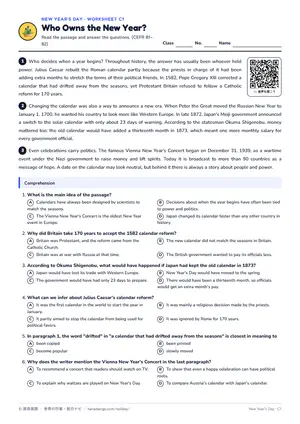
- advanced「Who Owns the New Year?」を読み、カエサル・グレゴリウス・ピョートル・明治政府の例を表にまとめる。
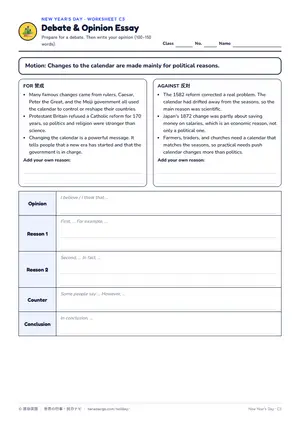
- 論題「暦の変更は主に政治的な理由で行われる」に賛成・反対で分かれる。
- 各チームが本文以外の例(フランス革命暦など)も調べて1つ加える。
- ディベートのあと、もし今カレンダーを変えるならどんな理由が考えられるか話し合う。
詳細版を開く(時間配分・Teacher Talk・板書)
「1年がいつ始まるかは、だれが決める?」と問いかけ、隣の人と30秒話させる。日本が1872年の終わりに、約23日の予告で太陽暦に切りかえたことを伝え、本文のテーマにつなげる。
🗣️ Who decides when a year begins? Talk with your partner for thirty seconds. / In late 1872, Japan changed its calendar with only about 23 days of warning. / Why so fast? Let's read and find out.
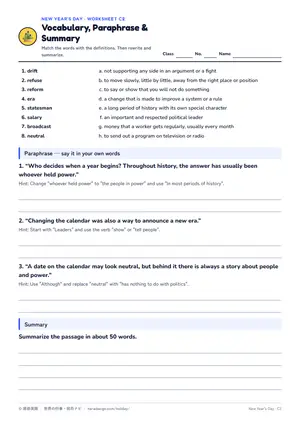
本文を個人で黙読させ、カエサル・グレゴリウス13世・ピョートル大帝・明治政府の4例を表にまとめさせる。ペアで答え合わせをしたあと、「理由」の列が政治・宗教・お金・イメージのどれに当たるかを分類させる。
🗣️ Read the passage silently. Then fill in the table. / Write who, when, what changed, and why. / Compare with your partner. Was the reason politics, religion, money, or image? / Okuma Shigenobu talked about money. What exactly was the problem?
論題「Changes to the calendar are made mainly for political reasons.」を示し、賛成・反対の2チームに分ける。各チームは本文以外の例(フランス革命暦など)を1つ調べて加え、立論のメモを作る。
🗣️ Here is the motion. Changes to the calendar are made mainly for political reasons. / This side is for, and that side is against. / Find one more example outside the passage. The French Republican Calendar is one idea. / You have eight minutes to prepare.
立論(各2分)→ 作戦タイム(1分)→ 反論(各2分)→ 最終弁論(各1分)の順でミニ・ディベートを行う。残りの時間で、審判役の学生が勝敗と理由を英語で述べる。先生は根拠が本文のどこにあるかを確かめながら進行する。
🗣️ Team For, you have two minutes. Please start. / Where in the passage is that? Give us the line. / Now Team Against. Please respond to their points. / Judges, who won and why?
「もし今カレンダーを変えるとしたら、どんな理由が考えられるか」をグループで話し合わせ、1つずつ発表させる。本文最後の文 A date on the calendar may look neutral ... を読み、筆者の主張を確認して終わる。
🗣️ If we changed the calendar today, what would the reason be? / Business? Science? Politics? Share one idea. / Read the last sentence again. Do you agree with the writer?
Who Owns the New Year?

人物 / 年 / 何を変えた / 理由
Julius Caesar / — / Roman calendar / priests added months for political friends
Pope Gregory XIII / 1582 / calendar fixed to seasons / Protestant Britain refused for 170 years
Peter the Great / 1700 / New Year → Jan 1 / look more like Western Europe
Meiji government / late 1872 / solar calendar(約23日前に発表)/ 13th month in 1873 = one more salary

Motion: Changes to the calendar are made mainly for political reasons.
For ⇔ Against