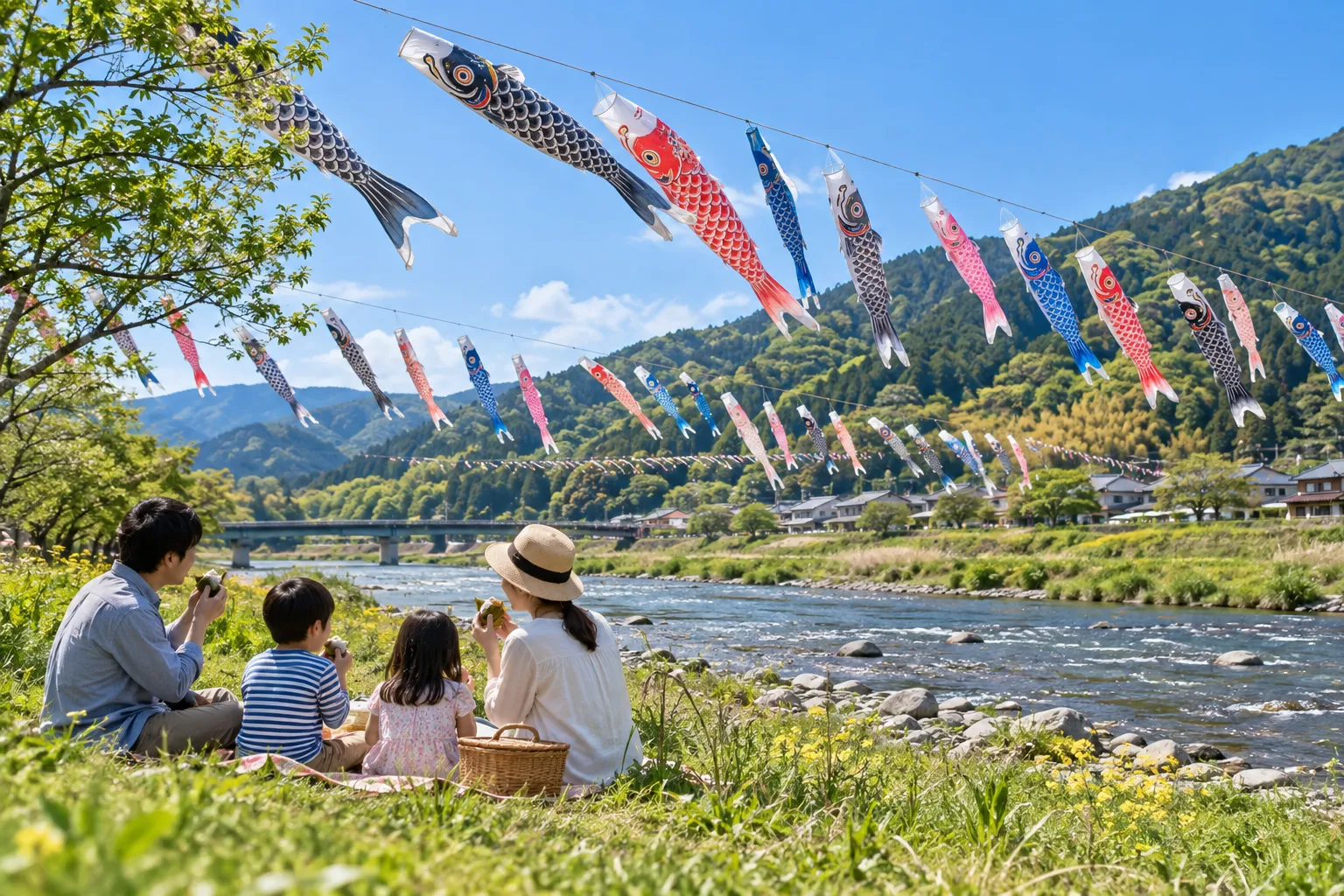
Children's Day
こどもの日(端午の節句)の英語の授業アイデアとワークシート
印刷してすぐ使えるワークシート(PDF・Word・解答つき)と、授業の手順書。
🖨️Worksheetsワークシート(無料・A4)
① 「中身を見る・印刷」で全ページを確認 → ② そのページ上の 🖨️ 印刷する でそのまま印刷できます。A4・無料。
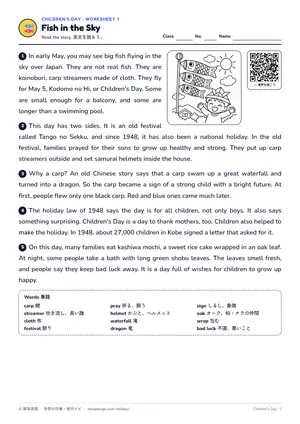
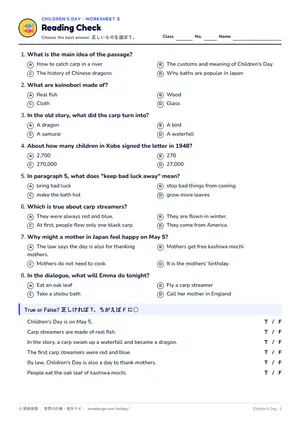
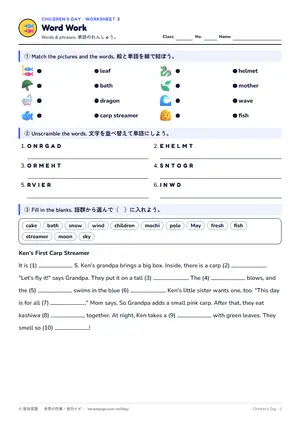
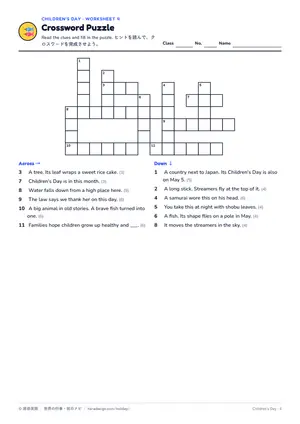
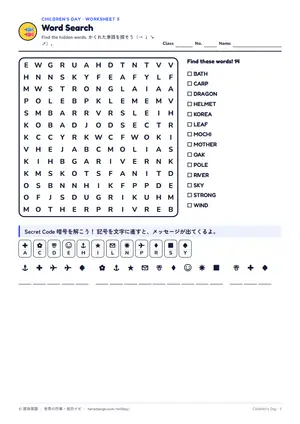
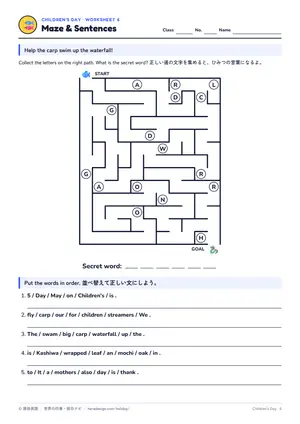
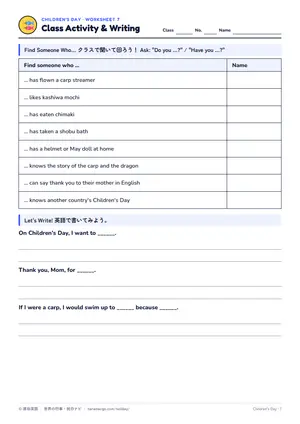
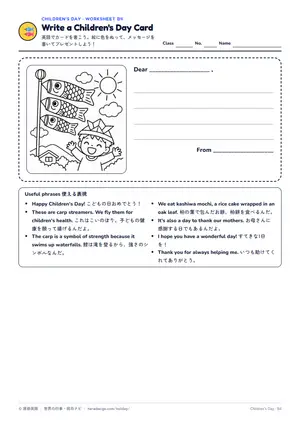
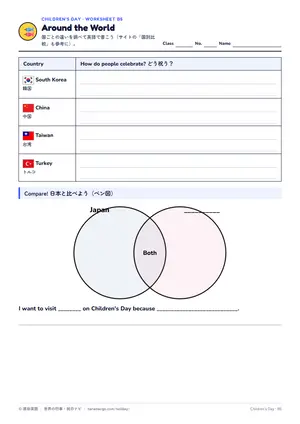
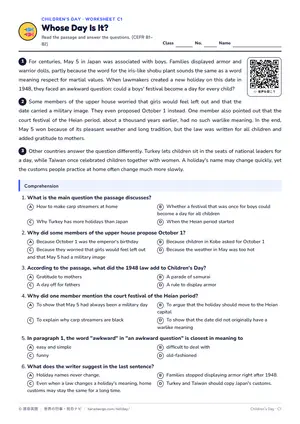
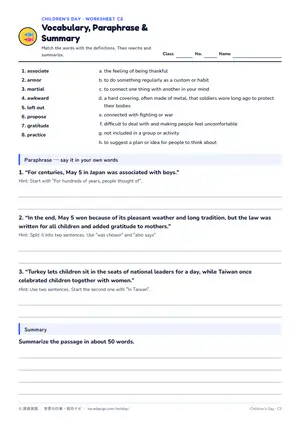
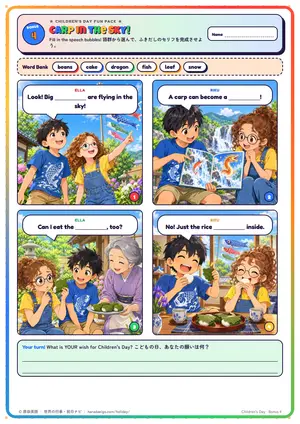
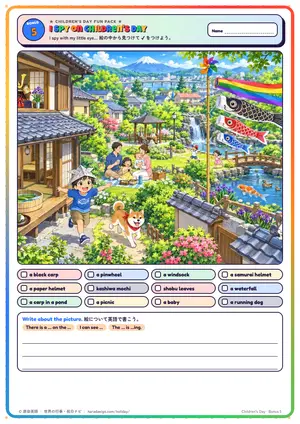
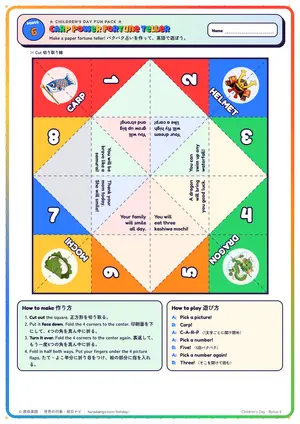
🍎Lesson Ideasこどもの日(端午の節句)を使った英語の授業アイデア
My Carp Streamer:家族のこいのぼりを英語で紹介
🎯 色と家族を表す英語で、自分の家族のこいのぼりを紹介する。
- 紙のこいのぼりを家族の人数分作り、好きな色をぬる。
- This is my father. He is black. のように色と家族を言う練習をする。
- 棒に貼って、ペアで紹介し合う。
詳細版を開く(時間配分・Teacher Talk・板書)
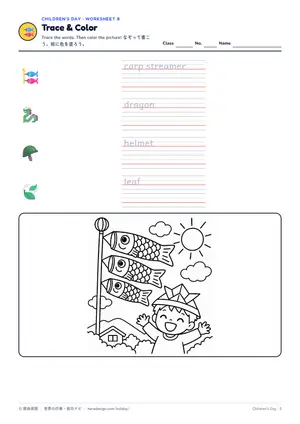
こいのぼりの写真を見せ、What's this? と聞く。carp streamer という英語を教え、「5月5日のこどもの日に空を泳ぐ魚」と話す。最初のこいのぼりは黒い鯉1匹だけだったことも紹介する。
🗣️ What's this? It's a carp streamer. / Carp streamers fly in the sky for Children's Day. / Long ago, people flew only one black carp.
色(black, red, blue, green, yellow, pink)と家族(father, mother, brother, sister, grandmother, me)の英語を、カードで練習する。先生のこいのぼりの見本で This is my father. He is black. と言って見せる。
🗣️ Black, red, blue. Say it with me. / Father, mother, brother, sister. / Look. This is my father. He is black.
型紙を家族の人数分切り取り、好きな色をぬらせる。できたら棒に上から順に貼らせる。作りながら、先生は What color is your mother? などと声をかける。
🗣️ Make carp for your family. / Choose your favorite colors. / What color is your mother?
ペアでこいのぼりを見せ合い、This is my ~. He/She is ~. と紹介させる。聞いた子は Nice! と返す。何人かに全体の前で紹介してもらう。
🗣️ Show your carp streamer to your partner. / This is my sister. She is pink. / Who wants to show us?
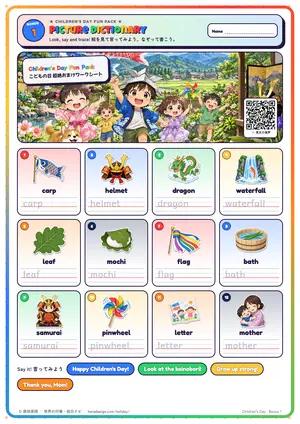
🎏 carp streamer

This is my father. He is black.
This is my mother. She is red.
This is me. I am blue.

black / red / blue / green / yellow / pink
father / mother / brother / sister / grandmother
登竜門ストーリーを英語で演じよう
🎯 過去形を使って、鯉が竜になる話を短い劇にする。
- 本文の第3段落を読み、話の流れを確認する。
- 班で鯉・滝・竜・ナレーターの役を決める。
- The carp swam ... It turned into ... などのせりふを書く。
- 1班2分で発表し、いちばん迫力のあった班を選ぶ。
詳細版を開く(時間配分・Teacher Talk・板書)
英語ページ本文の第3段落を聞かせ、Why a carp? の答えを本文から探させる。a carp swam up a great waterfall and turned into a dragon. の文を板書し、swam(swim の過去形)と turned into(〜になった)を確認する。
🗣️ Why a carp? Find the answer. / A carp swam up a great waterfall. / Then it turned into a dragon.
班で鯉・滝・竜・ナレーターの役を決めさせる。話の流れを「鯉が滝を見つける→何度も挑戦する→のぼりきる→竜になる」の4場面に分けて板書する。
🗣️ Choose your roles: carp, waterfall, dragon, and narrator. / There are four scenes. / Who is the narrator?
せりふを書かせる。ナレーターは過去形で話を進め(The carp swam to a big waterfall. It jumped again and again.)、鯉や滝は現在形のせりふでよい(I can do it! / You can't climb me!)。動きもつけて練習させる。
🗣️ The narrator uses the past tense. / The carp swam to a big waterfall. / The carp can say, "I can do it!" / Practice with actions.
1班2分で発表させる。全部終わったら、いちばん迫力のあった班を拍手で選ぶ。最後に「だから鯉は、明るい未来をもつ強い子のしるしになった」と本文の文で締める。
🗣️ Each group has two minutes. / Which group was the most exciting? / So the carp became a sign of a strong child with a bright future.
Why a carp?
A carp swam up a great waterfall and turned into a dragon.

Scene 1 The carp swam to a big waterfall.
Scene 2 It jumped again and again.
Scene 3 It climbed to the top.
Scene 4 It turned into a dragon!

swim → swam / jump → jumped / turn into → turned into
→ a sign of a strong child with a bright future
法律クイズ:こどもの日は誰の日?
🎯 祝日法の文言から、こどもの日の意味を英語で説明できるようにする。
- 「こどもの日は男の子の日?」「母の日と関係ある?」と問いかける。
- 祝日法の文言を見せ、children と mothers の2つがキーワードだと確認する。
- It is a day for all children. It is also a day to thank mothers. を言えるようにする。
詳細版を開く(時間配分・Teacher Talk・板書)
○×クイズを出す。「こどもの日は男の子の日?」「こどもの日は母の日と関係ある?」と問い、○×カードで答えさせる。答えはまだ言わない。
🗣️ Quiz time! Is Children's Day only for boys? / Is Children's Day a day for mothers too? / Show me your card.
祝日法の文言を見せ、「こども」と「母」の2つがキーワードだと確認する。英語ページ本文の第4段落を聞かせ、for all children, not only boys と a day to thank mothers に線を引かせる。1948年に神戸の子ども約2万7千人がこの祝日を求める署名をしたことも紹介する。
🗣️ Look at the law. Find two key words. / Children and mothers. / It is for all children, not only boys. / About 27,000 children in Kobe asked for this holiday.
It is a day for all children. It is also a day to thank mothers. の2文を全員で言い、ペアで1回ずつ言い合う。最後にクイズの答えを確認する。
🗣️ It is a day for all children. / It is also a day to thank mothers. / Say these two sentences to your partner.
Q1. Children's Day is only for boys. → ×
Q2. Children's Day is a day to thank mothers. → ○

祝日法:こどもの人格を重んじ、こどもの幸福をはかるとともに、母に感謝する

It is a day for all children.
It is also a day to thank mothers.

1948:about 27,000 children in Kobe signed a letter.
世界のこどもの日リサーチ
🎯 国ごとのこどもの日を調べ、比較の表現を使ってプレゼンする。
- 韓国・中国・台湾・トルコ・メキシコ・国連を班に割り当てる。
- 日付・始まり・過ごし方をワークシートにまとめる。
- Japan and Korea both ..., but Turkey ... のように比べる文を3つ書く。
- 1分で発表し、聞き手は「いちばんまねしたい習慣」を選ぶ。
詳細版を開く(時間配分・Teacher Talk・板書)
「5月5日がこどもの日なのは日本だけ?」と聞き、韓国も5月5日であることを紹介する。ほかの国も調べようと伝え、班に1か国ずつ割り当てる。
🗣️ Is Japan the only country with Children's Day on May 5? / No. Korea also celebrates on May 5. / Each group will study one country.
国比べ表と端末で、担当の国の日付・始まり・過ごし方をまとめさせる。例:トルコの4月23日は、子どもの代表が大統領や大臣の席に座る。出典をメモさせる。
🗣️ When is Children's Day in your country? / When did it start? / What do children do on that day?
Japan and Korea both ~, but Turkey ~. のように、日本と比べる文を3つ書かせる。共通点と違いの両方を入れるよう指示する。
🗣️ Write three sentences to compare with Japan. / Japan and Korea both celebrate on May 5, but Turkey celebrates on April 23. / Include a similarity and a difference.
1班1分で発表させる。聞き手は「いちばんまねしたい習慣」を1つ選び、理由を英語で1文書く。最後に何人かに読ませる。
🗣️ Each group has one minute. / Which custom do you want to try in Japan? / I want to try ... because ....
Children's Day around the world
Japan:May 5(since 1948)
Korea:May 5(started on May 1 in 1923)
China:June 1(International Children's Day)
Taiwan:April 4
Turkey:April 23(children sit in leaders' seats)
Mexico:April 30(piñatas)
UN:November 20(World Children's Day)

Japan and ___ both ___, but ___ ___.
I want to try ___ because ___.
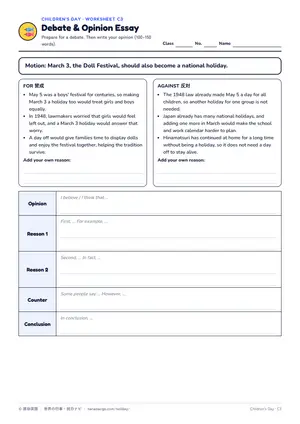
ディベート:ひな祭りも祝日にすべき?
🎯 1948年の国会の議論(女の子が置き去りになる心配・10月1日案)を素材に、公平さと伝統について議論する。
- advanced を読み、1948年の議論を整理する。
- 賛成(3月3日も祝日に)と反対に分かれ、論点を準備する。
- 立論・反論・まとめの順でディベートする。
- 結論を100語の英語でまとめる。
詳細版を開く(時間配分・Teacher Talk・板書)
「5月5日は国民の祝日なのに、3月3日はなぜ祝日でないのか」と問いかける。ひな祭りが国民の祝日ではないことを確認し、Discussion の問い Should March 3, the Doll Festival, also become a national holiday? を示す。
🗣️ May 5 is a national holiday. What about March 3? / Should the Doll Festival also be a holiday? / Let's read about the debate in 1948.
発展英文を読ませ、1948年の議論を整理させる(女の子が置き去りになる心配・軍事的なイメージ・10月1日案・平安時代の宮中行事には武の意味がなかったという指摘・最終的に5月5日が選ばれた理由・法律がすべての子どもと母への感謝を書きこんだこと)。
🗣️ What were some lawmakers worried about? / What date did they propose instead? / Why did May 5 win in the end?
賛成(3月3日も祝日に)と反対に分け、論点を準備させる。公平さ(fairness)と伝統(tradition)の両方の観点を入れるよう指示する。
🗣️ The for side says March 3 should be a holiday. / Think about fairness and tradition. / What will the other side say?
立論(各3分)→作戦タイム(2分)→反論(各2分)→まとめ(各1分)の順でディベートを行う。
🗣️ The for side, please start. / Take two minutes to prepare. / Now give your rebuttal. / Please sum up your points.
本文の最後の文 A holiday's name may change quickly, yet the customs people practice at home often change much more slowly. を読み、法律と家庭の習慣のずれを短く話し合う。そのうえで結論を100語の英語でまとめさせる。
🗣️ Laws can change quickly. Do customs change quickly too? / Write your conclusion in about 100 words. / Use one point from today's debate.
Whose Day Is It?
May 5:for centuries a boys' festival(shobu = respect for martial values)
1948 upper house:girls left out? / military image → October 1?
Heian court festival:no warlike meaning
→ May 5 won(pleasant weather, long tradition)
→ law:for all children + gratitude to mothers

Motion:March 3 should also be a national holiday.
fairness / tradition