
Valentine's Day
バレンタインデーの英語の授業アイデアとワークシート
印刷してすぐ使えるワークシート(PDF・Word・解答つき)と、授業の手順書。
🖨️Worksheetsワークシート(無料・A4)
① 「中身を見る・印刷」で全ページを確認 → ② そのページ上の 🖨️ 印刷する でそのまま印刷できます。A4・無料。
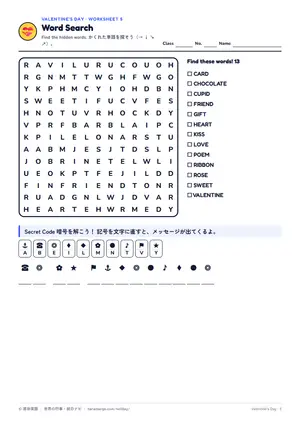
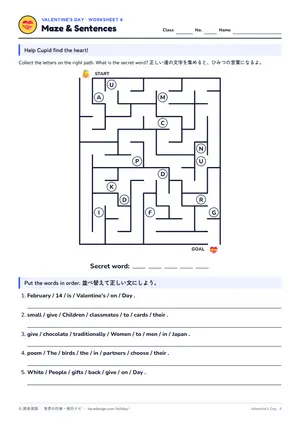
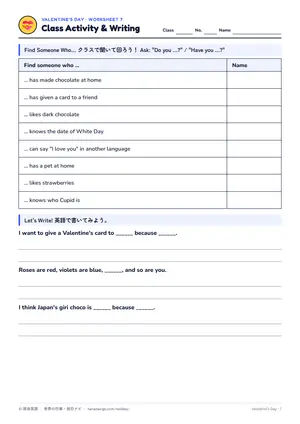
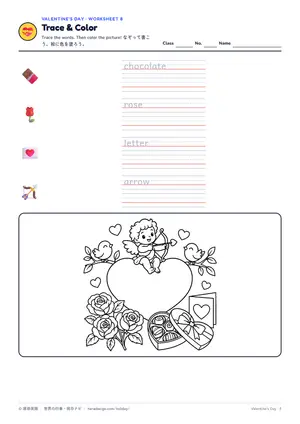
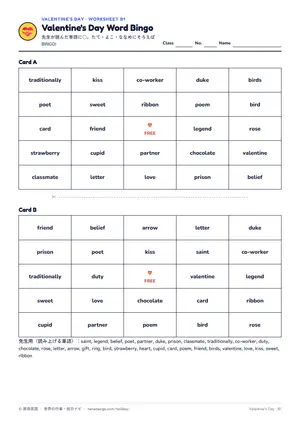
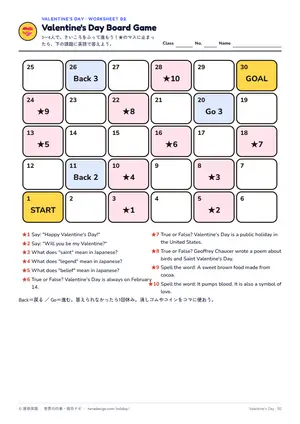
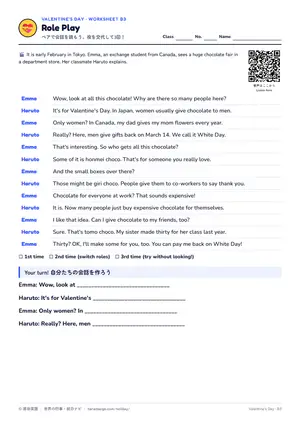
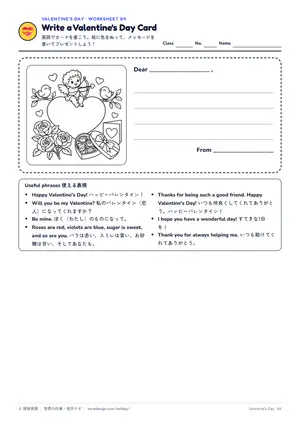
🍎Lesson Ideasバレンタインデーを使った英語の授業アイデア
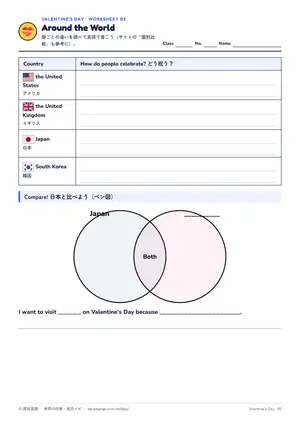
「誰が誰に?」世界のバレンタイン矢印マップ
🎯 国ごとの「贈る人・もらう人・贈る物」のちがいを英語で読み取り、説明できる。
- 国別比べの英文(アメリカ・日本・韓国・台湾・フィンランドなど)をカードにして班に配る。
- 白地図に、その国で「誰から誰へ」贈るかを矢印と絵で描き込む。
- In Taiwan, men give gifts to women. のように、1班1文ずつ発表する。
- いちばん驚いた国を選び、理由を英語で一言書く。
詳細版を開く(時間配分・Teacher Talk・板書)
「日本のバレンタインでは、だれがだれにチョコをあげる?」と聞き、黒板に「女性→男性」の矢印をかく。英語ページ本文の第4段落(アメリカ)を聞かせ、「アメリカでは?」と矢印が両方向になることを確かめる。
🗣️ In Japan, who gives chocolate to whom? / Yes. Women traditionally give chocolate to men. / Listen. What about the United States? / Men and women both give gifts. So the arrow goes both ways.
班に英文カードと白地図を配る。各カードを読んで、その国で「誰から誰へ」「何を」贈るかを、矢印と絵で地図にかきこませる。韓国の4月14日(ブラックデー)やデンマークのなぞなぞの手紙など、贈り物以外の習慣にも気づかせる。
🗣️ Read each card. Who gives? Who gets? What do they give? / Draw arrows on the map. / In Finland, it is Friend's Day. Who gets the cards? / What do single people eat in Korea on April 14?
1班1文ずつ発表させる(In Taiwan, men give gifts to women. / In Finland, people send cards to their friends. など)。発表に合わせて先生が黒板の地図に矢印をかき、クラス全体の矢印マップを完成させる。
🗣️ Each group, tell us about one country. / In Taiwan, men give gifts to women. Is that right? Good. / Look at the big map. Which country is the most like Japan?
いちばん驚いた国を1つ選ばせ、I was surprised by 〜 because 〜. の形で理由を英語で一言書かせる。何人かに読んでもらって終わる。
🗣️ Which country surprised you the most? / Write one sentence. I was surprised by Denmark because people send funny poems. / Who wants to read?
Who gives to whom?Japan:women → men(March 14 White Day:men → women)
the U.S.:men ⇔ women, children → every classmate
South Korea:Feb 14 women → men, Mar 14 men → women, Apr 14 Black Day(black noodles)
Taiwan:men → women(White Day:women → men)
Finland:Friend's Day → friends
Denmark:funny poems with dots In __, __ give gifts to __. I was surprised by __ because __.
Roses are red… オリジナル詩カードづくり
🎯 英語の定番の詩の形をまねて、色の単語と形容詞を使った短い詩を書く。
- Roses are red, violets are blue, sugar is sweet, and so are you. をリズムよく音読する。
- 色の単語と、sweet / kind / funny などの形容詞をカードで確認する。
- 後半2行を自分で作り、友だち・家族・先生あてのカードに書く。
- カードを交換して、声に出して読み合う。
詳細版を開く(時間配分・Teacher Talk・板書)
バラとスミレの写真を見せ、詩のポスターを先生がリズムよく読む。手拍子をつけて全員で2〜3回音読し、blue と you の音がそろっていること(韻)に気づかせる。
🗣️ Look. This is a rose, and this is a violet. / Listen to my poem. Roses are red, violets are blue ... / Let's read it together with claps. / Blue, you. Do they sound the same?
色の言葉カードと物の絵を組み合わせ、Bananas are yellow. / Apples are red. と言う練習をする。形容詞カードを見せ、意味をジェスチャーで確かめる(sweet=なめるまね、funny=笑う、など)。
🗣️ Bananas are ... yellow! Apples are ... red! / What is sweet? Sugar is sweet. Chocolate is sweet. / Kind, funny, cool. Let's do the gestures.
前半2行(Roses are red, violets are blue,)はそのまま使い、後半2行を自分で作らせる。3行目は「物+is+形容詞」、4行目は And so are you. のままでよい。友だち・家族・先生など、だれあてのカードかを決めて、絵もかかせる。
🗣️ Keep the first two lines. Change line three. / For example: Chocolate is sweet, and so are you. / Or: My dog is funny, and so are you. / Who is your card for? Your friend? Your family?
クラスの友だちあてのカードを交換し、もらったカードを声に出して読ませる。読んでもらった子は Thank you! と返す。家族あてのカードは持ち帰らせる。
🗣️ Give your card to your friend. / Read the poem out loud. / Say, Thank you! It's a nice poem.
Roses are red,
Violets are blue,
Sugar is sweet,
And so are you.

🌹 red  🍌 yellow  🍏 green  ☁ white
sweet  kind  funny  cool  cute  strong

Roses are red,
Violets are blue,
__ is __,
And so are you.
義理チョコ、続ける?やめる?ミニディベート
🎯 身近な習慣について、理由と例を挙げて英語で意見を述べる。
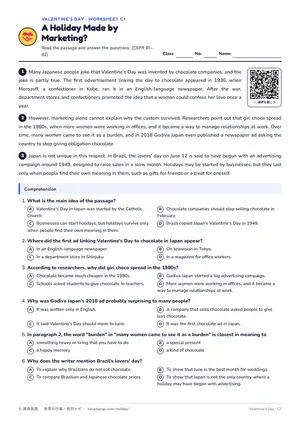
- advanced の英文とゴディバの広告の話(2018年)を読み、背景をつかむ。
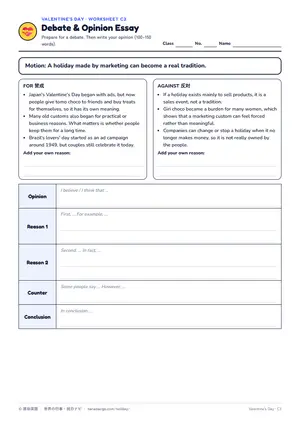
- 肯定側(Giri choco should continue.)と否定側に分かれ、理由を3つずつ英語で書く。
- 立論1分・質問1分・反論1分の短いディベートを行う。
- 最後に自分の本当の意見を3文で書く。
詳細版を開く(時間配分・Teacher Talk・板書)
advanced の英文の第2段落を読ませ、義理チョコが1980年代に広まった背景と、2018年のゴディバ・ジャパンの広告を確かめる。「チョコを売る会社が『やめよう』と言った」意外さに注目させる。
🗣️ Read paragraph two. When did giri choco spread? / Why did it spread in the 1980s? / In 2018, Godiva Japan asked people to stop giving obligation chocolate. / Why is that surprising?
肯定側(Giri choco should continue.)と否定側に分かれ、チームで理由を3つずつ英語で書かせる。理由には例や本文の内容を1つ以上入れるよう指示する。相手の反論も予想させる。
🗣️ Here is the motion. Giri choco should continue. / This side is for, and that side is against. / Write three reasons. Give an example for each one. / What will the other team say? Prepare an answer.
立論1分(各チーム)→ 質問1分(各チーム)→ 作戦タイム2分 → 反論1分(各チーム)の順でディベートを行う。残りの時間で、聞き手の生徒に「どちらの理由が説得力があったか」を一言ずつ言わせる。
🗣️ For team, one minute. Please start. / Against team, ask one question. / Now the rebuttals. Answer their strongest point. / Which team gave better reasons? Why?
チームの立場とは別に、自分の本当の意見を3文で書かせる(意見・理由・例)。何人かに発表してもらい、職場の習慣が時代とともに変わることにふれて終わる。
🗣️ Now forget your team. What do you really think? / Write three sentences. Your opinion, a reason, and an example. / Who wants to share?
Giri choco(obligation chocolate)
1980s:more women working in offices → a way to manage relationships at work
→ many women came to see it as a burden
2018:Godiva Japan「日本は、義理チョコをやめよう。」

Motion:Giri choco should continue.
立論1分 → 質問1分 → 作戦2分 → 反論1分

I think __ because __. For example, __.
バレンタイン年表ならべかえレース
🎯 年号と出来事を結びつけ、過去形の文を正しく読む。
- In 1477, Margery wrote a letter to her Valentine. などの英文カード8枚を配る。
- 班で古い順に並べ、最も早く正しく並べた班の勝ち。
- 答え合わせで、日本のバレンタイン(1936年・1958年)がどこに入るかを確認する。
詳細版を開く(時間配分・Teacher Talk・板書)
「バレンタインはいつから恋の日になった?」と聞き、予想を出させる。カードには年号と過去形の文が書いてあることを伝え、ルール(古い順に並べ、全部そろったら手をあげる)を説明する。
🗣️ When did Valentine's Day become a day of love? Guess. / Put the eight cards in order, from the oldest to the newest. / When you finish, raise your hands. Ready, go!
班で8枚のカードを古い順に並べさせる。速さだけでなく、1枚ずつ声に出して読み合うことをルールにする。早くできた班の順番を記録する。
🗣️ Read each card out loud in your group. / Look at the years. Which is the oldest? / Finished? Let me check.
答え合わせをする。1枚ずつ全員で読み、wrote / sold / started などの過去形を確かめる。最も早く正しく並べた班を発表する。
🗣️ Let's check. Number one. In the 1380s, Chaucer wrote a poem about birds. / Wrote is the past form of write. / And the winner is group three!
日本のカード2枚(1936年・1958年)を配り、年表のどこに入るかを考えさせる。1868年と1969年の間に入ることを確かめ、1958年の売り上げが3日間で170円だった話で終わる。
🗣️ Here are two cards about Japan. Where do they go? / Yes, between 1868 and 1969. / In 1958, the shop sold only three chocolate bars and one card!
Valentine's Day timeline
1380s  Chaucer wrote a poem about birds.
1415〜  a French duke wrote poems in prison.
1477  Margery wrote a letter.
1797  a book of valentine letters
1840  cheap stamps → card boom
1847ごろ  paper lace cards
1868  heart-shaped box
★1936  Morozoff ad(Kobe)
★1958  Tokyo:3 chocolate bars and 1 card
1969  Saint Valentine off the main calendar

write → wrote / sell → sold / start → started
「企業が作った記念日」を分析しよう
🎯 記念日と商業の関係を、複数の国の事例から英語で分析・発表する。
- 日本のバレンタイン、ブラジルの恋人の日、韓国のブラックデーなどを分担して調べる。
- 誰が始めたか・なぜ広まったか・今どう変わっているかを表にまとめる。
- A holiday made by marketing can become a real tradition. という主張に対し、賛否を5分で発表する。
- 他の班の発表に英語で質問し、共通点をまとめる。
詳細版を開く(時間配分・Teacher Talk・板書)
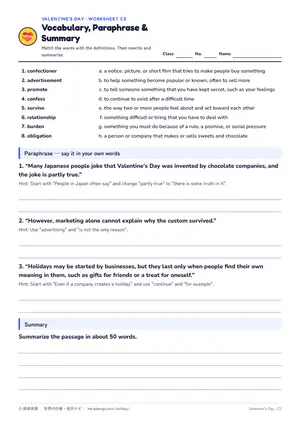
advanced の英文の第1段落を読ませ、「バレンタインはチョコ会社が作った」という冗談がどこまで本当かを確かめる。最後の段落の Holidays may be started by businesses, but they last only when people find their own meaning in them. を示し、今日の分析の視点にする。
🗣️ Many people joke that chocolate companies invented Valentine's Day. Is it true? / Read paragraph one. What happened in 1936? / Look at the last paragraph. When do holidays last?
4つの班に分担カードを配り、担当の記念日について調べさせる。本文と記事の国別比べ・年表を出発点にし、ネットの情報には出典を記録させる。「〜といわれる」レベルの情報は、そう書き分けるよう指示する。
🗣️ Research your holiday. Start with the passage and the article. / Write down your sources. / If something is only a story, say "It is said that ..."
分析表(誰が始めたか・なぜ広まったか・今どう変わっているか)にまとめさせ、A holiday made by marketing can become a real tradition. という主張に対する班の立場(賛成・反対・条件つき賛成)を決めさせる。5分の発表を準備させる。
🗣️ Fill in the table. Who started it? Why did it spread? How is it changing? / Now decide your position on this claim. / A holiday made by marketing can become a real tradition. / Prepare a five-minute presentation.
各班が5分ずつ発表する。聞き手は、ほかの班の記念日との共通点をメモしながら聞き、発表後に英語で質問を1つずつする(時間内に収まるよう、質問は先生が2つまでに絞る)。
🗣️ Group one, you have five minutes. / Listeners, note the things that are the same in every holiday. / Any questions? Please ask in English.
4つの事例の共通点(売り上げの少ない時期・お店の宣伝・人々が自分なりの意味を見つけたか)をクラスでまとめる。最後に、友チョコ・自分チョコのように「意味が変わって続く」例を挙げ、各自が主張への最終的な意見を2〜3文で書いて提出する。
🗣️ What do all four holidays have in common? / Did people find their own meaning in them? / Write your final opinion in two or three sentences.
A Holiday Made by Marketing?

事例 / 誰が始めた / なぜ広まった / 今どう変わる
Japan Valentine's:Morozoff ad 1936 → department stores, confectioners / honmei → giri → tomo, jibun
Japan White Day:1980s / gifts back / ?
Brazil Lovers' Day(June 12):ad campaign around 1949 / slow month / ?
Korea Black Day(April 14):? / single people eat black noodles / ?

Claim:A holiday made by marketing can become a real tradition.
→ "They last only when people find their own meaning in them."