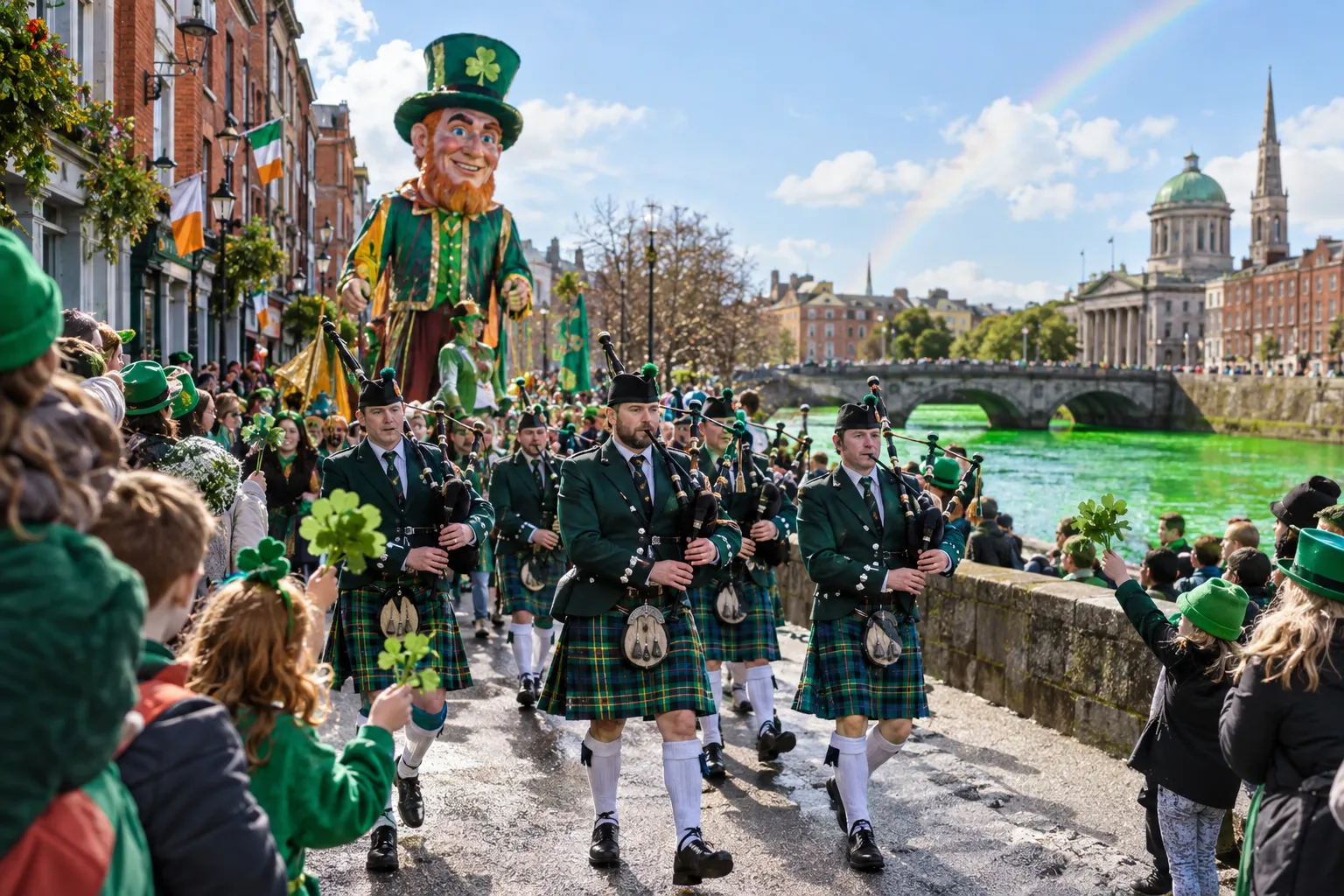
St. Patrick's Day
セント・パトリックス・デーの英語の授業アイデアとワークシート
印刷してすぐ使えるワークシート(PDF・Word・解答つき)と、授業の手順書。
🖨️Worksheetsワークシート(無料・A4)
① 「中身を見る・印刷」で全ページを確認 → ② そのページ上の 🖨️ 印刷する でそのまま印刷できます。A4・無料。
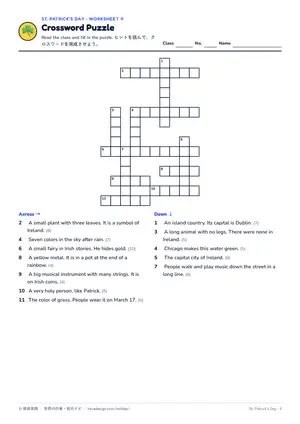
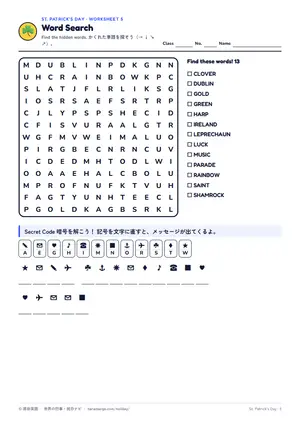
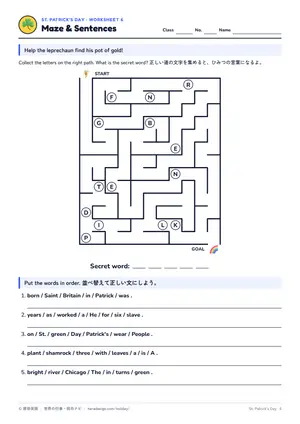
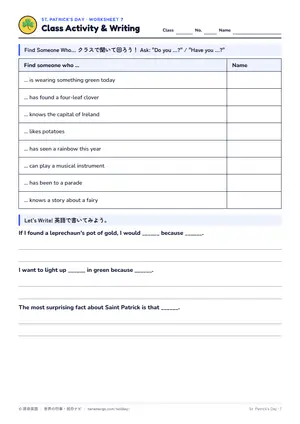
🍎Lesson Ideasセント・パトリックス・デーを使った英語の授業アイデア
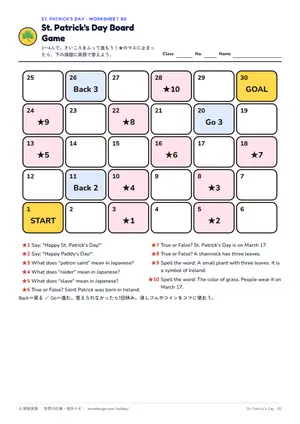
パトリックの人生すごろく
🎯 過去形の文を読み、出来事を順番に並べて人物の一生を説明できる。
- He was born in Britain. / Raiders took him to Ireland. などの英文カードを班に配る。
- カードを正しい順に並べ、すごろくのマスに貼る。
- サイコロをふって止まったマスの文を音読し、日本語で意味を言う。
- ゴール後、パトリックに聞きたい質問を英語で1つ書く。
詳細版を開く(時間配分・Teacher Talk・板書)
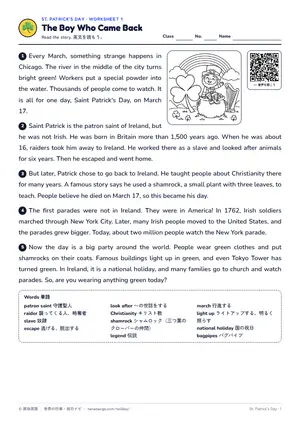
「アイルランドの守護聖人パトリックは、アイルランド人ではなかった」と伝え、英語ページ本文の第2段落を聞かせる。born in Britain・raiders・slave を聞き取らせ、「さらわれた少年」の話であることをつかませる。
🗣️ Saint Patrick is the patron saint of Ireland. But was he Irish? / Listen. Where was he born? / Raiders took him to Ireland. He was only about 16.
班に英文カード9枚を配り、正しい順に並べさせる。並べたらすごろくのマスに順に貼る。過去形の動詞(was, took, worked, escaped, walked, went, chose, taught)に下線を引かせ、原形を確かめる。
🗣️ Put the cards in order. What happened first? / Read each card out loud in your group. / Underline the past forms. Took is the past form of take. / Now stick the cards on the board in order.
すごろくで遊ぶ。サイコロをふって止まったマスの英文を音読し、日本語で意味を言えたらそのまま、言えなければ1マス戻る。先生は班を回り、発音と意味を確かめる。
🗣️ Roll the dice and move. / Read the sentence on your square. Then say it in Japanese. / If you can't, go back one square. / Who reached the goal first?
ゴール後、パトリックに聞きたい質問を英語で1つ書かせる(Why did you go back to Ireland? など)。何人かに読んでもらい、本文第3段落の「自分で戻ることを選んだ」点に注目させて終わる。
🗣️ Write one question for Patrick. / For example: Why did you go back to Ireland? / He chose to go back. Why do you think he did that?
The Boy Who Came Back
1. He was born in Britain.
2. Raiders took him to Ireland.(about 16)
3. He worked as a slave for six years.
4. He escaped.
5. He walked about 300 km to find a ship.
6. He went home.
7. He chose to go back to Ireland.
8. He taught people about Christianity.
9. People believe he died on March 17.

take → took / go → went / teach → taught / choose → chose

Question for Patrick:Why did you __?
ウソ?ホント?伝説バスター
🎯 伝説と事実を区別し、根拠を英語で説明できる。
- Patrick drove the snakes out of Ireland. など5つの主張を提示する。
- 班で True / Legend / False を予想する。
- 本文と「誤解とホント」の節を読み、根拠となる文を探す。
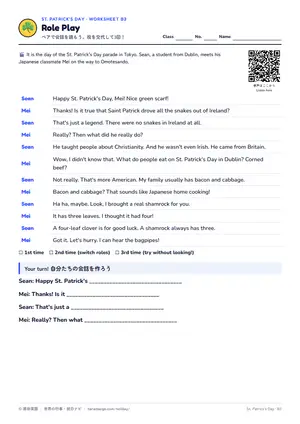
- It is a legend because there were no snakes in Ireland. の形で発表する。
詳細版を開く(時間配分・Teacher Talk・板書)
True(事実)・Legend(伝説:昔からの言い伝えで証拠がない)・False(間違い)の3つの区別を説明する。主張カード②を読み上げ、手を挙げさせて予想をとる。
🗣️ Today, we are legend busters. / True means it is a fact. Legend means it is an old story with no proof. False means it is wrong. / Patrick drove the snakes out of Ireland. True, legend, or false?
班に5枚の主張カードを配り、True / Legend / False を予想させる。予想の理由も一言メモさせる。まだ資料は見せない。
🗣️ Look at the five cards. Guess first. / Write a short reason for each guess. / Don't look at the article yet.
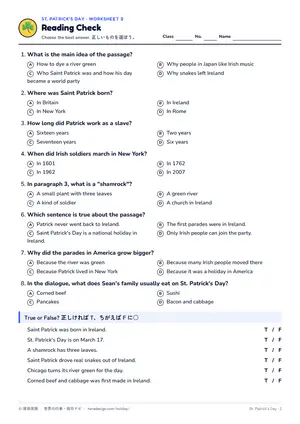
英語ページ本文・会話と記事の「よくある誤解」の節を配り、根拠となる文を探させる。判定シートに根拠の文を書き写させる(例:② There were no snakes in Ireland at all.)。③はシャムロックの話が文章に書かれた最初が1726年であることに注目させる。
🗣️ Now read the passage, the dialogue, and the article. / Find the sentence that proves your answer. / Card three. When was this story first written down? / Did you change any answers?
各班が1枚ずつ担当し、It is a legend because 〜. / It is false because 〜. / It is true because 〜. の形で発表する。発表後、全体で正解と根拠を確認する。
🗣️ Each group, explain one card. / It is a legend because there were no snakes in Ireland. / Is there any other evidence? / Good job, legend busters!
Legend Buster
True = fact / Legend = old story, no proof / False = wrong

① Patrick was Irish. → False(born in Britain)
② Snakes → Legend(no snakes in Ireland after the Ice Age, story from the late 1100s)
③ Shamrock to teach → Legend(first written in 1726)
④ Corned beef and cabbage → False(Irish immigrants in America)
⑤ Pubs 1927–1961 → True

It is a legend / false / true because __.
グローバル・グリーニング企画書
🎯 理由を挙げて提案する英文を書き、発表する。
- 世界の名所が緑にライトアップされた例を紹介する。
- 日本の建物や場所を1つ選び、緑にする理由を3つ考える。
- We want to light up ___ in green because ___. の形で企画書を書く。
- クラスで発表し、いちばん説得力のある企画に投票する。
詳細版を開く(時間配分・Teacher Talk・板書)
緑の名所の写真を見せ、「なぜ世界中が緑になる?」と問う。advanced の英文の第2段落を読ませ、2010年に始まったグローバル・グリーニングで、約50か国の300以上の名所が緑になってきたことを確かめる。東京タワーも緑になったことを伝える。
🗣️ Look at these photos. Why are they all green? / Read this paragraph. When did the Global Greening start? / More than 300 landmarks in about fifty countries. Even Tokyo Tower!
班で日本の建物や場所を1つ選ばせ、緑にする理由を3つ考えさせる。アイルランドとのつながり、町の宣伝、観光、人々に伝えたいメッセージなど、いろいろな観点から考えるよう促す。
🗣️ Choose one place in Japan. / Why should it turn green? Think of three reasons. / Think about tourism, the message, and the link with Ireland.
We want to light up 〜 in green because 〜. の型と、First, ... Second, ... Finally, ... のつなぎ言葉を示し、企画書を英語で書かせる。最後に期待される効果を1文入れさせる。
🗣️ Start with: We want to light up Osaka Castle in green. / Give three reasons. First, ... Second, ... Finally, ... / End with the result. This will bring more visitors to our city.
各班が1分半で企画を発表する。聞き手は「理由の説得力」「わかりやすさ」の2点をメモしながら聞く。
🗣️ Each group has ninety seconds. / Listeners, check two things. Are the reasons strong? Is it clear? / Thank you. Next group, please.
いちばん説得力のある企画に投票させ、結果を発表する。勝った班の理由のどこがよかったかを一言ふり返る。
🗣️ Vote for the most convincing plan. Not your own! / The winner is ...! / Why was this plan so strong?
Global Greening(since 2010)
→ more than 300 landmarks, about 50 countries
→ Tokyo Tower, Chicago River

We want to light up __ in green because __.
First, __.
Second, __.
Finally, __.
This will __.
緑を探せ!クラス・ビンゴ
🎯 色や身近な物の英語を使い、質問と答えのやりとりをする。
- Do you have something green? の言い方を練習する。
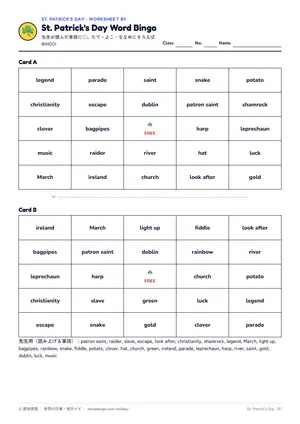
- find_someone のカードを使い、友だちに質問してサインを集める。
- ビンゴになったら Happy St. Patrick's Day! と言う。
詳細版を開く(時間配分・Teacher Talk・板書)
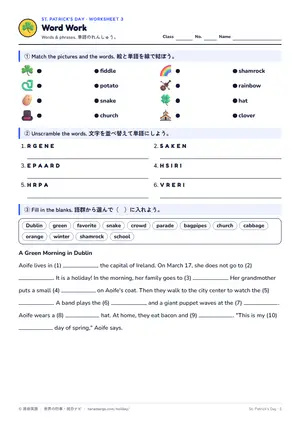
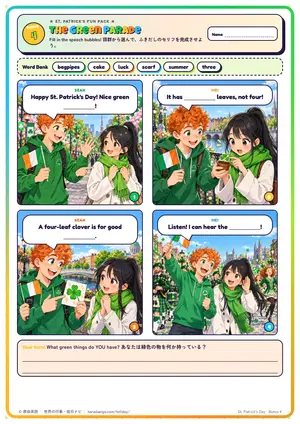
シャムロックの写真を見せ、3月17日はアイルランドの「セント・パトリックス・デー」で、みんなが緑の物を身につける日だと紹介する。先生が身につけた緑の物を見せる。
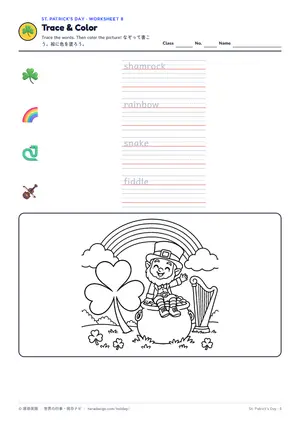
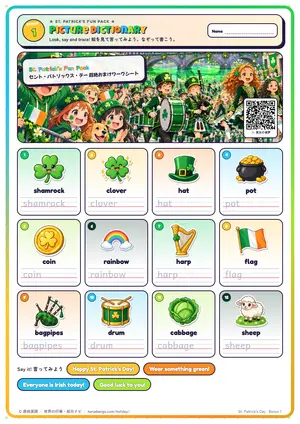
🗣️ Look. This is a shamrock. It has three leaves. / On March 17, people wear something green. / Look at me. I have something green. My scarf!
Do you have something green? / Yes, I do. / No, I don't. を全員で言う練習をする。ビンゴカードの質問を先生が1つずつ読み、子どもたちがまねする。
🗣️ Repeat after me. Do you have something green? / Yes, I do. No, I don't. / Let's read the bingo questions together.
教室を歩いて友だちに質問させ、Yes の答えをもらったマスにその友だちのサインをもらう。1人の友だちからは1つだけサインをもらうルールにする。ビンゴになったら Happy St. Patrick's Day! と言って先生に見せる。
🗣️ Walk around and ask your friends. / If they say Yes, I do, get their name. / One name from one friend. / Bingo? Say, Happy St. Patrick's Day!
ビンゴになった子を立たせて拍手する。「緑の物を持っていた人は何人?」と聞き、Do you have something green? をもう一度全員で言って終わる。
🗣️ Who got bingo? Stand up! Great job! / Let's say it one more time. Do you have something green?
☘ St. Patrick's Day(March 17)

Do you have something green?
Yes, I do. 🙂  No, I don't. 🙁

Do you like __?
Can you __?

BINGO → Happy St. Patrick's Day!
移民と祭り:ディアスポラのアイデンティティ
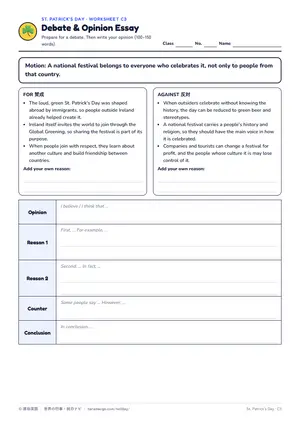
🎯 移民社会で祭りが果たす役割を、資料を読んで英語で議論する。
- advanced の英文を読み、immigrant, discrimination, stereotype などのキーワードを確認する。
- アメリカのアイルランド系、ブラジルの日系人など、移民と祭りの例を班で調べる。
- Who owns a national festival? について、立場を決めて5分で発表する。
- 議論をふまえ、英語で250語のエッセイを書く。
詳細版を開く(時間配分・Teacher Talk・板書)
「アイルランドにルーツをもつアメリカ人は約3860万人で、アイルランド共和国の人口の約7倍」という数字を示し、「この祭りはだれのもの?」と問いかける。ペアで30秒話させる。
🗣️ More than 38 million Americans have Irish roots. That's about seven times the population of Ireland. / So whose festival is St. Patrick's Day? / Talk with your partner for thirty seconds.
本文を個人で読ませ、キーワードを確認する。ペアで「祭りの3つの段階(アイルランドの静かな宗教の日 → アメリカの移民のパレード → 政府の観光イベント)」と、第3段落の3つの立場を整理させる。
🗣️ Read the passage and check the key words. / How did the day change? Find three stages. / For immigrants, what did a parade mean? / Paragraph three shows three views. What are they?
班ごとに分担カードの事例(アメリカのアイルランド系、ブラジルの日系人の七夕祭りや日本祭り、日本の中華街の春節など)を調べさせ、「だれが始めたか・祭りの役割・今の参加者」を整理させる。Who owns a national festival? への班の立場を決めさせる。
🗣️ Research your example. Who started the festival? / What role does it play for the community? / Who joins it today? / Decide your position. Who owns a national festival?
各班が5分で発表する(3班の場合)。本文の例と自分たちの事例を比べて立場を述べさせる。発表ごとに英語の質問を1つ受け、残りの時間で先生が論点を整理する。
🗣️ Group one, five minutes. Tell us your position and your example. / How is your example similar to the Irish in America? / Questions? Please ask in English.
250語のエッセイの構成(主張 → 本文からの根拠 → 調べた事例 → 反対の立場への応答 → 結論)を示し、構成メモと最初の段落を授業内で書かせる。残りは宿題にする。
🗣️ Write a 250-word essay on this question. / Use the passage and your group's example. / Answer the other side before your conclusion. / Start now, and finish it at home.
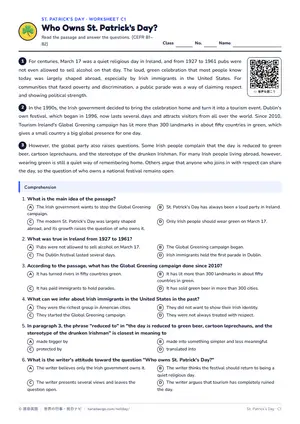
Who Owns St. Patrick's Day?

① Ireland:a quiet religious day(1927–1961 no alcohol in pubs)
② USA:Irish immigrants → parades = respect, political strength(against poverty, discrimination)
③ Ireland 1990s〜:tourism → Dublin festival 1996, Global Greening 2010

Views:
・reduced to green beer, leprechauns, stereotypes
・a quiet way of remembering home
・anyone who joins with respect can share it

Who owns a national festival?