
SOUNDS OF SPACE
宇宙の音
火星の風、ヘリコプターの羽音、土星の輪にちりが当たる「パチパチ」、ブラックホールのうなり声――。NASA の探査機や望遠鏡がとらえた本物の「宇宙の音」19本を、波形を見ながら聞いてみよう。イヤホンやヘッドホンがおすすめ!

WHY CAN WE HEAR SPACE?
宇宙は真空なのに、なぜ「音」があるの?
Space is almost empty, so sound cannot travel there. Most space sounds are radio waves changed into sound. But Mars has thin air, so we can record real sound there!In the near-empty vacuum of space, sound cannot travel the way it does in air. So most "space sounds" are not sounds you could hear with your own ears. They are radio waves, plasma waves or data that scientists change into sound. But on Mars, which has a thin atmosphere, a microphone can record real sound. Here are the five kinds of sounds on this page.ほとんど空っぽ(真空)の宇宙では、空気の中のようには音が伝わりません。だから「宇宙の音」の多くは、耳でそのまま聞こえる音ではなく、電波やプラズマの波、望遠鏡のデータを、科学者が音に変えたものです。いっぽう、うすい空気がある火星では、マイクで本物の音が録れます。このページの音は、次の5種類に分けられます。
Sound moves through air. Mars has thin air, so we can record real sound there.Sound is a wave that travels through air. Mars has a thin atmosphere, so a microphone on Mars can record real sound.音は空気をふるわせて伝わる波。火星にはうすい空気があるので、マイクで本物の音が録れます。
A machine feels the ground shake. We make it faster so we can hear it.A seismometer feels the ground shake. The shaking is too low for our ears, so it is sped up until we can hear it.地震計が地面のゆれを感じとります。そのままでは低すぎて聞こえないので、速くして聞こえるようにしています。
Sound cannot travel in empty space. But spacecraft catch radio waves. Scientists change them into sound.Space is almost empty, so normal sound cannot travel there. But spacecraft can catch radio waves and waves in plasma (electrically charged gas). Scientists change these waves into sound we can hear.宇宙はほとんど空っぽ(真空)なので、ふつうの音は伝わりません。でも探査機は電波や、プラズマ(電気をおびたガス)の波をとらえられます。それを人の耳に聞こえる音に変えたものです。
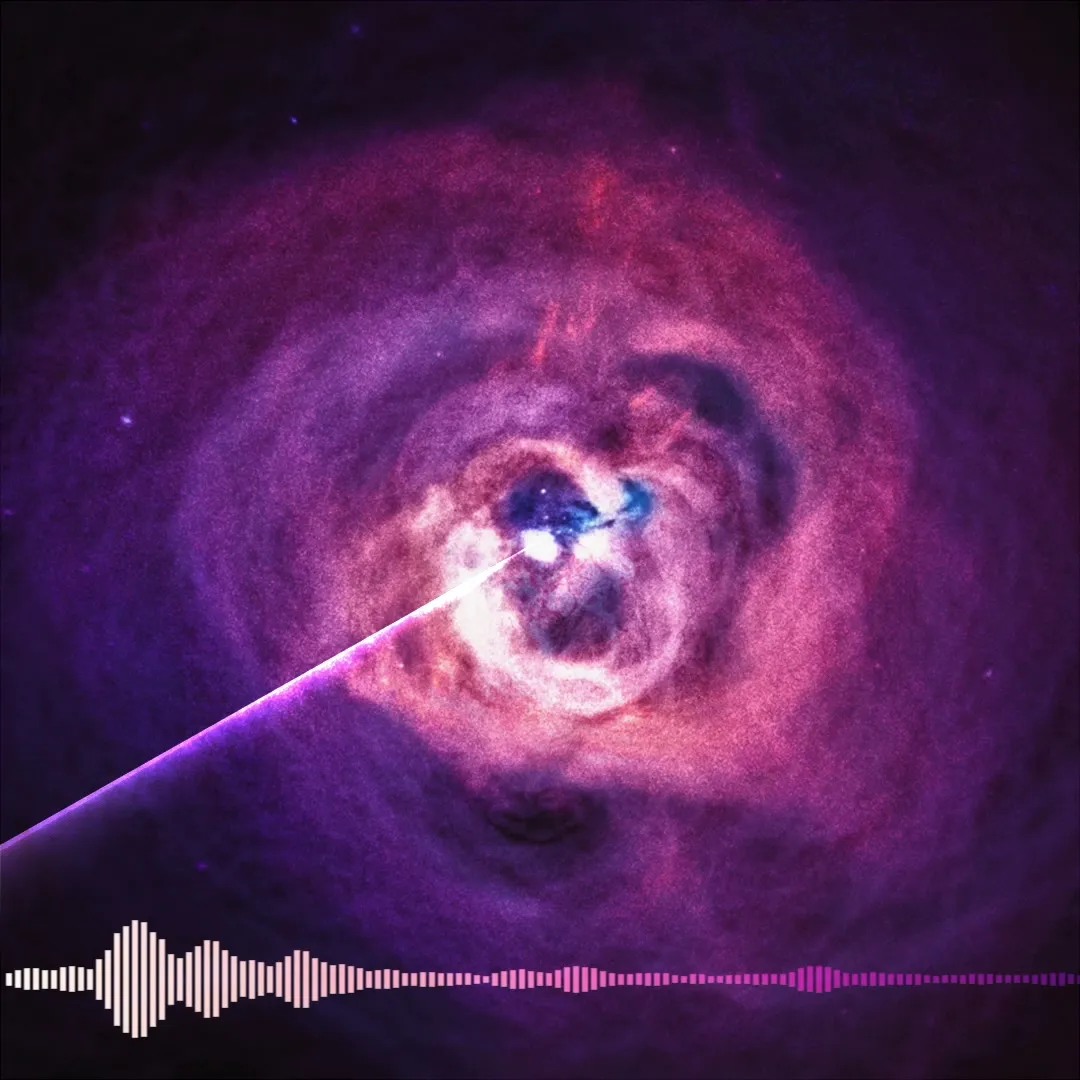
There is gas around this black hole, so sound waves can move. They are very low, so we made them higher.A galaxy cluster is filled with hot gas, so pressure waves (like sound) can really travel there. The waves are far too low to hear, so they were raised 57 and 58 octaves.銀河団の中は熱いガスで満たされているので、音と同じ「圧力の波」が本当に伝わります。低すぎて聞こえないので、57〜58オクターブ高くしています。
This is called sonification. Bright light becomes sound, so you can hear a space picture.This is called sonification. The brightness and position of light in a space picture are matched to pitch and volume, so you can 'hear' the picture.「ソニフィケーション(音にすること)」といいます。宇宙の写真の光の明るさや位置を、音の高さや大きさに置きかえて、写真を「聞ける」ようにしたものです。
ALL SOUNDS
ぜんぶの音(19本)
タップすると上のプレーヤーで再生します。
🎙️マイクで録った本物の音
📳地面のゆれを音にしたもの
📡電波・プラズマの波を音に変えたもの
🌀ガスの中を伝わる本物の圧力の波
🎼望遠鏡の光のデータを音に置きかえたもの
QUIZ
この音、なーんだ?
音を聞いて、どこの何の音か当ててね。全5問!(音が出ます)
SOUND ON MARS
火星で声を出したら、どう聞こえる?
Mars has very thin air. Sound is much quieter there. Try the 'Mars air' switch in the player!Mars's air is very thin — about 1% as dense as Earth's. Perseverance's microphones showed that sound is much quieter there and fades quickly with distance. The speed of sound is about 240 meters per second (on Earth it is about 340), and high-pitched sounds travel a little faster than low ones. The "Mars air" switch in the player gives you a rough idea of this muffled, quiet sound.火星の空気は、地球のおよそ100分の1のうすさ。パーサビアランスのマイクの記録から、火星では音がずっと小さく、遠くまで届きにくいことがわかりました。音の速さは秒速約240m(地球は約340m)で、高い音は低い音より少しだけ速く伝わります。プレーヤーの「火星の空気で聞くと?」スイッチで、こもって小さく聞こえる感じを、おおまかに体験できます(効果はイメージです)。
音と写真の出典・クレジット(19本)
すべて NASA(および NASA と共同で探査を行う機関)が一般に公開している音です。NASA は「Sounds from Beyond」「Data Sonifications」のページで、音のダウンロードと利用を案内しています。チャンドラX線観測衛星の素材は「著作権を主張しない」と明記されています。音量だけそろえ、音そのものは加工していません(長い音は短く切ったものがあります)。
| 音 | 日付 | クレジット | |
|---|---|---|---|
| 火星で初めて録れた音 The First Sound Recorded on Mars | 2021年2月19日 | 音:NASA/JPL-Caltech/LANL/CNES/CNRS/ISAE-Supaero 写真:NASA/JPL-Caltech | 出典 ↗ |
| 火星の風 Wind on Mars | 2021年2月22日 | 音:NASA/JPL-Caltech/LANL/CNES/CNRS/ISAE-Supaero 写真:NASA/JPL-Caltech | 出典 ↗ |
| 火星の岩にレーザー「パチパチ」 Laser Zaps on a Mars Rock | 2021年3月2日 | 音:NASA/JPL-Caltech/LANL/CNES/CNRS/ISAE-Supaero 写真:NASA/JPL-Caltech | 出典 ↗ |
| 火星を飛ぶヘリコプターの音 A Helicopter Flying on Mars | 2021年4月30日 | 音:NASA/JPL-Caltech/LANL/CNES/CNRS/ISAE-Supaéro 写真:NASA/JPL-Caltech/MSSS | 出典 ↗ |
| 火星のつむじ風(ダストデビル) A Martian Dust Devil | 2021年9月27日 | 音:NASA/JPL-Caltech/LANL/CNES/CNRS/INTA-CSIC/Space Science Institute/ISAE-Supaero 写真:NASA/JPL-Caltech/LANL/CNES/CNRS/INTA-CSIC/Space Science Institute/ISAE-Supaero | 出典 ↗ |
| 火星の地震(マーズクエイク) A Marsquake | 2019年5月22日 | 音:NASA/JPL-Caltech/CNES/IPGP 写真:NASA/JPL-Caltech | 出典 ↗ |
| 火星の風で太陽電池がふるえる音 Martian Wind Shaking a Lander | 2018年12月1日 | 音:NASA/JPL-Caltech/CNES/IPGP/Imperial College London 写真:NASA/JPL-Caltech | 出典 ↗ |
| アポロ11号の打ち上げ Apollo 11 Liftoff | 1969年7月16日 | 音:NASA 写真:NASA | 出典 ↗ |
| アルテミス1号の打ち上げ Artemis I Liftoff | 2022年11月16日 | 音:NASA 写真:NASA/Joel Kowsky | 出典 ↗ |
| 地球のまわりの「朝の小鳥」電波 Earth's 'Chorus' Radio Waves | (公開) | 音:NASA / EMFISIS team, University of Iowa 写真:NASA/Van Allen Probes/Goddard Space Flight Center | 出典 ↗ |
| 木星の衛星ガニメデのそばを飛んだ音 Juno's Flyby of Ganymede | 2021年6月7日 | 音:NASA/JPL-Caltech/SwRI/Univ of Iowa 写真:NASA/JPL-Caltech/SwRI/MSSS | 出典 ↗ |
| 木星のオーロラが「歌う」電波 Jupiter's Auroras Sing | 2016年8月27日 | 音:NASA/JPL-Caltech/SwRI/Univ. of Iowa 写真:NASA, ESA, and J. Nichols (University of Leicester) | 出典 ↗ |
| 木星のカミナリ「ホイッスラー」 Lightning 'Whistlers' on Jupiter | 1979年3月5日 | 音:NASA 写真:NASA/JPL-Caltech | 出典 ↗ |
| 土星のふしぎな電波 Eerie Radio Sounds of Saturn | 2005年7月25日(公開) | 音:NASA/JPL/University of Iowa 写真:NASA/JPL/Space Science Institute | 出典 ↗ |
| 土星の輪をくぐる「パチパチ」 Crossing Saturn's Rings | 2016年12月18日 | 音:NASA/JPL-Caltech/University of Iowa 写真:NASA/JPL-Caltech | 出典 ↗ |
| 太陽系の外、星と星のあいだの音 Sounds of Interstellar Space | 2013年9月12日(公開) | 音:NASA/JPL-Caltech/University of Iowa 写真:NASA/JPL-Caltech | 出典 ↗ |
| ブラックホールの「声」(ペルセウス座銀河団) The Sound of a Black Hole (Perseus Cluster) | 2022年5月4日(公開) | 音:NASA/CXC/SAO/K.Arcand, SYSTEM Sounds (M. Russo, A. Santaguida) 写真:X-ray: NASA/CXC/SAO | 出典 ↗ |
| 「創造の柱」を音で聞く Listening to the Pillars of Creation | 2020年(公開) | 音:X-ray: NASA/CXC/SAO; Optical: NASA/STScI; Sonification: NASA/CXC/SAO/K.Arcand, SYSTEM Sounds (M. Russo, A. Santaguida) 写真:X-ray: NASA/CXC/SAO; Optical: NASA/STScI | 出典 ↗ |
| ウェッブの「宇宙の断崖」の音 Webb's Cosmic Cliffs in Sound | 2022年8月3日(公開) | 音:NASA, ESA, CSA, STScI, and K.Arcand (CXC/SAO), M.Russo & A.Santaguida (SYSTEM Sounds), Q.Hart & C.Blome (STScI), and C.Malec (consultant) 写真:NASA, ESA, CSA, STScI | 出典 ↗ |
MORE TO EXPLORE