White Day
ホワイトデーの英語の授業アイデアとワークシート
印刷してすぐ使えるワークシート(PDF・Word・解答つき)と、授業の手順書。
🖨️Worksheetsワークシート(無料・A4)
① 「中身を見る・印刷」で全ページを確認 → ② そのページ上の 🖨️ 印刷する でそのまま印刷できます。A4・無料。
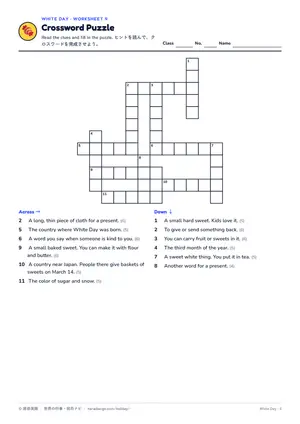
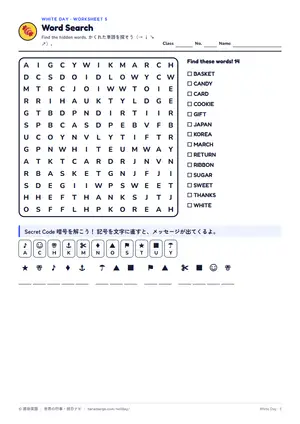
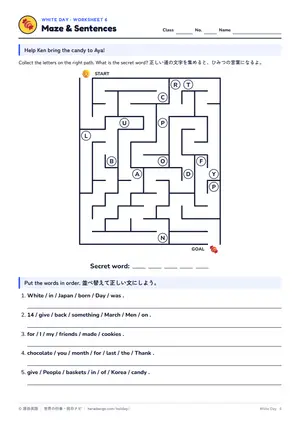
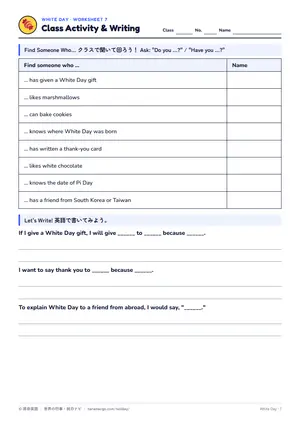
🍎Lesson Ideasホワイトデーを使った英語の授業アイデア
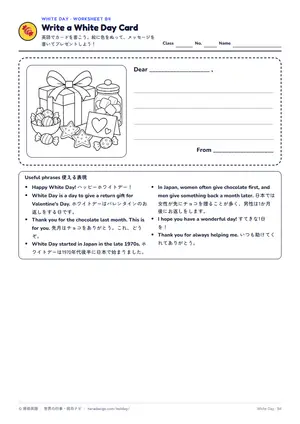
サンキューカードを英語で書こう
🎯 Thank you for ~. / I really liked ~. の形を使って、お礼のカードを英語で書ける。
- 教師が Thank you for the chocolate. I really liked it. などのモデル文を示す。
- 生徒は「ありがとうを言いたい人」を1人決め(家族・友だち・先生など)、理由を日本語でメモする。
- モデル文を使って3〜4文のカードを英語で書く。
- ペアで読み合い、相手のカードから良い表現を1つ選んで発表する。
詳細版を開く(時間配分・Teacher Talk・板書)
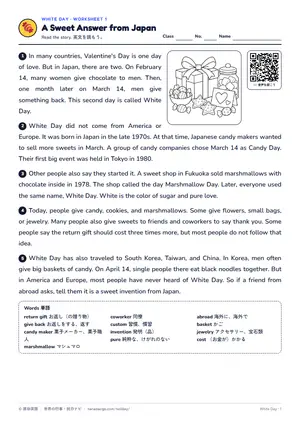
英語ページ本文の第4段落を音声で聞かせ、Many people also give sweets to friends and coworkers to say thank you. の文を板書する。「ホワイトデーはお返しの日。今日は物ではなく、言葉でお礼をしよう」と伝える。
🗣️ March 14 is White Day in Japan. / People give sweets to say thank you. / Today, let's say thank you with words.
モデルカード(Dear Grandma, / Thank you for the chocolate. / I really liked it. / It was sweet and soft. / Love, Ken)を貼って読み上げ、Thank you for ~. と I really liked ~. に線を引く。for のあとには物や行動(for helping me)が来ることを2例で示す。
🗣️ Read the card with me. / Thank you for the chocolate. Thank you for helping me. / After "for," say a thing or an action.
お礼を言いたい人を1人決め、理由を日本語で1行メモさせる(家族・友だち・先生・部活の先輩など)。メモをもとに3〜4文のカードを英語で書かせる。机間巡視で、for のあとの形を中心に直す。
🗣️ Who do you want to thank? Choose one person. / Write your reason in Japanese first. / Now write three or four sentences in English. / Nice. "Thank you for teaching me." That's perfect.
ペアでカードを読み合い、相手のカードからよい表現を1つ選んで発表させる。出た表現を板書に追加する。カードは実際に相手に渡すよう伝える。
🗣️ Read your card to your partner. / Which sentence did you like? / Please give your card to that person this week.
White Day = March 14(お返しの日)
People give sweets to say thank you.

Dear ___,
Thank you for ___.(物・〜してくれたこと)
  for the chocolate / for helping me
I really liked ___.
___,(Love, / From,)___
「元祖はだれだ?」ディベート
🎯 複数の資料の主張を読み比べ、根拠をもとに英語で意見を述べられる。
- 本文と origin の節を読み、全飴協説と石村萬盛堂(いしむらまんせいどう)説の根拠を表にまとめる。
- クラスを2チームに分け、それぞれの説の「代理人」として英語で主張を準備する。
- 1分ずつ主張し、相手に質問を1つずつする。
- 最後に「元祖を一つに決めるべきか」を全員で話し合い、I think ~ because ~. で意見を書く。
詳細版を開く(時間配分・Teacher Talk・板書)
「ホワイトデーを始めたのはだれ?」と問い、予想を聞く。本文の Other people also say they started it. を示し、元祖を名乗る説が2つあることを伝える。
🗣️ Who started White Day? Any ideas? / Look at this sentence. Other people also say they started it. / So there are two stories. Let's compare them.
本文と由来の節を読み、表を埋めさせる。全飴協説(1978年の総会でキャンデーの日に決定、1980年に銀座三越で第1回)と、石村萬盛堂説(福岡、1978年にマシュマロデー)を整理する。答え合わせで、どちらも1978年であることに注目させる。
🗣️ Read the texts and fill in the table. / When and where did each story start? / What was the first name of the day? / Both stories say 1978. Interesting, right?
クラスを2チームに分け、それぞれの説の代理人として主張を準備させる。主張は We believe ... because ... の形で根拠を2つ入れる。相手チームへの質問も1つ用意させる。
🗣️ Team A speaks for the candy makers' association. Team B speaks for the shop in Fukuoka. / Use "We believe ... because ...." Give two reasons. / Prepare one question for the other team.
各チーム1分ずつ主張し、相手に質問を1つずつする。答えられない質問が出たら、資料のどこを見ればよいかを全員で確認する。
🗣️ Team A, you have one minute. Go. / Team B, ask your question. / Can you find the answer in the text?
「元祖を一つに決めるべきか」を全員で話し合う。本文と記事では、どちらが正しいとも決めていないことを確認する。最後に I think ~ because ~. で自分の意見を2〜3文書かせて回収する。
🗣️ Should we decide only one origin? / Can both stories be true in some way? / Write your opinion. Use "I think ... because ...."
Who started White Day?

① 全飴協(candy makers' association)
 1978 general meeting → March 14 = Candy Day
 1980 first event(Tokyo, 銀座三越)
② 石村萬盛堂(a sweet shop in Fukuoka)
 1978 Marshmallow Day(chocolate inside marshmallow)
→ later: the same name "White Day"

We believe ___ because ___.
I think ___ because ___.
世界の「14日」カレンダーをつくろう
🎯 月の名前と日付の言い方を練習しながら、記念日の文化の違いに気づく。
- February 14 / March 14 / April 14 の読み方を確認する。
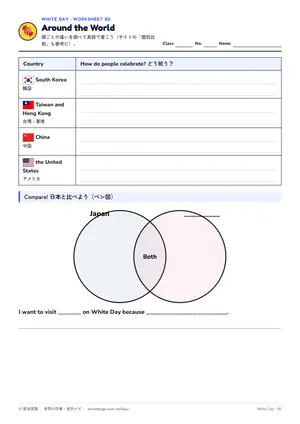
- グループで compare の表を見て、各国の「14日」に何をするかを英語で1文ずつ書く。
- 大きなカレンダーに書きこみ、教室に掲示する。
- 自分たちで新しい「14日の記念日」を考え、英語で名前と内容を発表する。
詳細版を開く(時間配分・Teacher Talk・板書)
February 14 / March 14 / April 14 を板書し、読み方(February fourteenth)を全員で練習する。「2月14日と3月14日は何の日?」と聞き、4月14日は何かを予想させる。
🗣️ Let's read the dates. February fourteenth. / What day is February 14? And March 14? / What about April 14? Any guesses?
グループに国比べ表を配り、各国の「14日」に何をするかを英語1文で付せんに書かせる。例:In Korea, men give baskets of candy on March 14. / In the U.S., people eat pie on March 14.
🗣️ Read the table in your group. / Write one sentence for each country. / Start with "In Korea, ..." or "In the U.S., ...."
付せんを大きなカレンダーの日付の欄に貼らせる。グループの代表が1文ずつ読み上げ、同じ日に国によってちがう行事があることを確認する(3月14日は日本のホワイトデー、アメリカのパイ・デー、ユネスコの国際数学の日など)。
🗣️ Put your notes on the calendar. / Read your sentence to the class. / Look at March 14. How many different days are there?
グループで新しい「14日の記念日」を考えさせ、名前と内容を英語で発表させる(例:May 14 is Book Day. We give books to friends.)。カレンダーは教室に掲示する。
🗣️ Make a new day for the 14th of a month. / What is its name? What do people do? / Tell the class in two sentences.
February 14(fourteenth)Valentine's Day
March 14 White Day(Japan)/ Pi Day(U.S.)
April 14 Black Day(Korea)

In Korea, men give baskets of candy on March 14.
In the U.S., people eat pie on March 14.

Our new day: ___ 14 is ___ Day. We ___.
パイ・デー×ホワイトデー:数字で話そう
🎯 3月14日という同じ日に、国によってちがう行事があることを知り、数字の英語に親しむ。
- three point one four と円周率を英語で言ってみる。
- アメリカの子どもがパイを食べる写真と、日本のホワイトデーのお菓子の写真を見比べる。
- What do you eat on March 14? と英語でたずね合う。
- 好きな方の日を選んで、絵と一言の英語でカードを作る。
詳細版を開く(時間配分・Teacher Talk・板書)
数字カード 3・1・4 を並べ、three, one, four と読む。間に点を入れて three point one four と言い、算数で習う円周率(パイ)だと伝える。だから3月14日はアメリカで Pi Day と呼ばれることを話す。
🗣️ Let's count. Three, one, four. / Three point one four. This number is pi. / March 14 is Pi Day in America.
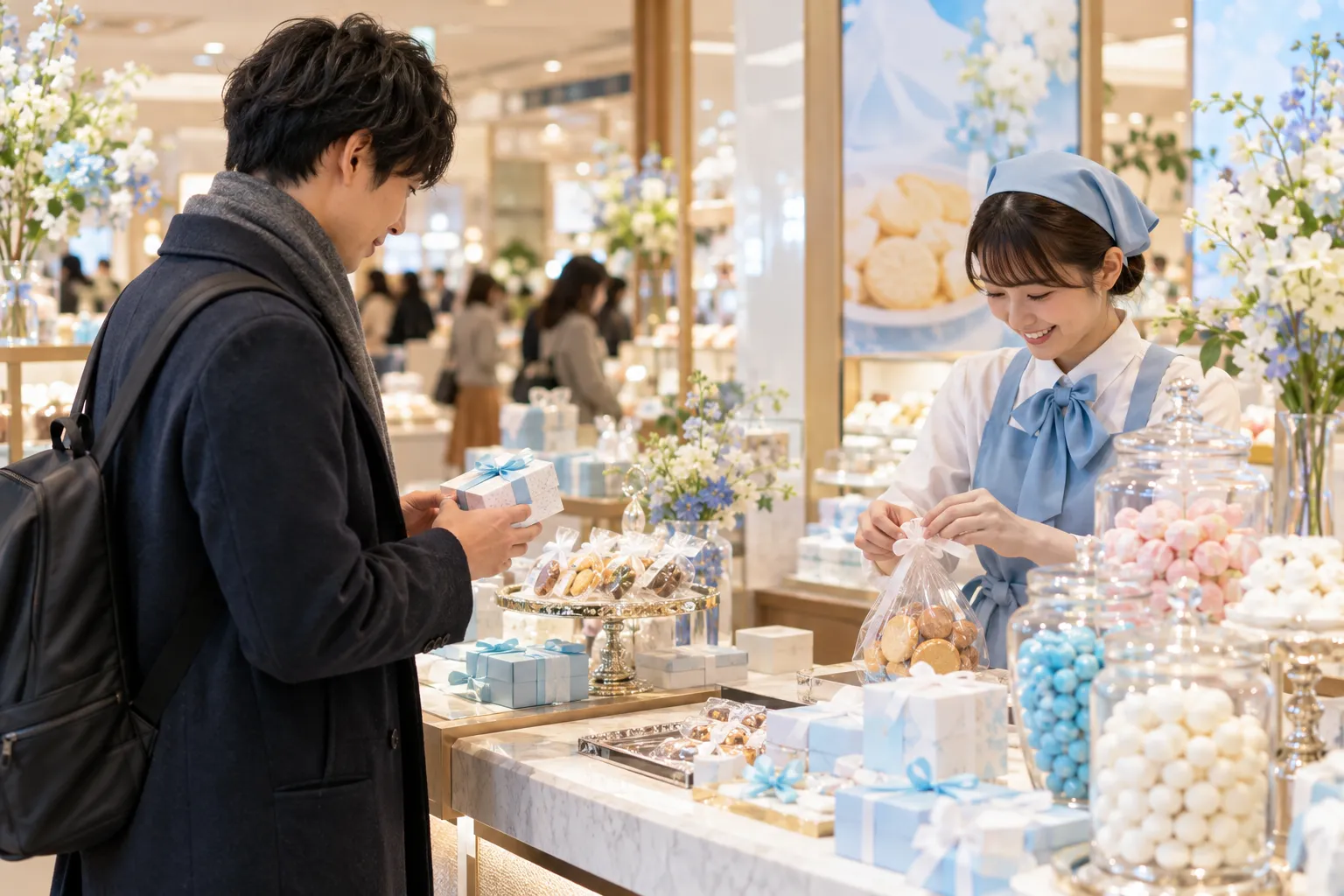
パイの写真とホワイトデーのお菓子の写真を見せ、「同じ3月14日に、アメリカではパイ、日本ではお菓子のお返し」と比べる。写真のお菓子の名前を英語で言わせる(pie, candy, cookies, marshmallows)。
🗣️ In America, children eat pie on March 14. / In Japan, people give candy and cookies. / What's this? Yes, marshmallows!
What do you eat on March 14? — I eat pie. / I eat candy. のやりとりを先生と代表の子で見せたあと、近くの友だち3人とたずね合わせる。
🗣️ What do you eat on March 14? / I eat pie. How about you? / Ask three friends.
パイ・デーとホワイトデーのどちらか好きな方を選び、絵と一言の英語(I like Pi Day! / Happy White Day!)でカードを作らせる。できた子から見せ合う。
🗣️ Which day do you like? / Draw a picture and write one word or sentence. / Show your card to your friend.
March 14
🥧 Pi Day(America)3.14 = three point one four
🍬 White Day(Japan)candy / cookies / marshmallows

What do you eat on March 14?
I eat ___.
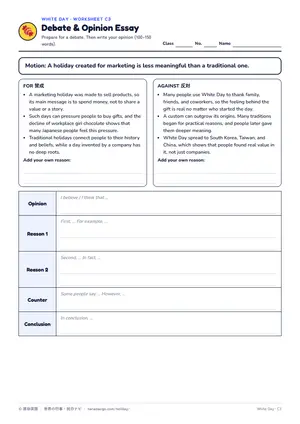
記念日マーケティングを考える(advanced の発展)
🎯 宣伝から生まれた記念日の功罪を、複数の国の例をもとに英語で議論できる。
- advanced の英文を読み、批判派と支持派の主張を英語でまとめる。
- グループで、ホワイトデー・スウィーテスト・デー・韓国の14日など、宣伝発の記念日を1つ選んで調べる。
- その日が「文化」になったと言えるかどうかを、根拠を2つあげて発表する。
- ほかのグループと質疑を行い、最後に自分の意見を150語程度の英文で書く。
詳細版を開く(時間配分・Teacher Talk・板書)
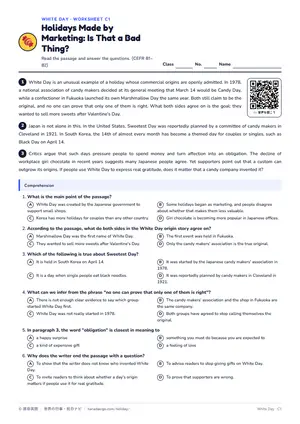
「お菓子会社が作った記念日を、あなたは祝う?」と問い、手を挙げさせる。発展英文の第1段落を読み、ホワイトデーが商業目的を公に認めている珍しい例であることを確認する。
🗣️ Would you celebrate a day made by a candy company? / Read paragraph 1. What makes White Day unusual? / Yes. Its commercial origins are openly admitted.
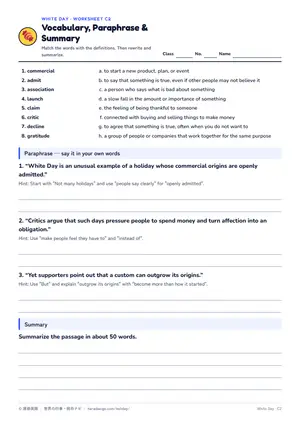
第2・第3段落を読み、批判派(critics)と支持派(supporters)の主張を2列の表に英語でまとめさせる。義理チョコが減っていることを批判派の根拠として本文がどう使っているかを確認する。
🗣️ Read paragraphs 2 and 3. / What do the critics say? What do the supporters say? / How does the decline of giri chocolate support the critics?
グループで宣伝発の記念日を1つ選び(ホワイトデー、スウィーテスト・デー、韓国のブラックデーなど)、端末で調べさせる。「その日は文化になったと言えるか」について、根拠を2つ用意させる。根拠には出典をメモさせる。
🗣️ Choose one day that started as marketing. / Has it become a real part of culture? / Find two reasons. Write down your sources.
各グループ2分で発表し、ほかのグループが質問を1つずつする。先生は「宣伝から始まったこと」と「今の人々の使い方」を分けて考えているかに注目して、問い返す。
🗣️ Please present your group's view. / Any questions for them? / Is that about how it started, or how people use it today?
本文の最後の問い does it matter that a candy company invented it? に対する自分の意見を、150語程度の英文で書かせる。立場・理由2つ・具体例を入れるよう指示し、書き終わらない分は課題にする。
🗣️ Answer the last question in the text. / Write about 150 words. / Include your position, two reasons, and an example.
Holidays Made by Marketing
White Day:1978 candy makers' association → Candy Day / Fukuoka shop → Marshmallow Day
Sweetest Day:1921 Cleveland(reportedly)
Korea:the 14th of almost every month(Black Day = April 14)

Critics:pressure to spend / affection → obligation(giri chocolate ↓)
Supporters:a custom can outgrow its origins

Q. Does it matter that a candy company invented it?