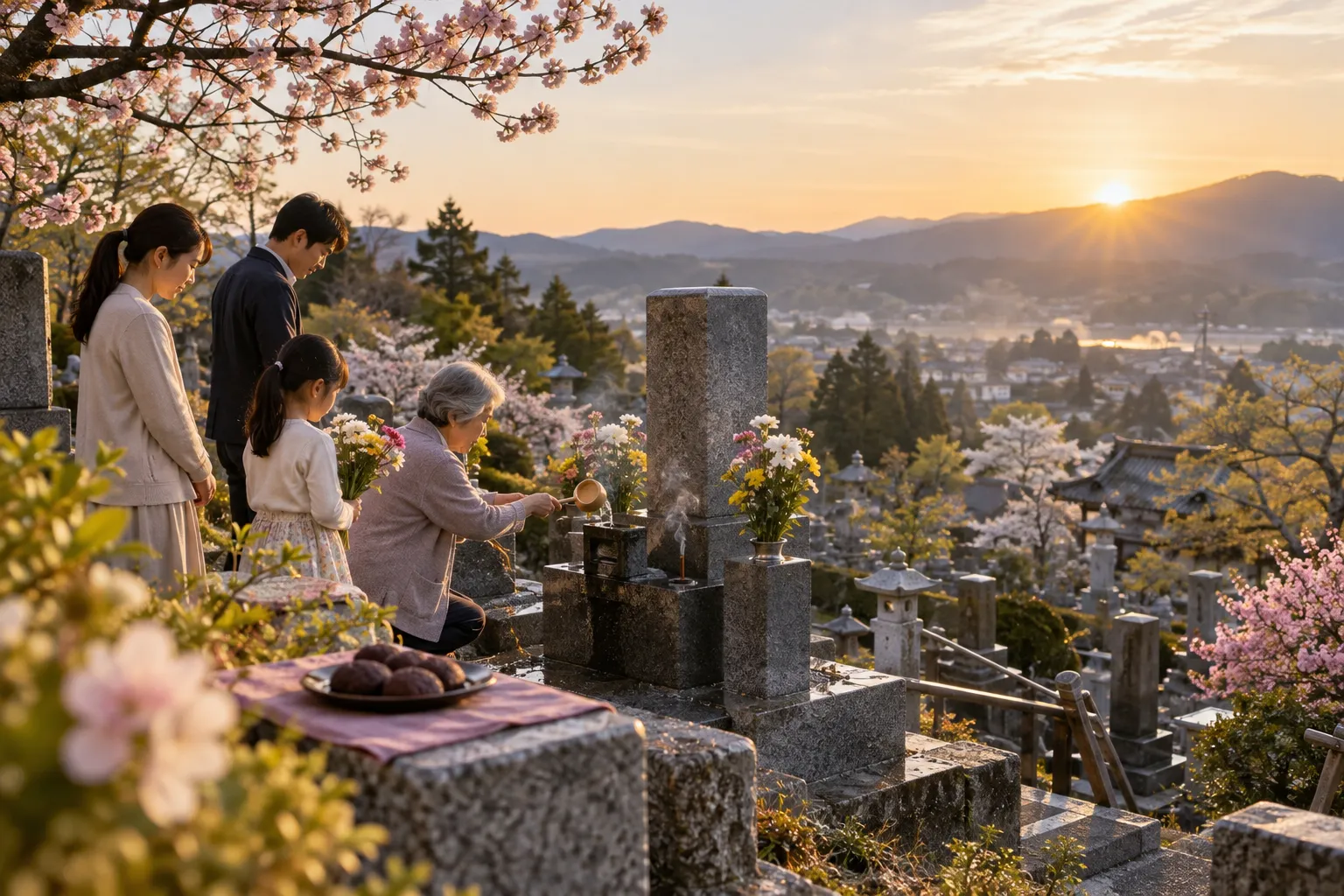
Vernal Equinox Day
春分の日(春のお彼岸)の英語の授業アイデアとワークシート
印刷してすぐ使えるワークシート(PDF・Word・解答つき)と、授業の手順書。
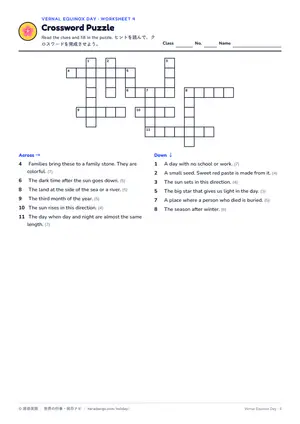
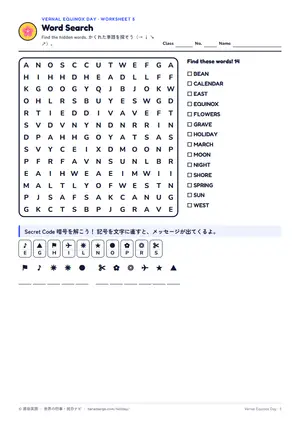
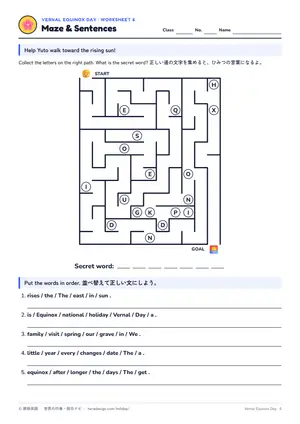
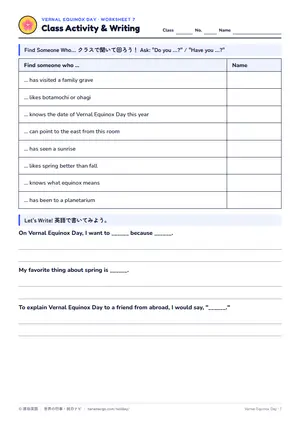
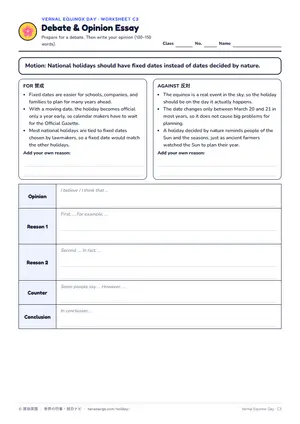
🖨️Worksheetsワークシート(無料・A4)
① 「中身を見る・印刷」で全ページを確認 → ② そのページ上の 🖨️ 印刷する でそのまま印刷できます。A4・無料。
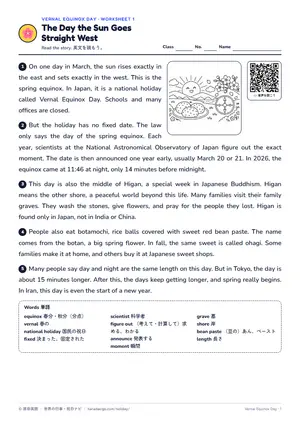
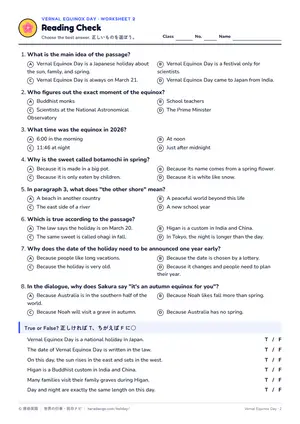
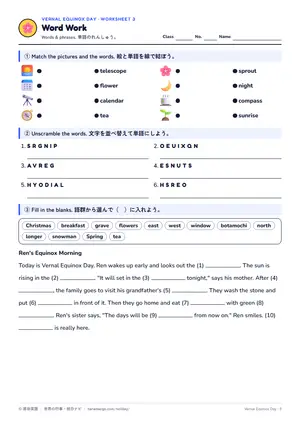
🍎Lesson Ideas春分の日(春のお彼岸)を使った英語の授業アイデア
教室で「真東」を探そう
🎯 方角の英語(east, west, north, south)を、春分の日の太陽と結びつけて覚える。
- east / west / north / south をジェスチャーつきで練習する。
- 方位磁針(compass)で教室の東を確かめ、Point to the east! のゲームをする。
- The sun rises in the east. The sun sets in the west. を声に出して読む。
- 春分の日には太陽が真東からのぼることを伝え、家で朝日を見てみようと声をかける。
詳細版を開く(時間配分・Teacher Talk・板書)
east / west / north / south をジェスチャーつきで練習する(east は右手を横に、west は左手を横に、など教室の向きに合わせて決めておく)。先生が言った方角のジェスチャーを素早くする。
🗣️ Let's learn four directions. / East! West! North! South! / I say a word. You show me the gesture.
方位磁針を見せて compass という言葉を教え、子どもと一緒に教室の東を確かめる。E・W・N・S のカードを壁に貼る。Point to the east! のゲームをし、慣れたら Turn to the west! など動きを変える。
🗣️ This is a compass. Where is east? / Point to the east! / Turn to the west! / Great job. You know the directions.
朝日の写真を東の壁に、夕日の写真を西の壁に貼る。The sun rises in the east. The sun sets in the west. を写真を指しながら全員で声に出して読む。
🗣️ Look. The sun rises in the east. / The sun sets in the west. / Read with me.
「春分の日には、太陽がちょうど真東からのぼって、真西にしずむ」と伝える。家で朝日を見て、どの方角からのぼったか確かめてみようと声をかける。p.6 の迷路を宿題やすきま時間に配る。
🗣️ On Vernal Equinox Day, the sun rises exactly in the east. / Look at the sunrise at home. / Where does the sun rise? Tell me next time.
🧭 compass
   north
west   east
   south

🌅 The sun rises in the east.
🌇 The sun sets in the west.

春分の日:太陽は真東からのぼり、真西にしずむ
春分の日を英語で30秒スピーチ
🎯 本文の表現を使い、日本の祝日を外国の人に30秒で紹介できる。
- 本文を読み、使えそうな文に線を引く(national holiday / visit graves / botamochi など)。
- 「いつ・何をする・おもしろい事実」の3つで原稿を作る。
- ペアで練習し、相手の発表から1つ質問をする。
- 数人が全体で発表し、聞き手は一番おもしろかった事実をメモする。
詳細版を開く(時間配分・Teacher Talk・板書)
英語ページ本文を音声で聞かせる。聞きながら、使えそうな文(national holiday / visit graves / botamochi など)に線を引かせる。
🗣️ Listen and read the text. / Underline useful sentences for your speech. / What did you underline?
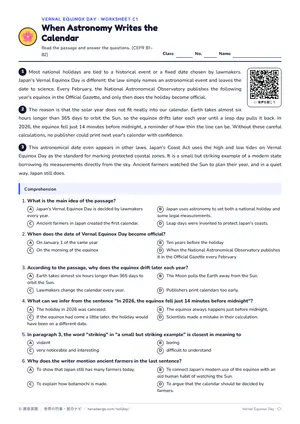
原稿シートの3つの欄に、本文の文を使って原稿を書かせる。「おもしろい事実」は本文から1つ選ばせる(例:In 2026, the equinox came only 14 minutes before midnight. / In Iran, this day is the start of a new year.)。
🗣️ First, when is the holiday? / Second, what do people do? / Third, choose one surprising fact from the text.
ペアで練習させる。1人がタイマーを持って30秒を計り、聞き手は発表のあとに英語で質問を1つする。役割を交代し、もう一度練習する。
🗣️ Practice with your partner. You have 30 seconds. / Listener, ask one question after the speech. / Now change roles.
数人に全体の前で発表させる。聞き手は、一番おもしろかった事実をノートにメモする。最後に何人かにどの事実が印象に残ったかを聞く。
🗣️ Who wants to try in front of the class? / Listeners, write down the most interesting fact. / Which fact did you like best?
My 30-second speech
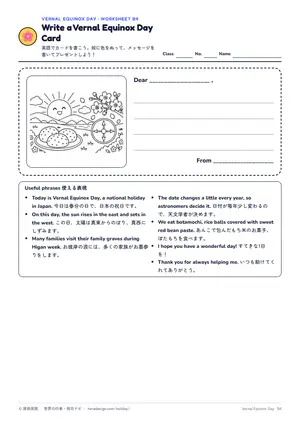
① When? Vernal Equinox Day is a national holiday in March.
② What? Many families visit their family graves. / People eat botamochi.
③ Fun fact! In 2026, the equinox came only 14 minutes before midnight.
 In Iran, this day is the start of a new year.
なぜ日付が変わる?天文学ミニ実験
🎯 地球の公転と暦のずれを英語の簡単な説明とモデルで理解する。
- ボールと電灯で地球と太陽のモデルを作る。
- One year is about 365 days and 6 hours. を確認し、4年で約1日ずれることを計算する。
- 国立天文台の予測から、2025〜2028年の春分の日を表にする。
- The date changes because ~. の形で理由を英語で書く。
詳細版を開く(時間配分・Teacher Talk・板書)
「春分の日は毎年同じ日付?」と聞き、カレンダーで確かめさせる。英語ページ本文の第2段落を聞かせ、But the holiday has no fixed date. の意味を確認する。
🗣️ Is Vernal Equinox Day always on the same date? / Listen. The holiday has no fixed date. / So who decides the date?
電灯を太陽、ボールを地球にして、地球が太陽のまわりを1周する様子を生徒に動かしてもらう。1周にかかる時間が約365日と6時間であることを英語で示す。
🗣️ This light is the Sun. This ball is the Earth. / The Earth goes around the Sun. / One year is about 365 days and 6 hours.
表に1年目6時間、2年目12時間、3年目18時間、4年目24時間とずれを書かせ、4年で約1日ずれることを計算させる。うるう年の2月29日でずれをもどしていることを伝える。
🗣️ After one year, six hours are left over. / After four years, how many hours? / Yes, 24 hours. That's one day. / So we add February 29 every four years.
国立天文台の予測から、2025〜2028年の春分の日の表を完成させる(2025・2026・2028年は3月20日、2027年は3月21日)。2026年は春分の瞬間が23時46分で、あと14分で3月21日だったことを紹介する。
🗣️ Look at the table. Which year is different? / 2027 is March 21. / In 2026, the equinox came only 14 minutes before midnight.
The date changes because ~. の形で理由を英語で1〜2文書かせる。数人に読ませ、よい文を板書する。
🗣️ Why does the date change? Write one or two sentences. / Start with "The date changes because ...." / Read your sentence, please.
Q. Why does the date of Vernal Equinox Day change?

One year = about 365 days and 6 hours
1 year 6 h / 2 years 12 h / 3 years 18 h / 4 years 24 h = 1 day
→ February 29(leap day)

2025 March 20 / 2026 March 20 / 2027 March 21 / 2028 March 20
2026:11:46 p.m.(あと14分で3月21日)

The date changes because ___.
世界の春分ポスター発表
🎯 春分を祝う世界の行事を調べ、日本との共通点と違いを英語で発表できる。
- グループで1つ選ぶ(ノウルーズ、チチェン・イッツァ、イースター、アンコール・ワットなど)。
- When / Where / What do people do? / Why the equinox? の4項目で調べる。
- 日本の春分の日・お彼岸と比べて、共通点と違いを1つずつ書く。
- ポスターを貼り出し、ギャラリーウォーク形式で発表と質問をする。
詳細版を開く(時間配分・Teacher Talk・板書)
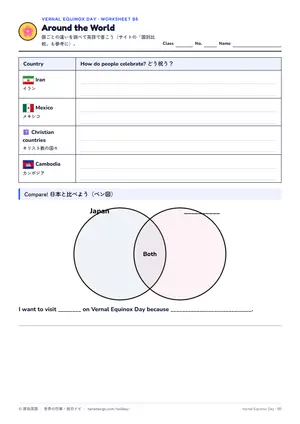
「春分の日、世界では何をしている?」と問う。国比べ表から、イランでは春分が新年ノウルーズであることだけを紹介し、ほかの国も調べようと伝える。
🗣️ What do people do on the spring equinox around the world? / In Iran, the new year starts on the equinox. It's called Nowruz. / Let's find out more.
グループでノウルーズ、チチェン・イッツァ、イースター、アンコール・ワットなどから1つ選ばせ、When / Where / What do people do? / Why the equinox? の4項目で調べさせる。出典をポスターの隅に書くよう指示する。
🗣️ Choose one event in your group. / Find out when, where, what people do, and why the equinox matters. / Write your sources on the poster.
日本の春分の日・お彼岸(お墓参り、ぼたもち、太陽が真東からのぼる)と比べ、共通点と違いを1つずつ英語で書かせる。調べた内容と合わせてポスターを仕上げさせる。
🗣️ Compare your event with Vernal Equinox Day in Japan. / Write one similarity and one difference. / Both ... and .... But ....
ポスターを教室に貼り出し、ギャラリーウォーク形式で発表する。グループの半分が説明役、半分が見て回る役になり、7分で交代する。見て回る生徒は、各ポスターで質問を1つする。
🗣️ Half of your group stays and explains. The other half walks around. / Ask one question at each poster. / Time to change.
「春分を新しい年の始まりにする国が多いのはなぜか」を問い、2〜3人に答えさせる。南半球のオーストラリアでは3月の分点が秋の始まりであることも紹介して終える。
🗣️ Why do many people see the equinox as a new start? / Remember, in Australia, March is the start of fall. / Thank you for your great posters.
The spring equinox around the world
When? / Where? / What do people do? / Why the equinox?

Iran:Nowruz(New Year)
Mexico:Chichen Itza(a snake-like shadow)
Christian countries:Easter(Sunday after the first full moon on or after March 21)
Cambodia:Angkor Wat(sunrise over the central tower)

Both ___ and Vernal Equinox Day ___.
But ___.
祝日と宗教をめぐるディスカッション
🎯 春季皇霊祭から春分の日への変化を題材に、祝日と宗教・国家の関係を英語で議論する。
- history の節と advanced の英文を読み、1878年と1948年の変化を英語で要約する。
- ほかの国の宗教由来の祝日(クリスマス、イードなど)の扱いを調べる。
- Should a modern state keep holidays with religious roots? について賛成・反対に分かれて準備する。
- ディベートのあと、自分の考えを200語程度の英文で書く。
詳細版を開く(時間配分・Teacher Talk・板書)
「春分の日は何のための祝日?」と問い、法律上の趣旨「自然をたたえ、生物をいつくしむ」を示す。一方で多くの人がお墓参りをすることを確認し、法律と実際の過ごし方のずれに目を向けさせる。
🗣️ What is the purpose of Vernal Equinox Day by law? / To praise nature and care for living things. / But what do many people actually do on this day?
歴史の節を読み、1878年(太政官布告で春季皇霊祭として休日に)と1948年(祝日法で春分の日に、宗教色をなくした)の変化を英語で要約させる。発展英文を読み、今の春分の日が天文学で日付を決める祝日であることも確認する。
🗣️ Read the history section. / What happened in 1878? What changed in 1948? / Summarize the change in two or three sentences.
グループで、ほかの国の宗教由来の祝日(クリスマス、イードなど)を1つ選び、その国で祝日としてどう扱われているかを調べさせる。出典をメモさせる。
🗣️ Choose one religious holiday in another country. / Is it a public holiday there? How do people treat it? / Note your sources.
Should a modern state keep holidays with religious roots? について賛成・反対に分かれ、準備5分ののち、立論2分・反論2分ずつでディベートを行う。調べた他国の例を根拠に使うよう促す。
🗣️ Should a modern state keep holidays with religious roots? / You have five minutes to prepare. / Use the examples you found as evidence. / Now, the other side. Please respond.
ディベートをふり返り、どちらの根拠が説得力があったかを短く話し合う。最後に自分の考えを200語程度の英文で書かせる(書き終わらない分は課題)。
🗣️ Which argument was the strongest? Why? / Now write your own view. About 200 words. / Use one example from Japan and one from another country.
Vernal Equinox Day
806 Higan service begins(彼岸会)
1878 春季皇霊祭 → a day off(imperial rites)
1948 Holiday Law → 春分の日
 purpose: to praise nature and care for living things(no religious meaning)
Today: many people visit family graves / the date is set by astronomy

Motion: Should a modern state keep holidays with religious roots?
For / Against evidence: Christmas, Eid, ...