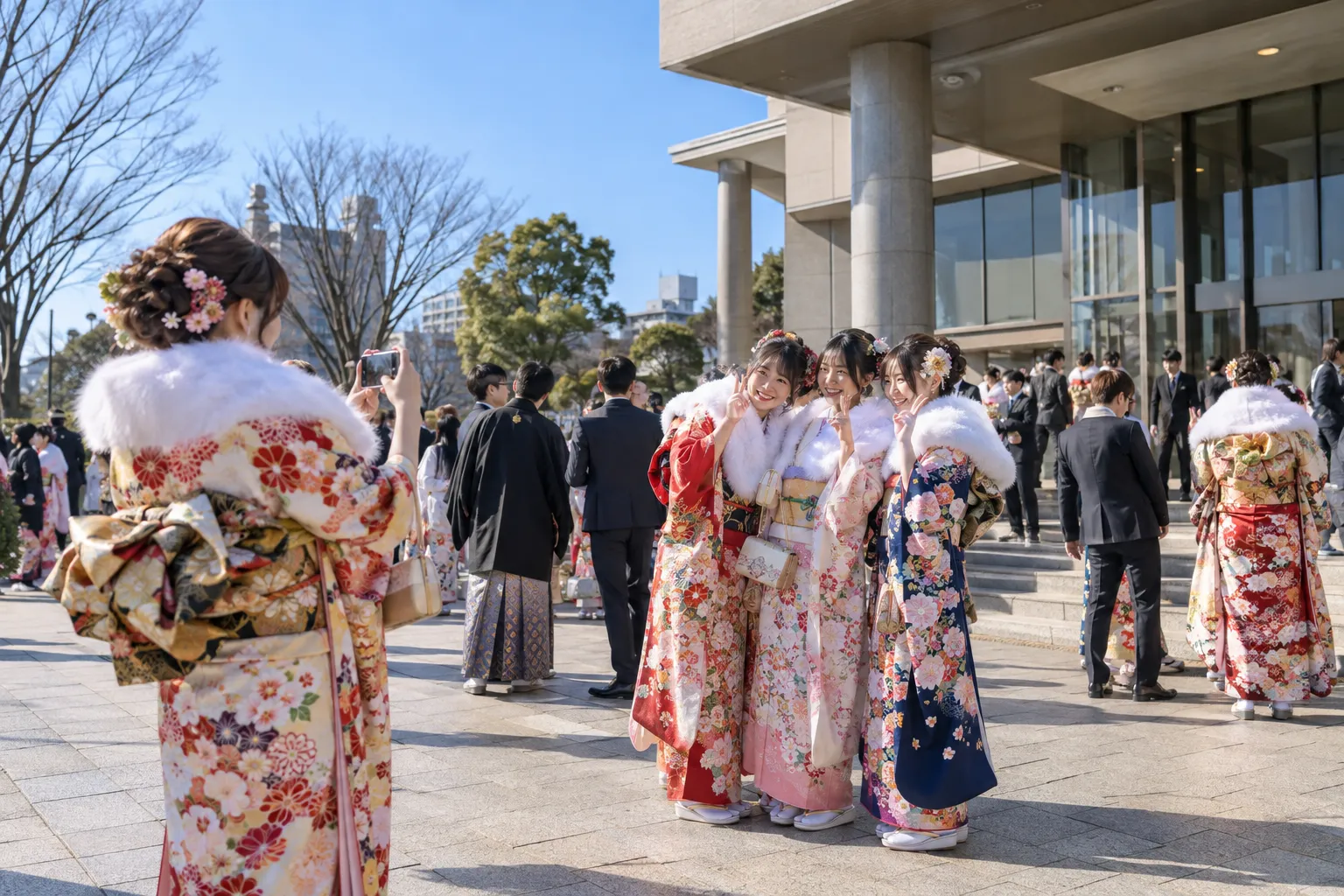
Coming of Age Day
成人の日の英語の授業アイデアとワークシート
印刷してすぐ使えるワークシート(PDF・Word・解答つき)と、授業の手順書。
🖨️Worksheetsワークシート(無料・A4)
① 「中身を見る・印刷」で全ページを確認 → ② そのページ上の 🖨️ 印刷する でそのまま印刷できます。A4・無料。
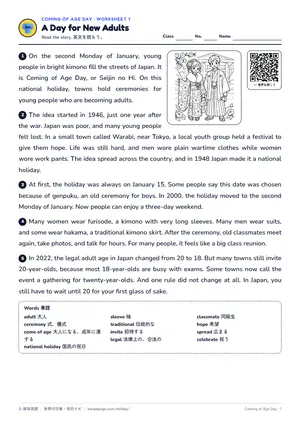
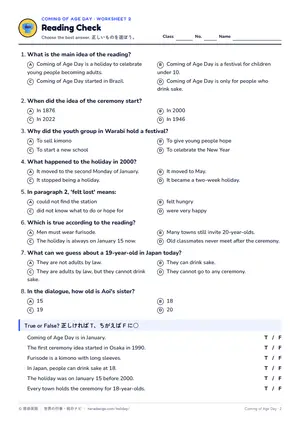
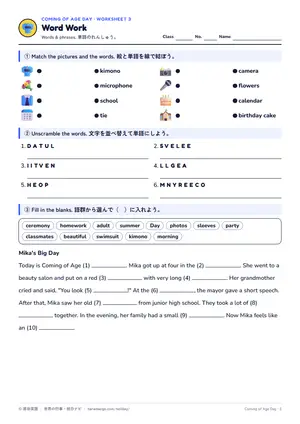
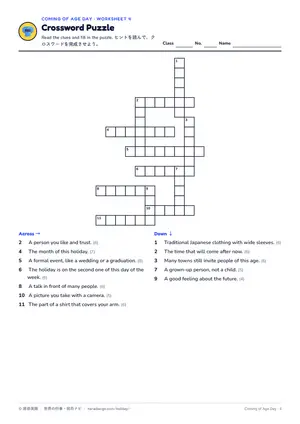
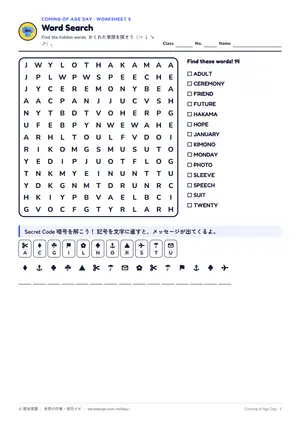
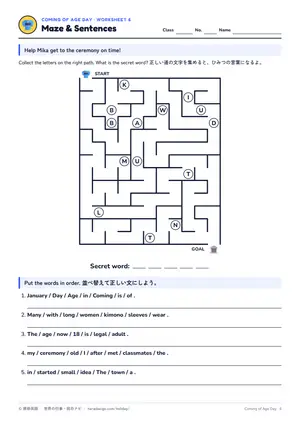
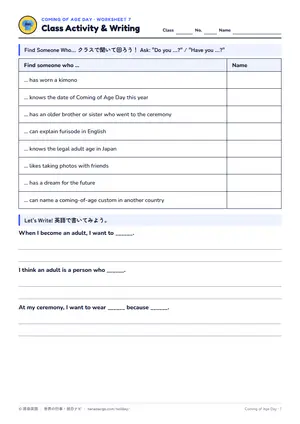
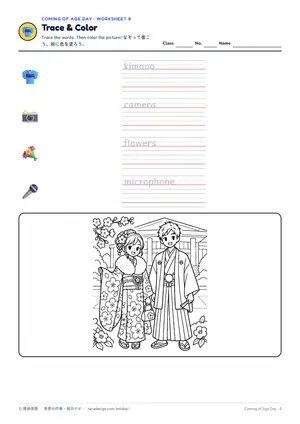
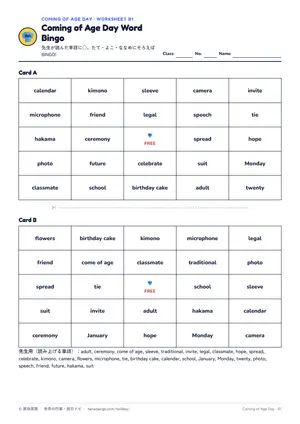
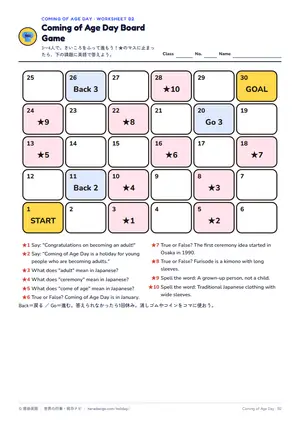
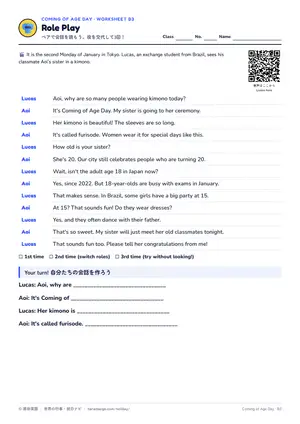
🍎Lesson Ideas成人の日を使った英語の授業アイデア
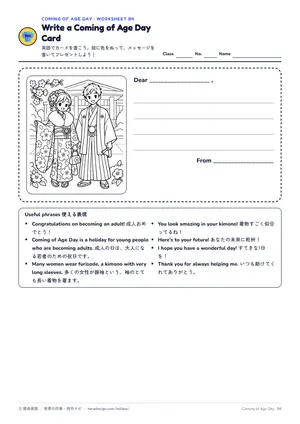
20歳の自分への手紙
🎯 未来形(will / want to)を使って、将来の自分に英語でメッセージを書く。
- 成人の日の写真を見せ、"What will you do at 20?" とクラスに聞く。
- "Dear me at 20, I hope you are ..." の書き出しで、5文の手紙を書く。
- ペアで読み合い、相手の夢に "Good luck!" などひとことコメントを書く。
- 希望者が発表する(封筒に入れて保管しておくのもよい)。
詳細版を開く(時間配分・Teacher Talk・板書)
式典の写真を見せ、本文の第1段落と第4段落を音声で聞かせる。1月の第2月曜日に、大人になる若者を町が祝うこと、式のあとに同級生と再会することを確認する。そのうえで What will you do at 20? とクラスに聞き、何人かに答えさせる。
🗣️ Look at these young people. What are they wearing? / This is Coming of Age Day. Towns celebrate people who are becoming adults. / After the ceremony, old classmates meet again. / What will you do at 20? Any ideas?
先生の見本の手紙を読み聞かせる。1文目 I hope you are ...、2文目 Are you still ...?、3文目 I want to ...、4文目 I will ...、5文目 Please remember ... のように、文ごとの役割を板書で示す。
🗣️ Here is my letter to myself at 20. / Dear me at 20, I hope you are happy. / Are you still playing the guitar? I want to be a teacher. / I will study hard every day. Please remember your dream.
手紙の用紙を配り、型を使って5文の手紙を書かせる。今の自分の好きなこと・夢・がんばっていることを入れるよう声をかける。机間指導で will と want to の使い分けを確かめる。
🗣️ Now write your own letter. Start with Dear me at 20. / Write about your hobbies, your dream, and your hard work now. / Use I want to for your dream. Use I will for your promise. / You have nine minutes.
ペアで手紙を交換して読み合い、相手の手紙の下に Good luck! / You can do it! / Nice dream! などのひとことコメントを書かせる。
🗣️ Exchange letters with your partner. / Read your partner's letter. / Write a short comment. Good luck! You can do it!
希望者2〜3人に手紙を読んでもらう。手紙は封筒に入れて先生が保管するか、家で大切にしまっておくよう伝える。
🗣️ Who wants to read your letter? / Put your letter in the envelope. / Open it when you are 20!
Coming of Age Day(the second Monday of January)

Dear me at 20,
① I hope you are __.
② Are you still __?
③ I want to __.(夢)
④ I will __.(約束)
⑤ Please remember __.
From me at __

Comment:Good luck! / You can do it! / Nice dream!
世界の成人式プレゼン
🎯 ほかの国の成人の習慣を調べ、日本とくらべて英語で発表する。
- グループで、キンセアニェーラ、バル・ミツワー、韓国の成年の日、ナゴルなどから1つ選ぶ。
- 年齢・何をするか・服装・意味の4点を英語でまとめる。
- 日本の成人の日との共通点と違いを1つずつ加える。
- 2分で発表し、聞き手は一番行ってみたいお祝いに投票する。
詳細版を開く(時間配分・Teacher Talk・板書)
英語ページの会話を聞かせ、ブラジルから来たルーカスが話した「15歳のパーティー」を聞き取らせる。「大人になるお祝いの年齢は国や文化でちがう」と伝え、12歳・13歳・15歳・16歳・18歳・19歳などの数字を板書して、どこの習慣か予想させる。
🗣️ Listen to Lucas and Aoi. What happens at 15 in Brazil? / Some girls have a big party and dance with their father. / Look at these ages. Twelve, thirteen, fifteen, sixteen, eighteen, nineteen. / Where do people celebrate at each age? Guess!
グループで担当カードを1枚選び、記事のコピーや信頼できる資料で4点(年齢・何をするか・服装・意味)を調べ、英語でシートにまとめさせる。最後に、日本の成人の日との共通点と違いを1つずつ英語で書かせる。
🗣️ Choose one card for your group. / Find four things: the age, what people do, what they wear, and the meaning. / Then add one thing that is the same as Japan, and one thing that is different. / Use reliable sources.
各グループが2分で発表する。型は In __, young people celebrate __ at the age of __. They __. It is similar to Japan because __, but it is different because __. 聞く側は表にメモを取る。
🗣️ Each group has two minutes. / Start with: In Mexico, girls celebrate their quinceañera at the age of fifteen. / Don't forget the same point and the different point. / Listeners, take notes.
付せんで「いちばん行ってみたいお祝い」に投票させ、何人かに理由を英語で言わせる。最後に、どのお祝いにも共通する「大人になること」の意味を1文で書かせて終わる。
🗣️ Which celebration do you want to join? Put your sticky note on it. / Why did you choose it? / What do all these celebrations have in common? Write one sentence.
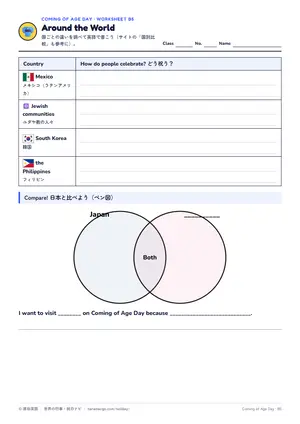
Coming of age around the world

名前 / Age / What they do / Meaning
Quinceañera(Mexico, Latin America)/ 15(girls)/ a dress, church, a waltz with father
Bar Mitzvah・Bat Mitzvah(Jewish)/ 13(boys), 12 or 13(girls)/ read from the Torah in front of people
Korea's Coming-of-Age Day / 19 / the third Monday of May
Naghol(Vanuatu)/ boys / jump from a high tower with vines on their ankles
Debut(Philippines)/ 18(women)/ a party, 18 roses
Japan / 20(the ceremony in most towns)/ furisode, hakama, suits, class reunion

It is similar to Japan because __, but it is different because __.
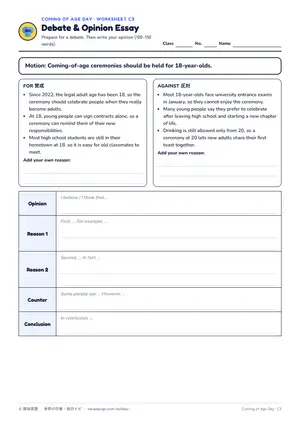
ディベート:成人式は18歳か20歳か
🎯 理由と例をあげて意見を述べる練習をする。
- 本文と advanced を読み、18歳成人で何が変わり、何が変わらなかったかを確認する。
- 18歳派・20歳派に分かれ、理由を3つずつ英語で準備する。
- 立論→質問→反論→まとめの順でディベートを行う。
- 最後に、自分の町への提案を3文で書く。
詳細版を開く(時間配分・Teacher Talk・板書)
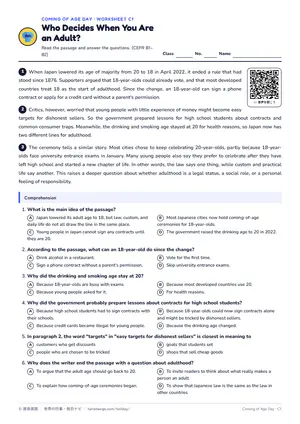
「日本では今、何歳から大人?」と聞き、答えが18と20に分かれるのを確かめる。本文の第5段落を音声で聞かせ、2022年に法律上の大人の年齢が18歳になったのに、多くの町が20歳を祝っていることを確認する。
🗣️ In Japan, how old is an adult now? 18 or 20? / Listen to paragraph five. / The legal adult age became 18 in 2022. / But many towns still invite 20-year-olds. Why?
advanced の英文を読ませ、整理表を埋めさせる。Changed at 18:親の同意なしで携帯電話の契約やクレジットカードの申しこみができる。Still at 20:お酒とたばこ。あわせて、多くの町が20歳を祝う理由(1月は大学入試、高校を卒業してから祝いたい)を確認する。ペアで答え合わせをする。
🗣️ Read the passage. Fill in the table. / What can an 18-year-old do now without a parent's permission? / What is still for 20-year-olds? / Why do most cities still celebrate at 20? Find two reasons.
18歳派・20歳派に分け、論題 Coming-of-age ceremonies should be held for 18-year-olds. について、チームで理由を3つずつ英語で準備させる。理由には本文の事実か、自分たちの生活の具体例を必ずつけさせる。
🗣️ This side says 18. That side says 20. / Prepare three reasons. Each reason needs an example. / Use facts from the passage or examples from your life. / You have eight minutes.
立論(各3分)→ 質問(各2分)→ 作戦タイム(1分)→ 反論(各2分)→ まとめ(各1分)の順でディベートを行う。先生は時間を管理し、本文の事実が正しく使われているかを確かめる。
🗣️ 18 team, you have three minutes. Please begin. / 20 team, ask them one or two questions. / Now the rebuttal. Answer their strongest point. / Last, sum up your ideas in one minute.
ディベートの立場を離れて、自分の町への提案を英語で3文書かせる(例:Our town should hold the ceremony for __-year-olds. This is because __. Also, __.)。何人かに読ませて終わる。
🗣️ Now forget your team. / Write three sentences to your town. / Our town should hold the ceremony for ... This is because ...
Motion: Coming-of-age ceremonies should be held for 18-year-olds.

Changed at 18(April 2022)
・sign a phone contract
・apply for a credit card(without a parent's permission)
Still at 20
・drinking and smoking(for health reasons)

Why most cities still celebrate at 20
・university entrance exams in January
・young people want to celebrate after high school

18 team ⇔ 20 team
Our town should hold the ceremony for __-year-olds. This is because __.
条文を読もう:「祝いはげます」を英訳する
🎯 法律の日本語を読み解き、意味を保ったまま英語に訳す。
- 祝日法の成人の日の条文(e-Gov)を読み、「自覚し」「生き抜こうとする」「祝いはげます」の意味を話し合う。
- 個人で英訳し、グループで訳をくらべる。
- 1948年という時代背景が言葉にどう表れているか、英語で短い感想を書く。
詳細版を開く(時間配分・Teacher Talk・板書)
条文のコピーを配り、声に出して読ませる。「なつた」と大きい「つ」で書かれていることに気づかせ、1948年の法律の書き方がそのまま残っていることを伝える。ほかの祝日の説明と比べ、「はげます」があるのは成人の日だけであることを確認する。
🗣️ Read the text of the law aloud. / Do you notice anything strange about the spelling? / Compare it with New Year's Day. What word appears only here? / Yes, hagemasu. To encourage.
グループで「自覚し」「みずから生き抜こうとする」「祝いはげます」の3つの表現の意味を話し合わせる。だれが、だれを、何のために祝い励ますのかを整理させる。英語ページ本文の第2段落(終戦の翌年、若者に希望を与えるために蕨町の青年団が祭りを開いた)も読み、背景をつかませる。
🗣️ Discuss the three key phrases in your group. / Who celebrates? Who is encouraged? Why? / Read paragraph two. What was Japan like in 1946? / How does that history connect to the word encourage?
個人で条文を英訳させる。そのあとグループで訳を比べ、3つの表現の訳し方(be aware / realize、survive / make one's own way in life、celebrate and encourage など)の違いと、それぞれのニュアンスを話し合わせる。グループで1つの訳を選ぶか、よい部分を組み合わせて模造紙に書かせる。
🗣️ Translate the sentence by yourself first. / Now compare your translations. / Is survive too strong? Is make their own way in life better? / Choose the best parts and write one group translation.
各グループの訳を掲示し、違いを全体で確認する。最後に、1948年という時代背景が「生き抜こうとする」「はげます」という言葉にどう表れているかを、英語で3〜4文の短い感想にまとめさせる。
🗣️ Let's look at all the translations. / Which words show the time after the war? / Write three or four sentences about it in English.
祝日法(1948)成人の日
「おとなになつたことを自覚し、みずから生き抜こうとする青年を祝いはげます。」

自覚し → be aware that ... / realize that ...
みずから生き抜こうとする → try to make their own way in life / try to live on their own strength
祝いはげます → celebrate and encourage
※「はげます」は16の祝日の説明のうち成人の日だけ

背景:1946 Warabi(after the war)→ a festival to give young people hope

訳例:to celebrate and encourage young people who realize they have become adults and who try to make their own way in life