
Pi Day
円周率の日(パイ・デー)の英語の授業アイデアとワークシート
印刷してすぐ使えるワークシート(PDF・Word・解答つき)と、授業の手順書。
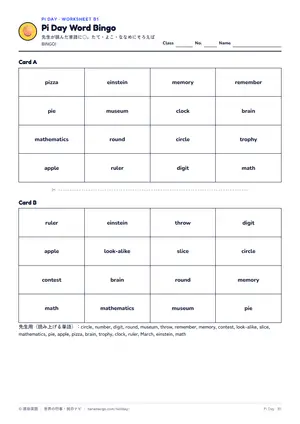
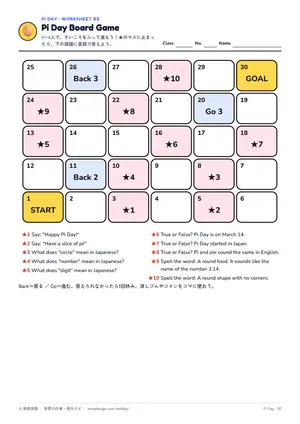
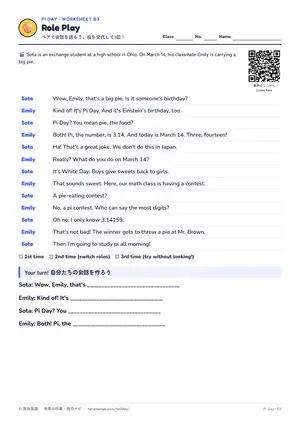
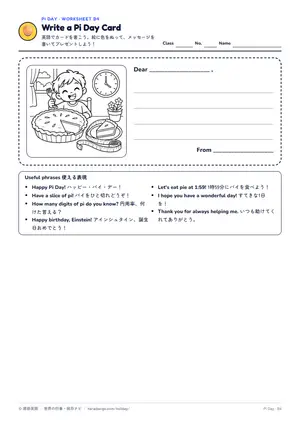
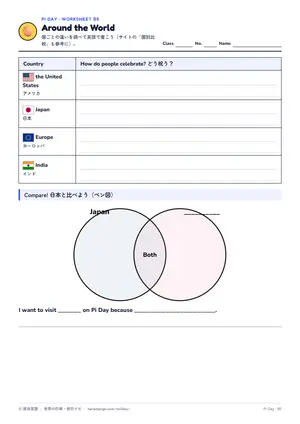
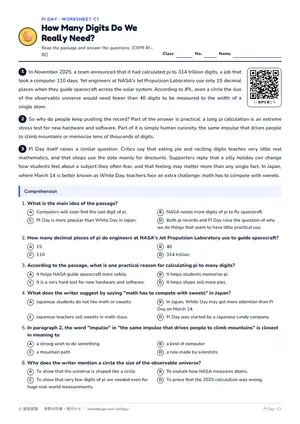
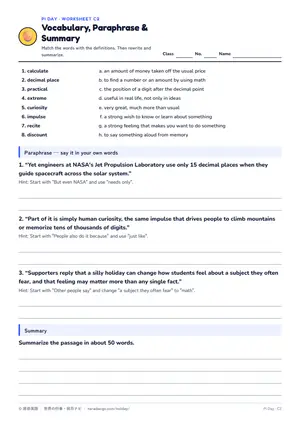
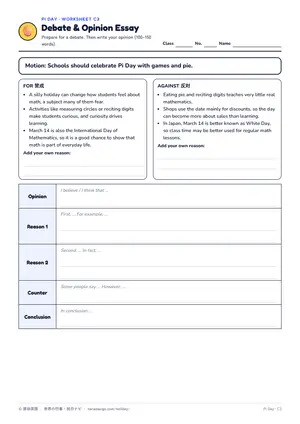
🖨️Worksheetsワークシート(無料・A4)
① 「中身を見る・印刷」で全ページを確認 → ② そのページ上の 🖨️ 印刷する でそのまま印刷できます。A4・無料。
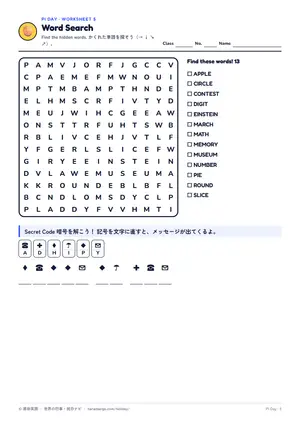
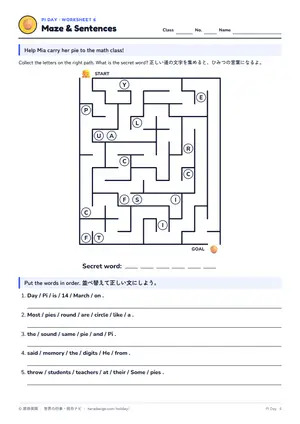
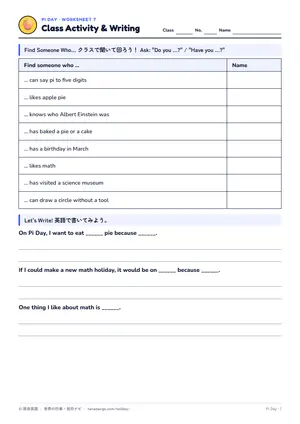
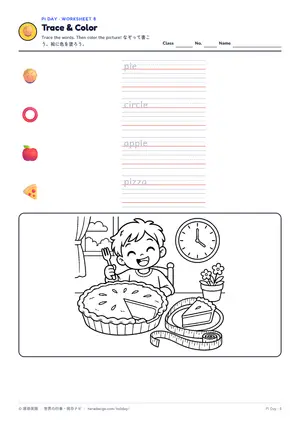
🍎Lesson Ideas円周率の日(パイ・デー)を使った英語の授業アイデア
ひもで円周率を見つけよう
🎯 身近な円で円周率がいつも約3.14になることを体験し、英語で結果を言う。
- 班ごとに皿・缶・テープなど丸い物を3つ用意し、ひもで円周を、定規で直径を測る。
- 円周÷直径を計算し、表に書く。
- The circle is ___ cm around. It is ___ cm across. The answer is about 3.1. と英語で発表する。
- どの班もほぼ同じ数になった理由をクラスで話し合う。
詳細版を開く(時間配分・Teacher Talk・板書)
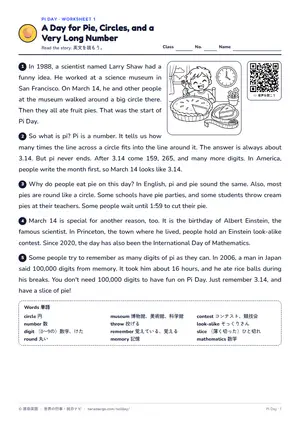
英語ページ本文の第2段落を聞かせ、Pi is a number. It tells us how many times the line across a circle fits into the line around it. の部分を確かめる。黒板に円をかき、around(円周)と across(直径)を指で示す。
🗣️ Listen. What is pi? / This is the line around the circle. This is the line across it. / How many times does across fit into around? Let's find out.
班で3つの丸い物の円周をひもで、直径を定規で測らせ、記録表に書かせる。ひもは物にぴったり巻きつけ、印をつけてから定規で測るよう手本を見せる。
🗣️ Wrap the string around the plate. Mark it. / Now measure the string with the ruler. / Then measure across the plate. Write the numbers.
電卓で around ÷ across を計算させる。各班に1つ選ばせ、The circle is 〜 cm around. It is 〜 cm across. The answer is about 3.1. の形で英語で発表させる。結果を黒板の表に書き込んでいく。
🗣️ Divide around by across. Use the calculator. / Tell us one result. The plate is 72 cm around. It is 23 cm across. / The answer is about 3.1. Great!
黒板の表を見て「大きさがちがうのに、なぜどの班もほぼ同じ数?」と問い、クラスで話し合う。どんな円でも同じ数になり、それが π(約3.14)であること、終わらずに続く数であることを確かめる。
🗣️ Look at the table. Big circles, small circles. The answer is always about 3.1. / Why? Talk with your group. / This number is pi. It is about 3.14, and it never ends.
π = around ÷ across

around(円周)  across(直径)

物 / around / across / around ÷ across
plate / 72 cm / 23 cm / about 3.1
(班の結果を書きこむ)

The circle is __ cm around.
It is __ cm across.
The answer is about __.

π = 3.14159265...(never ends)
円周率暗唱バトル:語呂合わせ vs 英語の文字数
🎯 日本語の語呂合わせと英語の piem(文字数で覚える文)を比べ、言語の特徴に気づく。
- 「産医師異国に向こう」と How I want a drink... を紹介し、それぞれ何けたをあらわすか確かめる。
- 班で、英語の単語の文字数が 3-1-4-1-5-9 になる文を自作する。
- できた文を発表し、いちばん自然な文に投票する。
- 語呂合わせと文字数方式、どちらが覚えやすいか理由を英語で1文書く。
詳細版を開く(時間配分・Teacher Talk・板書)
「産医師異国に向こう」を見せ、どの音がどの数字になっているかを確かめる(さん=3、い=1、し=4…)。続けて How I want a drink を見せ、単語の文字数を数えさせて 3-1-4-1-5 になっていることに気づかせる。
🗣️ In Japanese, we remember pi with sounds. San, i, shi, i, ko ... / In English, people count letters. Look at this sentence. How I want a drink. / Count the letters in each word. How, three. I, one. Want, four ... / So it means 3.1415!
班で、英語の単語の文字数が 3-1-4-1-5-9 になる文を作らせる。意味の通る文になるよう、主語と動詞を意識させる。辞書の使用は自由。最初の3語(3-1-4)だけ決めてから続けるとよいと助言する。
🗣️ Make your own sentence. Three letters, one letter, four letters, one, five, nine. / Start with three letters. Can, Yes, The ... / One letter? I or a. / Nine letters is hard. Use your dictionary!
各班が文を発表し、ほかの班が文字数を数えて確かめる。いちばん自然な文に投票させる。
🗣️ Read your sentence. Everyone, count the letters. / Is it 3, 1, 4, 1, 5, 9? Good! / Now vote for the most natural sentence.
語呂合わせと文字数方式のどちらが覚えやすいかを、理由とともに英語で1文書かせる(I think the Japanese way is easier because Japanese has many ways to read numbers.)。何人かに発表させる。
🗣️ Which way is easier, the Japanese way or the English way? / Write one sentence with because. / Why can Japanese use sounds so easily?
π = 3.14159265...

日本語:産医師異国に向こう
さん(3) い(1) し(4) い(1) こ(5) く(9) に(2) む(6) こう(5)

English:How(3) I(1) want(4) a(1) drink(5) ...

Our sentence:__(3) _(1) __(4) _(1) __(5) __(9)

I think the __ way is easier because __.
そっくりさん自己紹介:もしも私がアインシュタインなら
🎯 人物になりきって、過去形で自己紹介する。
- アインシュタインの基本情報(1879年3月14日生まれ、プリンストンに住んだ等)を英語カードで配る。
- I was born on March 14, 1879. のように一人称で3文の自己紹介を作る。
- 小物(白いかつらの絵など)を使ってペアで発表する。
- 聞き手は英語で質問を1つする(What is your favorite food? など)。
詳細版を開く(時間配分・Teacher Talk・板書)
英語ページ本文の第4段落を聞かせ、3月14日がアインシュタインの誕生日で、彼が住んだプリンストンではそっくりさんコンテストがあることを確かめる。先生が小物を持ってアインシュタインになりきり、自己紹介をして見せる。
🗣️ March 14 is Einstein's birthday. / In Princeton, people hold an Einstein look-alike contest. / Hello. I'm Albert Einstein. I was born on March 14, 1879.
英語カードを配り、一人称の過去形で3文の自己紹介を作らせる(I was born in Germany. / I lived in Princeton. / I won the 1921 Nobel Prize in Physics.)。he → I、was / lived / won の形を確かめる。
🗣️ Use the card. Make three sentences about yourself, as Einstein. / Change he to I. He was born → I was born. / I lived in Princeton. I won the 1921 Nobel Prize in Physics.
ペアで小物を顔の前に持ち、なりきって自己紹介をさせる。聞き手は英語で質問を1つする(What is your favorite food? / Do you like pie?)。カードにない質問には、自由に想像して答えてよいとする。役を交代する。
🗣️ Hold the wig picture. Introduce yourself. / Partner, ask one question. Do you like pie? / You can use your imagination to answer. / Now change roles.
いちばん「なりきっていた」人を全員で選び、拍手する。was born / lived / won の過去形をもう一度確かめて終わる。
🗣️ Who was the best Einstein? / Remember: I was born, I lived, I won. Happy Pi Day!
Albert Einstein(born March 14, 1879)

I was born on March 14, 1879, in Germany.
I lived in Princeton.
I won the 1921 Nobel Prize in Physics.

be born → was born / live → lived / win → won

Question:What is your favorite food? / Do you like pie?
ファクトチェック講座:「円周率は3」はなぜ広まった?
🎯 うわさが広まるしくみを、実例をもとに分析する。
- 「ゆとり教育で円周率は3になった」という話を示し、知っていたか挙手させる。
- 当時の学習指導要領の記述(3.14 とする/目的に応じて3を用いる)と塾の広告の関係を資料で読む。
- インディアナ州の円周率法案やファインマン・ポイントの話と比べ、共通点を班で話し合う。
- 「なぜ数学のうわさは広まりやすいか」を英語で150語にまとめる。
詳細版を開く(時間配分・Teacher Talk・板書)
「ゆとり教育で円周率は3になった」という話を示し、聞いたことがあるか挙手させる。「本当だと思う人?」と聞いてから、今日の資料で確かめることを伝える。
🗣️ Have you heard this? Pi became 3 in Japanese schools. / Raise your hand if you think it's true. / Today, we will check the facts.
資料1を読ませ、学習指導要領の実際の記述と塾の広告・報道の関係を分析シートにまとめさせる。2003年の東京大学の入試問題(円周率が3.05より大きいことを証明せよ)の意図も考えさせる。
🗣️ Read the first handout. What did the official course of study actually say? / Where did the rumor start? / Why did the media spread it so quickly? / Why do you think the University of Tokyo asked that question in 2003?
班で資料2・3を読ませ、資料1と比べて共通点を話し合わせる(「半分本当」の話が単純化される、権威のある名前が付く、話としておもしろい など)。advanced の英文第3段落の批判と支持の意見も参考にさせる。
🗣️ Read the other two stories. Indiana and the Feynman point. / What do the three stories have in common? / Is each story completely false, or half true? / Why are simple stories easier to share?
Why do math rumors spread so easily? について、150語の英文を書かせる(10分)。3つの例のうち2つ以上を根拠に使うことを条件にする。残りの5分でペアで読み合い、根拠の使い方にコメントさせる。
🗣️ Write 150 words. Why do math rumors spread so easily? / Use at least two examples from today. / Now swap with your partner. Did they use the evidence well?
Fact Check:Why do math rumors spread?

① 日本「円周率は3」
1999 塾の広告 → マスコミ → 「ゆとり」の象徴
事実:学習指導要領は 3.14(目的に応じて3も可)
2003 東大:Prove that pi is greater than 3.05.

② Indiana 1897:House passed → Senate postponed(pi = 3.2 になる計算法、"pi" という語はない)

③ Feynman point(762nd decimal place, 999999):oldest record 1985, another writer

共通点:half true / simple / a famous name / a funny story