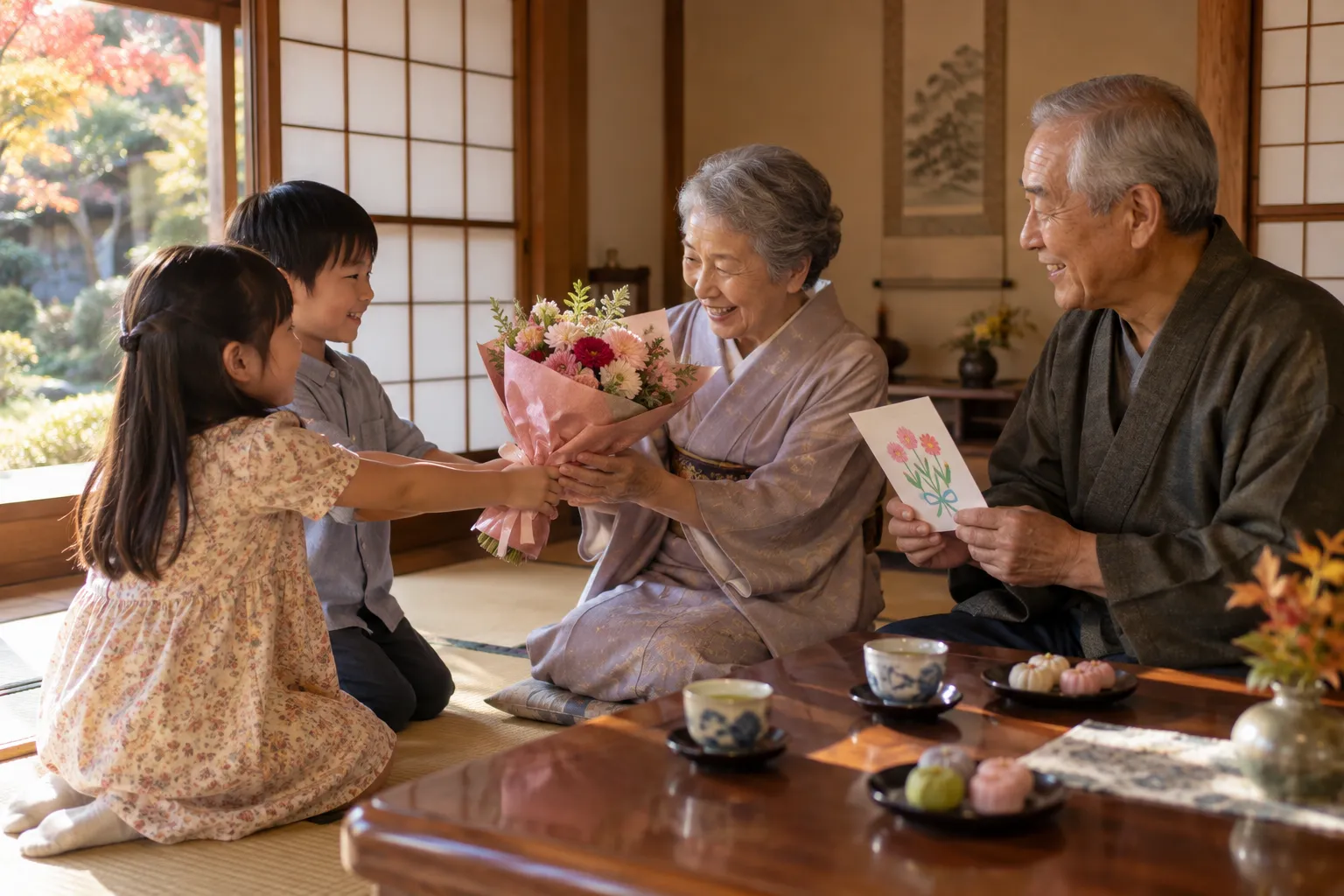
Respect for the Aged Day
敬老の日の英語の授業アイデアとワークシート
印刷してすぐ使えるワークシート(PDF・Word・解答つき)と、授業の手順書。
🖨️Worksheetsワークシート(無料・A4)
① 「中身を見る・印刷」で全ページを確認 → ② そのページ上の 🖨️ 印刷する でそのまま印刷できます。A4・無料。
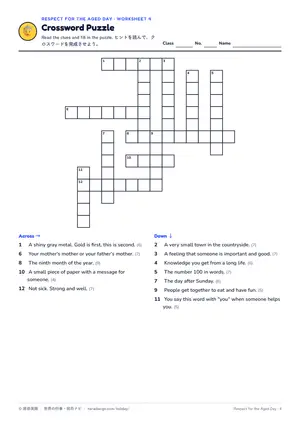
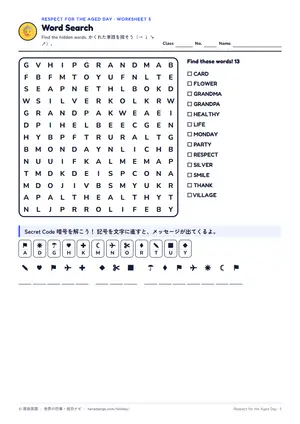
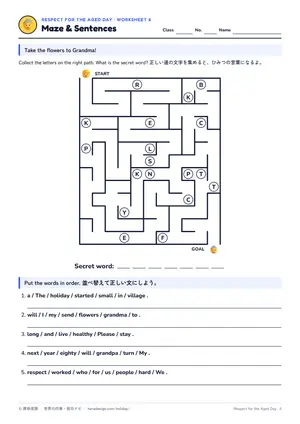
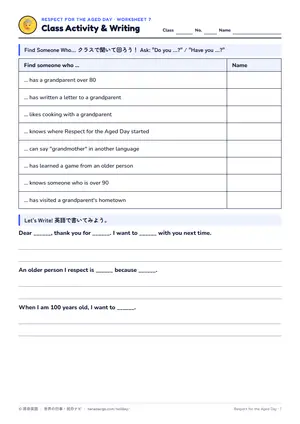
🍎Lesson Ideas敬老の日を使った英語の授業アイデア
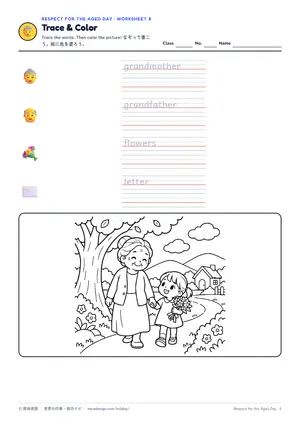
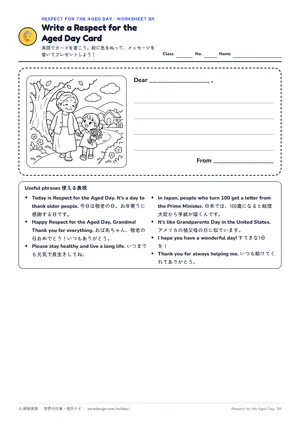
英語で「ありがとうカード」を書こう
🎯 祖父母や身近なお年寄りへの感謝を、英語の短いカードで伝える。
- Thank you for ___ing. / Please stay healthy. などの表現を確認する。
- 相手を1人決め、思い出を1つ選んで3〜4文のメッセージを書く。
- ペアで読み合い、よい表現に線を引いてあげる。
- カードに絵を添えて完成させ、敬老の日に渡す(郵送する)よう勧める。
詳細版を開く(時間配分・Teacher Talk・板書)
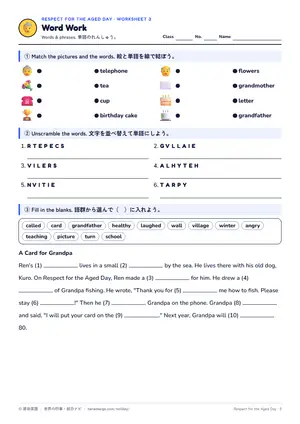
先生の見本カードを読み上げ、絵を見せる。基本セット p.3 の穴埋めの話(Ren が漁の好きな祖父にカードを書く)を音読し、Thank you for teaching me how to fish. の文に線を引かせる。「今日は自分のカードを書く」と伝える。
🗣️ This is my card for my grandmother. Let me read it. / Dear Grandma, thank you for teaching me how to cook rice. / Read Ren's story. Find the thank-you sentence. / Today, you will write your own card.
表現カードを黒板に貼り、Thank you for のあとは ___ing(動詞のing形)か名詞が来ることを示す(Thank you for teaching me. / Thank you for the delicious cake.)。相手を1人決めさせ、その人との思い出を1つメモさせる(一緒にしたこと・教わったこと・作ってもらったもの)。
🗣️ After thank you for, we use an ing word. Thank you for teaching me. / We can also use a thing. Thank you for the delicious cake. / Choose one person. A grandparent, or an older person you know. / Write down one memory with that person.
Dear ___, で始め、感謝の文・思い出の文・お願いや約束の文を入れて3〜4文のメッセージを書かせる。型を板書する(Dear ___, / Thank you for ___ing. / I like ___ with you. / Please stay healthy. / Love, ___)。机間指導で ing の形やつづりを確認する。
🗣️ Start with Dear Grandpa or Dear Mrs. Tanaka. / Write three or four sentences. / End with Please stay healthy. Then write your name. / Raise your hand if you need a word.
ペアでカードを読み合い、相手のカードのよい表現に線を引いてあげる。聞いた人は I like this sentence. と一言伝える。気づいたつづりのまちがいは鉛筆で小さく印をつける程度にする。
🗣️ Read your card to your partner. / Draw a line under a sentence you like. / Tell your partner, I like this sentence. / Now change roles.
絵を添えて家で仕上げるよう伝える。敬老の日(9月の第3月曜日)に手渡すか、遠くに住んでいる人には郵送するよう勧める。
🗣️ Draw a picture at home and finish your card. / Give it on Respect for the Aged Day, or send it by mail. / Your card will make someone very happy.
Respect for the Aged Day(9月の第3月曜日)

Dear __,
  Thank you for __ing.  (teaching me / cooking / playing with me)
  Thank you for the __.  (cake / sweater)
  I like __ with you.
  Please stay healthy.
  I want to __ with you next time.
Love, __

ペアで:I like this sentence.
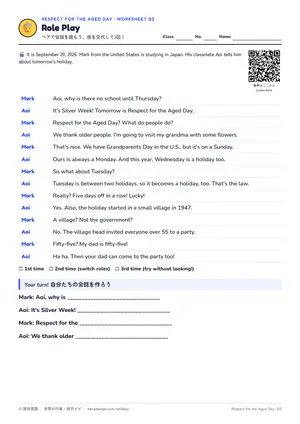
1947年の村長にインタビュー(ロールプレイ)
🎯 本文の内容を使って、過去形の質問と答えで敬老の日の始まりを再現する。
- 記者役と村長役に分かれ、When / Why / Who / How の質問を英語で準備する。
- 村長役は本文の情報(日付・55歳・三輪トラック・9月の理由)を使って答える。
- 役を交代し、最後に記者役が30秒のニュース原稿にまとめて読み上げる。
詳細版を開く(時間配分・Teacher Talk・板書)
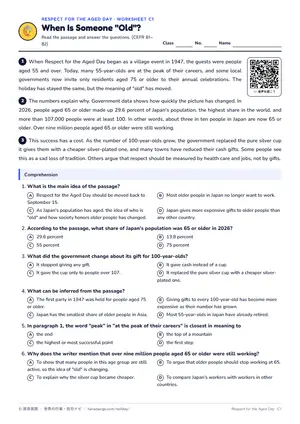
「敬老の日は国が始めた?」と聞き、予想を聞く。英語ページ本文の第1〜3段落を音声で聞かせ、1947年に兵庫県の山あいの村(野間谷村)で村長の門脇政夫さんが開いた敬老会が始まりだったことを確認する。
🗣️ Who started Respect for the Aged Day? The government? / Listen to paragraphs 1 to 3. / It started in a small village in Hyogo in 1947. / The village head, Kadowaki Masao, had the idea.
ペアで記者役と村長役に分かれる。記者役は When / Why / Who / How を使った過去形の質問を4つ以上作る(When did you hold the first party? / Who did you invite?)。村長役は本文から答えの材料(9月15日、55歳以上、三輪トラック、戦争のあとで親たちが疲れていた、農作業がひと段落・気候がよい)を探してメモする。
🗣️ A is a news reporter. B is the village head in 1947. / Reporters, make four questions in the past tense. When did you hold the party? / Village heads, find the answers in the text. / Why September? Find the reason in paragraph 2.
インタビューを行う(3分)。記者役はメモを取りながら聞く。村長役は I wanted to thank them for their long, hard work. のように、本文の表現を一人称に直して答える。役を交代してもう一度行う。早く終わったペアは追加の質問(How did the guests get to the hall?)に挑戦させる。
🗣️ Reporters, start the interview. Take notes. / Village heads, answer as Kadowaki. Use I and we. / Try this question too. How did the guests get to the hall? / Now switch roles.
記者役のメモをもとに、30秒のニュース原稿を書かせる(This is ___ News. On September 15, 1947, ...)。数人に読み上げさせる。最後に、この村の行事が広がって1966年に国民の祝日になり、2003年から9月の第3月曜日になったことを確認する。
🗣️ Write a 30-second news report from your notes. / Start like this: This is Hyogo News. On September 15, 1947, ... / Who wants to read their report? / The idea spread, and it became a national holiday in 1966.
Interview with the village head(1947)

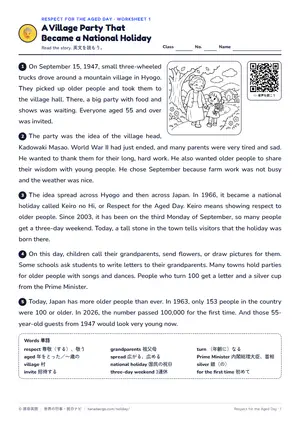
When did you hold the first party?  → On September 15, 1947.
Who did you invite?  → Everyone aged 55 and over.
How did they get to the hall?  → By three-wheeled trucks.
Why did you start it?  → I wanted to thank them for their long, hard work.
Why September?  → Farm work was not busy, and the weather was nice.

News: This is __ News. On September 15, 1947, ...
→ 1966 national holiday → 2003〜 the third Monday of September
グラフで読む高齢社会
🎯 100歳以上人口の変化(1963年153人→2026年10万7,677人)を英語で説明する。
- 100歳以上の人数の推移(1963年・1981年・1998年・2012年・2026年)を折れ線グラフにする。
- increase / double / pass ___ for the first time などのグラフ表現を学ぶ。
- ペアでグラフを3文の英語で説明し、その理由を予想して話し合う。
詳細版を開く(時間配分・Teacher Talk・板書)
「1963年、日本に100歳以上の人は何人いた?」とクイズを出す(A:153人、B:1,500人、C:1万5,000人)。答えは153人。続けて「2026年は?」と聞き、10万7,677人で初めて10万人をこえたことを伝え、約700倍になったことに注目させる。
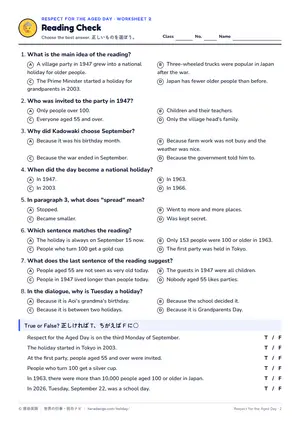
🗣️ In 1963, how many people in Japan were 100 or older? / A, 153. B, 1,500. C, 15,000. / The answer is A. Only 153 people. / In 2026, the number was 107,677. That's about 700 times more!
表を配り、ペアで折れ線グラフをかかせる。1981年・1998年・2012年は「こえた」年なので、その年は1,000人・1万人・5万人の位置に点を打つと伝える。縦軸の目盛り(0〜11万人)と横軸(1960〜2030年)の取り方を板書で示す。
🗣️ Make a line graph with your partner. / In 1981, the number passed 1,000. Put a dot at 1,000. / The vertical line shows the number of people. The horizontal line shows the year. / What does the line look like?
グラフ表現のカードを使い、例文を板書する(The number increased from 153 in 1963 to 107,677 in 2026. / In 2026, it passed 100,000 for the first time. / It rose sharply after 1998.)。全員で音読し、ペアで1文ずつ言い合って練習させる。
🗣️ The number increased from 153 in 1963 to 107,677 in 2026. / In 2026, it passed 100,000 for the first time. / Look at the line after 1998. It rose sharply. / Point at your graph and say one sentence each.
ペアでグラフを英語3文で説明する文を書かせ、続けて「なぜこんなに増えたのか」を予想して話し合わせる(医療・食事・生活の変化など。I think it is because ___.)。そのあと、発展セット第2段落の数字(2026年、65歳以上が29.6%で世界でいちばん高い、900万人以上が働いている)を紹介する。
🗣️ Write three sentences about your graph. / Why did the number grow so fast? Talk with your partner. / I think it is because medical care got better. / In 2026, 29.6 percent of people in Japan were 65 or older. That's the highest in the world.
2〜3組にグラフを見せながら3文を発表させる。最後に「1947年の最初の敬老会は55歳以上が対象だった」ことを伝え、「今、お年寄りは何歳から?」と問いかけて次時につなぐ。
🗣️ Show your graph and read your three sentences. / In 1947, the first party was for people aged 55 and over. / Today, when does a person become old? Think about it for next class.
People aged 100 or older in Japan

1963   153
1981   1,000 をこえる
1998   10,000 をこえる
2012   50,000 をこえる
2026   107,677(初めて10万人をこえる・約700倍)

The number increased from 153 to 107,677.
In 2026, it passed 100,000 for the first time.
It rose sharply after 1998.
I think it is because __.

65歳以上:29.6%(2026)→ about 3 in 10 people
世界の敬老の日 比べっこ
🎯 各国の高齢者・祖父母の日を比べ、贈り物や祝い方に表れる文化の違いを考える。
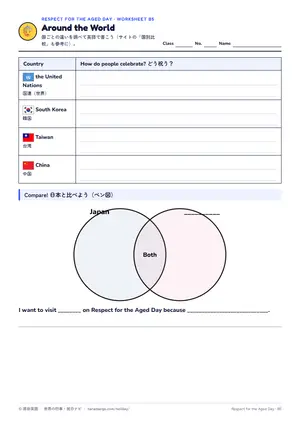
- 国別比べの表から担当国を決め、日付・始まり・贈り物を英語でまとめる。
- 日本の銀杯と韓国のつえのように、象徴的な贈り物を比べる。
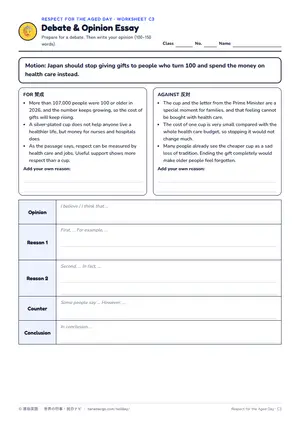
- "How should a society show respect for older people?" について150語の意見文を書く。
詳細版を開く(時間配分・Teacher Talk・板書)
日本で100歳になる人に総理大臣から贈られる銀杯の写真と、韓国で100歳の人に贈られるつえの写真を並べて見せ、「どちらがどこの国の贈り物?」と聞く。国ごとに祝い方が違うことを示し、担当の国を学生に割りふる。
🗣️ Look at these two gifts for people who turn 100. / One is from Japan. One is from South Korea. Which is which? / The silver cup is from Japan. The walking stick is from Korea. / Each of you will research one country's day for older people.
国別比べの表をもとに、担当国の日付・始まり・贈り物(または祝い方)を英語でまとめさせる。表にない情報は信頼できる資料で確かめ、出典を1つ書かせる。たとえばアメリカの祖父母の日は1978年にカーター大統領が宣言し、公式の花はわすれな草、など具体的な細部を入れさせる。
🗣️ Write the date, the beginning, and the gift or custom. / For example, the U.S. has Grandparents Day. President Carter declared it in 1978. / Its flower is the forget-me-not. / Check one reliable source and write it down.
4〜5人のグループで発表し合い、B5 国比べの表に記入する。続けて「象徴的な贈り物」に注目させ、日本の銀杯と韓国のつえが何を表すか(長寿のお祝い・実際の生活の支え)を比べて話し合わせる。発展セット第3段落の、銀杯が純銀から銀メッキに変わった話も紹介する。
🗣️ Share your country in your group. Fill in the table. / Compare the silver cup and the walking stick. What does each gift say? / Since 2016, Japan's cup has been silver-plated, not pure silver. Why? / Is a gift the best way to show respect?
"How should a society show respect for older people?" について150語の意見文を書かせる(15分)。主張・理由2つ・例(国比べや発展セットの数字)・結論の順で書くよう指示する。最後の3分で2人に読ませ、「贈り物派」と「仕組み(医療・仕事)派」の論点を板書で整理する。
🗣️ Write about 150 words. How should a society show respect for older people? / Give your opinion, two reasons, and examples from other countries. / You may use numbers from the advanced passage. / Let's hear two opinions. Gifts, or health care and jobs?
Days for older people around the world

UN      Oct 1  International Day of Older Persons(1991〜)
Korea   Oct 2  老人の日 → walking stick at 100
Taiwan  重陽節 Senior Citizens' Day(1966〜)
U.S.    Sunday after Labor Day  Grandparents Day(1978, Carter)forget-me-not
Poland  Jan 21 Grandma's Day / Jan 22 Grandpa's Day
Japan   3rd Monday of Sept → silver cup at 100(2016〜 silver-plated)

Essay(150 words): How should a society show respect for older people?
贈り物? / 医療・仕事?
おじいちゃん・おばあちゃんの子ども時代を聞いてこよう
🎯 身近なお年寄りの話を聞き、簡単な英語で紹介する。
- 宿題として、祖父母や近所のお年寄りに「子どものころの遊び」を1つ聞いてくる。
- My grandma played ___. の形でカードに書く。
- クラスで発表し、今の遊びとくらべる。
詳細版を開く(時間配分・Teacher Talk・板書)
先生が自分の祖父母(または知り合いのお年寄り)から聞いた遊びを英語で紹介する(My grandpa played with spinning tops.)。遊びの絵カードを見せながら英語の言い方を発音させる。
🗣️ My grandpa played with spinning tops when he was a child. / Look at these cards. Tag. Hide-and-seek. Kendama. / Say them with me. / What did your grandma or grandpa play?
宿題で聞いてきた遊びを、My grandma played ___. / My grandpa played ___. の形でカードに書かせる。遊びの英語がわからない子には、絵カードから選ばせるか、先生が小さく書いてなぞらせる。書けたら遊びの絵を描かせる。
🗣️ Write your sentence. My grandma played ___. / Do you need help? Look at the cards. / Kendama is kendama in English, too! / Now draw a picture of the game.
1人ずつ(人数が多ければ班ごとに)カードを見せながら発表させる。聞いている子は Me, too! / I want to try it! と反応する。発表された遊びを黒板に書き、同じ遊びが何回出てきたか数える。
🗣️ Show your card and read your sentence. / Did you play it too? Say, Me, too! / Do you want to play it? Say, I want to try it! / Kendama is popular. Five people!
今の遊びの絵カードを並べ、「昔からずっと残っている遊びはどれ?」と聞いて比べる。教えてくれた人にお礼を伝えるよう促して終わる。
🗣️ Look. Old games and new games. / Which games do we still play today? / Please say thank you to the person who told you!
When my grandma was a child...

My grandma played __.
My grandpa played __.

昔の遊び:tag / hide-and-seek / spinning tops / kendama / jump rope / marbles
今の遊び:video games / soccer / dodgeball

反応:Me, too!  I want to try it!