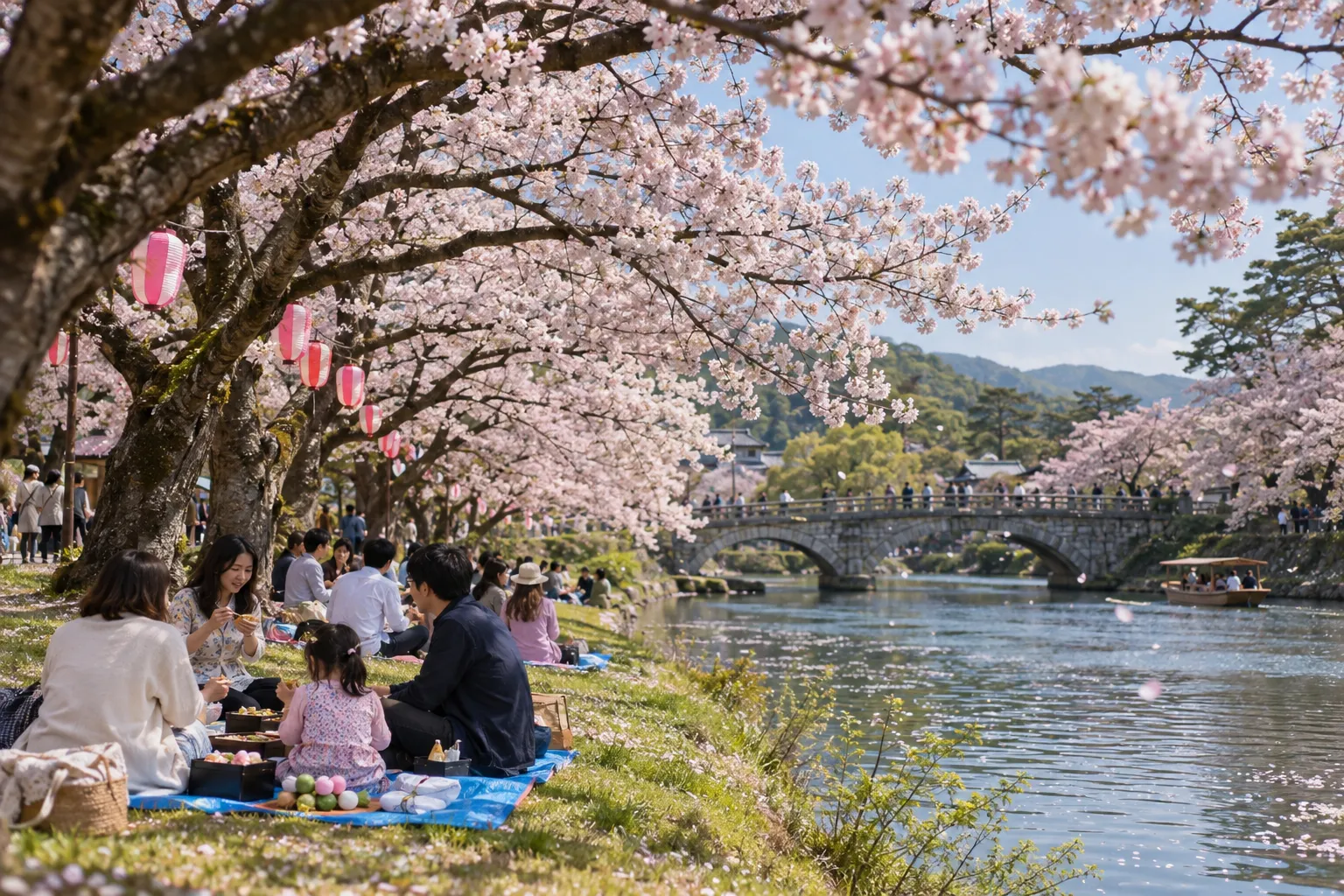
Hanami (Cherry Blossom Viewing)
お花見の英語の授業アイデアとワークシート
印刷してすぐ使えるワークシート(PDF・Word・解答つき)と、授業の手順書。
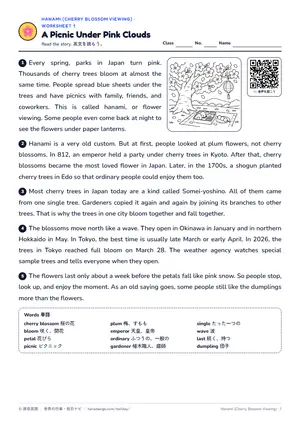
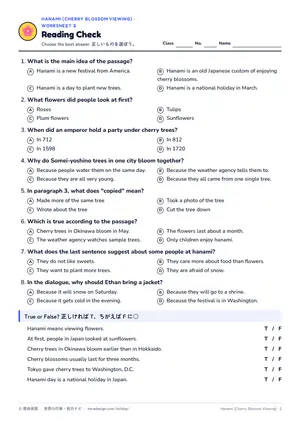
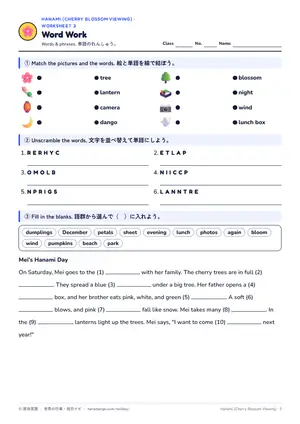
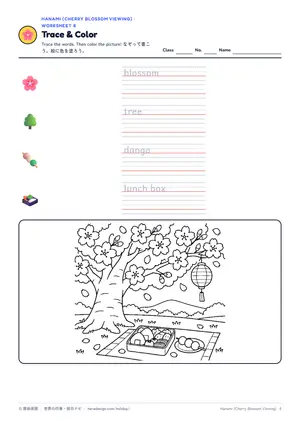
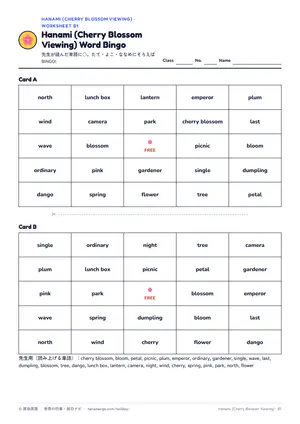
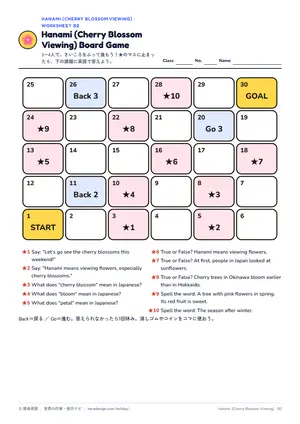
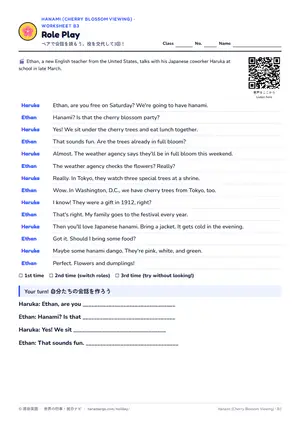
🖨️Worksheetsワークシート(無料・A4)
① 「中身を見る・印刷」で全ページを確認 → ② そのページ上の 🖨️ 印刷する でそのまま印刷できます。A4・無料。
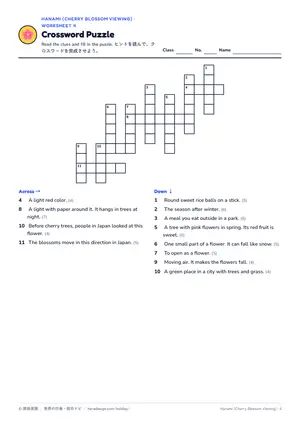
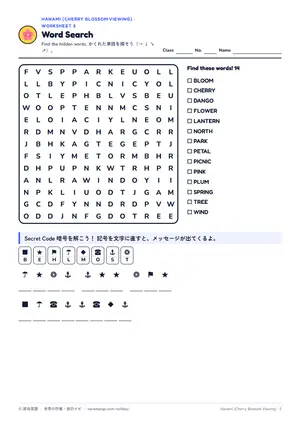
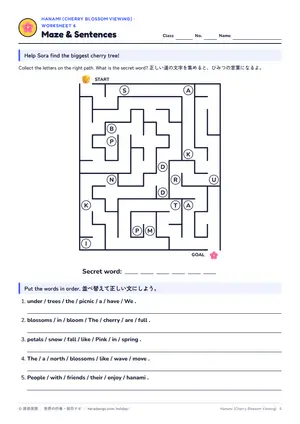
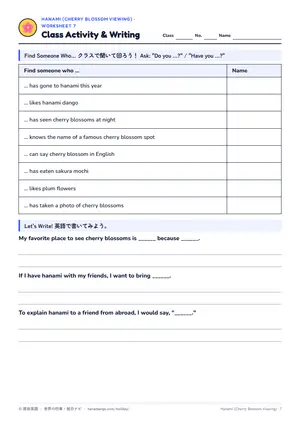
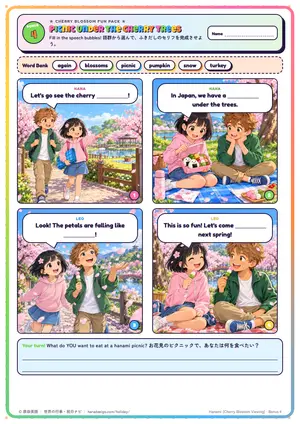
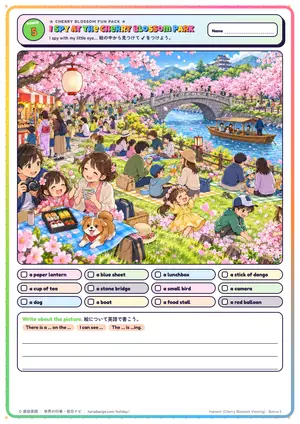
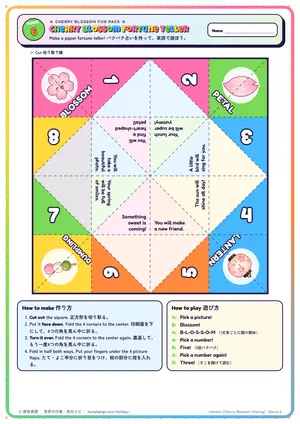
🍎Lesson Ideasお花見を使った英語の授業アイデア
英語で「お花見プラン」を立てよう
🎯 will / be going to を使い、だれと・どこで・何をするかを英語で説明できる。
- グループで桜の名所を1つ選ぶ(学校の近くでもよい)。
- When / Where / Who / What to bring / What to do の5項目を英語で決める。
- We are going to have hanami at ~. の形でプランを書く。
- クラスで発表し、いちばん行きたいプランに投票する。
詳細版を開く(時間配分・Teacher Talk・板書)
英語ページの会話の冒頭 We're going to have hanami. を聞かせ、be going to が予定を表すことを確認する。桜の名所の写真を見せ、「みんなならどこでお花見をする?」と聞く。
🗣️ Listen. "We're going to have hanami." / This is a plan for the future. / Where do you want to have hanami?
グループで桜の名所を1つ選ばせ、プランシートの5項目を英語で決めさせる。What to bring には、本文や会話に出てくる blue sheet / lunch / dango などを使ってよいと伝える。
🗣️ Choose one place in your group. / Decide five things: when, where, who, what to bring, and what to do. / Use words from the text. Blue sheet, lunch, dango.
We are going to have hanami at ~. で始め、5項目をつなげて4〜5文のプランを書かせる。机間巡視で、be going to と will の使い分け(予定は be going to、その場で決めたことは will)に気をつけて直す。
🗣️ Start with "We are going to have hanami at ...." / Then say who, what to bring, and what to do. / Good. "We will eat dango under the trees."
各グループが1分以内でプランを発表する。全員が、いちばん行きたいプランにシールを貼って投票する。いちばん人気のプランのよかった表現を板書する。
🗣️ Each group has one minute. / Which plan do you want to join? Vote with your sticker. / This plan won. Why did you like it?
Our hanami plan
When? We are going to have hanami on Saturday.
Where? ... at ___ Park.
Who? ... with our class.
What to bring? We will bring a blue sheet and dango.
What to do? We are going to eat lunch under the cherry trees.

be going to = 予定 will = その場で決めたこと・意志
桜前線を英語で実況しよう
🎯 月日と地名の英語、比較級を使って、桜前線の動きを説明できる。
- 気象庁の開花日データ(那覇・福岡・東京・仙台・札幌など)を配る。
- The cherry blossoms opened in ~ on ~. の形で1地点ずつ文を作る。
- earlier / later を使って2つの地点を比べる文を書く。
- 天気予報のアナウンサーになりきって、ペアで1分間「桜前線ニュース」を読む。
詳細版を開く(時間配分・Teacher Talk・板書)
英語ページ本文の第4段落を聞かせ、The blossoms move north like a wave. の意味を確認する。日本地図を見せ、沖縄と北海道で桜の時期がどれくらいちがうかを予想させる。
🗣️ The blossoms move north like a wave. / When do they open in Okinawa? When in Hokkaido? / Make a guess.
開花日の表を配り、The cherry blossoms opened in Tokyo on March 19. の形で、1地点ずつ文を作らせる(2026年の東京の開花は3月19日)。日付は序数(nineteenth)で読むことを確認する。作った地点の地図に桜のシールを貼る。
🗣️ Look at the data. / The cherry blossoms opened in Tokyo on March 19. / Say the date. March nineteenth. / Now make a sentence for Sendai.
earlier / later を使って2つの地点を比べる文を書かせる(例:The blossoms opened in Fukuoka earlier than in Sendai.)。何日違うかも足せる生徒には ~ days earlier than ~ を教える。
🗣️ Compare two places. / They opened earlier in Fukuoka than in Sendai. / How many days earlier? Add the number.
天気予報のアナウンサーになりきって、ペアで1分間の「桜前線ニュース」を読む。Good morning. This is the cherry blossom news. で始め、地点の文と比べる文を入れる。2〜3組に全体の前で読ませる。
🗣️ You are weather reporters now. / Start with "Good morning. This is the cherry blossom news." / You have one minute. Ready, go!
The blossoms move north like a wave.

The cherry blossoms opened in ___ on ___.
例:The cherry blossoms opened in Tokyo on March 19.(2026)

The blossoms opened earlier in ___ than in ___.
They opened ___ days later in ___.

Good morning. This is the cherry blossom news.
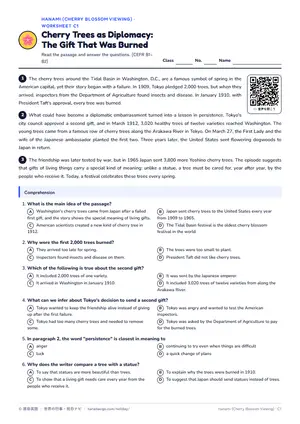
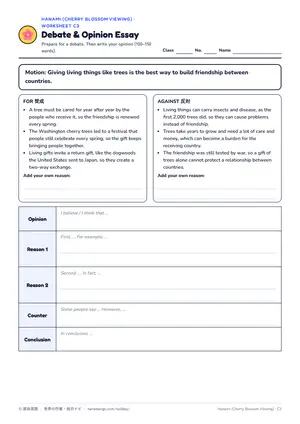
ワシントンの桜:手紙で読む日米交流
🎯 advanced の英文を読み、贈り物としての桜の意味を英語で考える。
- advanced の英文を読み、1909年から1965年までの出来事を年表にまとめる。
- 1910年に桜が焼かれたとき、両国の人々がどう感じたかを想像してペアで話し合う。
- 東京市長、またはタフト大統領夫人になりきって、相手への短い手紙を英語で書く。
- 手紙を読み合い、「生きている贈り物」の意味についてクラスで意見を交わす。
詳細版を開く(時間配分・Teacher Talk・板書)
ワシントンの桜の写真を見せ、「この桜は日本からの贈り物。でも最初の2000本は燃やされた」とだけ伝える。なぜ燃やされたのかを予想させる。
🗣️ These cherry trees are in Washington, D.C. / They were a gift from Tokyo. / But the first 2,000 trees were burned. Why?
発展英文を読ませ、年表を埋めさせる(1909年2000本の約束、1910年1月に害虫と病気で焼却、1912年3月に3020本到着・27日に最初の2本を植樹、3年後にハナミズキの返礼、1965年に3800本)。答え合わせで、焼却がタフト大統領の承認のもとで行われたことも確認する。
🗣️ Read the passage and complete the timeline. / What happened in January 1910? / How many trees arrived in 1912? / What did the United States send in return?
1910年に桜が焼かれたとき、東京の人々とアメリカの人々がそれぞれどう感じたかを、ペアで想像して話し合わせる。本文の What could have become a diplomatic embarrassment に注目させる。
🗣️ How did people in Tokyo feel in 1910? / How did people in America feel? / Why could it be an embarrassment?
東京市長か、タフト大統領夫人のどちらかになりきって、相手への短い手紙(6〜8文)を書かせる。時期は1910年(焼却のあと)か1912年(到着のあと)から選ばせる。本文の事実と食いちがわないよう注意させる。
🗣️ You are the mayor of Tokyo or the First Lady. / Choose 1910 or 1912. / Write a short letter. Six to eight sentences. / Make sure the facts match the text.
手紙をペアで読み合い、数人に発表させる。最後に本文の unlike a statue, a tree must be cared for, year after year を読み、「生きている贈り物」の意味についてクラスで意見を交わす。
🗣️ Read your letter to your partner. / A tree is different from a statue. Why? / What does a living gift mean to you?
Cherry Trees as Diplomacy
1909 Tokyo pledged 2,000 trees
1910 Jan. insects and disease → all burned(President Taft's approval)
1912 Mar. 3,020 trees(12 varieties)→ Mar. 27 the first two planted
1915 dogwoods from the U.S.(3 years later)
1965 3,800 more Yoshino cherry trees

A tree must be cared for, year after year.
→ a living gift
花見の俳句を英語で(English Haiku)
🎯 5-7-5の音節を意識して、桜をテーマにした英語の俳句を作る。
- 英語の syllable(音節)の数え方を練習する(cher-ry = 2 など)。
- 桜・花びら・風・夜などのテーマから1つ選び、キーワードを英語で集める。
- 5-7-5 syllables で英語の俳句を作る。
- 作品を教室に掲示し、気に入った俳句に付箋でコメントを書く。
詳細版を開く(時間配分・Teacher Talk・板書)
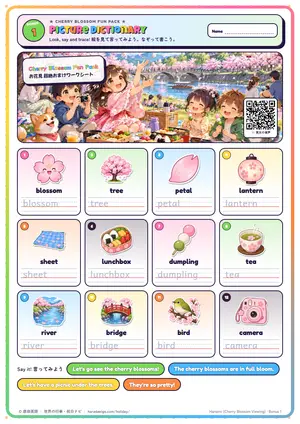
日本語の俳句が5-7-5の音でできていることを確認し、英語でも syllable(音節)を数えて5-7-5で作れることを伝える。手をたたきながら cher-ry(2)、blos-som(2)、pet-al(2)、lan-tern(2)を数える。
🗣️ A haiku has five, seven, and five sounds. / In English, we count syllables. / Clap with me. Cher-ry. Two syllables. / How many in "blossom"?
練習プリントで音節を数える練習をする(pink 1、spring 1、pic-nic 2、beau-ti-ful 3 など)。答え合わせで、つづりの長さではなく母音の音の数で数えることを確認する。
🗣️ Count the syllables on the sheet. / "Spring" is long, but it has only one syllable. / Count the vowel sounds, not the letters.
テーマを1つ選ばせ、関係のあるキーワードを英語でできるだけたくさん集めさせる。本文の第5段落の petals fall like pink snow のような表現もヒントにしてよい。集めた語の横に音節数を書かせる。
🗣️ Choose one theme. / Write as many words as you can. / Look at the text. "Petals fall like pink snow." / Write the number of syllables next to each word.
キーワードを組み合わせて5-7-5の英語の俳句を作らせる。先生の作例を1つ見せる(例:Pink petals falling / like snow on my picnic sheet / spring will not stay long)。できたら短冊に清書させる。
🗣️ Here is my haiku. Let's count together. / Now write your own. Five, seven, five. / Count again before you write it on the card.
短冊を教室に掲示し、生徒は自由に見て回って、気に入った俳句に付せんで英語のコメントを書く(I like the word ... / This haiku makes me feel ...)。最後に数作品を先生が読み上げる。
🗣️ Walk around and read the haiku. / Write a comment on a sticky note. / "I like the word ...." "This haiku makes me feel ...."
English Haiku(5-7-5 syllables)
cher-ry 2 / blos-som 2 / pet-al 2 / lan-tern 2 / spring 1 / beau-ti-ful 3

Pink petals falling(5)
like snow on my picnic sheet(7)
spring will not stay long(5)

Comment: I like the word ___. / This haiku makes me feel ___.
お花見のマナー問題を解決しよう
🎯 公共空間の利用ルールについて、国内外の事例をもとに英語で提案できる。
- 福岡市天神中央公園の予約・有料制など、花見のゴミや場所取り対策の事例を読む。
- 海外の公園(ワシントンの桜祭りなど)のルールと比べる。
- グループで、自分たちの町の公園のための花見ルール案を3つ作る。
- 賛成・反対の両方の立場から質疑を行い、最終案を英語でまとめる。
詳細版を開く(時間配分・Teacher Talk・板書)
お花見でこまったこと(ゴミ・場所取り・騒音)を挙げさせる。Discussion の問い Trash and noise at hanami are big problems. What rules would you make for a popular park? を示し、今日の課題にする。
🗣️ What problems do you see at hanami? / Trash, noise, and saving spots. / Today, let's make rules for a popular park.
記事の福岡市天神中央公園の例を読ませる(場所取り対策として予約制を取り入れ、2018年に1区画2時間500円の有料制にした)。この対策の長所と短所を英語で2つずつ挙げさせる。
🗣️ Read about Tenjin Central Park in Fukuoka. / What are the good points of this rule? / What are the bad points?
ワシントンの桜祭りなど、海外の公園の花見のルールをグループで調べさせる。福岡の例と比べ、何が同じで何がちがうかを英語でメモさせる。調べたルールは公式サイトで確かめるよう指示する。
🗣️ Find the hanami rules for a park abroad, like the parks for the National Cherry Blossom Festival in Washington. / Check the official website. / Compare them with the rules in Fukuoka.
グループで、自分たちの町の公園のための花見ルール案を3つ作らせる。各ルールにねらいを1文そえる。そのあと、となりのグループとペアになり、賛成・反対の両方の立場から質問し合う。
🗣️ Make three rules for a park in our town. / Add one sentence about the purpose of each rule. / Now ask the other group: Is this rule fair?
質疑で出た意見をもとにルール案を直し、最終案を英語でまとめさせる。各グループ2分で発表し、最後にクラスで「いちばん実行しやすいルール」を選ぶ。
🗣️ Change your rules if you need to. / Present your final plan in two minutes. / Which rule is the easiest to put into practice?
Hanami problems:trash / noise / saving spots(場所取り)

Case:Tenjin Central Park, Fukuoka
 reservations → 2018:500 yen for 2 hours per area
 good points / bad points

Abroad:___(official rules)

Our rules
Rule 1 ___ Purpose ___
Rule 2 ___ Purpose ___
Rule 3 ___ Purpose ___