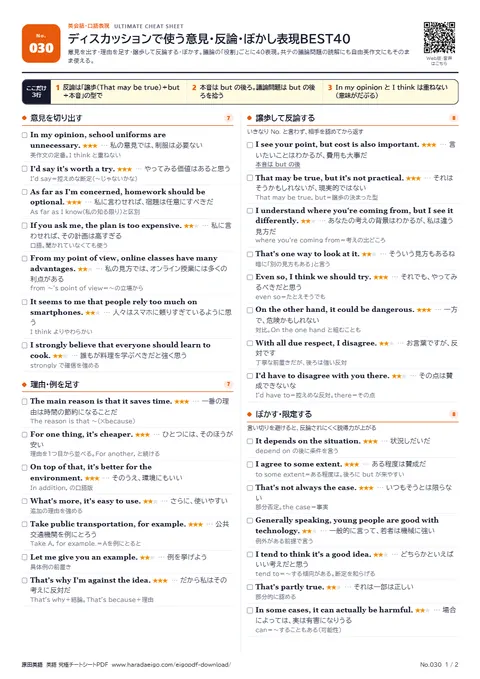
まずはこの3つ
- 反論は「譲歩(That may be true)+but+本音」の型で
- 本音は but の後ろ。議論問題は but の後ろを拾う
- In my opinion と I think は重ねない(意味がだぶる)
意見を切り出す7
- In my opinion, school uniforms are unnecessary.★★★私の意見では、制服は必要ない英作文の定番。I think と重ねない
- I'd say it's worth a try.★★★やってみる価値はあると思うI'd say=控えめな断定(〜じゃないかな)
- As far as I'm concerned, homework should be optional.★★★私に言わせれば、宿題は任意にすべきだAs far as I know(私の知る限り)と区別
- If you ask me, the plan is too expensive.★★★私に言わせれば、その計画は高すぎる口語。聞かれていなくても使う
- From my point of view, online classes have many advantages.★★★私の見方では、オンライン授業には多くの利点があるfrom 〜's point of view=〜の立場から
- It seems to me that people rely too much on smartphones.★★★人々はスマホに頼りすぎているように思うI think よりやわらかい
- I strongly believe that everyone should learn to cook.★★★誰もが料理を学ぶべきだと強く思うstrongly で確信を強める
理由・例を足す7
- The main reason is that it saves time.★★★一番の理由は時間の節約になることだThe reason is that 〜(✕because)
- For one thing, it's cheaper.★★★ひとつには、そのほうが安い理由を1つ目から並べる。For another, と続ける
- On top of that, it's better for the environment.★★★そのうえ、環境にもいいIn addition, の口語版
- What's more, it's easy to use.★★★さらに、使いやすい追加の理由を強める
- Take public transportation, for example.★★★公共交通機関を例にとろうTake A, for example.=Aを例にとると
- Let me give you an example.★★★例を挙げよう具体例の前置き
- That's why I'm against the idea.★★★だから私はその考えに反対だThat's why+結論。That's because+理由
譲歩して反論する8
いきなり No. と言わず、相手を認めてから返す
- I see your point, but cost is also important.★★★言いたいことはわかるが、費用も大事だ本音は but の後
- That may be true, but it's not practical.★★★それはそうかもしれないが、現実的ではないThat may be true, but=譲歩の決まった型
- I understand where you're coming from, but I see it differently.★★★あなたの考えの背景はわかるが、私は違う見方だwhere you're coming from=考えの出どころ
- That's one way to look at it.★★★そういう見方もあるね暗に「別の見方もある」と言う
- Even so, I think we should try.★★★それでも、やってみるべきだと思うeven so=たとえそうでも
- On the other hand, it could be dangerous.★★★一方で、危険かもしれない対比。On the one hand と組むことも
- With all due respect, I disagree.★★★お言葉ですが、反対です丁寧な前置きだが、後ろは強い反対
- I'd have to disagree with you there.★★★その点は賛成できないなI'd have to=控えめな反対。there=その点
ぼかす・限定する8
言い切りを避けると、反論されにくく説得力が上がる
- It depends on the situation.★★★状況しだいだdepend on の後に条件を言う
- I agree to some extent.★★★ある程度は賛成だto some extent=ある程度は。後ろに but が来やすい
- That's not always the case.★★★いつもそうとは限らない部分否定。the case=事実
- Generally speaking, young people are good with technology.★★★一般的に言って、若者は機械に強い例外がある前提で言う
- I tend to think it's a good idea.★★★どちらかといえばいい考えだと思うtend to=〜する傾向がある。断定を和らげる
- That's partly true.★★★それは一部は正しい部分的に認める
- In some cases, it can actually be harmful.★★★場合によっては、実は有害になりうるcan=〜することもある(可能性)
- I might be wrong, but I don't think that's true.★★★間違っているかもしれないが、それは違うと思う反対の前のクッション
確かめる・突っ込む5
- What exactly do you mean by that?★★★それは具体的にどういう意味?mean A by B=BでAを意味する
- Could you give me an example?★★★例を挙げてもらえますか抽象的な主張への定番の質問
- Do you have any evidence for that?★★★その根拠はありますかevidence=証拠(数えない名詞)
- So what you're saying is that we need more time.★★★つまり、もっと時間が必要だということですね相手の発言を要約して確認
- Could you elaborate on that?★★★もう少し詳しく説明してもらえますかelaborate on=詳しく述べる
進める・まとめる5
- Sorry to interrupt, but can I add something?★★★話の途中にすみません、付け加えてもいいですか割り込む時のマナー
- Let's look at it from a different angle.★★★別の角度から見てみようangle=角度・観点
- We seem to agree on the main point.★★★要点では意見が一致しているようだagree on 〜=〜について合意する
- Let's agree to disagree.★★★意見が違うことは認め合おう対立を穏やかに終える
- To sum up, both sides have good points.★★★まとめると、どちらにも良い点があるIn conclusion, より会話向き
自由英作文の型(議論の表現をそのまま使う)
| 役割 | 使える表現 |
|---|---|
| 主張 | In my opinion, / I strongly believe that |
| 理由1 | The main reason is that / For one thing, |
| 具体例 | Take 〜, for example. / For instance, |
| 理由2 | On top of that, / What's more, |
| 譲歩→反論 | Some people say 〜. That may be true, but |
| 結論 | That's why / To sum up, |
英作文で減点されるミス5
- ✕In my opinion, I think it's good.○In my opinion, it's good.意味の重複。どちらか1つで簡潔に
- ✕According to me, it's good.○In my opinion, it's good.according to は他人・資料の情報源
- ✕I agree your opinion.○I agree with your opinion.人・意見には agree with
- ✕The reason is because it's cheap.○The reason is that it's cheap.口語では見るが、英作文は that が安全
- ✕For example, smartphones.○For example, smartphones are useful.英作文では文を完成させる
なぜ「ぼかす」と説得力が上がる?
言語学では、断定を和らげる表現(tend to, to some extent, in some cases など)をヘッジ(hedge)と呼ぶ。英語の論文や議論では、根拠以上に言い切らないことが誠実さのしるしとされる。always / never / everyone と言い切ると例を1つ挙げられるだけで崩れるが、「多くの場合」「ある程度は」と限定すれば反論されにくい。共テの議論問題でも、極端な言い切りの選択肢はまず疑う。
確認テスト
- 1A: Homework should be banned. / B: I see your point, I think some practice at home is necessary.正解は but。譲歩→反論
- 2far as I'm concerned, the new rule is unfair.正解は As。私に言わせれば
- 3A: Is studying abroad always a good idea? / B: It on the person.正解は depends。人による
- 4A: Rich people are always happy. / B: That's not always the .正解は case。部分否定
- 5A: Cars should be banned in the city center. / B: What exactly do you by that?正解は mean。〜で…を意味する
- 6smartphones, for example. They have changed how we communicate.正解は Take。〜を例にとると
- 7We couldn't reach a conclusion, so we decided to agree to .正解は disagree。意見の違いを認め合う
- 8I agree to some , but there are still some problems.正解は extent。ある程度は
意見・反論・ぼかしを一覧にまとめ、A4 2枚で印刷できる無料PDFにしました。Web版は赤シート・覚えたチェック・カード・4択テスト・音声つき。