

 語学・英語学習ホント
赤ちゃんは大人同士の会話より「子ども同士のおしゃべり」を長く聞いていた。アマゾンの村でもスイスでも
 2026.10.03
 English Corner(A2〜B2・4択クイズ)
 読む前に予想してみよう!
赤ちゃんは、大人同士の会話より子ども同士の会話のほうを長く聞く傾向がある
ペルーとスイスの赤ちゃん127人の実験で、どちらの文化でも子ども同士の会話のほうが長く注目された。
 研究カード(どんな研究?)
- 対象
- 生後8〜20か月の赤ちゃん(ペルー・スイス)
- 規模
- 計188人(研究1:127人、研究2:61人)
- 研究の種類
- 注視時間を測る実験
- 確かさ
- ★★★☆☆
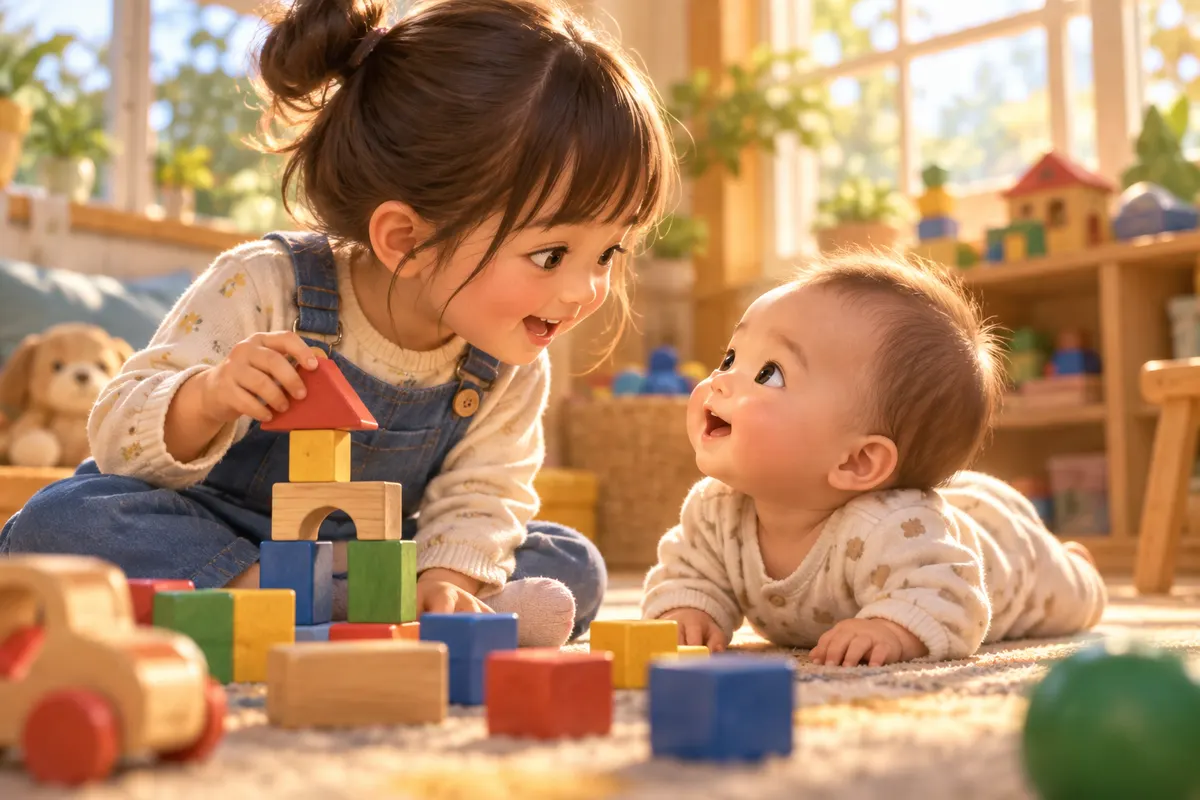
生後8〜20か月の赤ちゃんは、大人同士の会話より、幼い子ども同士の会話を長く聞いていた。ペルーのアマゾンの村でもスイスの都市でも同じ傾向だった。
ひとことで言うと赤ちゃんは、大人の話よりお兄ちゃんお姉ちゃんの話をよく聞いているみたい!
赤ちゃんに話しかけるとき、大人は自然と声が高くなり、ゆっくり、抑揚たっぷりになります。「マンマ、おいしいねぇ〜」というあの話し方です。
この「赤ちゃん向けの話し方」を赤ちゃんが好んで聞くことは、昔からよく知られていました。そのため、ことばの発達の研究は、長いあいだ「大人が赤ちゃんに話しかける言葉」を中心に進んできました。
でも、ちょっと考えてみてください。世界には、赤ちゃんがほかの子どもたちの声をたくさん耳にする暮らしもあります。スイス・チューリッヒ大学のチームは、そこに目をつけました。赤ちゃんは、ほかの子どものおしゃべりをどれくらい聞いているのでしょう?
01アマゾンの村とスイスの都会で実験
シピボ・コニボは、ペルーのアマゾン地域、ウカヤリ川の流域で約3万人が話す言語です。村の多くは船でしか行けず、年上の子どもが小さい子の面倒を見るのが当たり前。調べた赤ちゃんのきょうだいは平均4人近くいました。
一方、チューリッヒの赤ちゃんのきょうだいは平均0.5人ほど。暮らしぶりがまったく違う2つのグループで、同じ結果が出たのです。
02子どもの声は「赤ちゃん向けの大人の話し方」と互角
研究2では、スイスの赤ちゃん61人を対象に、さらに踏みこんだ比較をしました。
比べたのは、4〜5歳の子どもが1歳の子に話しかける声と、大人が赤ちゃん向けの話し方で話しかける声。赤ちゃんが大好きなはずの「大人の赤ちゃん向けの話し方」に、子どもの声はどこまで迫れるのか?
結果は、ほぼ互角(平均約11.3秒対11.2秒)。子どもの声は、大人が工夫した話し方と同じくらい赤ちゃんの注意を引きつけていたのです。
03なぜ子どもの声に引かれるの?
ひとつの手がかりは声の高さです。子どもの声は大人より高く、赤ちゃん向けの話し方とよく似た特徴を持っています。
ただ研究チームは、声の高さだけでは説明しきれないと考えています。子どもには、年上の子をよく見て、まねをして学ぶ傾向があります。そうした「子ども同士の社会的なつながり」も関係しているのではないか、というのです。
04まとめ
赤ちゃんは、大人の会話より子ども同士のおしゃべりに耳を傾けていました。しかも、その傾向はアマゾンの村でもヨーロッパの都会でも同じでした。
ことばを教えてくれるのは、パパやママだけではないのかもしれません。お兄ちゃんやお姉ちゃん、近所の子どもたち。にぎやかな子どもの声も、赤ちゃんにとって大切な「ことばの教室」のひとつなのかもしれません。
この研究を英語で読もう原田英語の English CornerMost research on how babies learn language has focused on adults speaking to them. 音声
音声 4択クイズ9問A2・B1・B2タップして開く
原田英語の English Corner
この研究を英語で読もう
Babies learn their first language from the people around them. Scientists wanted to know whose voices babies like to hear. They played recordings to babies in a village in Peru and in a city in Switzerland.
Some recordings had young children talking together. Others had adults talking together. In both places, the babies listened longer to the children. Maybe older brothers and sisters are important language teachers, too.
68 words ・ CEFR A2
和訳を見る
赤ちゃんは、まわりの人たちから最初の言語を学びます。科学者たちは、赤ちゃんが誰の声を聞くのが好きなのか知りたいと思いました。彼らはペルーの村とスイスの都市の赤ちゃんに録音を聞かせました。
いくつかの録音には幼い子どもたちが一緒に話す声が入っていました。ほかの録音には大人たちが一緒に話す声が入っていました。どちらの場所でも、赤ちゃんは子どもたちの声を長く聞きました。もしかすると、お兄さんやお姉さんも大切な言葉の先生なのかもしれません。
4択リーディングクイズ
Q1. Where did the scientists do the study?
a village in Peru and in a city in Switzerland とあるので B。
Q2. Which recordings did the babies listen to longer?
the babies listened longer to the children とあるので C。
Q3. What does "recordings" mean in the passage?
recording は「録音(したもの)」なので A。
Most research on how babies learn language has focused on adults speaking to them. But in many cultures, babies spend a lot of time around other children. Researchers from the University of Zurich tested 127 babies aged 8 to 20 months. Of these, 67 were from Shipibo-Konibo villages in the Peruvian Amazon and 60 were from Zurich, Switzerland.
The babies heard natural recordings of young children talking among themselves and of adults talking among themselves. In both cultures, the babies paid attention longer to the children's conversations. Attention is not proof of learning, but the researchers call it a first step. In a second study, Swiss babies listened just as long to children speaking to a baby as to adults using baby talk.
123 words ・ CEFR B1
和訳を見る
赤ちゃんがどのように言語を学ぶかについての研究の多くは、大人が赤ちゃんに話しかけることに注目してきた。しかし多くの文化では、赤ちゃんはほかの子どもたちのそばで長い時間を過ごす。チューリッヒ大学の研究者たちは、生後8〜20か月の赤ちゃん127人を調べた。そのうち67人はペルー・アマゾンのシピボ・コニボの村の赤ちゃん、60人はスイス・チューリッヒの赤ちゃんである。
赤ちゃんたちは、幼い子ども同士の会話と、大人同士の会話の自然な録音を聞いた。どちらの文化でも、赤ちゃんは子どもたちの会話のほうに長く注意を向けた。注意を向けることは学習の証明にはならないが、研究者たちはそれを最初の一歩と呼んでいる。2つ目の研究では、スイスの赤ちゃんは、子どもが赤ちゃんに話しかける声を、大人が赤ちゃん向けの話し方で話す声と同じくらい長く聞いた。
4択リーディングクイズ
Q1. How many babies took part in the first study?
tested 127 babies aged 8 to 20 months とあるので C。
Q2. What did the second study show?
listened just as long to children speaking to a baby as to adults using baby talk とあるので B。
Q3. What is the researchers' view about the results?
Attention is not proof of learning, but the researchers call it a first step. とあるので A。
For decades, studies of early language development have centered on child-directed speech from adults, the slow, high-pitched style that infants are known to prefer. But in many societies, infants hear much less adult baby talk but are exposed to a lot of speech from other children. A 2025 study in Developmental Science examined whether this overlooked input matters. Using a head-turn preference procedure, researchers measured how long 127 infants aged 8 to 20 months listened to recordings of young children chatting among themselves versus adults chatting among themselves. Both Shipibo-Konibo infants in the Peruvian Amazon, who had nearly four siblings on average, and Swiss infants from Zurich, with fewer than one, attended longer to the children's speech, with no meaningful cultural difference.
A follow-up with 61 Swiss infants found that children addressing a baby were as engaging as adults using baby talk. Higher pitch may partly explain the effect, but the authors also point to infants' social interest in older peers. The study measured only how long babies listened, and the follow-up included only Swiss infants, so whether this attention helps vocabulary grow was not tested.
186 words ・ CEFR B2
和訳を見る
何十年ものあいだ、初期の言語発達の研究は、大人が子どもに向ける話し方を中心に行われてきた。ゆっくりした高い声の話し方で、乳児が好むことで知られている。しかし多くの社会では、乳児が耳にする大人の赤ちゃん向けの話し方はずっと少ない一方で、ほかの子どもたちの話し声には多く触れている。『Developmental Science』誌の2025年の研究は、この見過ごされてきたインプットが重要かどうかを調べた。ヘッドターン選好法を使い、研究者たちは、生後8〜20か月の乳児127人が、幼い子ども同士のおしゃべりの録音と大人同士のおしゃべりの録音をどれだけ長く聞くかを測定した。ペルー・アマゾンのシピボ・コニボの乳児(きょうだいは平均4人近く)も、スイス・チューリッヒの乳児(きょうだいは平均1人未満)も、子どもの話し声のほうを長く聞いた。文化による意味のある差はなかった。
スイスの乳児61人を対象にした追加研究では、赤ちゃんに話しかける子どもの声は、赤ちゃん向けの話し方をする大人の声と同じくらい関心を引いた。声の高さがこの効果を部分的に説明するかもしれないが、著者たちは年上の仲間に対する乳児の社会的な興味も指摘している。この研究が測ったのは乳児が聞いていた時間だけで、追加研究に参加したのもスイスの乳児だけだった。そのため、この注意が語彙の発達に役立つかどうかは検証されていない。
4択リーディングクイズ
Q1. What does "this overlooked input" refer to?
直前で、多くの社会で乳児が大人の赤ちゃん言葉をあまり耳にせず、ほかの子どもたちの話し声に多く触れていると述べており、それまでの研究が見過ごしてきた「子どもの話し声」を指すので B。
Q2. What was found about cultural differences in the first study?
with no meaningful cultural difference とあるので C。
Q3. Which statement best reflects the author's caution?
The study measured only how long babies listened ... whether this attention helps vocabulary grow was not tested とあるので A。
重要単語
- infantB2名詞乳児、赤ちゃんThe infants sat on their parents' laps during the test.
 ラテン語 infans「話せない者」が語源。infancy「乳児期」。
 - language acquisitionC1名詞(句)言語習得Language acquisition happens quickly in the first years of life. acquire「習得する」の名詞形。second language acquisition(SLA)は第二言語習得研究。
- child-directed speechC1名詞(句)子ども向けの話し方(いわゆる赤ちゃん言葉)Child-directed speech is slow and high-pitched. motherese, parentese とも呼ばれる。高い声・ゆっくり・くり返しが特徴。
- attentionB1名詞注意、注目Child speech captured the babies' attention. pay attention to ~「~に注意を払う」、capture/attract attention「注意を引く」。
- siblingB2名詞きょうだいMany babies in the village had several siblings. brother と sister をまとめて言う語。sibling rivalry「きょうだい間の対抗心」。
- peerB2名詞仲間、同年代の人Children often learn by watching their peers. peer pressure「仲間からの圧力」は入試頻出。動詞 peer は「じっと見る」で別の意味。
- overlookB2動詞見過ごす;見渡すResearchers have long overlooked the role of other children. 「見落とす」と「(高い所から)見渡す」の2つの意味に注意。
 入試に出る順の単語帳を印刷する →
 全5903語の「科学英単語カード」で復習する →
 この話題を TED で聞く
同じテーマの TED・TED-Ed を、 TED HACK で。英語の見どころ・使える表現・学習ミッションつきの日本語ガイドです。(運営:原田英語)

このネタ、誰かに教えたくなった?
赤ちゃんは、大人同士の会話より「3歳半〜5歳の子ども同士のおしゃべり」を長く聞いているらしい。アマゾンの村の赤ちゃんでも、スイスの都会の赤ちゃんでも同じ結果。ことばを覚える“先生”は、親だけじゃないのかも。
押すと「マジかリスト」に保存されます
 出典・参考文献(3件)タップで表示
- Schick, Daum & Stoll (2025) Input to the Language Learning Infant: The Impact of Other Children, Developmental Sciencedoi.org
- Fernald (1985) Four-month-old infants prefer to listen to motherese, Infant Behavior and Developmentdoi.org
- ManyBabies Consortium (2020) Quantifying Sources of Variability in Infancy Research Using the Infant-Directed-Speech Preference, Advances in Methods and Practices in Psychological Sciencedoi.org

※本記事は上記の研究・公開資料をもとに、原田英語が独自の言葉で解説したものです。引用は著作権法第32条の範囲で行い、出典を明記しています。画像はすべてオリジナルのイメージです。研究結果には限界や個人差があります。誤りのご指摘は原田英語のお問い合わせフォームから。

別館
マジか!?ことばで読む、ことばの雑学
英語と日本語の「えっ、マジか!?」を辞書と論文でウラ取りする別館
 これも「マジか!?」
 語学
語学
なまりがあると、言い間違いを聞き手が「直して」聞いてくれやすい。483人で再確認
 語学
語学
「delve(掘り下げる)」が論文で急増中。ChatGPTが好む英単語が、人の書く論文に広がっていた
 語学
語学
「怒られないため」の英語勉強は、成績とほぼ無関係だった。74本の研究で成績と結びついたのは「楽しい」「大事だから」のやる気

 語学
語学
2つの言語を切り替える50分の練習で、気が散りにくくなった? ただし「テストに慣れただけ」の可能性も
 語学
語学
英語の間違いは「その場で直す」か「あとで直す」か。カギは直された後の言い直しかもしれない
 語学
語学