Labor Thanksgiving Day
勤労感謝の日の英語の授業アイデアとワークシート
印刷してすぐ使えるワークシート(PDF・Word・解答つき)と、授業の手順書。
🖨️Worksheetsワークシート(無料・A4)
① 「中身を見る・印刷」で全ページを確認 → ② そのページ上の 🖨️ 印刷する でそのまま印刷できます。A4・無料。
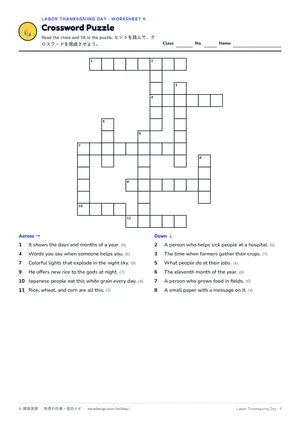
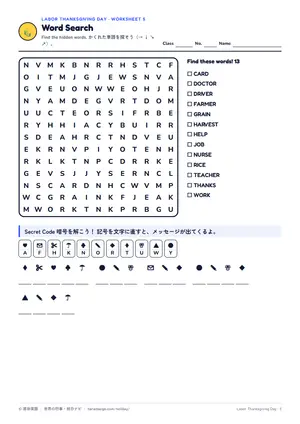
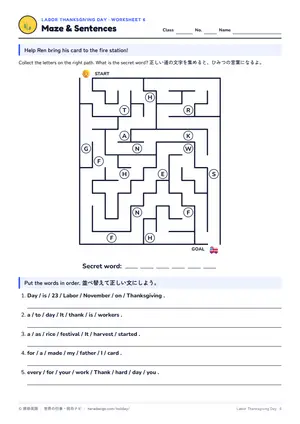
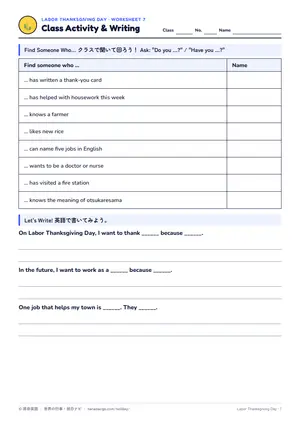
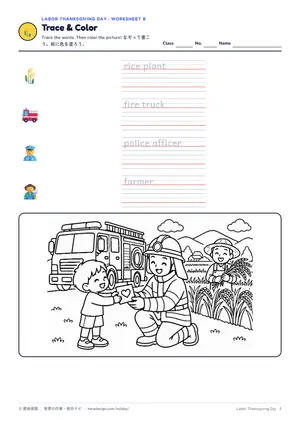
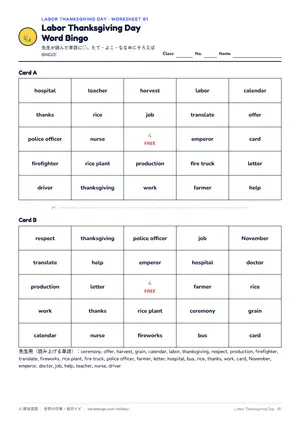
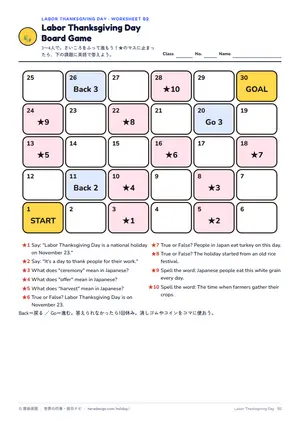
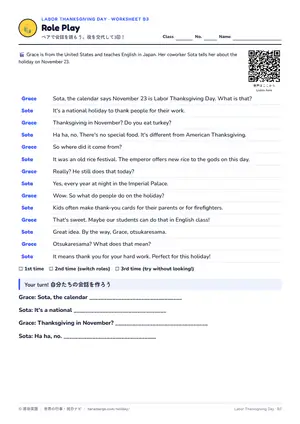
🍎Lesson Ideas勤労感謝の日を使った英語の授業アイデア
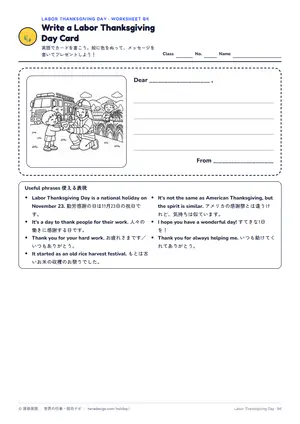
英語で感謝カードを書こう
🎯 身近な働く人への感謝を、理由をつけて英語で書く。
- Thank you for ~ing. の形を練習する(Thank you for driving the bus.)。
- 感謝したい人を一人決め、その人がしてくれていることを3つ書き出す。
- カードに英語で3文のメッセージと絵をかく。
- クラスで紹介し、実際に届ける。
詳細版を開く(時間配分・Teacher Talk・板書)
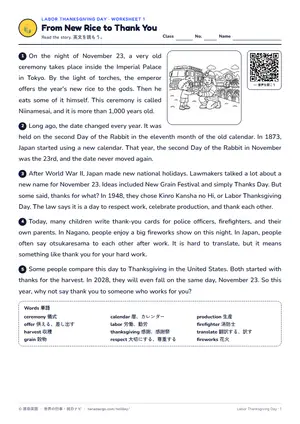
11月23日は勤労感謝の日で、法律では「勤労をたっとび、生産を祝い、国民たがいに感謝しあう」日だと伝える。英語ページ第4段落の音声を聞かせ、子どもたちが警察官や消防士、家族に感謝カードを書くことを確認する。
🗣️ November 23 is Labor Thanksgiving Day. / It's a day to thank each other for our work. / Listen. What do many children do on this day? / They write thank-you cards for police officers, firefighters, and parents.
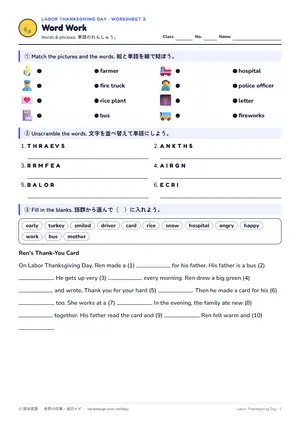
働く人の絵カードを見せ、Thank you for ___ing. の形を練習する(Thank you for driving the bus. / Thank you for cooking lunch.)。for のあとは動詞の ing 形になることを確認し、言葉カードで数回くり返す。
🗣️ Look. This is a bus driver. / Thank you for driving the bus. / After for, use the ing form. / This is a cafeteria worker. Thank you for ___.
感謝したい人を1人決めさせ、その人がしてくれていることを3つ日本語か英語で書き出させる。家族、学校の職員、地域の人など、ふだん目立たない仕事にも目を向けるよう促す。
🗣️ Who do you want to thank? Choose one person. / Think about people at school, too. The custodian? The school nurse? / Write three things this person does for you.
カードに英語で3文のメッセージと絵をかかせる。型を板書する(Dear ___, / Thank you for ___ing. / You ___ every day. / Thank you for your hard work. / From ___)。机間指導で ing の形やつづりを確認する。
🗣️ Write three sentences on your card. / Dear Mr. Sato, thank you for cleaning our school. / End with Thank you for your hard work. / Draw a picture, too.
数人にカードを読ませる。校内の人あてのカードはその日のうちに届け、家族や地域の人あては勤労感謝の日に手渡すよう勧める。
🗣️ Who wants to read their card? / Let's deliver the cards for people at school today. / Give the other cards on Labor Thanksgiving Day.
Labor Thanksgiving Day(November 23)
= a day to thank each other for our work

Dear __,
  Thank you for __ing.(driving / cooking / cleaning / teaching)
  You __ every day.
  Thank you for your hard work.
From __

for のあとは ing の形!
お仕事インタビュー
🎯 仕事について英語で質問し、答えを要約して発表する。
- What do you do? / What is the hardest part? などの質問を5つ作る。
- ALTや先生、家族に英語(または日本語)でインタビューする。
- 答えを英語で3〜4文に要約する。
- 1分で発表し、聞き手は Thank you for your work. と返す。
詳細版を開く(時間配分・Teacher Talk・板書)
英語ページの会話(Grace と Sota)の最後で、Sota が otsukaresama を説明する場面を聞かせる。勤労感謝の日は「たがいに感謝しあう日」であることを伝え、今日は働く人の話を英語で聞いて伝えると目標を示す。
🗣️ Listen to Grace and Sota. / Otsukaresama means something like thank you for your hard work. / Today, you will interview people about their jobs.
ペアで質問を5つ作らせる。質問の例のカードを参考に、Yes / No で終わらない質問(What / Why / How)を中心にするよう指示する。相手の答えを広げる追加の質問(Could you give me an example?)も1つ用意させる。
🗣️ Make five questions with your partner. / Use what, why, and how. Avoid yes or no questions. / Prepare one follow-up question. Could you give me an example? / Check your word order.
ALT や協力してくれる先生方にグループで順にインタビューする(1人につき4分程度で交代)。家族に聞いてきた生徒は、その答えも使ってよい。答えは語句でメモさせ、最後に必ず Thank you for your time. とお礼を言わせる。
🗣️ Go to your interview. You have four minutes. / Take notes. Words are enough. / Don't forget your follow-up question. / Say Thank you for your time at the end.
メモをもとに、英語3〜4文に要約させる。インタビューした人を三人称で書くこと(Ms. Brown teaches English. She says the hardest part is ___.)、says / thinks を使って相手の考えを伝えることを示す。
🗣️ Write a summary in three or four sentences. / Use he or she. Ms. Brown teaches English. / Use says or thinks. She says the hardest part is grading tests. / End with one thing you learned.
4〜5人のグループで、1人1分ずつ要約を発表させる。聞き手は発表のあと、インタビューした人に向けた気持ちで Thank you for your work. と声をそろえて返す。最後に何人かのよい要約を全体で紹介する。
🗣️ Share your summary in your group. One minute each. / After each talk, everyone says, Thank you for your work. / This summary was very clear. Let's hear it.
Job Interview

Questions
1. What do you do?
2. What is the hardest part of your job?
3. What do you like about your job?
4. Why did you choose this job?
5. What advice do you have for students?
+ Could you give me an example?

Summary:Ms. __ teaches __. She says __.
→ Thank you for your work.
日米の「感謝の日」比べ
🎯 日本の勤労感謝の日とアメリカの感謝祭・レイバーデーの違いを英語で説明する。
- compare の表と本文を読み、日付・由来・過ごし方を表にまとめる。
- ベン図で共通点と違いを整理する。
- Both ~. But ~. の形で英語の文を3つ作る。
- ペアで発表し合う。
詳細版を開く(時間配分・Teacher Talk・板書)
英語ページの会話で、Grace が Thanksgiving in November? Do you eat turkey? と聞く場面を聞かせる。「名前は似ているけれど、中身は同じ?」と問いかける。
🗣️ Grace asks, Do you eat turkey? What does Sota say? / The names are similar. But are they the same holiday? / Let's compare.
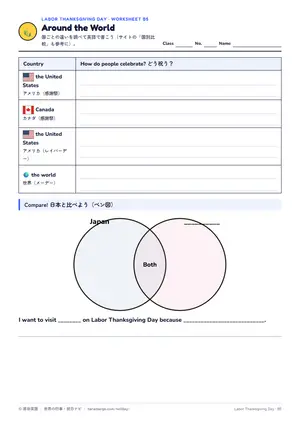
国別比べの表と本文を読ませ、3つの祝日を表にまとめさせる。勤労感謝の日(November 23 / Niinamesai, a rice harvest rite / thank-you cards, quiet day off)、アメリカの感謝祭(the fourth Thursday of November / a national holiday since 1863 / turkey with family)、レイバーデー(the first Monday of September / honors workers, a national holiday in 1894 / the end of summer, a three-day weekend)。
🗣️ Fill in the chart for three holidays. / Date, origin, and how people spend the day. / Labor Thanksgiving Day started as a rice festival. / Labor Day in the U.S. honors workers.
ベン図に、勤労感謝の日と感謝祭・レイバーデーの共通点と違いを書きこませる。勤労感謝の日は「収穫」と「働くこと」の両方の意味を持つので、真ん中に何が入るかを考えさせる。
🗣️ Now use the Venn diagram. / Thanksgiving is about the harvest. Labor Day is about workers. / Japan's holiday has both ideas. Where will you put it?
Both ___. But ___. の形で英語の文を3つ作らせる(Both Labor Thanksgiving Day and Thanksgiving started with thanks for the harvest. But Japan has no special food like turkey.)。本文第5段落の、2028年は2つの日が同じ11月23日になるという事実も使ってよい。
🗣️ Write three sentences with both and but. / Both started with thanks for the harvest. / But Japan's holiday has no special food. / In 2028, both holidays will be on November 23!
ペアで3つの文を発表し合う。数人に全体で発表させ、「名前は似ていても、由来と過ごし方は違う」ことを確認する。
🗣️ Read your sentences to your partner. / Who wants to share with the class? / Similar names, different stories.
Japan vs. U.S.

                         Date                 Origin                     How
勤労感謝の日             Nov 23               Niinamesai(rice harvest) cards, quiet day off
Thanksgiving(U.S.)     4th Thursday of Nov  national holiday 1863      turkey with family
Labor Day(U.S.)        1st Monday of Sept   honors workers(1894)     end of summer, 3-day weekend

Both __. But __.
2028:Nov 23 = Thanksgiving = 勤労感謝の日
「お疲れさま」を英語にしてみよう
🎯 訳しにくい日本語の気持ちを、場面に合わせた英語で伝える。
- 「お疲れさま」が使われる場面(仕事の終わり・部活のあと・家族の帰宅)を挙げる。
- 場面ごとに Thank you for your hard work. / Good job today. / You must be tired. などを比べる。
- ロールプレイで使い分ける。
- いちばん気持ちが伝わった表現をクラスで選ぶ。
詳細版を開く(時間配分・Teacher Talk・板書)
会話の最後の Sota の It means thank you for your hard work. を聞かせる。「お疲れさま」をどんなときに使うかを生徒に挙げさせ、場面カードを黒板に並べる(仕事の終わり・部活のあと・家族の帰宅・先に帰る上司)。
🗣️ Sota says otsukaresama means thank you for your hard work. / When do you say otsukaresama? / After work? After club practice? When your family comes home?
表現カードを1枚ずつ読み、場面に合うものを生徒と一緒に選ぶ。英語には「お疲れさま」にあたる決まった一言がなく、場面によって言い方が変わることを伝える。目上の人に Good job. と言うと、評価しているように聞こえることがあるので、Thank you for today. / See you tomorrow. などが無難だと補足する。
🗣️ There is no one perfect word for otsukaresama. / After club practice, say Good job today! or Nice work! / When your family comes home, say Welcome home. You must be tired. / To your boss, Good job can sound strange. Try Thank you for today.
ペアで場面カードを1枚引き、その場面のロールプレイをする(2往復程度)。表現カードから合うものを選んで使い、終わったら次のカードを引く。役を交代しながら少なくとも3場面を行う。
🗣️ Pick a card. Act out the scene with your partner. / Choose the best phrase for the scene. / Then pick another card and switch roles. / Try at least three scenes.
場面ごとに、いちばん気持ちが伝わった表現をシールで投票させる。結果を確認し、勤労感謝の日に家族や働く人に使ってみるよう伝える。
🗣️ Vote for the best phrase for each scene. / This one won. You must be tired. It sounds kind. / Try it on Labor Thanksgiving Day!
How do you say otsukaresama?

仕事の終わり(同僚)→ Thanks for your hard work today. / See you tomorrow.
部活のあと → Good job today! / Nice work!
家族の帰宅 → Welcome home. You must be tired. / How was your day?
上司が先に帰る → Thank you for today. See you tomorrow.

※ 目上の人に Good job. は「評価」に聞こえることも
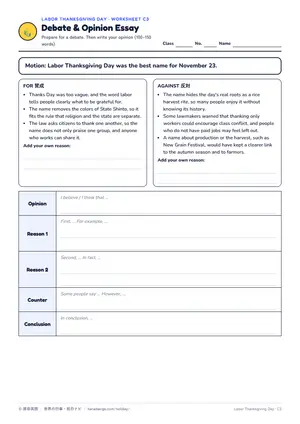
史料ディベート:祝日の名前をどう決めるか
🎯 1948年の国会の議論を読み、名前の候補を比較して論じる。
- 新穀祭・生産感謝の日・感謝の日・労働感謝の日・勤労感謝の日の5案を確認する。
- グループごとに一つの案を担当し、長所と短所を英語でまとめる。
- どの名前がよかったか、英語で討論する。
- 政教分離と伝統の両立について短いエッセイを書く。
詳細版を開く(時間配分・Teacher Talk・板書)
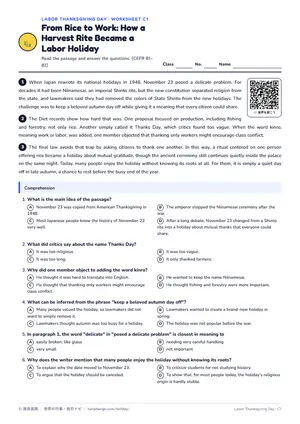
史料の要約と発展セットの英文を読ませ、5つの案が出てきた順番と、それぞれに出た意見を確認する。背景として、新しい憲法で国家と宗教が分けられ、議員たちが新しい祝日から国家神道の色を取り除いたと説明したことを押さえる。
🗣️ Read the Diet records and the passage. / There were five names. Put them in order. / Why was Thanks Day not enough? / Keep in mind the new rule: religion and the state are separate.
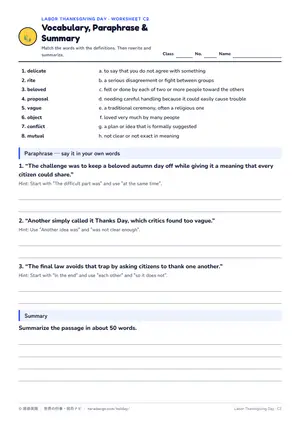
5つのグループに1案ずつ担当させ、その名前の長所と短所を英語でまとめさせる。観点の例(だれでも共有できるか・伝統とのつながり・意味のわかりやすさ・特定の集団だけを指さないか)を示す。新穀祭は伝統に近いが宗教色、感謝の日はわかりやすいがあいまい、労働と勤労は語感の違いなど、史料の意見を根拠に使わせる。
🗣️ Your group has one name. List its strengths and weaknesses. / Can everyone share it? Is it clear? Is it linked to tradition? / Critics found Thanks Day too vague. Do you agree? / Use the Diet records as evidence.
各グループが2分で担当の案を推す立論をし(計10分)、そのあと自由討論で「どの名前がよかったか」を英語で議論させる(10分)。先生は、史料にない主張と史料にもとづく主張を区別するよう促す。
🗣️ Each group has two minutes to argue for its name. / Now open discussion. Which name was the best? / Is that from the records, or is it your opinion? / Respond to the group that spoke before you.
「政教分離と伝統の両立」について、約200語の英語のエッセイを書かせる(14分)。11月23日の夜に宮中では今も新嘗祭(にいなめさい)が行われていることと、祝日法は「国民たがいに感謝しあう」としていることの両方に触れるよう指示する。最後の3分で2人に読ませる。
🗣️ Write about 200 words. How can a country keep a tradition and still separate religion from the state? / Use November 23 as your example. / The ancient rite continues inside the palace. The law asks citizens to thank one another. / Could two people read their essays?
1948: Naming November 23

① 新穀祭 New Grain Festival(衆議院の仮案)
② 生産感謝の日 Production Thanksgiving Day(参議院:海・山の生産も)
③ 感謝の日 Thanks Day →「何に感謝?」too vague
④ 労働感謝の日
⑤ 勤労感謝の日 Labor Thanksgiving Day ← 大多数で決定
   反対意見:「勤労」は階級意識をあおる?

観点:shared by everyone? / clear? / tradition? / one group only?
Essay(200 words):tradition × separation of religion and state