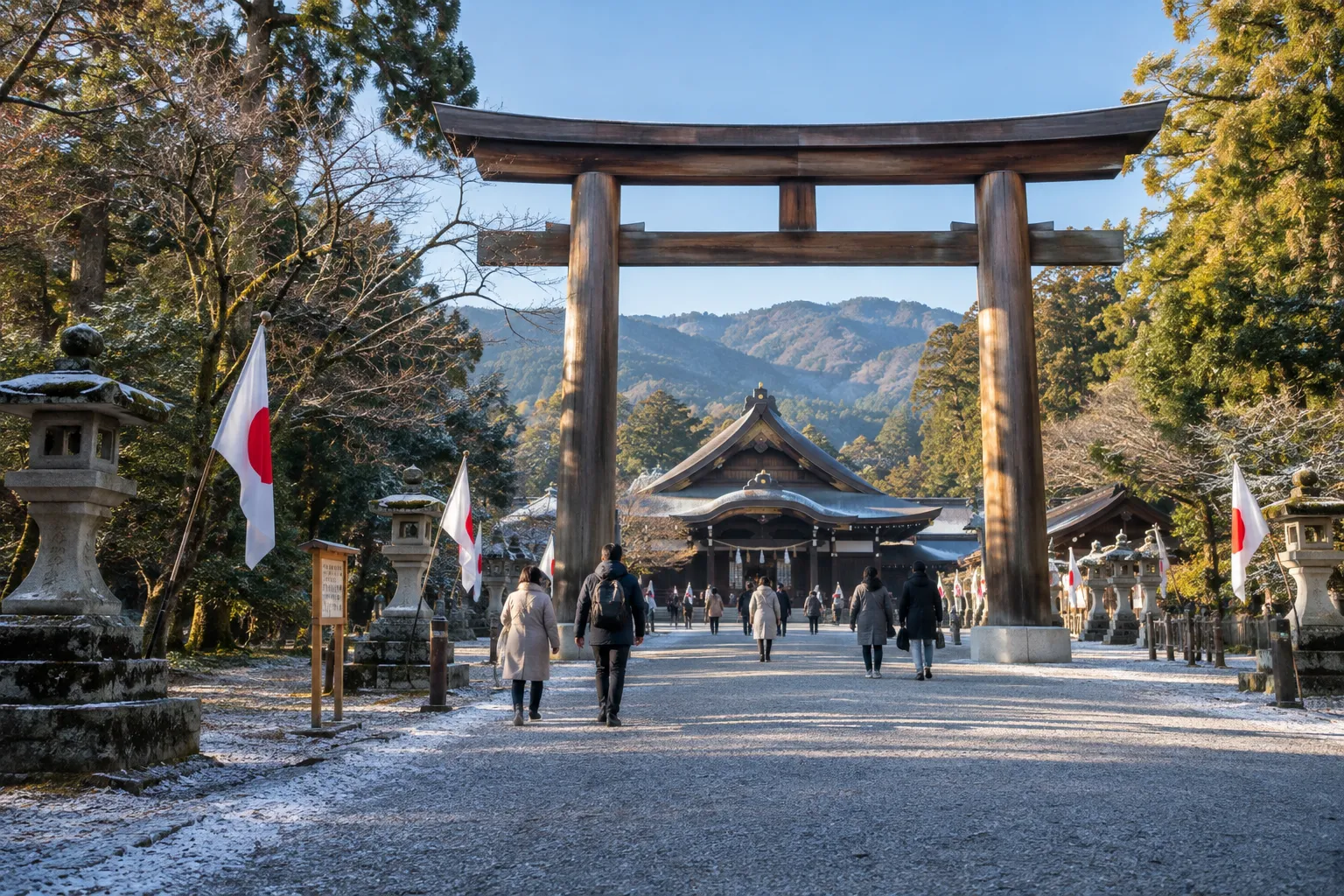
National Foundation Day
建国記念の日の英語の授業アイデアとワークシート
印刷してすぐ使えるワークシート(PDF・Word・解答つき)と、授業の手順書。
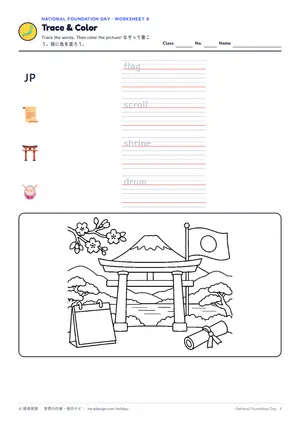
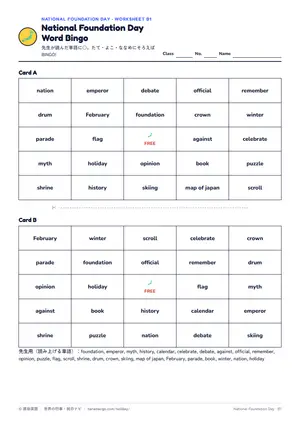
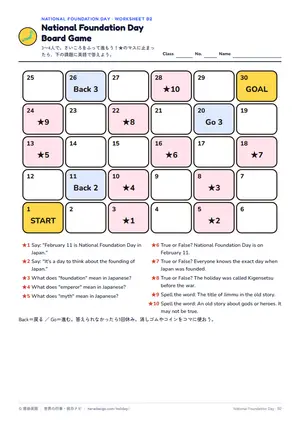
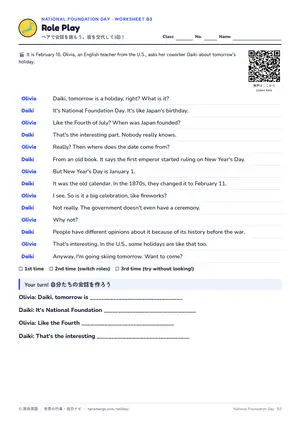
🖨️Worksheetsワークシート(無料・A4)
① 「中身を見る・印刷」で全ページを確認 → ② そのページ上の 🖨️ 印刷する でそのまま印刷できます。A4・無料。
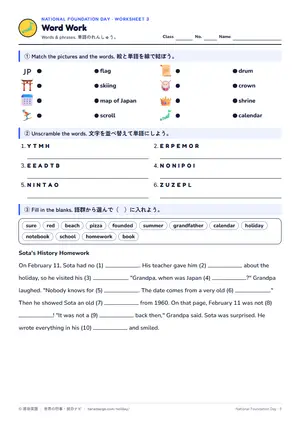
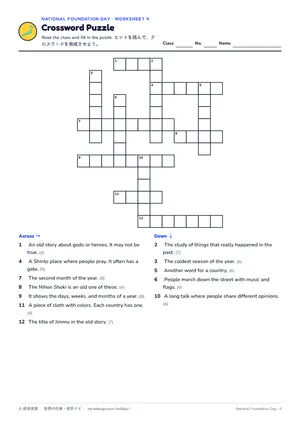
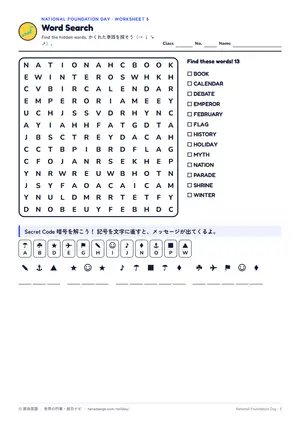
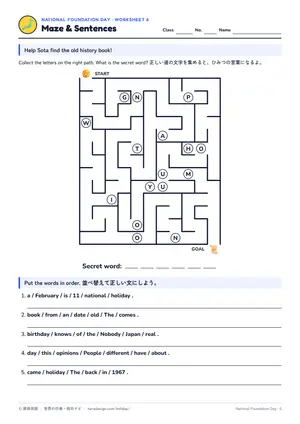
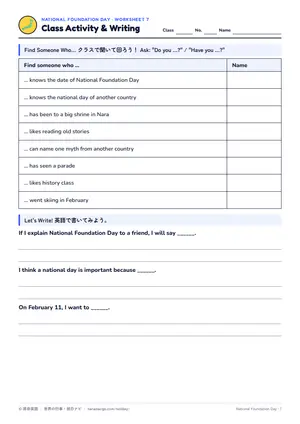
🍎Lesson Ideas建国記念の日を使った英語の授業アイデア
世界の建国記念日カレンダーを作ろう
🎯 国名と月日を英語で言い、世界の建国記念日に興味を持つ。
- アメリカ(July 4)、フランス(July 14)、韓国(October 3)、中国(October 1)、スイス(August 1)などのカードを配る。
- "When is the national day of France?" "It's July 14." の形でペアで質問し合う。
- クラスで1年のカレンダーに国旗を貼っていく。
- どの月にいちばん多いか、英語で1文にまとめる。
詳細版を開く(時間配分・Teacher Talk・板書)
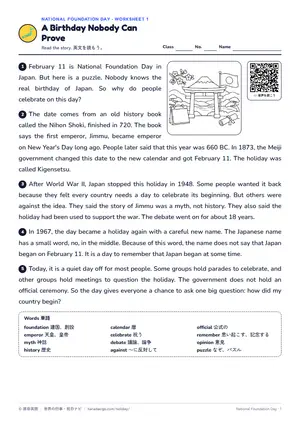
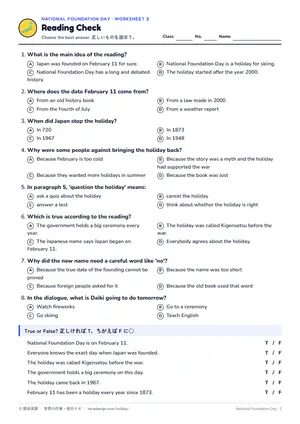
英語ページの会話の冒頭を聞かせ、オリビアが日本の祝日をアメリカの何にたとえたかを聞き取らせる(the Fourth of July)。「多くの国に、国の始まりを祝う日がある」と伝え、日本の建国記念の日が2月11日であることを確認する。
🗣️ Listen. Olivia asks about tomorrow's holiday. / What American holiday does she talk about? The Fourth of July! / Many countries have a national day. Japan's is February 11.
月の名前と序数(first, fourth, fourteenth など)を確認する。When is the national day of France? / It's July 14. の言い方を板書し、日付は July fourteenth と読むことを全員で練習する。
🗣️ Let's review the months. January, February, March ... / July 14 is July fourteenth. / Ask: When is the national day of France? / Answer: It's July fourteenth.
国カードを1人1枚配る(裏は見せない)。立って歩き、ペアを作って When is the national day of __? と質問し合い、答えを聞き取りメモに書かせる。答えたらカードを交換して、次の相手を探させる。
🗣️ Stand up and find a partner. / Ask about your partner's country. / Write the country and the date in your notes. / Then swap cards and find a new partner.
メモをもとに、1人ずつ前に出て黒板のカレンダーに国旗のシールをはらせる。はるときに The national day of __ is __. と言わせる。
🗣️ Come to the front and put your flag on the calendar. / Say: The national day of Canada is July first. / Is it right? Check with your notes.
完成したカレンダーを見て、どの月にいちばん多いかを英語の1文で書かせる(July and October have the most national days.)。最後に「日本の2月11日は、記録のはっきりした出来事の日ではなく、韓国の10月3日と同じように神話(古い本の物語)から来た日付」とひとこと伝えて終わる。
🗣️ Which month has the most national days? / Write one sentence. July and October have the most. / Japan's date comes from a very old book. We will learn more next time.
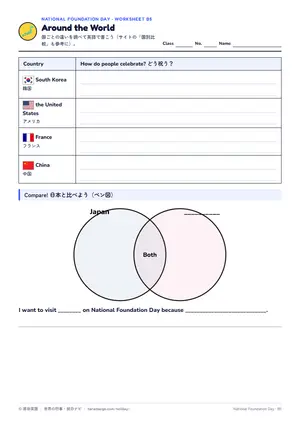
National days around the world 🌍

Q. When is the national day of __?
A. It's __.

January 26 Australia / February 11 Japan / April 21 Rome(city)
July 1 Canada / July 4 the U.S. / July 14 France
August 1 Switzerland / August 15 India / September 7 Brazil
October 1 China / October 3 South Korea, Germany

July and October have the most national days.
「の」の意味を英語で説明しよう
🎯 微妙なニュアンスを、やさしい英語でていねいに伝える。
- 「建国記念日」と「建国記念の日」の違いを日本語で確認する。
- "The name does not say that ..." "It is a day to ..." の形を使って、2〜3文で英語の説明を作る。
- ペアで説明し、相手が "So, does it mean ...?" と確認の質問をする。
- いちばんわかりやすかった説明を黒板で共有する。
詳細版を開く(時間配分・Teacher Talk・板書)
2つの名前のカードを並べて見せ、「どちらが正式な名前?」と聞く。カレンダーや手帳には「建国記念日」と書かれているものもあることにふれ、「の」があるかないかで意味が変わるか考えさせる。
🗣️ Look at these two names. Which one is the official name? / The official name has the small word no. / Does one small word change the meaning? Let's find out.
記事の節を読ませ、「建国記念日」は「2月11日に建国された、その記念日」と読めてしまうこと、「建国記念の日」は「建国されたこと自体を記念する日」と読めるようにした、と説明されていることを確認する。そのうえで本文の第4段落を音声で聞かせ、the name does not say that Japan began on February 11. It is a day to remember that Japan began at some time. の文を確認する。
🗣️ Read the handout. What does the name without no say? / It says Japan began on February 11. But nobody can prove that. / Now listen to paragraph four. How does the text explain it in English? / It is a day to remember that Japan began at some time.
The name does not say that ... / It is a day to ... の形を使い、外国の友だちに向けた2〜3文の説明を自分の言葉で書かせる。本文をそのまま写すのではなく、より簡単な語に言いかえるよう指示する。ペアで説明し合い、聞き手は So, does it mean ...? と確認の質問をし、話し手は答える。
🗣️ Write two or three sentences for a friend from abroad. / Use easier words than the text. / Listeners, check. So, does it mean nobody knows the real date? / Speakers, answer the question.
3〜4人の説明を黒板に書き出し、どれがいちばんわかりやすかったかを投票させる。わかりやすい説明の工夫(短い文、身近な比較、言いかえ)を確認する。最後に、英語名 National Foundation Day と、記事の説明 It's a day to think about the founding of Japan. を紹介して終わる。
🗣️ Here are four explanations. Which is the clearest? / Why is it easy to understand? / In English, we can say: It's a day to think about the founding of Japan.
建国記念日 → Japan was founded on February 11.(とも読める)
建国記念の日 → a day to remember that Japan was founded(建国されたこと自体を記念)

The name does not say that __.
It is a day to __.

Check:So, does it mean __?

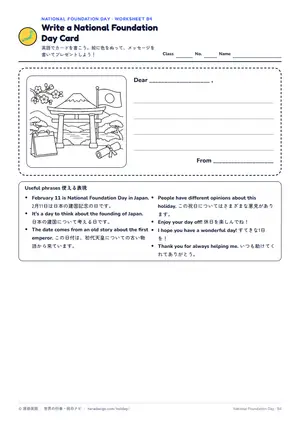
National Foundation Day
It's a day to think about the founding of Japan.
神話と歴史を見分けよう
🎯 myth と history の違いを考え、根拠をもって判断する。
- 神武天皇、檀君(だんくん)、ローマのロムルスなど、建国の話をいくつか英語で短く紹介する。
- グループで、それぞれが myth か history か、どんな証拠があればわかるかを話し合う。
- "We think it is a myth because ..." の形で発表する。
詳細版を開く(時間配分・Teacher Talk・板書)
myth と history を板書し、違いを日本語でも英語でも言わせる。本文の第2段落を音声で聞かせ、2月11日が『日本書紀(にほんしょき)』という720年に完成した本から来ていること、紀元前660年という年はのちの人が計算したものであることを確認する。
🗣️ What is the difference between a myth and history? / Listen. Where does the date February 11 come from? / An old book called the Nihon Shoki, finished in 720. / But the story is about a time long before that. Can we prove it?
4つの英文カードをグループに配り、読ませる。それぞれの話について、いつ書かれた記録にもとづいているかに注目させる。わからない語は語群カードで確認する。
🗣️ Read the four founding stories. / When did each story happen? When was it written down? / Look at the evidence words on the cards.
グループで、それぞれの話が myth か history かを判断シートにまとめさせる。今ある証拠と、判断するのに必要な証拠(同じ時代に書かれた記録、遺跡の発掘など)を英語で書かせる。アメリカの独立宣言を比べる材料にして、「同じ時代の記録がある」ことの意味に気づかせる。
🗣️ Decide: is each story a myth or history? / What evidence do we have now? / What evidence would we need? Written records from the time? Archaeology? / Compare with the Declaration of Independence. Why is it different?
各グループが1つの話を担当して、We think it is a myth / history because ... の形で発表する。最後に、advanced の英文の In both places, few people treat these dates as proven facts, yet many still enjoy them ... の考え方を紹介し、「神話であっても大切にされることがある」と伝えて終わる。
🗣️ Group one, tell us about your story. Myth or history? / We think it is a myth because the book was written much later. / In Korea and Rome, people enjoy these dates, but few people treat them as facts. / Can a myth still be important to people?
Myth or History?

話 / いつのこと / いつ書かれた / 判断
Jimmu(Japan)/ 660 BC とされる / Nihon Shoki, 720 / myth?
Dangun(Korea)/ 2333 BC とされる / much later / myth?
Romulus(Rome)/ 753 BC とされる / much later / myth?
Declaration of Independence(U.S.)/ July 4, 1776 / written at the time / history

Evidence:written records from the time / archaeology / old books written much later / legends

We think it is a myth because __.
We think it is history because __.
公平な紹介文を書く(ペーパー・ディスカッション)
🎯 意見が分かれるテーマを、賛否の両方を示しながら英語で紹介する。
- advanced の英文を読み、事実と意見を色分けする。
- 賛成・反対それぞれの主な理由を英語で3つずつ書き出す。
- 外国の読者向けに、どちらの立場にも寄らない150語の紹介文を書く。
- 互いの文章を読み、公平さについてコメントし合う。
詳細版を開く(時間配分・Teacher Talk・板書)
「この祝日には、国が主催する式典がない」という事実を示し、なぜかを30秒ペアで話させる。本文を読む目的として「公平に紹介するとはどういうことか」を考えることを伝える。
🗣️ There is no official government ceremony on this holiday. Why? / Talk with your partner for thirty seconds. / Today, you will write a fair introduction for readers abroad.
本文を読ませ、事実(年号・出来事)を1色、意見や評価(unusual, especially sensitive など)を別の色でマークさせる。ペアで比べ、判断が分かれた箇所について話し合わせる。
🗣️ Read the passage. Mark facts in yellow and opinions in pink. / Is unusual a fact or an opinion? / Compare with your partner. Where did you disagree?
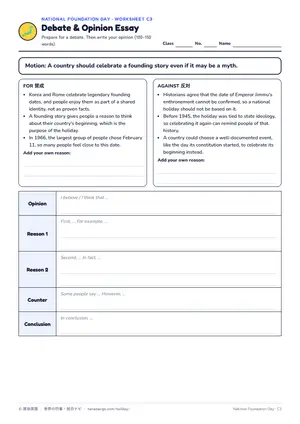
模造紙を使ったペーパー・ディスカッションを行う。グループで声を出さずに、賛成側の理由(どの国にも建国を祝う日がある、長く親しまれた日付、1966年の世論調査で2月11日が47.4%)と、反対側の理由(神武天皇の即位は史実として確かめられない、戦前の国家の考え方と結びついていた、国民主権の憲法と合わない)を英語で書きこみ、ほかの人の書きこみに矢印でコメントさせる。
🗣️ No talking. Write your ideas on the paper. / Write three reasons for each side. / Draw an arrow and comment on someone else's idea. / Use facts from the passage and the handout.
外国の読者向けに、どちらの立場にも寄らない150語の紹介文を書かせる。構成は、①祝日の基本情報 ②日付の出どころ ③賛成と反対の理由を同じ分量で ④今の過ごし方(祝う人、問い直す人、ただの休日として過ごす人)。評価のことばを避け、Some people believe ... / Others argue ... を使うよう指示する。
🗣️ Write a 150-word introduction for readers abroad. / Give the facts first. Then explain both sides equally. / Use Some people believe ... and Others argue ... / Avoid words that show your own opinion.
ペアで紹介文を交換し、チェックリストを使って公平さについてコメントさせる。片方の立場に寄っていると感じた語を1つ指摘し、言いかえ案を書かせる。
🗣️ Exchange your writing with a partner. / Use the checklist. Is it fair to both sides? / Point out one word that sounds one-sided, and suggest another word.
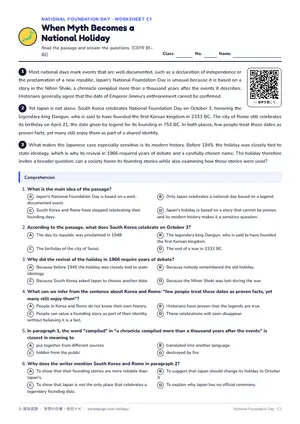
When Myth Becomes a National Holiday

Facts:Nihon Shoki(compiled more than 1,000 years after the events)/ 1948 removed / 1966 law revived it / first day in 1967 / no official government ceremony
Opinions:unusual / especially sensitive

For:every country has a founding day / a date people knew for a long time / 1966 poll:Feb 11 = 47.4%
Against:the date of Jimmu's enthronement cannot be confirmed / tied to state ideology before 1945 / does not fit the new constitution

Fair writing:Some people believe __. Others argue __.
Today:some celebrate, some question, many just enjoy a day off