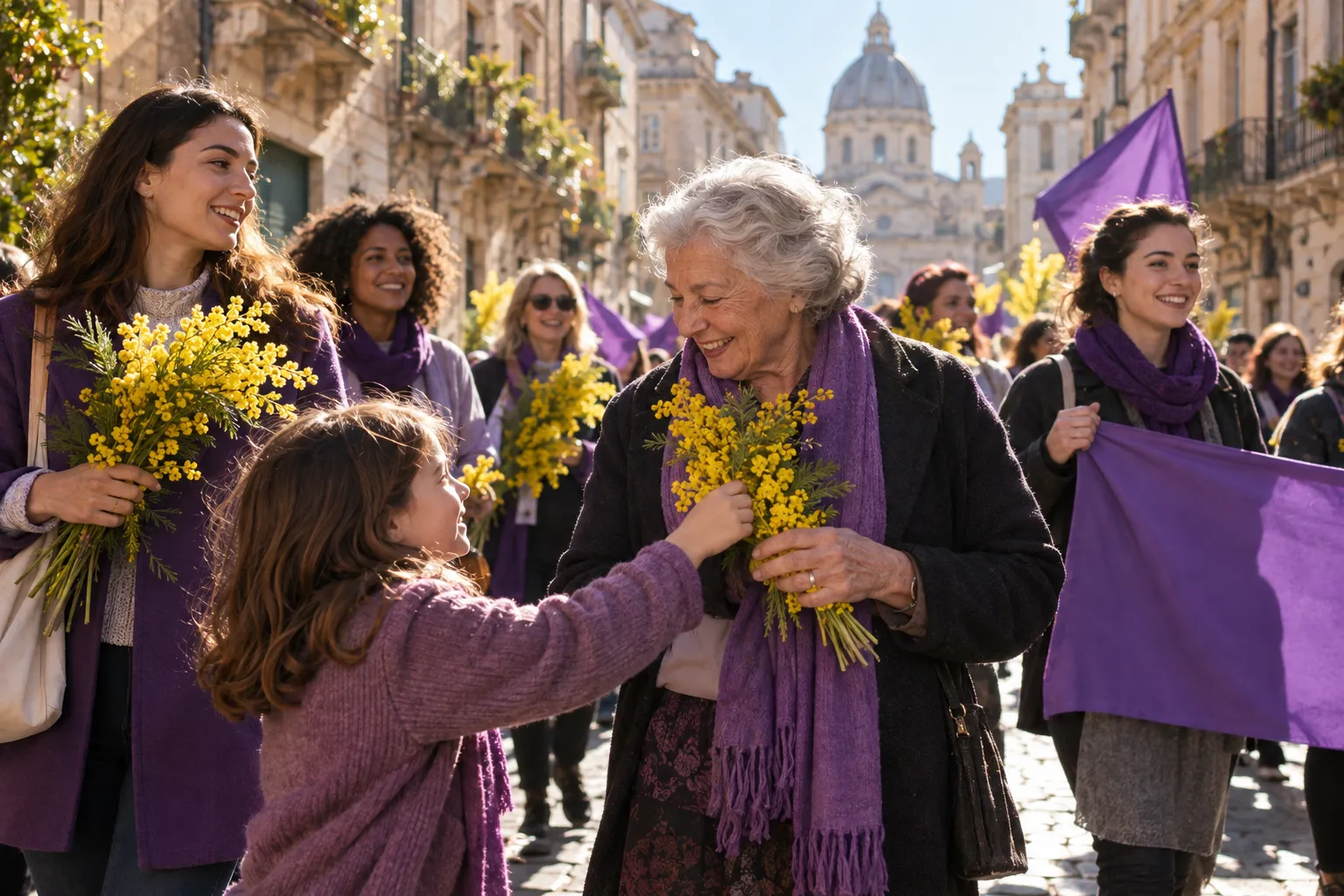
International Women's Day
国際女性デーの英語の授業アイデアとワークシート
印刷してすぐ使えるワークシート(PDF・Word・解答つき)と、授業の手順書。
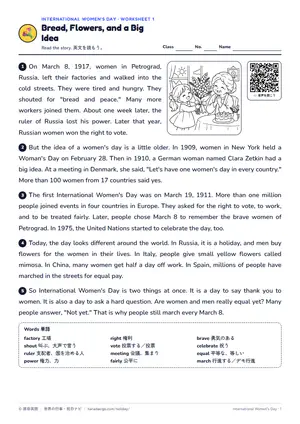
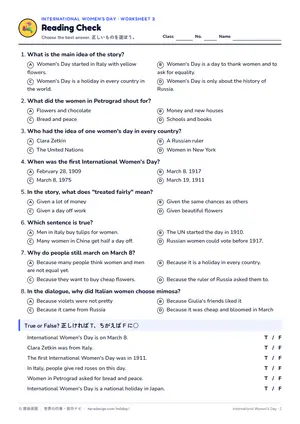
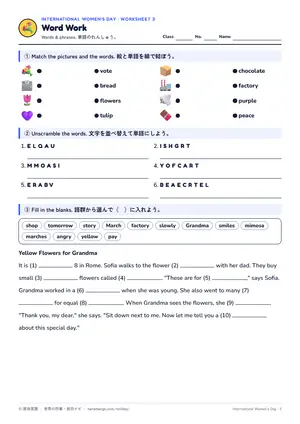
🖨️Worksheetsワークシート(無料・A4)
① 「中身を見る・印刷」で全ページを確認 → ② そのページ上の 🖨️ 印刷する でそのまま印刷できます。A4・無料。
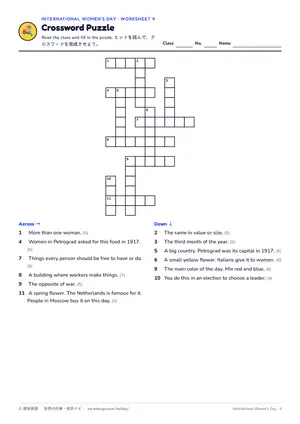
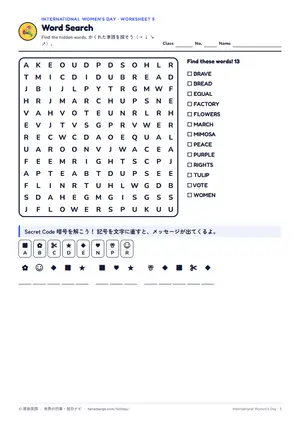
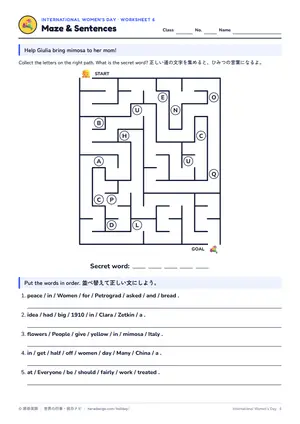
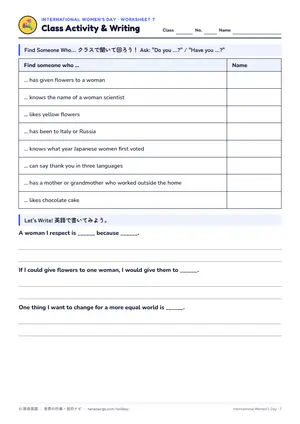
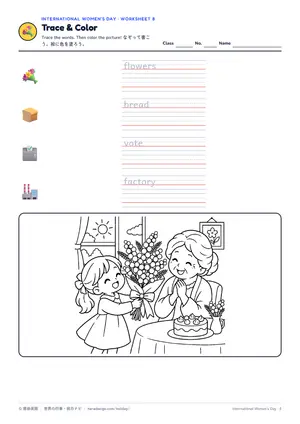
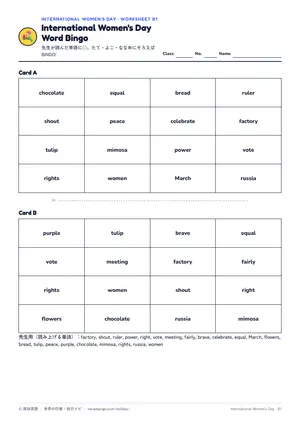
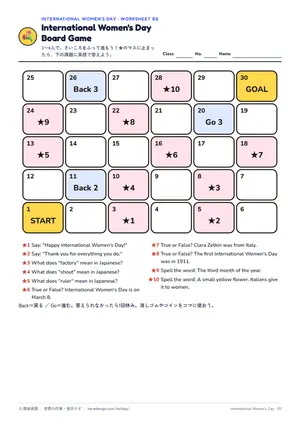
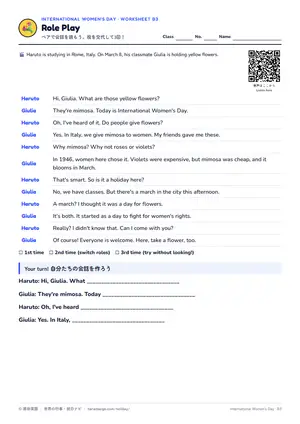
🍎Lesson Ideas国際女性デーを使った英語の授業アイデア
1857年の謎を解け:由来の探偵ゲーム
🎯 「よく知られた由来」を資料で確かめる力をつける。
- 「国際女性デーは1857年のニューヨークのデモが由来」という説明を見せ、本当か予想させる。
- ヒントカードを配る(1857年3月8日は日曜日/当時の新聞に記事がない/話が初めて出たのは1955年)。
- 班で「本当/ウソ/わからない」を判定し、理由を英語1文で書く。
- 本当の由来(1917年ペトログラード)を本文で確認し、なぜ作り話が広まったか話し合う。
詳細版を開く(時間配分・Teacher Talk・板書)
よく知られた説明のカードを見せ、「国際女性デーは1857年のニューヨークのデモが由来。本当?」と聞く。日本語の解説でもよく見る話であることを伝え、手を挙げさせて予想をとる。
🗣️ Read this card. Many websites say this. / Is it true? Raise your hand if you think so. / Today, you are history detectives. Let's check the evidence.
班にヒントカード3枚を配り、1枚ずつ読んで「この事実は何を意味する?」を話し合わせる。最後に True / False / We can't be sure を判定し、理由を英語1文で書かせる(We can't be sure because no newspaper reported it in 1857.)。
🗣️ Read the three hint cards. / March 8, 1857, was a Sunday. Why is that important? / Decide. True, false, or we can't be sure? / Write your reason in one sentence.
各班の判定と理由を聞く。そのうえで英語ページ本文を読ませ、本当の由来(1909年のニューヨークの Woman's Day、1910年のツェトキンの提案、1911年3月19日の最初の国際女性デー、1917年3月8日のペトログラード)を確かめる。
🗣️ Tell us your answer and your reason. / Now read the passage. When was the first International Women's Day? / Why do we celebrate on March 8? / Yes. To remember the brave women of Petrograd in 1917.
「なぜ作り話が広まったのか」を班で話し合わせる。研究者の説(冷戦の時代に、ソ連のイメージから離れたアメリカの起源を与えた)を紹介し、由来を確かめる大切さをまとめる。
🗣️ Why did this story spread? Talk in your group. / Some researchers think it gave the day an American origin during the Cold War. / Always check the evidence!
The 1857 Mystery
"IWD began with a march in New York on March 8, 1857." → ?

Hints:
① March 8, 1857 = Sunday
② no newspaper report in 1857
③ first printed in a French newspaper in 1955

Real history:
1909 New York:Woman's Day(Feb 28)
1910 Clara Zetkin:"one women's day in every country"
1911 Mar 19:first IWD(over one million people)
1917 Mar 8:Petrograd → "bread and peace"

We can't be sure / It is false because __.
Thank You カード:身近な女性への英語メッセージ
🎯 感謝の気持ちを英語の短い文で書けるようにする。
- greetings の表現(Thank you for everything you do. など)を音読する。
- 母・祖母・先生・友だちなど、カードを贈る相手を1人決める。
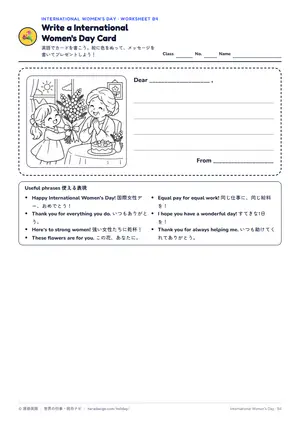
- I want to thank you because ~. の形で2〜3文書き、ミモザの絵を描く。
- ペアで読み合い、相手のカードのよい表現を1つ伝える。
詳細版を開く(時間配分・Teacher Talk・板書)
ミモザの写真を見せ、イタリアでは3月8日にこの黄色い花を女性に贈ることを紹介する。あいさつ表現のカードを全員で音読する。
🗣️ This is mimosa. In Italy, people give it to women on March 8. / Let's read these. Happy International Women's Day! / Thank you for everything you do.
カードを贈る相手(母・祖母・先生・友だちなど)を1人決めさせる。I want to thank you because 〜. の形で2〜3文書き、ミモザの絵を描かせる。語群から選んでもよいと伝え、机間指導で表現を助ける。
🗣️ Choose one woman. Your mother, your grandmother, a teacher, or a friend. / Write: I want to thank you because you always listen to me. / Add one more sentence. Then draw some mimosa.
ペアでカードを読み合い、相手のカードのよい表現を1つ伝えさせる(I like "you always listen to me.")。カードは持ち帰って渡すように伝える。
🗣️ Read your card to your partner. / Tell your partner one nice phrase. I like your sentence about ... / Take your card home and give it to her!
🌼 March 8:International Women's Day
Italy → mimosa(yellow flowers)

Happy International Women's Day!
Thank you for everything you do.
I want to thank you because you __.
These flowers are for you.
花の国・デモの国:世界の3月8日マップ
🎯 同じ記念日でも国によって意味が違うことを比べて説明する。
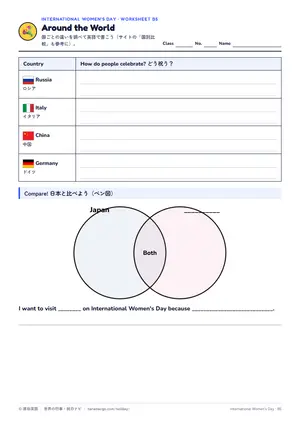
- 国別比べの表を班ごとに2か国ずつ分担する。
- その国の過ごし方を「Flowers / Holiday / Protest」のどれに近いか地図に色分けする。
- なぜその国はその形になったのか、歴史と結びつけて仮説を立てる。
- 英語で1分発表する(In Italy, people ... because ...)。
詳細版を開く(時間配分・Teacher Talk・板書)
英語ページ本文の第4段落を聞かせ、ロシア・イタリア・中国・スペインの過ごし方のちがいを確かめる。「花を贈る国」「休みの国」「デモの国」の3つの型を示し、地図の色分けのルールを説明する。
🗣️ Listen. What do people do in Russia? In Italy? In Spain? / Some countries give flowers. Some have a holiday. Some march in the streets. / Yellow for flowers, green for holiday, purple for protest.
4つの班に国別比べの表から2か国ずつ分担させる。その国の過ごし方を読み、Flowers / Holiday / Protest のどれに近いかを決めて地図に色をぬらせる。2つ以上にあてはまる国は、色を重ねてよい。
🗣️ Read about your two countries. / Is it flowers, a holiday, or a protest? Maybe two of them. / Color the map.
「なぜその国はその形になったのか」を、歴史と結びつけて仮説を立てさせる(ロシア=1917年のペトログラードの国、イタリア=1946年に女性団体がミモザを選んだ、スペイン=2018年の同一賃金を求めるストライキ など)。記事や本文から根拠を探させる。
🗣️ Why is the day like this in your country? Make a guess. / Look for clues in the passage and the article. / Russia is where the 1917 march happened. Does that help?
各班が1分ずつ英語で発表する(In Italy, people give mimosa because women chose it in 1946.)。発表に合わせて黒板の大きな地図に色をぬっていく。
🗣️ Each group, one minute. / Use this pattern. In Italy, people give mimosa because ... / Let's color the big map together.
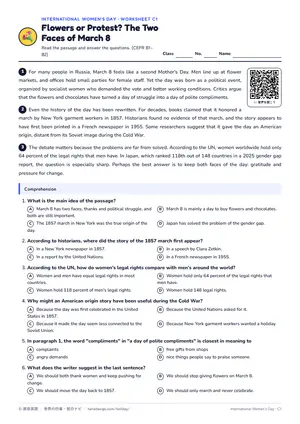
advanced の英文第1段落の Critics argue that the flowers and chocolates have turned a day of struggle into a day of polite compliments. を紹介し、「花」と「デモ」のどちらも大事か、一言ずつ意見を書かせる。
🗣️ Some people say flowers turned a day of struggle into a day of compliments. / Do you agree? Write one sentence.
Flowers 🌼 / Holiday 🟩 / Protest 🟪
Russia:holiday + flowers(Petrograd 1917)
Italy:mimosa(chosen in 1946)
China:half a day off for women
Germany:holiday in Berlin(since 2019)
Spain:protest(2018:strike for equal pay)
Vietnam:two women's days(March 8 and October 20)
the U.S.:Women's History Month
Japan:not a holiday, more mimosa every year

In __, people __ because __.
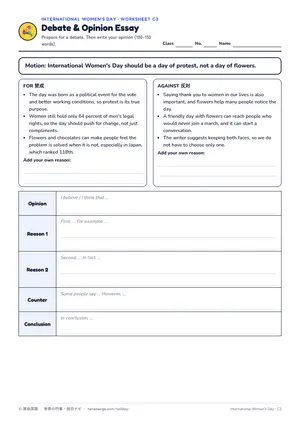
数字で見るジェンダーギャップ・ディベート
🎯 統計を根拠に英語で意見を述べる。
- ジェンダーギャップ指数(2025年、日本は148か国中118位)と分野別の結果を読む。
- 論題「Japan should set a quota for women in politics.」を示し、賛否に分かれる。
- advanced の英文と統計から根拠を3つ集める。
- ディベートを行い、最後に自分の本当の意見を英語で100語書く。
詳細版を開く(時間配分・Teacher Talk・板書)
「日本はジェンダーギャップ指数で何位?」とクイズを出し、148か国中118位であることを示す。分野別の結果を見せ、どの分野で差が大きいかを予想させてから確かめる。
🗣️ Guess Japan's rank in the 2025 gender gap report. / 118th out of 148 countries. / Which areas are the problem? Education, health, economy, or politics?
advanced の英文を読ませ、第3段落の UN の数字(法的な権利は男性の64%)と日本の順位を確かめる。論題 Japan should set a quota for women in politics. を示し、quota の意味を確認して賛否に分ける。
🗣️ Read the passage. What does the UN number tell us? / Here is the motion. Japan should set a quota for women in politics. / A quota means a fixed number or percentage. For example, 30 percent of candidates.
チームで根拠を3つ集めさせる(統計・本文・そのほかの調べた事実)。2018年に成立した「政治分野における男女共同参画推進法」(候補者の数をできるだけ男女均等にするよう政党に求める法律)や、ほかの国のクオータ制を調べてよいとする。
🗣️ Find three reasons. Use the data, the passage, and your research. / You can look up Japan's 2018 law on gender balance in politics. / What do other countries do?
立論(各2分)→ 質問(各1分)→ 作戦タイム(2分)→ 反論(各2分)→ 最終弁論(各1分)の順でディベートを行う。数字を引用するときは出典を言わせる。
🗣️ For team, two minutes. Please begin. / Where is that number from? Tell us the source. / Against team, answer their strongest point. / Final statements, one minute each.
チームの立場とは別に、自分の本当の意見を英語で100語書かせる。advanced の英文最後の keep both faces of the day: gratitude and pressure for change にふれてもよいとする。
🗣️ Now, what do you really think? Write 100 words. / Use at least one number as evidence. / You can finish with the writer's idea: gratitude and pressure for change.
Gender Gap Report 2025:Japan 118th / 148
→ education, health:small gap
→ politics, economy:big gap
→ only G7 country outside the top 100
UN:women hold only 64 percent of the legal rights that men have

Motion:Japan should set a quota for women in politics.
quota = a fixed number or percentage

立論2分 → 質問1分 → 作戦2分 → 反論2分 → 最終1分
3分スピーチ:わたしの「すごい女性」
🎯 人物紹介の英語を使ってスピーチする。
- クララ・ツェトキンや山川菊栄など、本文に出てくる女性を例に、人物紹介の型を確認する(She was born in ... / She is famous for ...)。
- 自分が尊敬する女性(有名人でも家族でもよい)を1人選ぶ。
- その人の「すごいところ」を3つ英語でメモする。
- 1人3分でスピーチし、聞き手は質問を1つする。
詳細版を開く(時間配分・Teacher Talk・板書)
例の人物カードを使い、先生がクララ・ツェトキンと山川菊栄を英語で短く紹介する。型カードの表現に下線を引かせ、人物紹介の流れ(生まれ → 何で有名 → 尊敬する理由)を確かめる。
🗣️ Let me introduce two great women. / Clara Zetkin was a German woman. In 1910, she said, Let's have one women's day in every country. / Yamakawa Kikue was a Japanese writer. In 1923, she called for the first Women's Day meeting in Japan. / I respect them because they were brave.
自分が尊敬する女性(有名人でも家族でもよい)を1人選ばせ、その人の「すごいところ」を3つ英語でメモさせる。メモは文ではなく単語やフレーズでよいと伝える。
🗣️ Choose one woman you respect. She can be famous or in your family. / Write three great things about her. / Just words and phrases are OK.
1人3分(質問をふくむ)でスピーチをする。メモを見てよいが、顔を上げて話すよう促す。聞き手は1つ質問をする(When did you meet her? / What is she doing now? など)。
🗣️ You have three minutes, including questions. / Look up when you speak. / Listeners, ask one question. What is she doing now?
スピーチのよかった点を1つずつ伝え、よく使われた表現を板書してふり返る。次回までに、スピーチを作文として書いてくる課題を出す。
🗣️ Great speeches, everyone! / Homework: Write your speech as a short essay.
My Amazing Woman

She was born in __.
She is famous for __.
She __ in __.(過去の出来事)
I respect her because __.
I want to be like her because __.

Questions:
When did you meet her? / What is she doing now?