
 語学・英語学習ビミョー
英作文は「書いてから、お手本と見比べる」がよさそう。書く途中で詰まった所ほど、お手本の表現を覚えていた
 2026.10.02
 English Corner(A2〜B2・4択クイズ)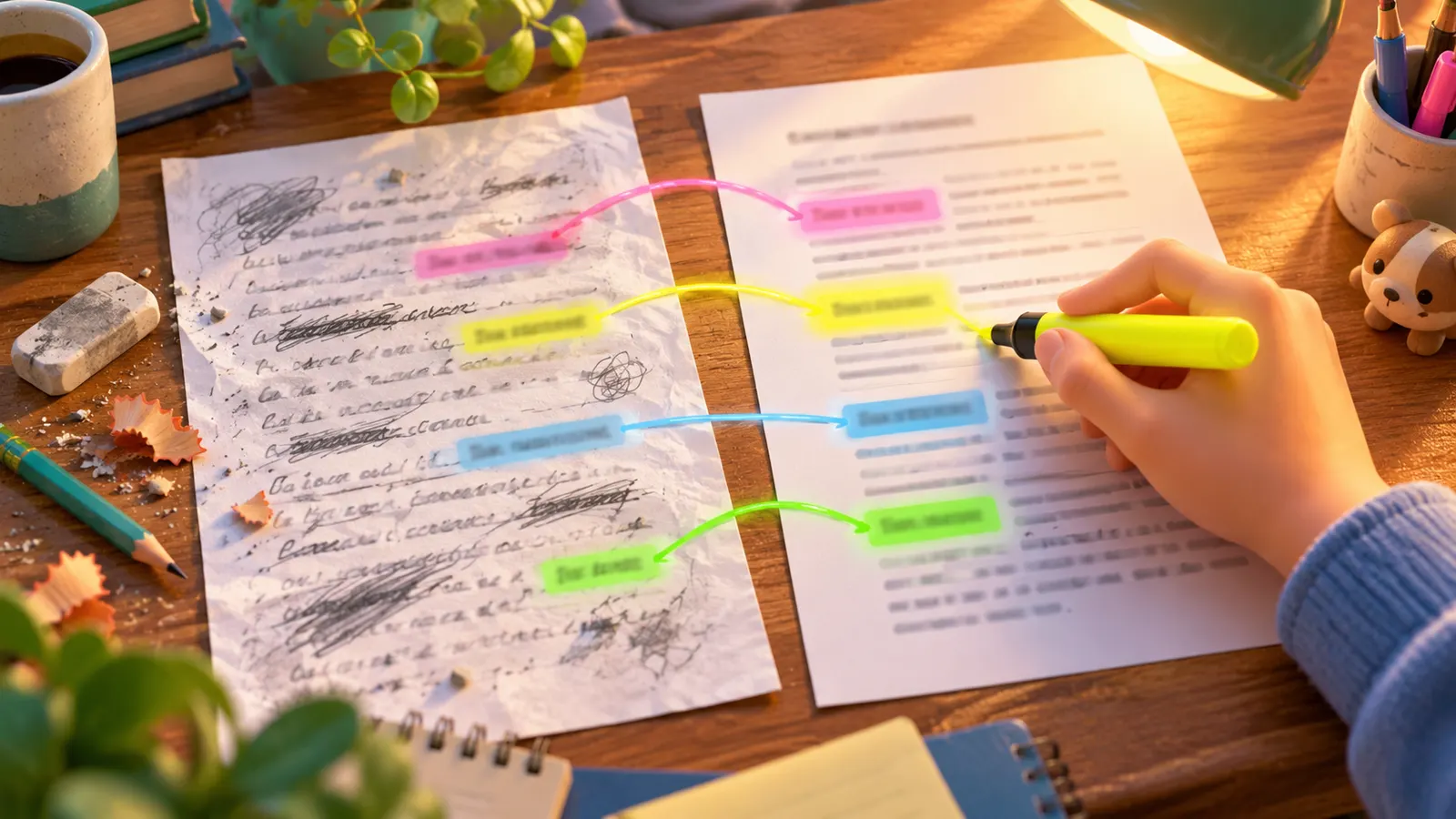
 読む前に予想してみよう!
英作文のお手本は、自分で書く前に読んだほうが、書いた後に読むより必ず学びが大きい
先に書いて「言えない」部分に気づいてからお手本を読むと、その部分の表現を優先的に取り込み、長く覚えていたという研究がある。
 研究カード(どんな研究?)
- 対象
- 日本人大学生、カナダの中国語話者など
- 規模
- 数人〜数十人規模
- 研究の種類
- 記述的研究・事例研究
- 確かさ
- ★★☆☆☆
先に英作文を書き、後でお手本と比べると、学習者は自分が困った部分の表現をお手本から見つけて取り込んだ。困った所に関係する表現ほど、時間をおいた書き直しでも使われていた。
ひとことで言うとまず自分で書く→お手本と見比べる。「言えなかった所」の表現ほど覚えやすいみたい!
英作文の勉強法として、お手本の英文を読んでマネするのは定番です。でも、お手本を読むタイミングは書く前がいいのでしょうか、それとも書いた後?
日本の大学生を対象にした研究から、「まず自分で書いて、それからお手本と見比べる」ことの強みが見えてきました。
014段階の英作文実験
つまり、書いている最中に「これ英語で何て言うんだろう?」と困った経験が、お手本を読むときの「探しもの」になっていたのです。探していた答えを見つけると、その表現は記憶に残りやすいようです。
一方、自分が困っていなかった部分の表現は、お手本に書かれていても、取り込まれる割合が低めでした。
02「書く」ことで、自分の“穴”が見える
カナダの言語学者スウェインとラプキンは1995年、データを示して次のように報告しました。学習者は書く途中で「言いたいことが言えない」と気づくと、言い方をあれこれ考え直しはじめるのです。2人は、この考え直しが学習の一部になっていると考えています。
つまり、書いてみると自分の英語の「穴」(言いたいのに言えない所)が分かります。穴が分かった状態でお手本を読むと、その穴を埋める表現が見つけやすくなるのです。
花岡と泉による2012年の研究では、穴の中でも「言いたかったけれど、書くのをあきらめた」ような、作文に表れない問題に注目しました。学習者はこうした見えない問題についても、自分で答えを見つけて書き直しに取り込んでいました。お手本の文章には、作文に表れた問題と表れない問題の両方の答えが、ほぼ同じくらい含まれていました。

03注意点:英語力によって「気づく量」が違う
ただし、この方法にも限界があります。
花岡の研究では、英語の熟達度が高い学習者ほど、お手本と見比べたときに多くのことに気づいた一方、熟達度が低い学習者は気づく量が少なめでした。
チーとラプキンの2001年の事例研究は、カナダで英語を学ぶ中国語話者2人を詳しく調べました。2人は、自分の作文をネイティブが書き直した文と見比べています。この研究では、気づきの「質」が大切だと指摘されています。単に「違う」と気づくだけでなく、なぜそう書くのかまで理解する深い気づきのほうが、書き直しの改善につながっていました。
また、これらの研究は少人数で、比べるグループのない記述的な研究が中心です。「お手本比較が他の方法より優れている」と言い切るには、まだ証拠が足りません。
04まとめ
英作文は、まず自分で書いて「言えない!」と困り、そのあとでお手本を見る。この順番が、新しい表現を自分のものにする助けになりそうです。
次の英作文では、詰まった所に★をつけておきましょう。お手本の中で見つけたその答えは、記憶に残りやすいかもしれません。
この研究を英語で読もう原田英語の English CornerModel texts are a common tool for learning to write in English, but when should learners read them? 音声
音声 4択クイズ9問A2・B1・B2タップして開く
原田英語の English Corner
この研究を英語で読もう
Should you read a model essay before you write, or after? A 2007 study with Japanese university students points to a strength of writing first. The students first wrote a story in English.
Then they compared it with two model stories. They mostly noticed words and phrases. They especially took in expressions for the parts they had trouble with. These expressions stayed in their memory longer. So write first, mark the hard parts, and then check the model.
78 words ・ CEFR A2
和訳を見る
お手本の作文は、書く前に読むべきでしょうか、それとも書いた後でしょうか。日本の大学生を対象にした2007年のある研究は、先に書くことの強みを示唆しています。学生たちはまず英語で物語を書きました。
それから、それを2つのお手本の物語と比べました。彼らが気づいたのは主に単語や表現でした。特に、自分が苦労した部分の表現を取り入れていました。それらの表現は、より長く記憶に残りました。だから、まず書いて、難しかった部分に印をつけ、それからお手本を確認しましょう。
4択リーディングクイズ
Q1. What is the passage mainly about?
まず書いてからお手本と比べることの効果がテーマなので D。
Q2. What did the students mostly notice in the model stories?
They mostly noticed words and phrases. とあるので C。
Q3. In this passage, "compared" means the students ...
compare は「比べる」。自分の作文とお手本の同じ点・違う点を見ること。正解は B。
Model texts are a common tool for learning to write in English, but when should learners read them? In a 2007 study, Hanaoka gave Japanese university students a four-stage task. First, they wrote a story based on pictures while noting any problems.
Next, they compared their stories with two model texts written by native speakers. Then they rewrote the story immediately, and again after some time. Most of what the students noticed was vocabulary. Expressions related to problems they had faced while writing were often taken from the models and remembered in later rewrites.
So struggling to say something gave them a reason to look for the answer. However, more proficient students noticed more, and the study had no comparison group.
121 words ・ CEFR B1
和訳を見る
お手本の文章は英語で書くことを学ぶための一般的な道具ですが、学習者はいつそれを読むべきなのでしょうか。2007年の研究で、花岡は日本の大学生に4段階の課題を与えました。まず、学生たちは困ったことをメモしながら、絵をもとに物語を書きました。
次に、自分の物語をネイティブスピーカーが書いた2つのお手本と比べました。そして、すぐに物語を書き直し、時間をおいてもう一度書き直しました。学生たちが気づいたことの大部分は語彙でした。書いている間に直面した問題に関わる表現は、お手本から取り込まれることが多く、後の書き直しでも覚えられていました。
つまり、何かを言おうとして苦労したことが、答えを探す理由になったのです。ただし、熟達度の高い学生ほど多くに気づき、この研究には比較グループがありませんでした。
4択リーディングクイズ
Q1. What did the students do in the first stage?
First, they wrote a story based on pictures while noting any problems. とあるので A。
Q2. Which expressions were often taken from the models?
Expressions related to problems they had faced while writing were often taken from the models とあるので D。
Q3. What does the writer mean by "struggling to say something gave them a reason to look for the answer"?
言えなくて困った経験が、お手本で答えを探す動機になった、という意味なので C。
Hanaoka's 2007 study began with a picture story. Japanese university students wrote it in English and, as they worked, noted problems they ran into. Then they compared their stories with two versions written by native speakers, revised at once, and revised again after a delay.
Almost everything they noticed in the models was vocabulary. What they kept tells us even more. Expressions that matched problems the learners had flagged during the first draft were adopted at a high rate and tended to survive into the delayed revision.
Features unrelated to those problems were taken up less often. This fits Swain and Lapkin's argument that producing output makes learners aware of gaps in their knowledge, and those gaps then steer attention when new input arrives. The benefits were not shared equally.
More proficient learners noticed considerably more, and Qi and Lapkin's case study of two Chinese speakers in Canada suggested that the quality of noticing, not only its quantity, predicts improvement. None of these studies had a control group, and all were small and descriptive. What they do document is the order of events. In Hanaoka's design, the first draft handed each learner specific questions to bring to the model.
199 words ・ CEFR B2
和訳を見る
花岡の2007年の研究は、絵にもとづく物語から始まりました。日本の大学生がその物語を英語で書き、書きながら、行き詰まった問題をメモしました。次に、自分の物語をネイティブスピーカーが書いた2つのお手本と比べ、すぐに書き直し、時間をおいてもう一度書き直しました。
彼らがお手本の中で気づいたことは、ほとんどすべてが語彙でした。何が残ったかからは、さらに多くのことが分かります。最初の下書きの段階で学習者が自覚した問題に合う表現は高い割合で取り入れられ、時間をおいた書き直しにも残る傾向がありました。
そうした問題に関係のない特徴は、取り入れられる割合が低めでした。これは、アウトプットを産出することで学習者は自分の知識のギャップに気づき、そのギャップが新しいインプットに出会ったときの注意を導く、というスウェインとラプキンの主張と合っています。効果は誰にでも同じように表れたわけではありません。
熟達度の高い学習者のほうがかなり多くのことに気づき、カナダの中国語話者2人を対象としたチーとラプキンの事例研究は、気づきの量だけでなく質が改善を予測することを示唆しました。これらの研究にはどれも対照群がなく、すべて小規模で記述的なものでした。これらの研究が記録しているのは、出来事の順序です。花岡の設計では、最初の下書きが、お手本に向かうときの具体的な疑問を一人ひとりの学習者に与えていたのです。
4択リーディングクイズ
Q1. What is the main idea of the passage?
書いてからお手本と比べると、困った部分の表現に気づき保持しやすいが、対照群のない小規模な研究しかない、という内容なので C。
Q2. How does Swain and Lapkin's argument relate to the study?
producing output makes learners aware of gaps in their knowledge, and those gaps then steer attention when new input arrives とあるので B。
Q3. What weakness of these studies does the author point out?
None of these studies had a control group, and all were small and descriptive. とあるので D。
重要単語
- model textB2名詞(句)お手本の文章(モデル文)Compare your essay with a model text.
 model essay / model answer「模範解答」とも言う。model は「手本・模範」の意味。
 - noticeB1動詞・名詞気づく・気づきLearners noticed useful phrases in the model. SLA では noticing(気づき)が習得の入口とされる(Schmidt の気づき仮説)。notice the gap「ギャップに気づく」。
- incorporateC1動詞取り入れる・組み込むShe incorporated new expressions into her revision. incorporate A into B「A を B に取り入れる」。in-(中に)+ corpor(体)。
- revisionB2名詞書き直し・修正The second revision was much better. 動詞 revise。研究では immediate revision(直後の書き直し)と delayed revision(時間をおいた書き直し)を比べる。
- holeA2名詞穴・(知識の)欠けている所Writing shows you the holes in your English. SLA では「言いたいのに言えない部分」を hole や gap と呼ぶ。a hole in one's knowledge「知識の穴」。
- lexicalC1形容詞語彙のMost of what learners noticed was lexical. lexicon(語彙・辞書)の形容詞。lexical item「語彙項目」、grammatical(文法の)と対で使う。
- outputB2名詞アウトプット(話す・書くこと)Output helps learners find gaps in their knowledge. SLA では input(聞く・読む)と対。Swain のアウトプット仮説は「話す・書く」ことの学習効果を説く。
 入試に出る順の単語帳を印刷する →
 全5903語の「科学英単語カード」で復習する →
 この話題を TED で聞く
同じテーマの TED・TED-Ed を、 TED HACK で。英語の見どころ・使える表現・学習ミッションつきの日本語ガイドです。(運営:原田英語)

このネタ、誰かに教えたくなった?
英作文は「自分で書いてから、お手本と見比べる」のが効くかも。日本の大学生の研究では、書きながら「これ英語で何て言う?」と困った部分の表現ほど、後の書き直しに取り込まれ、時間がたっても覚えていたらしい。
押すと「マジかリスト」に保存されます
 出典・参考文献(4件)タップで表示
- Hanaoka (2007) Output, noticing, and learning: An investigation into the role of spontaneous attention to form in a four-stage writing task. Language Teaching Researchdoi.org
- Hanaoka & Izumi (2012) Noticing and uptake: Addressing pre-articulated covert problems in L2 writing. Journal of Second Language Writingdoi.org
- Qi & Lapkin (2001) Exploring the role of noticing in a three-stage second language writing task. Journal of Second Language Writingdoi.org
- Swain & Lapkin (1995) Problems in output and the cognitive processes they generate: A step towards second language learning. Applied Linguisticsdoi.org

※本記事は上記の研究・公開資料をもとに、原田英語が独自の言葉で解説したものです。引用は著作権法第32条の範囲で行い、出典を明記しています。画像はすべてオリジナルのイメージです。研究結果には限界や個人差があります。誤りのご指摘は原田英語のお問い合わせフォームから。

別館
マジか!?ことばで読む、ことばの雑学
英語と日本語の「えっ、マジか!?」を辞書と論文でウラ取りする別館
 これも「マジか!?」
 語学
語学
英作文で「日本語で書いてから訳す」はダメ? 英語が苦手な人ほど訳すほうが良かった実験

 語学
語学
英作文は友だちと添削し合うと伸びる? 実は「直してもらう側」より「直す側」が伸びていた
 語学
語学
英作文の赤ペンは「全部直す」か「1つに絞る」か。日本の大学生で比べたら、効果は引き分けだった
 語学
語学
AI添削で英作文はうまくなる? 研究のまとめは「効く」、でも頼りきると自力が育たない恐れも
 語学
語学
カタカナ語になっている英単語は覚えやすい。でも覚えた直後は、文の中で使うのが意外と難しかった
 語学
語学