 ワークシート
 ぬりえ
 迷路
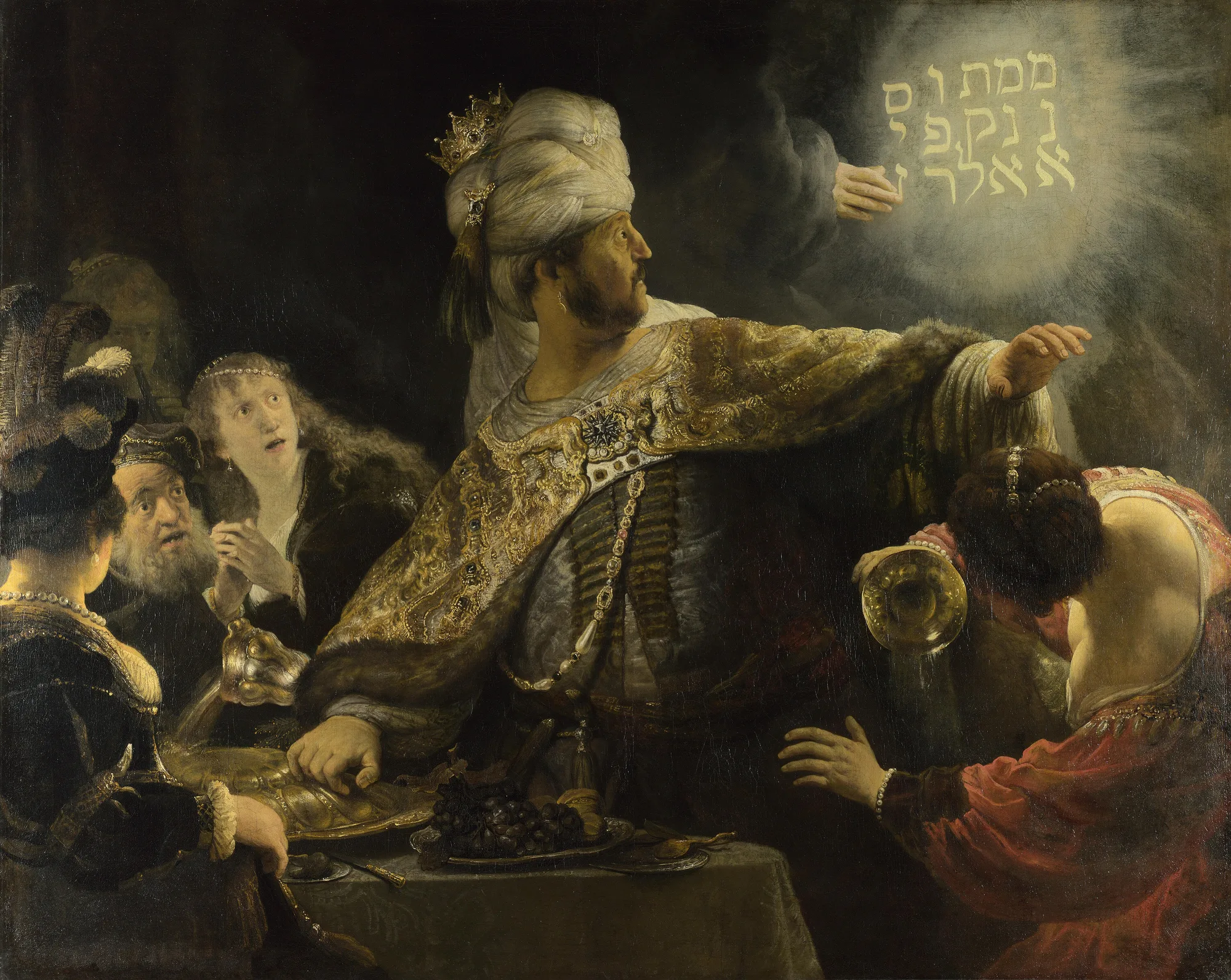
宴会の最中、壁に光る文字が!英語の「不吉な予感」の語源になった名場面。In the middle of a feast, glowing words appear on the wall! The scene behind an English idiom.
この作品のお話
Story金の衣をまとった王が、ぎょっとしてふり返ります。宴会の最中、どこからか手が現れ、壁に光る文字を書いたのです。王の名はベルシャザル。旧約聖書『ダニエル書』に登場する古代バビロンの王です。描いたのはレンブラント。1636〜38年ごろ、30歳前後の作品で、今はロンドンのナショナル・ギャラリーにあります。
A king in golden robes turns around in shock. In the middle of a feast, a hand has appeared from nowhere and written glowing words on the wall. The king is Belshazzar, a ruler of ancient Babylon in the Book of Daniel in the Old Testament. Rembrandt painted this around 1636 to 1638, when he was about 30. It is now in the National Gallery in London.
物語では、王はエルサレムの神殿からうばった聖なる金の器で酒をふるまい、神をばかにしていました。壁の文字はだれにも読めず、預言者ダニエルが「神はあなたの国の終わりを決めた。あなたははかりにかけられ、足りないとわかった」と読み解きます。その夜、王国は終わりをむかえました。レンブラントは、王の目の動き、こぼれる器、おびえる客の一瞬を、劇の一場面のように切り取りました。
In the story, the king served wine in holy gold cups taken from the temple in Jerusalem, and he mocked God. No one could read the words on the wall. Then the prophet Daniel explained them: 'God has ended your kingdom. You have been weighed and found lacking.' That night, the kingdom came to an end. Rembrandt caught one moment, like a scene from a play: the king's eyes, the spilling cup and the frightened guests.
絵は長いあいだイギリスの貴族ダービー伯爵家にあり、19世紀には「迫力が足りない」と低く評価されたこともありました。1964年にナショナル・ギャラリーが手に入れると人気が高まり、今ではレコードのジャケットなどにも使われる、美術館を代表する一枚です。
For a long time, the painting belonged to the Earls of Derby in England. In the 19th century, one critic even called it 'tame.' After the National Gallery bought it in 1964, it became very popular. Today it is one of the museum's best-known pictures and has even appeared on album covers.
王さまが大きなパーティーを開いています。とつぜん、手が壁に文字を書きます。文字は光っています!王さまはとてもこわがります。文字は、王国が終わることを告げていたのです。
A king is having a big party. Suddenly, a hand writes on the wall. The words shine with light! The king is very scared. The words say his kingdom will end.
英語のレベルは上の「やさしい/ふつう」で切りかえられます。
えっ!?な裏ネタ
Secretsヘブライ文字はふつう右から左へ横に書きますが、この絵では文字がたてにならんでいます。同じ珍しいならべ方は、アムステルダムのユダヤ教学者メナセ・ベン・イスラエルの1639年の本にもあります。彼が画家に助言したという説もありますが、確かな証拠はありません。たて書きだから王の学者たちは読めなかった、という解釈もあります。
Hebrew is usually written in rows from right to left. But here the letters run down in columns. The same unusual arrangement appears in a 1639 book by Menasseh ben Israel, a Jewish scholar and printer in Amsterdam. Some think he advised Rembrandt, but there is no firm proof. One idea is that the king's wise men could not read the words because they were written in columns.
1993年の研究で、文字のうち1つが、正しいヘブライ文字とはちがう形で書かれていると指摘されました。似た形の別の文字と取りちがえたと考えられています。天才レンブラントも、知らない文字を写すのはむずかしかったようです。
A study in 1993 pointed out that one of the letters is not the right Hebrew letter. Rembrandt probably mixed it up with another letter of a similar shape. Even a genius found it hard to copy letters he did not know.
英語の the writing is on the wall は「よくないことが起こる前ぶれがはっきり見えている」という意味。この「壁に現れた文字」の物語から生まれた表現です。ニュースでも使われる、今も生きたことばです。
In English, 'the writing is on the wall' means the signs of coming trouble are clear. It comes from this story of words appearing on a wall. You can still hear it in the news today.
1857年のマンチェスターの大展覧会では、担当者がこの絵を「迫力がなく、仕上げも不十分」と書きました。今では、若きレンブラントの野心が詰まった名作として高く評価されています。評価は時代で変わるのです。
At a big exhibition in Manchester in 1857, an organizer wrote that this painting was 'tame, and inadequate in execution.' Today it is praised as a masterpiece full of the young Rembrandt's ambition. Opinions change with the times.
ここを見て!
Look Closer1光る文字と手The glowing words and hand
雲の中から現れた手が、光るヘブライ文字を書いています。文字はたてに読むように並んでいます。
A hand comes out of a cloud and writes glowing Hebrew letters. They are arranged to be read in columns.
2おどろく王The shocked king
ターバンの上に小さな王冠。目を見開き、体ごとふり向いています。
A small crown sits on his turban. His eyes are wide as he turns his whole body.
3こぼれる器The spilling cup
女性がかたむけた金の器から、ワインが流れ落ちています。神殿からうばった聖なる器です。
Wine pours out of a golden cup that a woman tips over. It is one of the holy cups taken from the temple.
4おびえる女性The frightened woman
左の女性は、目を大きく見開いてかたまっています。客たちの表情を見くらべてみましょう。
The woman on the left freezes with wide eyes. Compare the faces of the guests.
英語で名画を語ろう
Talk about Art in EnglishWhen the king saw the words, the writing was on the wall.
王が文字を見たとき、もう終わりの前ぶれははっきりしていました。
💡 まさにこの絵の物語から生まれた英語の決まり文句。ニュースでもよく使われます。
英語で説明すると… Describe it
これは宴会中の暗い部屋です。中央では、金色の服の王がふり向いています。右上では、手が壁に光る文字を書いています。右では、女性が金の器からワインをこぼしています。
This is a dark room at a feast. In the center, a king in gold clothes turns around. In the upper right, a hand is writing glowing letters on the wall. On the right, a woman spills wine from a golden cup.
考えてみよう Think & Talk
- もし目の前の壁に文字が現れたら、あなたはどうしますか?If you saw writing appear on the wall, what would you do?
- 客ひとりひとりの顔を見てみましょう。いちばんこわがっているのはだれ?それはなぜ?Look at each guest's face. Who looks the most scared? Why?
この作品の英単語
WordsThe king is holding a great feast.
王は盛大な宴会を開いています。
The prophet Daniel read the words.
預言者ダニエルがその文字を読みました。
Wine spills from the golden cup.
金の器からワインがこぼれています。
The guests look terrified.
客たちはおびえているように見えます。
ミニクイズ
QuizQ. 壁の文字を読み解いたのはだれ?Who read the words on the wall?
王の学者たちはだれも読めず、預言者ダニエルが意味を告げました。
None of the king's wise men could read it. The prophet Daniel told the king what it meant.
ウソ?ホント? 絵の中のヘブライ文字は、右から左へ横書きで書かれている。The Hebrew words in the painting are written in rows from right to left.
ふつうとちがい、たての列に並べて書かれています。
Unusually, they are arranged in columns.
ウソ?ホント? ナショナル・ギャラリーがこの絵を手に入れたのは20世紀になってから。The National Gallery got this painting in the 20th century.
1964年に手に入れました。それまではダービー伯爵家にありました。
It bought it in 1964. Before that, it belonged to the Earls of Derby.
 画像の出典とライセンス / Image credit
- PDRembrandt-Belsazar.jpg(Wikimedia Commons)
ライセンス:Public domain(パブリックドメイン)/作者・撮影者の表記:Rembrandt
この作品は、作者の死後長い年月がたち著作権の保護期間が終わった「パブリックドメイン」の作品です。画像は平面の作品を忠実に写したもので、新しい著作権は生じません(Wikimedia Commons の PD-Art の考え方)。 所蔵:ナショナル・ギャラリー(ロンドン)(The National Gallery, London)。画像は表示のために縮小・WebP 形式に変換しています。
レンブラント・ファン・レインのほかの作品