

 ワークシート
 ぬりえ
 迷路
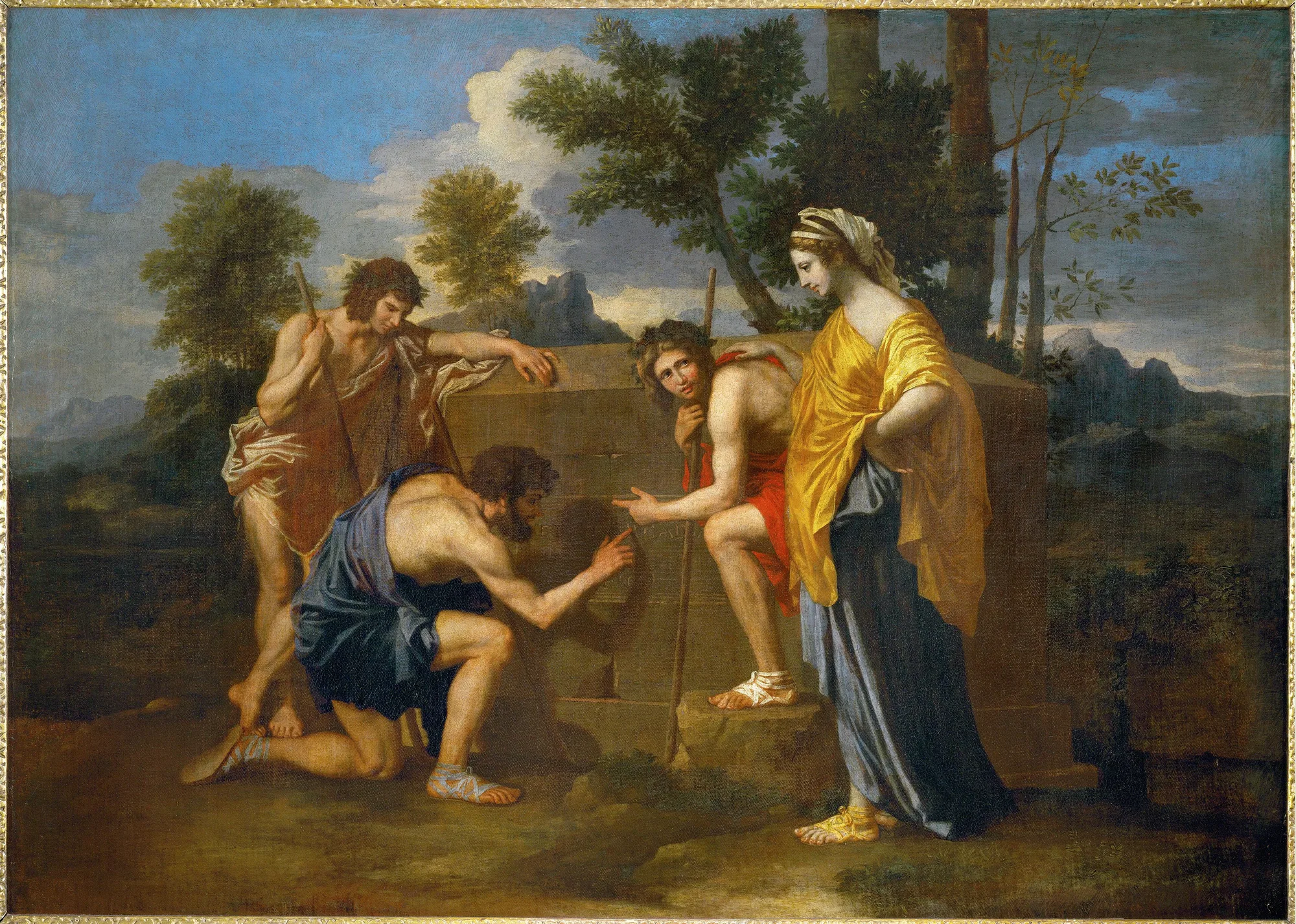
楽園で見つけたお墓に、なぞの言葉「われアルカディアにもあり」。A tomb in paradise with mysterious words: 'Et in Arcadia ego.'
この作品のお話
Story「アルカディア」は、古代ギリシャ・ローマの詩に出てくる、羊飼いたちがのどかに暮らす理想の楽園です。フランスの画家プッサンが1637〜38年ごろに描いたこの絵では、3人の羊飼いと1人の女性が、野原で石のお墓を見つけます。お墓にはラテン語で「ET IN ARCADIA EGO(われアルカディアにもあり)」と彫られています。
Arcadia is an ideal paradise in ancient Greek and Roman poems, where shepherds live peaceful lives. In this painting, made around 1637–38 by the French artist Nicolas Poussin, three shepherds and a woman find a stone tomb in the countryside. On it are Latin words: 'ET IN ARCADIA EGO', or 'Even in Arcadia, I am here.'
「われ」とは死のこと。つまり「この楽園にも、死はある」という意味だとよく説明されます。ひざまずく羊飼いは文字を指でなぞり、もう1人はふり向いて女性に問いかけ、女性はしずかに肩に手を置いています。プッサンはローマで暮らし、古代の彫刻のように落ち着いた構図を大切にしました。これは同じ主題の2作目で、1作目よりずっとしずかな絵になっています。
The 'I' is often explained as Death. So the words mean, 'Even in this paradise, there is death.' One shepherd kneels and traces the letters with his finger. Another turns to ask the woman a question, and she calmly rests her hand on his shoulder. Poussin lived in Rome and loved calm designs, like ancient sculpture. This is his second version of the subject, and it is much quieter than the first.
この絵はのちにフランス王ルイ14世のコレクションに入り、今はルーヴル美術館にあります。フランスの古典主義を代表する作品として、多くの画家のお手本になりました。「われアルカディアにもあり」という言葉は、ゲーテなどの作家にも使われ、のちには小説や映画、さらには作り話の陰謀論にまで登場するようになりました。
The painting later entered the collection of King Louis XIV of France, and it is now in the Louvre. As a great example of French classical painting, it became a model for many artists. The phrase 'Et in Arcadia ego' was used by writers like Goethe. Later, it even appeared in novels, films and made-up conspiracy stories.
アルカディアは、むかしのお話に出てくる幸せな国です。羊飼いたちが、そこでお墓を見つけます。お墓には「エト・イン・アルカディア・エゴ」という言葉。「アルカディアにも、わたしはいる」という意味です。「わたし」とは、死のことかもしれません!
Arcadia is a happy land in old stories. Some shepherds find a tomb there. On it are the words 'Et in Arcadia ego.' They mean 'Even in Arcadia, I am here.' The 'I' may be Death!
英語のレベルは上の「やさしい/ふつう」で切りかえられます。
えっ!?な裏ネタ
Secrets「われ」を死と読めば「楽園にも死はある」という警告になります。でも、お墓にねむる人と読めば「わたしもかつてアルカディアにいた」という思い出の言葉に。18〜19世紀には後者の読み方が広まり、ゲーテやシラーもこの意味で使いました。
If 'I' is Death, it is a warning: 'Even in paradise, there is death.' But if 'I' is the person in the tomb, it becomes a memory: 'I, too, once lived in Arcadia.' In the 18th and 19th centuries, the second meaning spread, and writers like Goethe and Schiller used it.
羊飼いの腕の影が、お墓の上にうつっています。古代ローマのプリニウスは、壁にうつった人の影の輪郭をなぞったのが絵のはじまりだ、と書きました。影は死の象徴でもあり、この場面に二重の意味を重ねていると考えられています。
The shadow of the shepherd's arm falls on the tomb. The ancient Roman writer Pliny said that painting began when someone traced the outline of a person's shadow on a wall. A shadow is also a symbol of death, so this detail may carry two meanings.
プッサンは1627年ごろにも同じ主題を描いています(イギリスのチャッツワース・ハウス所蔵)。そこでは、草におおわれたお墓を羊飼いたちがおどろいて見つけます。さらに前、イタリアの画家グエルチーノも、この言葉とどくろを描いた絵を残しています。
Poussin painted the same subject around 1627 (now at Chatsworth House in England). In that version, the shepherds are surprised to find a tomb covered in plants. Even earlier, the Italian painter Guercino painted the phrase together with a skull.
20世紀、フランスのピエール・プランタールは「シオン修道会」というひみつ結社の話をでっち上げ、この言葉を合い言葉にしました。その影響で、この絵に宝のありかがかくされているという作り話が広まりましたが、もちろん根拠はありません。
In the 20th century, a Frenchman named Pierre Plantard invented a fake secret society, the 'Priory of Sion', and used this phrase as its motto. Because of this, made-up stories spread that the painting hides the location of treasure. Of course, there is no evidence for this.
ここを見て!
Look Closer1文字をなぞる指Finger tracing the words
ひざまずく羊飼いが、彫られた文字を指でなぞっています。腕の影もお墓にうつっています。
A kneeling shepherd traces the carved letters with his finger. The shadow of his arm falls on the tomb.
2ふり向く羊飼いThe shepherd who turns
文字を指さしながら、女性を見上げています。「これはどういう意味?」とたずねているようです。
He points at the words and looks up at the woman, as if asking, 'What does this mean?'
3しずかな女性The calm woman
黄色と青の衣の女性は、落ち着いた表情でお墓を見下ろしています。すべてを知っているかのようです。
The woman in yellow and blue looks down at the tomb calmly, as if she understands everything.
英語で名画を語ろう
Talk about Art in EnglishThe kneeling shepherd is pointing at the words on the tomb.
ひざまずく羊飼いは、墓の文字を指さしています。
💡 point at 〜 で「〜を指さす」。point to 〜 なら「〜の方を示す」。
英語で説明すると… Describe it
4人の人が石の墓のまわりにいます。左では、羊飼いがひざまずいて墓の文字にふれています。右では、黄色い服の女性がしずかに立っています。背景には木々と青い空があります。
Four people are around a stone tomb. On the left, a shepherd is kneeling and touching the words on the tomb. On the right, a woman in a yellow dress is standing quietly. There are trees and a blue sky in the background.
考えてみよう Think & Talk
- お墓の「われ」はだれのことだと思いますか?Who do you think the 'I' on the tomb is?
- プッサンはなぜ、羊飼いたちをこわがらせず、落ち着いた様子で描いたのだと思いますか?Why do you think Poussin made the shepherds look calm, not scared?
この作品の英単語
WordsThe shepherds find a stone tomb.
羊飼いたちは石の墓を見つけます。
A shepherd takes care of sheep.
羊飼いは羊の世話をします。
He traces the letters with his finger.
彼は文字を指でなぞります。
Arcadia appears in ancient poems.
アルカディアは古代の詩に出てきます。
ミニクイズ
QuizQ. お墓の言葉の意味として、よく説明されるのは?What is the usual explanation of the words on the tomb?
「われ(死)はアルカディアにもいる」という意味だとよく説明されます。宝の話は後世の作り話です。
It is often explained as 'I (Death) am even in Arcadia.' The treasure story is a modern invention.
ウソ?ホント? ひざまずく羊飼いは、お墓に彫られた文字を指でなぞっている。The kneeling shepherd is tracing the words on the tomb with his finger.
腕の影もお墓にうつっています。
The shadow of his arm also falls on the tomb.
ウソ?ホント? お墓の言葉は、フランス語で書かれている。The words on the tomb are written in French.
古代ローマのことば、ラテン語で書かれています。
They are written in Latin, the language of ancient Rome.
 画像の出典とライセンス / Image credit
- PDNicolas Poussin - Et in Arcadia ego (deuxième version).jpg(Wikimedia Commons)
ライセンス:Public domain(パブリックドメイン)/作者・撮影者の表記:Nicolas Poussin
この作品は、作者の死後長い年月がたち著作権の保護期間が終わった「パブリックドメイン」の作品です。画像は平面の作品を忠実に写したもので、新しい著作権は生じません(Wikimedia Commons の PD-Art の考え方)。 所蔵:ルーヴル美術館(Musée du Louvre)。画像は表示のために縮小・WebP 形式に変換しています。
