

 PDF をダウンロード
Let's Look at Art!
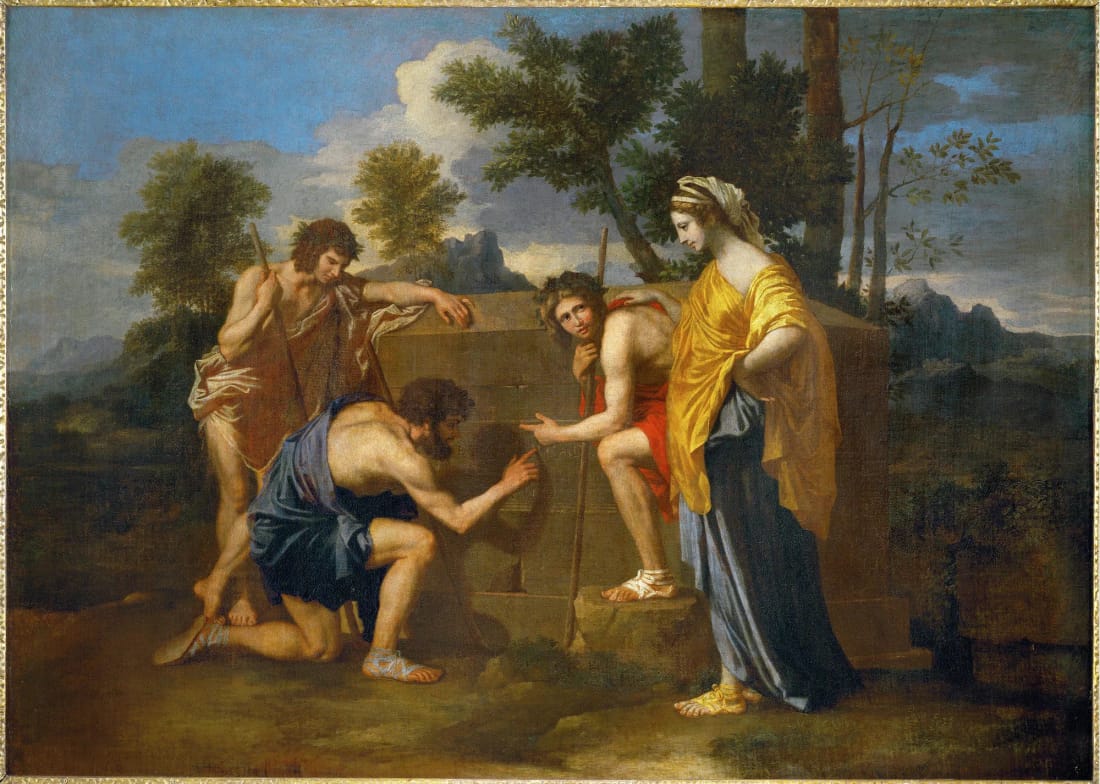
Title: The Arcadian Shepherds
Artist: Nicolas Poussin (1594–1665)
Year: c. 1637–1638
Medium: Oil on canvas
Museum: Musée du Louvre, Paris
1 Find it! 絵の中から見つけて、○でかこもう。
- ☐ Finger tracing the words
- ☐ The shepherd who turns
- ☐ The calm woman
2 First look 最初に見たときの感想を書こう。
When I first saw this painting, I felt ______________ because ______________________.
Three colors I can see: ①__________ ②__________ ③__________
3 Words — Match them. 英語と日本語を線で結ぼう。
- tomb ●
- shepherd ●
- trace ●
- ancient ●
- ● なぞる
- ● 羊飼い
- ● 古代の
- ● 墓
The Arcadian Shepherds
4 Fill in the blanks. 下の箱から選んで、( )に入れよう。形を変えるものもあります。
- The shepherds find a stone .
- A takes care of sheep.
- He the letters with his finger.
- Arcadia appears in poems.
5 Read and answer — True or False? 英文を読んで、正しければ T、ちがえば F。
Arcadia is a happy land in old stories. Some shepherds find a tomb there. On it are the words 'Et in Arcadia ego.' They mean 'Even in Arcadia, I am here.' The 'I' may be Death!
Arcadia is an ideal paradise in ancient Greek and Roman poems, where shepherds live peaceful lives. In this painting, made around 1637–38 by the French artist Nicolas Poussin, three shepherds and a woman find a stone tomb in the countryside. On it are Latin words: 'ET IN ARCADIA EGO', or 'Even in Arcadia, I am here.'
- The kneeling shepherd is tracing the words on the tomb with his finger. T / F
- The words on the tomb are written in French. T / F
6 Quiz — Choose the best answer. 正しいものを選ぼう。
What is the usual explanation of the words on the tomb?
- Treasure is buried here
- Take care of your sheep
- This road leads to Rome
- Even in paradise, there is death
The Arcadian Shepherds
7 Put the words in order. 語を正しく並べかえて、文を書こう。
- the / at / on / The / kneeling / is / tomb / shepherd / words / the / pointing .
- people / around / stone / a / Four / are / tomb .
8 Complete the description. 箱の語を(1)〜(4)に入れて、絵の説明を完成させよう。
Four (1) are (2) a stone tomb. On the left, a shepherd is (3) and touching the words on the tomb. On the right, a woman in a (4) dress is standing quietly. There are trees and a blue sky in the background.
9 Describe the painting in English. この絵を英語で説明しよう(3文以上)。
10 Think & Talk 考えて、ペアやグループで話し合おう。
Who do you think the 'I' on the tomb is?
Why do you think Poussin made the shepherds look calm, not scared?
11 My favorite part いちばん好きなところを英語で。
I like the ____________ because ____________________________.
Answers & Notes
1 Find it!
Finger tracing the words=文字をなぞる指/The shepherd who turns=ふり向く羊飼い/The calm woman=しずかな女性
2 First look
自由に書けたら正解。I felt calm / surprised / happy … などの形容詞を使おう。
3 Words
1–d(tomb=墓) 2–b(shepherd=羊飼い) 3–a(trace=なぞる) 4–c(ancient=古代の)
4 Fill in the blanks
- tomb The shepherds find a stone tomb.
羊飼いたちは石の墓を見つけます。 - shepherd A shepherd takes care of sheep.
羊飼いは羊の世話をします。 - traces He traces the letters with his finger.
彼は文字を指でなぞります。 - ancient Arcadia appears in ancient poems.
アルカディアは古代の詩に出てきます。
5 Read — T / F
【本文の訳】アルカディアは、むかしのお話に出てくる幸せな国です。羊飼いたちが、そこでお墓を見つけます。お墓には「エト・イン・アルカディア・エゴ」という言葉。「アルカディアにも、わたしはいる」という意味です。「わたし」とは、死のことかもしれません!
【本文の訳】「アルカディア」は、古代ギリシャ・ローマの詩に出てくる、羊飼いたちがのどかに暮らす理想の楽園です。フランスの画家プッサンが1637〜38年ごろに描いたこの絵では、3人の羊飼いと1人の女性が、野原で石のお墓を見つけます。お墓にはラテン語で「ET IN ARCADIA EGO(われアルカディアにもあり)」と彫られています。
- T ひざまずく羊飼いは、お墓に彫られた文字を指でなぞっている。
解説:腕の影もお墓にうつっています。 - F お墓の言葉は、フランス語で書かれている。
解説:古代ローマのことば、ラテン語で書かれています。
6 Quiz
D 問:お墓の言葉の意味として、よく説明されるのは?
選択肢:A ここに宝がうまっている/B 羊を大切にせよ/C この道はローマに通じる/D 楽園にも、死はある
解説:「われ(死)はアルカディアにもいる」という意味だとよく説明されます。宝の話は後世の作り話です。
7 Put the words in order
- The kneeling shepherd is pointing at the words on the tomb.
ひざまずく羊飼いは、墓の文字を指さしています。 - Four people are around a stone tomb.
4人の人が石の墓のまわりにいます。
💡 is pointing at(〜を指さしている):point at 〜 で「〜を指さす」。point to 〜 なら「〜の方を示す」。
8 Complete the description
(1) people (2) around (3) kneeling (4) yellow
9 Describe(模範解答)
Four people are around a stone tomb. On the left, a shepherd is kneeling and touching the words on the tomb. On the right, a woman in a yellow dress is standing quietly. There are trees and a blue sky in the background.
4人の人が石の墓のまわりにいます。左では、羊飼いがひざまずいて墓の文字にふれています。右では、黄色い服の女性がしずかに立っています。背景には木々と青い空があります。
10 Think & Talk(問いの訳)
- Who do you think the 'I' on the tomb is?
お墓の「われ」はだれのことだと思いますか? - Why do you think Poussin made the shepherds look calm, not scared?
プッサンはなぜ、羊飼いたちをこわがらせず、落ち着いた様子で描いたのだと思いますか?
正解のない問いです。理由をつけて話せたら◎。
Fun Fact(訳)
「われ」はだれ?意味が分かれる言葉 「われ」を死と読めば「楽園にも死はある」という警告になります。でも、お墓にねむる人と読めば「わたしもかつてアルカディアにいた」という思い出の言葉に。18〜19世紀には後者の読み方が広まり、ゲーテやシラーもこの意味で使いました。
