

 脳と心理ビミョー
【共通テストに出た】「怖いと時間がスローになる」は本当?31m落下実験の答え
 2026.10.02
 English Corner(A2〜B2・4択クイズ)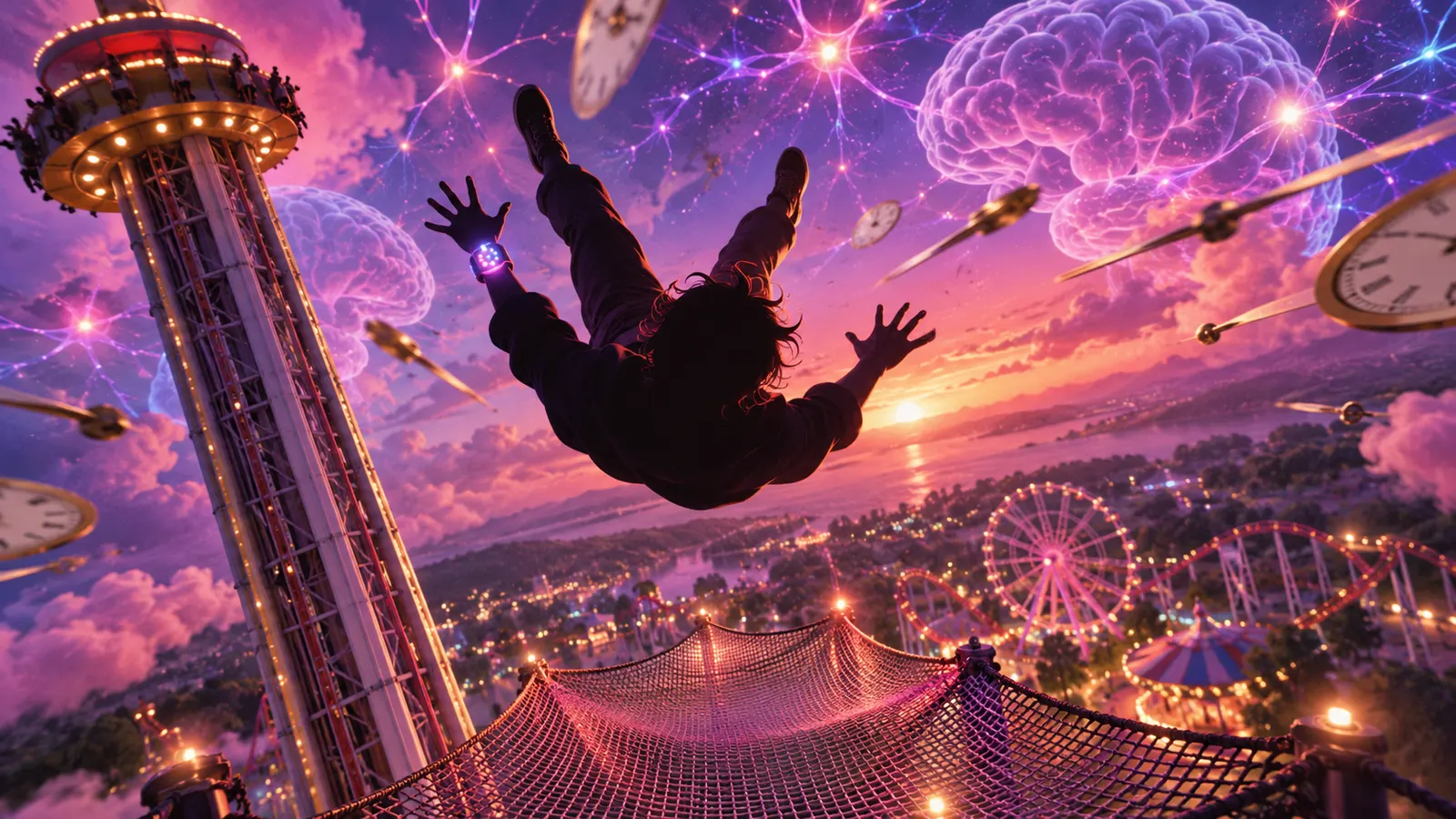

 読む前に予想してみよう!
怖い体験の最中は、脳の処理速度が上がって世界がスローモーションに見えている
落下中も、速い変化を見分ける目の力は上がっていなかった。「長く感じた」のは後から思い出した記憶の影響と考えられている。
 研究カード(どんな研究?)
- 対象
- 成人の参加者
- 規模
- 数十人規模
- 研究の種類
- 実験研究(自由落下)+スカイダイバー調査
- 確かさ
- ★★★☆☆
31mの自由落下を体験した人は、自分の落下時間を、他人の落下を見たときより36%長く見積もった。でも目や脳の処理が速くなったわけではなく、スローに感じるのは「記憶」のしわざらしい。
ひとことで言うと怖い時に時間がゆっくりに感じるのは、あとから思い出す記憶のせいらしい!
交通事故に遭いかけた瞬間、「すべてがスローモーションに見えた」。そんな体験談、聞いたことありませんか?
ピンチの時だけ脳がフル回転して、世界がゆっくり見える。そうだとしたら、映画のワンシーンみたいでちょっとかっこいい。では本当にそうなのか。人を高さ31mから落として確かめた、大胆な実験があります。
この「心の中で感じる時間(心理的時間)」は、入試にも出ています。2024年度の大学入学共通テスト(本試験)英語リーディングで、長文のテーマになりました。
01遊園地のアトラクションで「落ちる」実験
ここまでは「やっぱり時間はスローになる」と言えそうです。でも研究チームは、もう一歩踏み込みました。
02手首の装置で「スローモーション視覚」をテスト
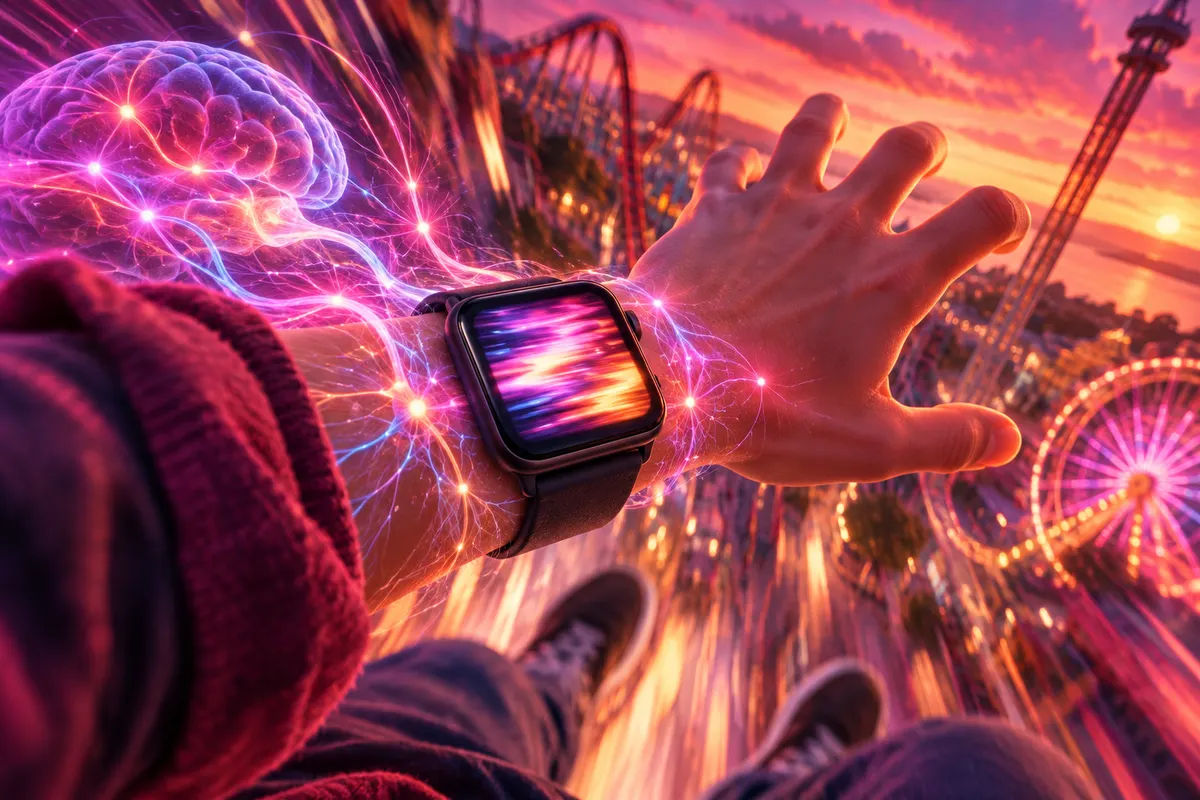
参加者の手首には、数字がチカチカ点滅する特製の表示装置が付けられていました。点滅が速すぎて、ふだんは数字が読み取れない設定です。
もし落下中に脳が本当に「高速モード」になるなら、ふだん読めない数字も読めるはずです。
結果は――読めませんでした。落下中でも、速い変化を見分ける目や脳の力(時間の解像度)は、上がっていなかったのです。
03スローの正体は「記憶の濃さ」
では、なぜ長く感じたのか。研究チームの答えは、記憶です。
怖い体験の最中は、扁桃体(危険を知らせる警報装置のような脳の部分)などが強く働きます。そのため出来事が、いつもより細かく、濃く記録されると考えられています。あとで思い出すと、記憶の量が多いぶん「長い時間だった」と感じてしまう。つまりスローモーションは、体験の最中ではなく、振り返った時に生まれるのではないか。これが研究チームの考えです。
04「怖さ」と「ワクワク」で逆になる?
スカイダイビング初体験の人を調べた研究もあります(2007年)。オーストラリアの研究者が調べたのは、初めてタンデムで飛ぶ76人です。タンデムとは、インストラクターと二人一組で飛ぶ方法のこと。飛ぶ前と着地直後に気持ちを聞き、着地後に「どれくらいの時間に感じたか」を答えてもらいました。
すると、恐怖が強い人ほど時間をゆっくり、ワクワクが強い人ほど時間を速く感じていたのです。同じ体験でも、怖さとワクワクのどちらが強いかで、時間の感じ方が変わるようです。感情で時間の感じ方が変わることは、ほかの多くの研究でも報告されています(Droit-Volet & Meck, 2007)。
05まとめ
「時間がスローに見えた」は、体験としてはホント。でも、そのとき脳が高速化しているわけではありませんでした。
スローモーションの正体は、脳が必死に残した、濃い記憶。初めての場所をめぐった旅行の1日は、その場ではあっという間なのに、あとで思い出すと長く感じる。それも、もしかしたら同じ仕組みかもしれません。
この研究を英語で読もう原田英語の English CornerPeople who almost have accidents often say that everything happened in slow motion. 音声
音声 4択クイズ9問A2・B1・B2タップして開く
原田英語の English Corner
この研究を英語で読もう
Many people say time slowed down during a car accident. Is it true? Scientists tested this at an amusement park. People fell 31 meters backward into a safety net.
Later, they said their own fall was about 36% longer than other people's falls. But a small device on their wrist showed very fast numbers. During the fall, they could not read them.
So their eyes did not get faster. The slow feeling seems to come from rich memories.
78 words ・ CEFR A2
和訳を見る
多くの人が、自動車事故のときに時間がゆっくりになったと言います。それは本当でしょうか。科学者たちは遊園地でこれを試しました。人々は後ろ向きに31メートル落ちて安全ネットに着地しました。
あとで彼らは、自分の落下は他の人の落下より約36%長かったと言いました。しかし、手首の小さな装置にはとても速く数字が表示されていました。落下中、彼らはその数字を読めませんでした。
つまり、目が速くなったわけではありません。ゆっくりに感じるのは、濃く残った記憶から来るようです。
4択リーディングクイズ
Q1. What is the passage mainly about?
冒頭で「事故のとき時間がゆっくりになるのは本当か」と問いを立て、実験で確かめているので D。
Q2. How far did the people fall?
People fell 31 meters backward into a safety net. とあるので B。36 は「長く感じた割合(%)」なので注意。
Q3. In this passage, a "device" is ...
手首に付けて数字を表示するもの、と説明されているので A「小さな機械・道具」。device は入試でも頻出の基本語。
People who almost have accidents often say that everything happened in slow motion. To test this idea, Eagleman and his team asked volunteers to fall 31 meters backward into a safety net at an amusement park. Afterward, the volunteers estimated that their own fall had lasted about 36% longer than the falls of other people they watched.
However, the researchers also put a device on each person's wrist that flashed numbers too quickly to read normally. If the brain really sped up, the numbers would become readable during the fall. They did not. The team suggested that frightening moments are recorded in richer detail, so when we remember them later, they seem longer.
113 words ・ CEFR B1
和訳を見る
事故に遭いかけた人は、すべてがスローモーションで起きたとよく言います。この考えを確かめるため、イーグルマンらのチームは、遊園地でボランティアに後ろ向きに31メートル落下して安全ネットに着地してもらいました。その後、ボランティアたちは、自分の落下が、見ていた他の人の落下より約36%長く続いたと見積もりました。
しかし研究者たちは、ふだんなら速すぎて読めない数字を点滅させる装置を、一人ひとりの手首にも付けていました。もし脳が本当に高速になっているなら、落下中に数字が読めるはずです。読めませんでした。チームは、怖い瞬間はより細かく記録されるため、あとで思い出したときに長く感じられるのだろうと考えました。
4択リーディングクイズ
Q1. What was the wrist device used to test?
If the brain really sped up, the numbers would become readable during the fall. とあり、落下中に知覚が速くなるかを調べる装置なので C。
Q2. What did the volunteers say about their own fall?
estimated that their own fall had lasted about 36% longer than the falls of other people とあるので A。
Q3. According to the researchers, when does the slow-motion feeling appear?
最終文で、細かく記録された瞬間を when we remember them later 長く感じると述べているので D。C は数字が読めなかった結果と矛盾する。
In a 2007 study, Eagleman and colleagues had participants fall 31 meters backward into a net. They wanted to test a common report, that time slows down in moments of danger. Does the brain actually process information faster, or does it only seem that way afterward?
When asked later, participants estimated that their own fall had lasted about 36 percent longer than the falls they had watched others take. Each participant also wore a wrist display that flashed numbers at a speed normally too fast to read.
Had their temporal resolution increased, they should have been able to read the digits mid-fall. They could not. The researchers therefore argued that the slow-motion effect is retrospective. Under high arousal, the brain records an event more densely, and this richer memory is later interpreted as a longer duration. The design had a weak point.
Comparing one's own fall with someone else's might be affected by factors other than memory. A separate 2007 study of 76 novice tandem skydivers found that the type of emotion mattered too. Those who felt more fear judged time as passing slowly, while those who felt more excitement judged it as passing quickly.
195 words ・ CEFR B2
和訳を見る
2007年の研究で、イーグルマンらは参加者を後ろ向きに31メートル落下させ、ネットで受け止めました。危険な瞬間には時間がゆっくりになる、というよくある報告を確かめたかったのです。脳は実際に情報をより速く処理しているのでしょうか。
それとも後からそう思えるだけなのでしょうか。あとで尋ねると、参加者は自分の落下が、他の人の落下を見たときより約36パーセント長く続いたと見積もりました。
参加者はそれぞれ、ふだんなら速すぎて読めない速度で数字を点滅させる手首の表示装置も身につけていました。もし時間分解能が上がっていたなら、落下の最中に数字を読めたはずです。しかし読めませんでした。そのため研究者たちは、スローモーション効果は回顧的なものだと主張しました。強い覚醒状態のもとで脳は出来事をより密に記録し、この豊かな記憶が後になって長い時間として解釈される、というのです。この実験設計には弱点がありました。
自分の落下と他人の落下を比べることには、記憶以外の要因が影響した可能性があります。初めてタンデムでスカイダイビングをする76人を調べた別の2007年の研究では、感情の種類も関係していることがわかりました。恐怖を強く感じた人ほど時間がゆっくり過ぎたと判断し、興奮を強く感じた人ほど速く過ぎたと判断したのです。
4択リーディングクイズ
Q1. Which of the following best summarizes the main finding?
数字が読めなかったことから知覚の高速化は否定され、the slow-motion effect is retrospective(振り返りの記憶による)と結論づけているので B。
Q2. What would have happened if the participants' temporal resolution had increased?
Had their temporal resolution increased, they should have been able to read the digits mid-fall とあるので C。Had ~ は if の省略による倒置(仮定法過去完了)で、入試の文法・読解の両方で狙われる。
Q3. According to the skydiving study, which statement is true?
those who felt more excitement judged it as passing quickly とあるので A。対象は novice(初心者)なので D は誤り。
重要単語
- perceptionB2名詞知覚、感じ方Our perception of time changes with our mood.
 動詞は perceive。time perception(時間知覚)は心理系長文の定番テーマ。
 - estimateB1動詞・名詞見積もる、推定する/見積もりParticipants estimated how long the fall lasted. overestimate(過大評価する)/ underestimate(過小評価する)は設問の言い換えに頻出。
- retrospectiveC1形容詞振り返っての、回顧的なRetrospective judgments of time depend on memory. retro(後ろへ)+spect(見る)。反対は prospective(前を見る=これからの)。
- resolutionB2名詞分解能、解像度The device tested the temporal resolution of vision. 「決意」「解決」の意味もある多義語。文脈で意味を決める問題が入試で出やすい。temporal は「時間の」。
- arousalC1名詞覚醒、興奮状態High arousal can make a moment feel longer. 動詞は arouse(呼び起こす)。arouse interest / arouse suspicion のコロケーションで覚える。
- noviceB2名詞初心者Novice skydivers were asked about their fear. nov-(新しい)は novel, innovation と同語源。反対語は expert / veteran。
- durationB2名詞継続時間、期間The duration of the fall was about two and a half seconds. dur-(続く)は during, durable と同語源。時間の長さを表す硬い語として長文で頻出。
 入試に出る順の単語帳を印刷する →
 全5903語の「科学英単語カード」で復習する →
 動画でもっと知る
動画は各チャンネルの公式埋め込みで表示しています(YouTube)。
 公式・一次情報をチェック
 4コマでわかる
このネタ、誰かに教えたくなった?
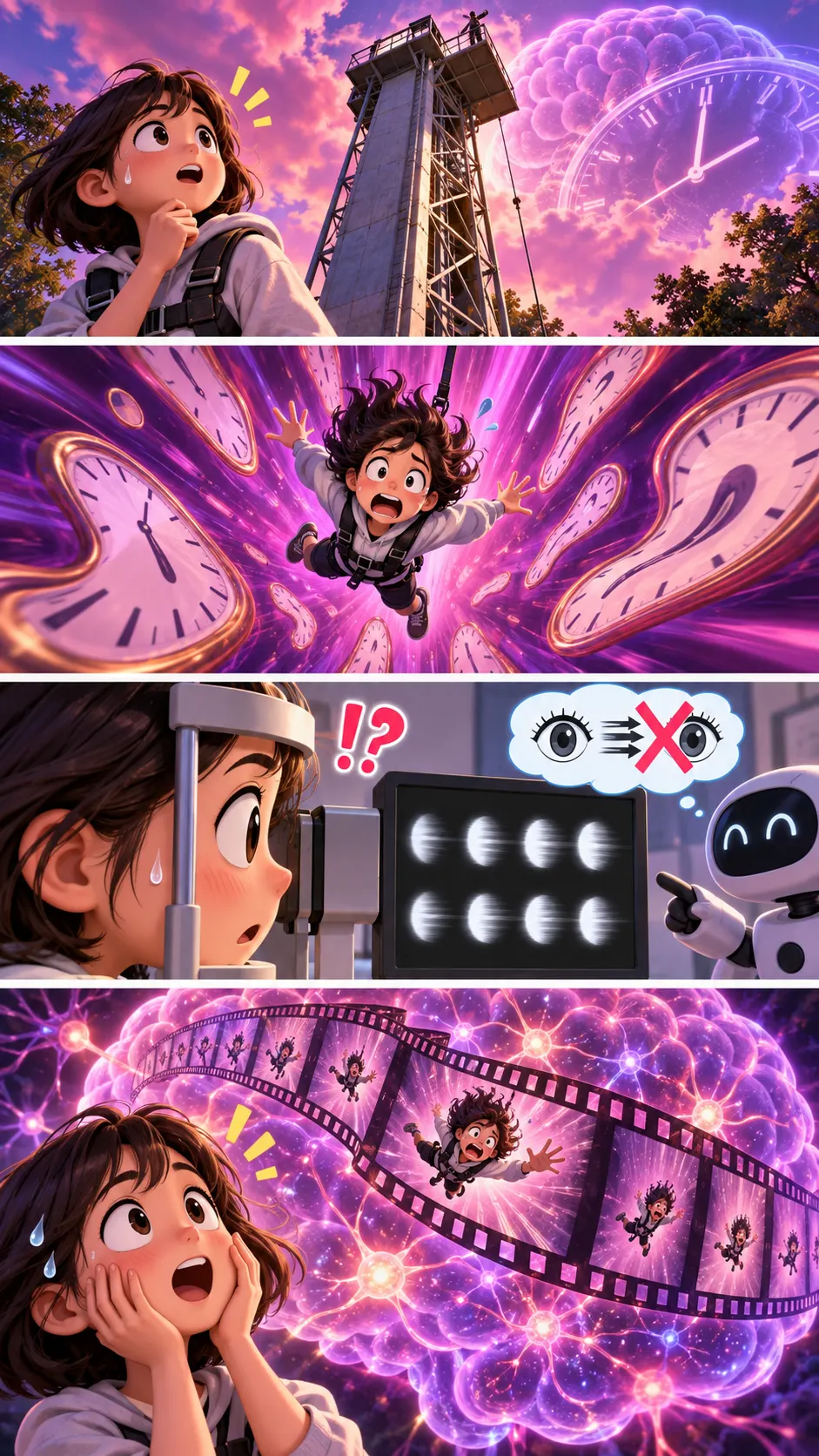
事故の瞬間「時間がスローになった」ってよく聞くけど、31mの自由落下実験で確かめたら、落ちている最中に目や脳が速くなるわけではなかったらしい。スローに感じる正体は、濃く残った「記憶」。共通テストにも出たテーマ。
押すと「マジかリスト」に保存されます
 出典・参考文献(3件)タップで表示
- Stetson, Fiesta & Eagleman (2007) Does time really slow down during a frightening event?, PLoS ONEdoi.org
- Campbell & Bryant (2007) How time flies: a study of novice skydivers, Behaviour Research and Therapydoi.org
- Droit-Volet & Meck (2007) How emotions colour our perception of time, Trends in Cognitive Sciencesdoi.org

※本記事は上記の研究・公開資料をもとに、原田英語が独自の言葉で解説したものです。引用は著作権法第32条の範囲で行い、出典を明記しています。画像はすべてオリジナルのイメージです。研究結果には限界や個人差があります。誤りのご指摘は原田英語のお問い合わせフォームから。
 これも「マジか!?」
 脳・心理
脳・心理
【早稲田の入試に出た】人生で一番覚えているのは10〜30歳。「レミニセンス・バンプ」の謎
 脳・心理
脳・心理
記憶の「分けると残る」は腎臓の細胞にも? 薬を一気より4回に分けると遺伝子が長く働いた

 脳・心理
脳・心理
赤ちゃんの頃の記憶がないのは、「記憶を作れない」からではないかもしれない


 脳・心理
脳・心理
【関学の入試に出た】地平線の月が大きく見えるのは脳の錯覚。写真に撮ると大きさはほぼ同じだった

 脳・心理
脳・心理
【共通テストに出た】人は起きている時間の約半分「上の空」だった。ハーバードのスマホ調査
 脳・心理
脳・心理