 ワークシート
 ぬりえ
 迷路
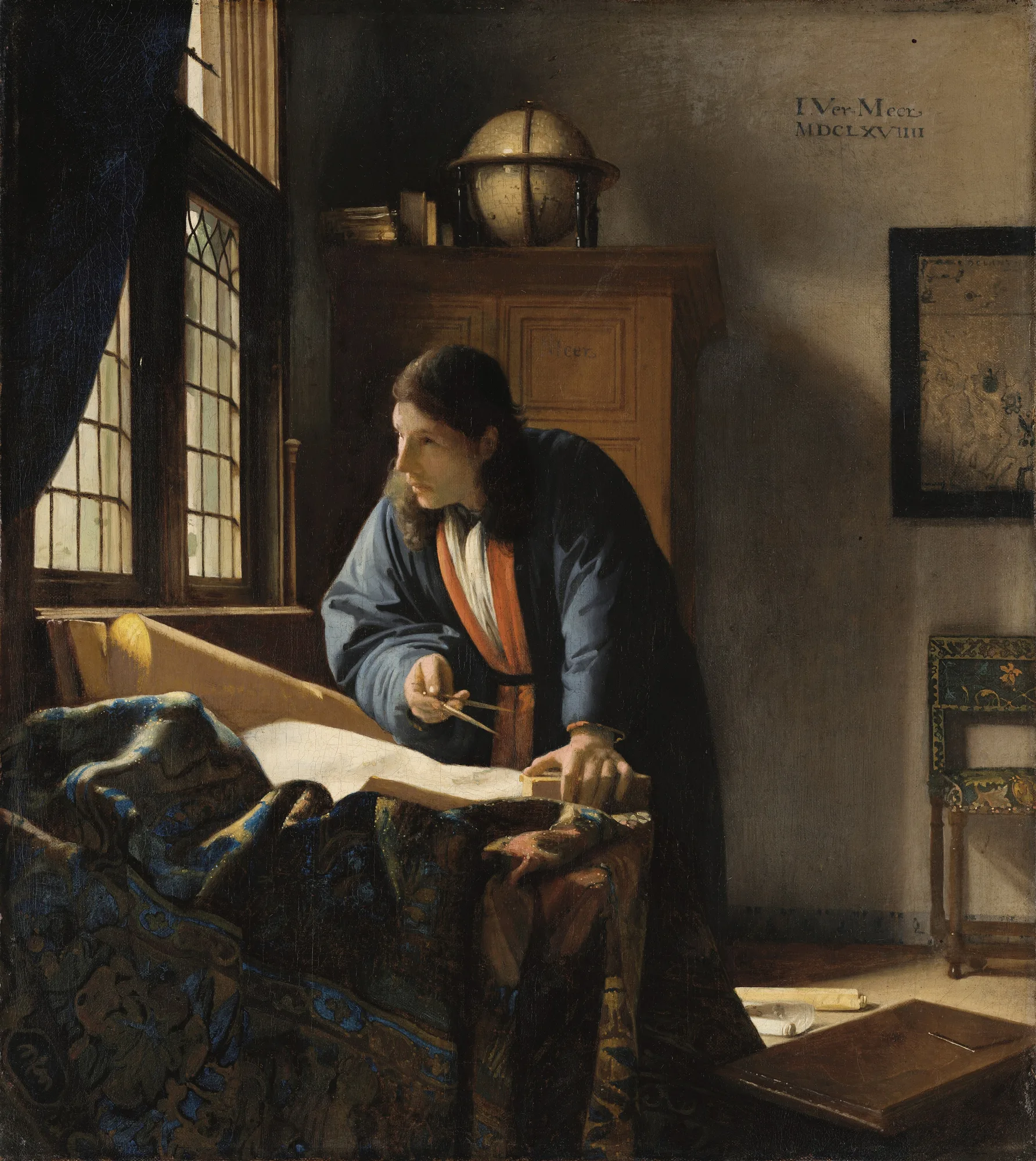
学者が着ているのは「日本の着物」風のガウン!ひらめきの瞬間を描いた一枚。The scholar wears a Japanese-style robe! A picture of a moment of inspiration.
この作品のお話
Story窓辺の机に地図を広げた若い学者が、コンパスのような道具(ディバイダー)を手に、ふと手を止めて窓の方を見ています。たなの上には地球儀、壁には海図。オランダの画家フェルメールが1669年に描いた作品で、今はドイツのフランクフルトにあるシュテーデル美術館にあります。
A young scholar has spread a map on a table by the window. He holds a measuring tool called a pair of dividers and pauses, looking toward the window. A globe stands on the cupboard, and a sea chart hangs on the wall. The Dutch painter Johannes Vermeer painted this in 1669. It is now in the Städel Museum in Frankfurt, Germany.
17世紀のオランダは、東インド会社の船が世界の海をわたり、地図作りの中心地でもありました。学者が着ている青いガウンは、当時「日本の着物」と呼ばれ、学問をする人たちの間で人気だった日本風の部屋着です。日本との貿易で伝わった着物が、知的でおしゃれな服として好まれていたのです。
In the 17th century, ships of the Dutch East India Company sailed the world's oceans, and the Netherlands was a center of mapmaking. The blue robe the scholar wears was a Japanese-style gown, popular among learned men at that time. Kimonos came to the Netherlands through trade with Japan and were seen as smart and stylish clothes.
フェルメールは、窓から差しこむ光で、学者の顔や手、机の上の紙を照らしています。考えに集中していた人が、何かひらめいて顔を上げた一瞬です。この絵は18世紀から何度も売り買いされ、1885年ごろにフランクフルトのシュテーデル美術館のものになりました。今もこの美術館を代表する名作です。
Vermeer used light from the window to brighten the scholar's face, his hands and the paper on the table. It is the moment when a person deep in thought looks up with a new idea. The painting was sold many times from the 18th century on, and it came to the Städel Museum in Frankfurt around 1885. It is still one of the museum's greatest treasures.
若い男の人が地図を調べています。窓の方を見ています。いい考えがうかんだのかもしれません!長い青いガウンを着ています。日本の着物のようなものです。
A young man studies a map. He looks toward the window. Maybe he has a good idea! He wears a long blue robe. It is like a Japanese kimono.
英語のレベルは上の「やさしい/ふつう」で切りかえられます。
えっ!?な裏ネタ
Secrets17世紀のオランダでは、日本から伝わった着物が「ヤポンス・ロック(日本の上着)」と呼ばれ、大人気でした。数が少なく高価だったため、オランダで似せて作ったガウンも出回りました。学者がそれを着て描かれるのは、知的でおしゃれな人のしるしだったのです。
In the 17th century, kimonos from Japan were very popular in the Netherlands, where they were called 'Japanese robes.' Real ones were rare and expensive, so copies were made in Europe too. Painting a scholar in one showed that he was clever and stylish.
たなの上の地球儀は、1618年にアムステルダムのホンディウスが出版したもの。フェルメールは、オランダ東インド会社が活やくしたインド洋の面をこちらに向けて描きました。世界の海に広がるオランダの力が、さりげなく表されています。
The globe on the cupboard was published in Amsterdam in 1618 by Jodocus Hondius. Vermeer turned it so we see the Indian Ocean, where the Dutch East India Company was busy trading. It quietly shows the power of the Netherlands across the world's seas.
フェルメールの作品で、年が書きこまれているのはわずか3点。この絵はそのひとつで、右上の壁に「I Ver.Meer」の名前とローマ数字の「MDCLXVIIII」(1669)が書かれています。フェルメール研究にとって大切な手がかりです。
Only three of Vermeer's paintings have a date on them. This is one of them. On the wall at the upper right, you can see 'I Ver.Meer' and the Roman numerals 'MDCLXVIIII' (1669). It is an important clue for people who study Vermeer.
調査によると、学者の手のディバイダーは、はじめたてに描かれていて、あとから横向きに直されました。また、頭ももっと左にあり、下の地図を見ていたのではないかと考えられています。考えるために手を止めた姿、あるいは「ひらめきの瞬間」とも見える今のポーズは、こうした描き直しから生まれたのです。
Studies show that the dividers in his hand were first painted vertical and later changed to horizontal. His head was also once further left, and he may have been looking down at the map. These changes created the pose we see today, often seen as a pause for thought or a 'moment of inspiration.'
ここを見て!
Look Closer1地球儀The globe
1618年のホンディウスの地球儀。インド洋の側をこちらに向けています。
Hondius's globe of 1618. The Indian Ocean side faces us.
2窓の方を見る顔Looking toward the window
長い髪の学者が、ふと手を止めて窓の方を見ています。何を考えているのでしょう。
The long-haired scholar pauses and looks toward the window. What might he be thinking about?
3ディバイダーThe dividers
地図の上で距離をはかる道具。もとはたてに持っていたのを、横向きに描き直しています。
A tool for measuring distances on maps. It was first painted vertical and later made horizontal.
4サインと年Signature and date
壁に「I Ver.Meer」と「MDCLXVIIII」(1669)。年まで書いためずらしい作品です。
On the wall: 'I Ver.Meer' and 'MDCLXVIIII' (1669). It is rare for Vermeer to add a date.
英語で名画を語ろう
Talk about Art in EnglishThe geographer is holding a pair of dividers.
地理学者は1組のディバイダーを持っています。
💡 2本の脚や刃がある道具は a pair of で数えます。scissors、glasses、jeans も同じです。
英語で説明すると… Describe it
若い男性が窓辺の机のそばに立っています。長い青いガウンを着ています。ディバイダーを持ち、窓の方を見ています。うしろには、たなの上の地球儀と、壁の地図があります。
A young man stands at a table by a window. He wears a long blue robe. He holds a pair of dividers and looks toward the window. Behind him, there is a globe on a cupboard and a map on the wall.
考えてみよう Think & Talk
- 地理学者は今、どんなことをひらめいたと思いますか?What idea do you think the geographer just had?
- 日本の着物風のガウンは、なぜオランダで人気だったのだと思いますか?Why do you think Japanese robes were so popular in the Netherlands?
この作品の英単語
WordsThe geographer studies a map.
地理学者は地図を調べています。
A globe stands on the cupboard.
たなの上に地球儀があります。
He uses dividers to measure distances.
彼はディバイダーで距離をはかります。
He wears a long blue robe.
彼は長い青いガウンを着ています。
ミニクイズ
QuizQ. 学者が着ている青いガウンは、当時どう呼ばれていた?What was the scholar's blue robe called at the time?
日本から伝わった着物風のガウンで、学者に人気でした。
It was a kimono-like gown from Japan, popular among scholars.
ウソ?ホント? この絵には、描いた年が書きこまれている。The year it was painted is written on this painting.
右上の壁に、ローマ数字で1669と書かれています。
On the wall at the upper right, it says 1669 in Roman numerals.
ウソ?ホント? 地球儀は、日本がよく見える面をこちらに向けている。The globe is turned so we can see Japan clearly.
こちらに向いているのはインド洋の面です。
It shows the Indian Ocean side.
 画像の出典とライセンス / Image credit
- PDJohannes Vermeer - The Geographer - Google Art Project.jpg(Wikimedia Commons)
ライセンス:Public domain(パブリックドメイン)/作者・撮影者の表記:Johannes Vermeer
この作品は、作者の死後長い年月がたち著作権の保護期間が終わった「パブリックドメイン」の作品です。画像は平面の作品を忠実に写したもので、新しい著作権は生じません(Wikimedia Commons の PD-Art の考え方)。 所蔵:シュテーデル美術館(Städel Museum)。画像は表示のために縮小・WebP 形式に変換しています。
ヨハネス・フェルメールのほかの作品