

 PDF をダウンロード
Let's Look at Art!
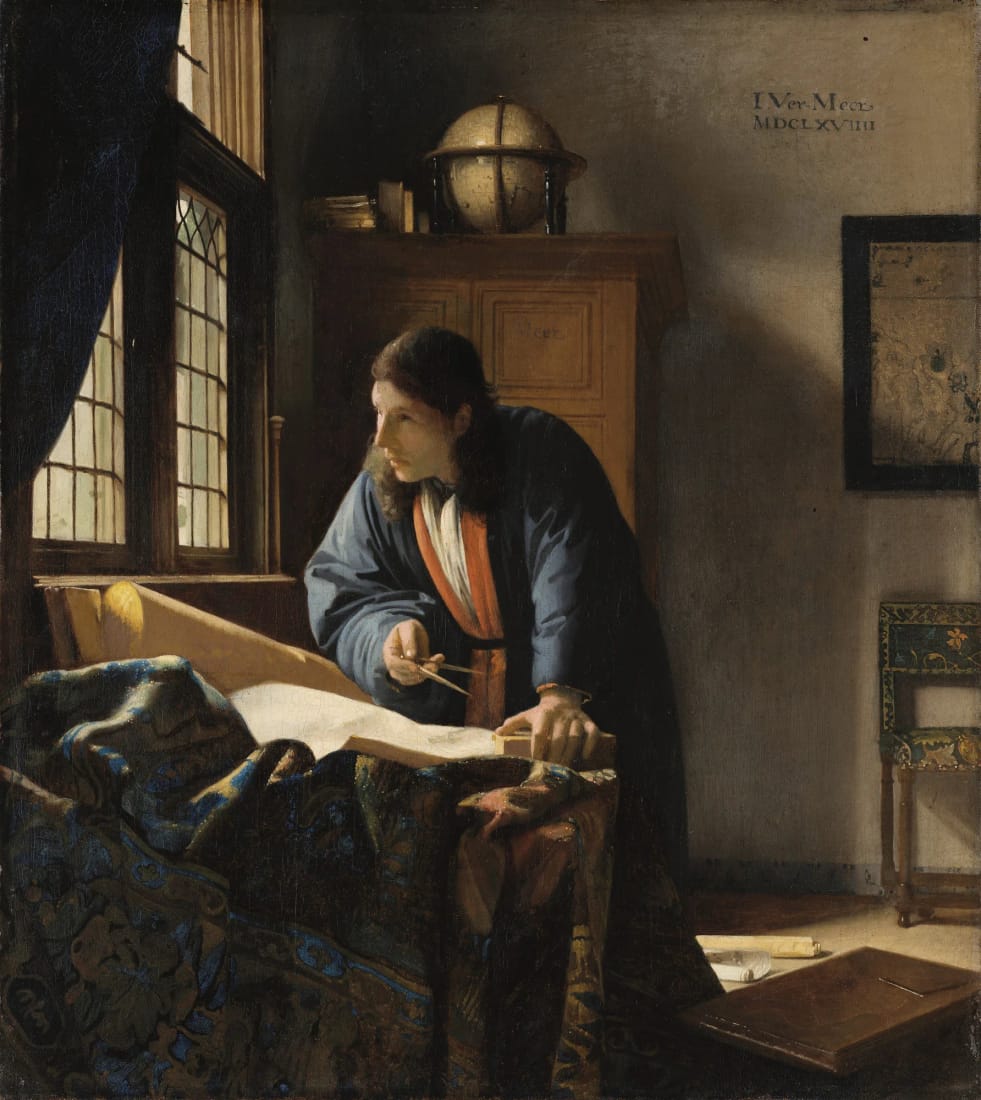
Title: The Geographer
Artist: Johannes Vermeer (1632–1675)
Year: 1669
Medium: Oil on canvas
Museum: Städel Museum, Frankfurt
1 Find it! 絵の中から見つけて、○でかこもう。
- ☐ The globe
- ☐ Looking toward the window
- ☐ The dividers
- ☐ Signature and date
2 First look 最初に見たときの感想を書こう。
When I first saw this painting, I felt ______________ because ______________________.
Three colors I can see: ①__________ ②__________ ③__________
3 Words — Match them. 英語と日本語を線で結ぼう。
- geographer ●
- globe ●
- measure ●
- robe ●
- ● はかる
- ● 地球儀
- ● 地理学者
- ● ガウン・長い上着
The Geographer
4 Fill in the blanks. 下の箱から選んで、( )に入れよう。形を変えるものもあります。
- The studies a map.
- A stands on the cupboard.
- He uses dividers to distances.
- He wears a long blue .
5 Read and answer — True or False? 英文を読んで、正しければ T、ちがえば F。
A young man studies a map. He looks toward the window. Maybe he has a good idea! He wears a long blue robe. It is like a Japanese kimono.
A young scholar has spread a map on a table by the window. He holds a measuring tool called a pair of dividers and pauses, looking toward the window. A globe stands on the cupboard, and a sea chart hangs on the wall. The Dutch painter Johannes Vermeer painted this in 1669. It is now in the Städel Museum in Frankfurt, Germany.
- The year it was painted is written on this painting. T / F
- The globe is turned so we can see Japan clearly. T / F
6 Quiz — Choose the best answer. 正しいものを選ぼう。
What was the scholar's blue robe called at the time?
- A Japanese robe
- A king's cape
- Pirate clothes
- A raincoat
The Geographer
7 Put the words in order. 語を正しく並べかえて、文を書こう。
- The / dividers / holding / geographer / a / pair / of / is .
- table / young / stands / by / man / a / a / window / A / at .
8 Complete the description. 箱の語を(1)〜(4)に入れて、絵の説明を完成させよう。
A young man (1) at a table by a (2). He wears a long blue robe. He holds a pair of (3) and looks toward the (4). Behind him, there is a globe on a cupboard and a map on the wall.
9 Describe the painting in English. この絵を英語で説明しよう(3文以上)。
10 Think & Talk 考えて、ペアやグループで話し合おう。
What idea do you think the geographer just had?
Why do you think Japanese robes were so popular in the Netherlands?
11 My favorite part いちばん好きなところを英語で。
I like the ____________ because ____________________________.
Answers & Notes
1 Find it!
The globe=地球儀/Looking toward the window=窓の方を見る顔/The dividers=ディバイダー/Signature and date=サインと年
2 First look
自由に書けたら正解。I felt calm / surprised / happy … などの形容詞を使おう。
3 Words
1–c(geographer=地理学者) 2–b(globe=地球儀) 3–a(measure=はかる) 4–d(robe=ガウン・長い上着)
4 Fill in the blanks
- geographer The geographer studies a map.
地理学者は地図を調べています。 - globe A globe stands on the cupboard.
たなの上に地球儀があります。 - measure He uses dividers to measure distances.
彼はディバイダーで距離をはかります。 - robe He wears a long blue robe.
彼は長い青いガウンを着ています。
5 Read — T / F
【本文の訳】若い男の人が地図を調べています。窓の方を見ています。いい考えがうかんだのかもしれません!長い青いガウンを着ています。日本の着物のようなものです。
【本文の訳】窓辺の机に地図を広げた若い学者が、コンパスのような道具(ディバイダー)を手に、ふと手を止めて窓の方を見ています。たなの上には地球儀、壁には海図。オランダの画家フェルメールが1669年に描いた作品で、今はドイツのフランクフルトにあるシュテーデル美術館にあります。
- T この絵には、描いた年が書きこまれている。
解説:右上の壁に、ローマ数字で1669と書かれています。 - F 地球儀は、日本がよく見える面をこちらに向けている。
解説:こちらに向いているのはインド洋の面です。
6 Quiz
A 問:学者が着ている青いガウンは、当時どう呼ばれていた?
選択肢:A 日本の上着/B 王様のマント/C 海賊の服/D 雨がっぱ
解説:日本から伝わった着物風のガウンで、学者に人気でした。
7 Put the words in order
- The geographer is holding a pair of dividers.
地理学者は1組のディバイダーを持っています。 - A young man stands at a table by a window.
若い男性が窓辺の机のそばに立っています。
💡 a pair of(一対の・1組の):2本の脚や刃がある道具は a pair of で数えます。scissors、glasses、jeans も同じです。
8 Complete the description
(1) stands (2) window (3) dividers (4) window
9 Describe(模範解答)
A young man stands at a table by a window. He wears a long blue robe. He holds a pair of dividers and looks toward the window. Behind him, there is a globe on a cupboard and a map on the wall.
若い男性が窓辺の机のそばに立っています。長い青いガウンを着ています。ディバイダーを持ち、窓の方を見ています。うしろには、たなの上の地球儀と、壁の地図があります。
10 Think & Talk(問いの訳)
- What idea do you think the geographer just had?
地理学者は今、どんなことをひらめいたと思いますか? - Why do you think Japanese robes were so popular in the Netherlands?
日本の着物風のガウンは、なぜオランダで人気だったのだと思いますか?
正解のない問いです。理由をつけて話せたら◎。
Fun Fact(訳)
学者の服は「日本の着物」!? 17世紀のオランダでは、日本から伝わった着物が「ヤポンス・ロック(日本の上着)」と呼ばれ、大人気でした。数が少なく高価だったため、オランダで似せて作ったガウンも出回りました。学者がそれを着て描かれるのは、知的でおしゃれな人のしるしだったのです。
