 ワークシート
 ぬりえ
 迷路
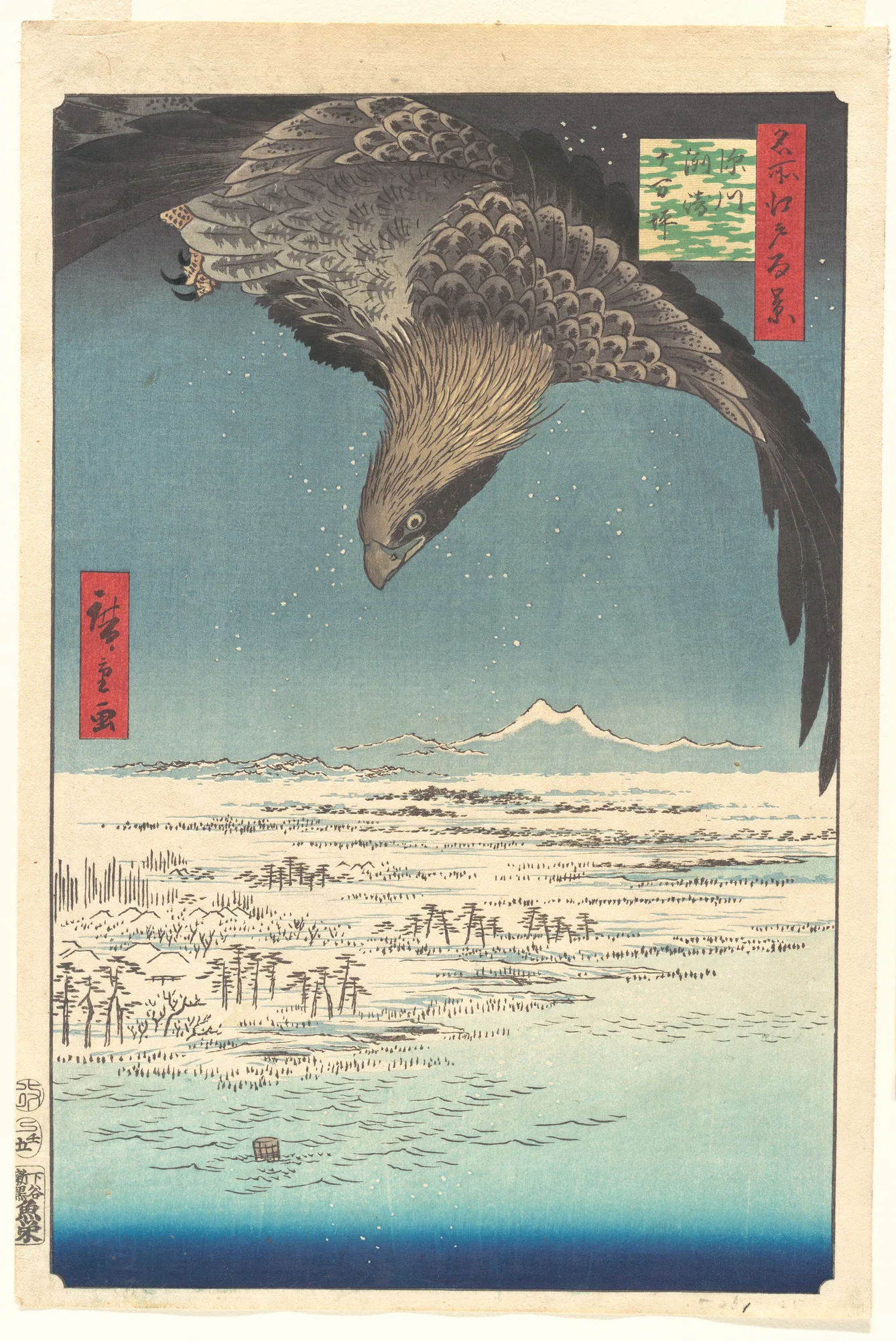
空から急降下!雪の野原をにらむ大きなワシの目線で見た江戸。Diving from the sky! Edo in the snow, seen through the eyes of an eagle.
 美術館アンテナ:この作品に会える展覧会
この作品のお話
Story雪の積もった広い野原の上を、一羽の大きなワシが舞っています。場所は江戸の東の海ぞい、深川洲崎の「十万坪」。海をうめ立てて作った、だだっ広い土地でした。歌川広重の「名所江戸百景」の一枚で、1857年に出版されました。遠くには、山頂が二つにわかれた筑波山が見えています。
A large eagle soars over a wide field covered in snow. The place is Jūmantsubo in Fukagawa Susaki, by the sea on the east side of Edo. It was a huge, empty area made by filling in the sea. This print is from Hiroshige's One Hundred Famous Views of Edo and was published in 1857. Far away, you can see Mount Tsukuba with its two peaks.
見る人は、まるでワシと一緒に空を飛んでいるような高さから景色を見下ろします。手前にはワシのつめと羽が大きくはみ出し、下の地面はとても小さい。この「近いものは巨大に、遠いものは小さく」という思いきった組み立てが、晩年の広重の得意技でした。羽の一枚一枚は、細い線でていねいに彫られています。
We look down at the land from high up, as if we were flying with the eagle. The bird's claws and wings stick out at the top, while the ground below looks tiny. Making near things huge and far things small was Hiroshige's favorite trick in his last years. Each feather is carved with fine, careful lines.
「名所江戸百景」は春夏秋冬に分けて並べられ、この絵は冬の部に入っています。浮世絵は同じ版木から何枚も摺られたので、この図柄も世界中の美術館にあります。ここで見ているのは、ニューヨークのメトロポリタン美術館の一枚です。大胆な構図は、のちにヨーロッパの画家たちにも刺激をあたえました。
The series is arranged by the four seasons, and this print belongs to winter. Many sheets were printed from the same woodblocks, so museums around the world own this design. The one you see is from the Metropolitan Museum of Art in New York. Bold compositions like this later inspired painters in Europe.
大きなワシが冬の空を飛んでいます。ワシは雪の野原を見下ろしています。わたしたちは鳥のように、空から地面を見ています。水を見てください。小さな桶がぷかぷか浮かんでいます。ワシはそれを見ているのでしょうか?
A big eagle is flying in the winter sky. It is looking down at a snowy field. We see the land from the sky, like a bird. Look at the water. A small tub is floating there. Is the eagle looking at it?
英語のレベルは上の「やさしい/ふつう」で切りかえられます。
えっ!?な裏ネタ
Secretsワシの目線の先、水面にぽつんと小さな桶(おけ)が浮かんでいます。なぜ桶が描かれているのかは、はっきりわかっていません。するどい目のワシと、のんびり浮かぶ桶の取り合わせが、見る人の想像をかき立てます。
Below the eagle, a small wooden tub floats alone on the water. No one knows for sure why Hiroshige put it there. The sharp-eyed eagle and the quiet little tub make us imagine a story.
「名所江戸百景」は人気が出て枚数がふえ、初代広重が描いた絵だけで118図になりました。広重は1858年に亡くなり、一部の図は死後に出版されました。そのあと弟子の二代目広重が1図を加え、目録とあわせると全部で120枚になります。
The series became so popular that Hiroshige I designed 118 views for it. He died in 1858, and some of his designs came out after his death. His pupil Hiroshige II added one more view. With a contents page, a full set has 120 sheets.
「十万坪」とは、とても広い土地という意味の呼び名です。江戸時代に海をうめ立てて新しい田畑を作ろうとした場所で、人家の少ない、さびしい原っぱでした。だからこそワシが飛んでいてもおかしくない景色なのです。
'Jūmantsubo' means 'one hundred thousand tsubo', a name for a very large piece of land. People filled in the sea there to make new fields. Few people lived there, so it was a lonely, empty plain, a good place for an eagle.
空に舞う雪の白い点は、絵の具で白をぬったのではなく、版木のその部分を彫り残さないことで紙の白を見せています。白い絵の具を使わずに雪を降らせる、浮世絵ならではの工夫です。
The white dots of snow are not white paint. The carver left those spots off the block, so the white paper shows through. It is a clever way to make snow fall without white ink.
ここを見て!
Look Closer1ワシの顔The eagle's head
するどい目とくちばしで、下の野原をじっと見下ろしています。羽毛は細い線で一本ずつ彫られています。
With a sharp eye and beak, the eagle stares down at the field. Each feather is carved with thin lines.
2ワシのつめThe claws
黄色い足とするどいつめが、画面の左上にはみ出しそうです。いかにも急降下の途中という感じがします。
The yellow feet and sharp claws almost go out of the top left. It feels like the eagle is in the middle of a dive.
3筑波山Mount Tsukuba
遠くに見える、頂上が二つにわかれた雪の山。江戸の人々が東の方角によくながめた筑波山です。
The snowy mountain with two peaks in the distance. It is Mount Tsukuba, which people in Edo often saw to the east.
4浮かぶ桶The floating tub
水面にぽつんと浮かぶ小さな桶。広い景色の中の、ちょっとしたなぞの小道具です。
A small tub floats alone on the water. It is a little mystery in this wide view.
英語で名画を語ろう
Talk about Art in EnglishThe print gives us a bird's-eye view of the snowy plain.
この版画は、雪の野原を鳥の目から見下ろした眺めを見せてくれます。
💡 高い所から見下ろした図や地図にも使います。日本語の「俯瞰図」にあたります。
英語で説明すると… Describe it
これは冬の景色です。上のほうに、茶色い羽の大きなワシがいます。ワシは広い雪の野原を見下ろしています。奥には、頂上が二つある白い山があります。暗い空から小さな雪が降っています。
This is a winter scene. At the top, there is a big eagle with brown feathers. It is looking down at a wide, snowy field. In the background, there is a white mountain with two peaks. Small snowflakes are falling from the dark sky.
考えてみよう Think & Talk
- ワシはこのあと何をすると思いますか?What do you think the eagle is going to do next?
- 鳥の目線から見ると、景色の感じ方はどう変わるでしょう?How does the picture change when we see it from a bird's point of view?
この作品の英単語
WordsA huge eagle flies over the snowy field.
大きなワシが雪の野原の上を飛んでいます。
The eagle soars high above Edo.
ワシが江戸の上空高く舞っています。
Its sharp claws are ready to catch something.
そのするどいつめは、何かをつかまえようとしています。
The land below is wide and empty.
下の土地は広くて何もありません。
ミニクイズ
QuizQ. 空に舞う雪の白は、どうやって表した?How did the printer make the white snow?
版木のその部分を彫り残さず、紙の白を見せています。
Those spots were not printed, so the white paper shows through.
ウソ?ホント? 遠くに見える二つの頂上の山は、富士山である。The mountain with two peaks is Mount Fuji.
頂上が二つにわかれているのは筑波山です。
The mountain with two peaks is Mount Tsukuba.
ウソ?ホント? この絵は「名所江戸百景」の冬の部に入っている。This print is in the winter section of the series.
シリーズは春夏秋冬に分けて並べられています。
The series is arranged by the four seasons.
 画像の出典とライセンス / Image credit
- CC0「名所江戸百景 深川洲崎十万坪」-“Jūmantsubo Plain at Fukagawa Susaki,” from the series One Hundred Famous Views of Edo (Meisho Edo hyakkei, Fukagawa Susaki Jūmantsubo) MET DP121668.jpg(Wikimedia Commons)
ライセンス:CC0(パブリックドメイン提供)/作者・撮影者の表記:Utagawa Hiroshige/提供元:This file was donated to Wikimedia Commons as part of a project by the Metropolitan Museum of Art. See the Image and Data Resources Open Access Policy
この作品は、作者の死後長い年月がたち著作権の保護期間が終わった「パブリックドメイン」の作品です。画像は平面の作品を忠実に写したもので、新しい著作権は生じません(Wikimedia Commons の PD-Art の考え方)。 所蔵:メトロポリタン美術館(画像の摺り)(The Metropolitan Museum of Art (this impression))。画像は表示のために縮小・WebP 形式に変換しています。
歌川広重のほかの作品