 ワークシート
 ぬりえ
 迷路
フェルメールが手放さなかった絵。ヒトラーも欲しがった!The painting Vermeer never sold. Even Hitler wanted it!
この作品のお話
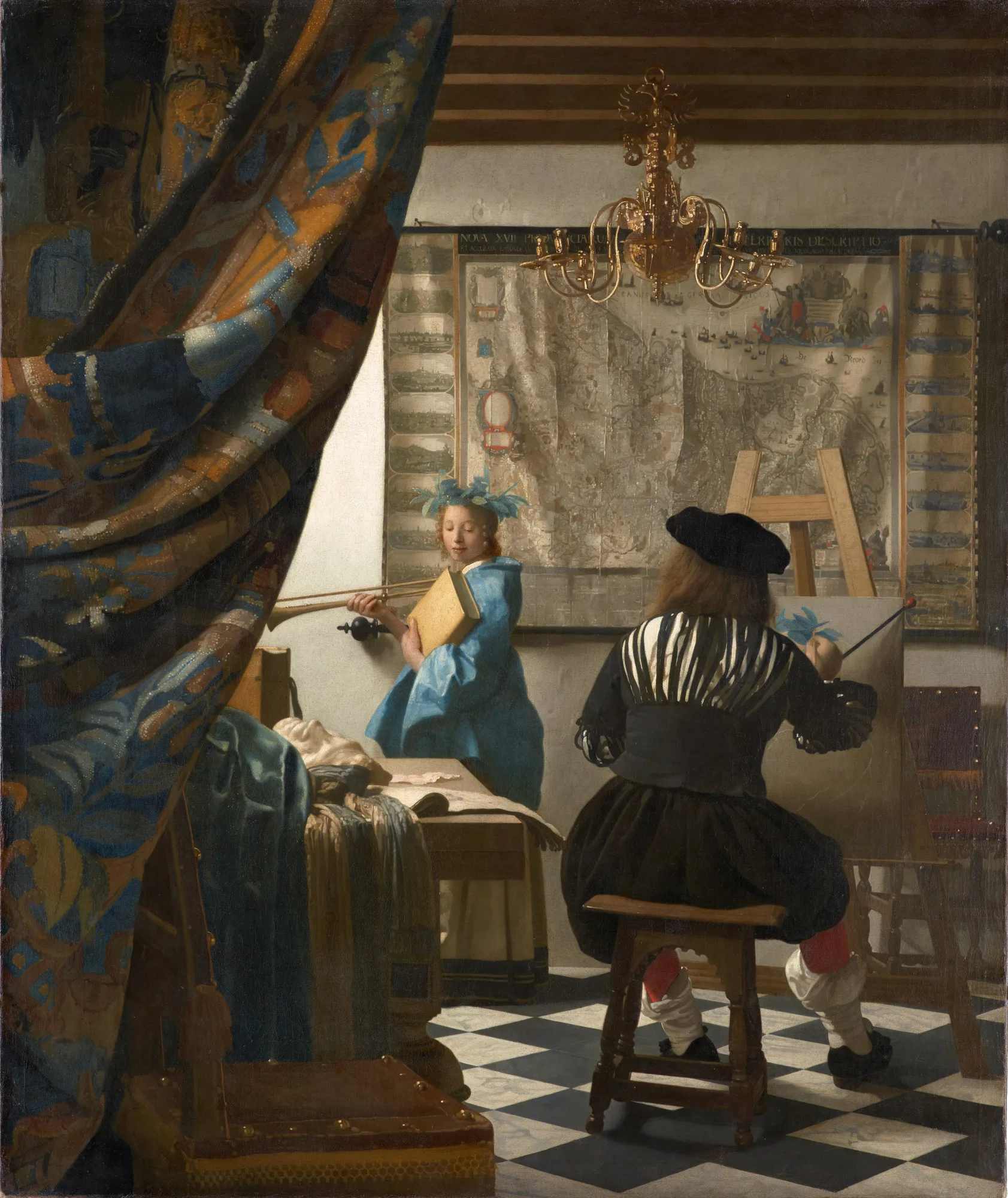
Story「絵画芸術」は、フェルメールが1666〜68年ごろに描いた、画家のアトリエの絵です。私たちは手前の重いカーテンのすき間から、そっと部屋をのぞいています。こちらに背を向けた画家が、青い服の女性を描いています。女性は月桂冠をかぶり、トランペットと本を持っています。これは歴史の女神クレイオの姿だと考えられています。
The Art of Painting shows an artist's studio. Vermeer painted it around 1666–68. We peek into the room past a heavy curtain. A painter, with his back to us, is painting a woman in blue. She wears a laurel wreath and holds a trumpet and a book. She is thought to be Clio, the muse of history.
壁にはオランダ全体を描いた大きな地図、天井には金色のシャンデリア、床は白と黒の市松模様。どれも光を受けて、本物のようにかがやきます。「絵を描くこと」そのものをテーマにしたこの絵を、フェルメールは生きているあいだ一度も売りませんでした。1675年に彼が亡くなると、家族には多くの借金が残りました。妻はこの絵を母親にゆずりましたが、のちに遺産の管理人がその譲渡に異議を唱えました。
On the wall hangs a big map of the Netherlands. A gold chandelier hangs from the ceiling, and the floor has black and white tiles. Everything shines in the light as if it were real. This painting is about the art of painting itself, and Vermeer never sold it in his lifetime. When he died in 1675, the family was deeply in debt. His wife gave the painting to her mother, but the man handling the estate later challenged this.
その後、この絵はフェルメールの名とともに忘れられ、19世紀には別の画家ピーテル・デ・ホーホの作品とされていました。1813年、ウィーンのチェルニン伯爵家が手に入れます。1940年にはヒトラーが、自分の美術館を作る計画のために買い取りました。戦後に連合軍が取りもどし、今はオーストリアの国のものとして、ウィーン美術史美術館にあります。
Later, the painting, like Vermeer's name, was forgotten. In the 19th century, it was thought to be by another painter, Pieter de Hooch. In 1813, the Czernin family in Vienna bought it. In 1940, Hitler acquired it for a museum he planned to build. After the war, the Allies recovered it. Today it belongs to Austria and hangs in the Kunsthistorisches Museum in Vienna.
私たちは画家の部屋をのぞいています。画家はこちらに背を向けてすわっています。青い服の女性がモデルになっています。フェルメールはこの絵を一度も売りませんでした。ずっと後に、ヒトラーがこの絵を手に入れたのです!
We are looking into a painter's room. The painter sits with his back to us. A woman in blue poses for him. Vermeer never sold this painting. Much later, Hitler got it!
英語のレベルは上の「やさしい/ふつう」で切りかえられます。
えっ!?な裏ネタ
Secretsフェルメールの死後、財産の整理役になったのは、同じデルフトの町で同じ1632年に生まれた科学者レーウェンフックでした。手作りの顕微鏡で微生物を初めて観察した人です。彼は、妻が母親に絵をゆずったことを認めませんでした。
After Vermeer died, the person in charge of his estate was Antonie van Leeuwenhoek. He was born in Delft in 1632, the same year as Vermeer, and was the first to see tiny living things through his own microscopes. He did not accept the transfer of the painting to Vermeer's mother-in-law.
1940年、ヒトラーは故郷近くのリンツに作る予定の巨大美術館のため、この絵を手に入れました。戦争の終わりには、空襲から守るためオーストリアのアルトアウスゼーの岩塩坑に保管され、1945年に連合軍によって見つけ出されました。
In 1940, Hitler acquired this painting for a huge museum he planned to build in Linz. Near the end of the war, it was stored in a salt mine at Altaussee, Austria, safe from bombing. Allied soldiers found it there in 1945.
19世紀には、この絵にはピーテル・デ・ホーホのにせのサインが入れられ、1860年ごろまで彼の作品と思われていました。本物のフェルメールのサインは、女性のすぐ右、地図のすそに小さく書かれています。
In the 19th century, a fake signature of Pieter de Hooch was added, and people thought he had painted it until around 1860. Vermeer's real signature is small, on the bottom edge of the map, just to the right of the woman.
壁の地図は1636年にフィッセルが出版した、ネーデルラント17州の地図で、まわりに20の町の景色がならびます。地図をたてに横切る折り目は、当時、北のオランダと、スペインのハプスブルク家が治める南とに分かれていたことを表している、という説があります。
The map on the wall was published by Claes Visscher in 1636. It shows the Seventeen Provinces of the Netherlands, with 20 city views around it. One idea is that the fold across the map stands for the split between the free north and the south ruled by the Habsburgs.
ここを見て!
Look Closer1歴史の女神クレイオClio, the muse of history
月桂冠をかぶり、名声のトランペットと歴史の本を持つ女性。少し照れたように目をふせています。
She wears a laurel wreath and holds a trumpet of fame and a book of history. She looks down a little shyly.
2背中を向けた画家The painter from behind
画家は、モデルの月桂冠の葉から描き始めています。カンヴァスには青緑の葉が少しだけ見えます。
The painter has started with the leaves of the laurel wreath. You can see a few blue-green leaves on his canvas.
3オランダの地図Map of the Netherlands
まわりに町の景色がならぶ大きな地図。しわや折り目まで、手でさわれそうなほど細かく描かれています。
A large map framed by city views. Even its wrinkles and folds look real enough to touch.
4シャンデリアChandelier
金色のシャンデリアには、ろうそくが立っていません。てっぺんには双頭のワシの飾りがあります。
The gold chandelier has no candles. At the top is a double-headed eagle.
英語で名画を語ろう
Talk about Art in EnglishThe painter is sitting with his back to us.
画家はこちらに背を向けてすわっています。
💡 with one's back to 〜 で「〜に背を向けて」。顔の見えない人物の説明に便利。
英語で説明すると… Describe it
これは画家のアトリエです。左には、重そうなカーテンがあります。画家がこちらに背を向けてすわっています。彼は青い服の若い女性を描いています。壁には大きな地図があります。
This is an artist's studio. On the left, there is a heavy curtain. A painter is sitting with his back to us. He is painting a young woman in a blue dress. There is a big map on the wall.
考えてみよう Think & Talk
- この画家はだれだと思いますか?なぜ顔が見えないのでしょう?Who do you think the painter is? Why can't we see his face?
- あなたが「絵を描くこと」をテーマに絵をかくなら、何を描きますか?If you made a picture about 'the art of painting', what would you show?
この作品の英単語
WordsWe are looking into a painter's studio.
私たちは画家のアトリエをのぞいています。
We peek into the room past a curtain.
私たちはカーテンのすき間から部屋をのぞきます。
The model holds a long trumpet.
モデルは長いトランペットを持っています。
The floor has a checkered pattern.
床は市松模様です。
ミニクイズ
QuizQ. モデルの女性は、だれの姿をしていると考えられている?Who is the model thought to be dressed as?
月桂冠・トランペット・本は、歴史の女神クレイオのしるしとされています。
The laurel wreath, trumpet and book are signs of Clio, the muse of history.
ウソ?ホント? フェルメールは、この絵を生きているあいだ一度も売らなかった。Vermeer never sold this painting in his lifetime.
死後、妻はこの絵を母親にゆずりましたが、のちに遺産の管理人がそれに異議を唱えました。
After his death, his wife gave it to her mother, but the man handling his estate later challenged this.
ウソ?ホント? この絵は、19世紀にもずっとフェルメールの代表作として有名だった。In the 19th century, this was always famous as a work by Vermeer.
19世紀にはデ・ホーホのにせサインが入れられ、彼の作品と思われていました。
In the 19th century, it had a fake de Hooch signature and was thought to be his.
 画像の出典とライセンス / Image credit
- PDJan Vermeer - The Art of Painting - Google Art Project.jpg(Wikimedia Commons)
ライセンス:Public domain(パブリックドメイン)/作者・撮影者の表記:Johannes Vermeer/提供元:Google Arts & Culture — lAHeqBoLaePtEA
この作品は、作者の死後長い年月がたち著作権の保護期間が終わった「パブリックドメイン」の作品です。画像は平面の作品を忠実に写したもので、新しい著作権は生じません(Wikimedia Commons の PD-Art の考え方)。 所蔵:ウィーン美術史美術館(Kunsthistorisches Museum)。画像は表示のために縮小・WebP 形式に変換しています。
ヨハネス・フェルメールのほかの作品