 ワークシート
 ぬりえ
 迷路
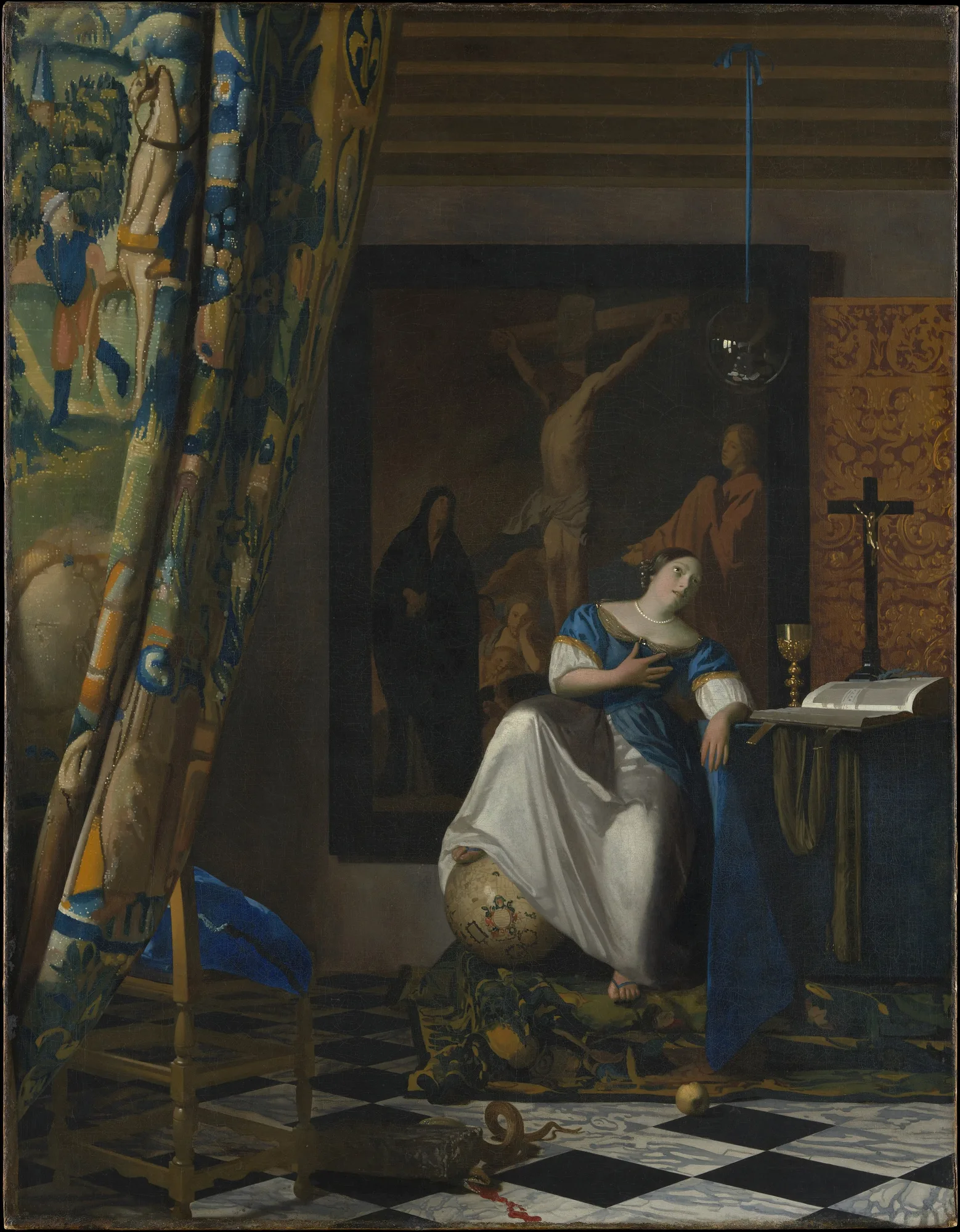
地球儀をふみつけ、ガラス玉を見上げる女性。フェルメールなのに「なぞなぞ」の絵!A woman steps on a globe and gazes at a glass ball. A Vermeer that is a riddle!
この作品のお話
Story白と青の服の女性が、胸に手をあて、天井からつるされたガラスの玉を見上げています。右足は地球儀の上。テーブルには金の杯、本、十字架がならび、床にはリンゴと、石につぶされたヘビ。フェルメールが1670〜1672年ごろに描いた作品で、今はニューヨークのメトロポリタン美術館にあります。
A woman in white and blue puts her hand on her heart and looks up at a glass ball hanging from the ceiling. Her right foot rests on a globe. On the table are a gold cup, a book and a cross. On the floor are an apple and a snake crushed by a stone. Vermeer painted this around 1670–1672. It is now in the Metropolitan Museum of Art in New York.
これはふつうの部屋の絵ではなく、「信仰」という目に見えない考えを、女性の姿であらわした「寓意画」です。フェルメールは、イタリアのチェーザレ・リーパの本『イコノロギア』を参考にしました。この本には、信仰は「世界を足の下にふむ」と書かれていて、フェルメールはそれを文字どおり地球儀で描いたのです。学識のある、信心深いカトリックの依頼主のために描かれたと考えられていますが、だれなのかはわかっていません。
This is not an ordinary room. It is an allegory: the idea of 'Faith' is shown as a woman. Vermeer used a book called Iconologia by Cesare Ripa. It says Faith has 'the world under her feet,' and Vermeer painted that literally, with a globe. It was probably made for a learned and devout Catholic patron, but we do not know who.
この絵の評価は、時代によって大きく変わりました。フェルメールらしくない、かたい絵だと言われることもあります。何人もの持ち主の手をわたり、1928年にアメリカの収集家マイケル・フリードサムが買い、1931年に彼の遺言でメトロポリタン美術館のものになりました。
People's opinion of this painting has changed a lot over time. Some have called it stiff and unlike Vermeer. It passed through many owners. In 1928, the American collector Michael Friedsam bought it, and in 1931 he left it to the Metropolitan Museum of Art in his will.
女性がガラス玉を見上げています。足は地球儀の上です。床にはリンゴとヘビがあります。どの物にも、かくれた意味があります。女性は「信仰」をあらわしているのです。
A woman looks up at a glass ball. Her foot is on a globe. There is an apple and a snake on the floor. Every object has a hidden meaning. The woman represents Faith.
英語のレベルは上の「やさしい/ふつう」で切りかえられます。
えっ!?な裏ネタ
Secrets1699年のアムステルダムの競売で、この絵は400ギルダー、1718年には500ギルダーで売れました。ところが1735年には、たった53ギルダー。フェルメールの名前が忘れられていった時代のことです。
At an auction in Amsterdam in 1699, it sold for 400 guilders, and in 1718 for 500 guilders. But in 1735, it sold for only 53 guilders. By then, Vermeer's name was being forgotten.
1899年、オランダの美術史家ブレディウスがこの絵を買い、長くハーグのマウリッツハイス美術館などに貸し出していました。ところがのちに彼は、これを「大きいが、好きになれないフェルメール」と呼んでいます。1928年、絵はアメリカへ売られました。
In 1899, the Dutch art historian Abraham Bredius bought this painting and lent it to museums like the Mauritshuis for many years. But later he called it 'a large but unpleasant Vermeer.' In 1928, it was sold to America.
19世紀の終わり、この絵はモスクワの収集家たちのもとにあり、別のオランダの画家エグロン・ファン・デル・ネールの作品だと思われていました。フェルメールの絵だとわかったのは、そのあとのことです。
In the late 19th century, the painting belonged to collectors in Moscow. They thought it was by another Dutch painter, Eglon van der Neer. Only later was it recognized as a Vermeer.
天井からつるされたガラス玉は、1636年に出版されたイエズス会の本の挿絵とよく似ています。小さな球が大きな世界をうつすことから、人の心が無限の神を受け入れることのたとえだと考えられています。
The glass ball looks like a picture in a Jesuit book published in 1636. A small ball can reflect a big world. So it is thought to show how the human mind can hold the infinite God.
ここを見て!
Look Closer1ガラス玉The glass ball
青いリボンでつるされたガラス玉。部屋の光がうつりこんでいます。
A glass ball hangs from a blue ribbon. It reflects the light of the room.
2地球儀The globe
「世界を足の下に」という本の言葉を、そのまま絵にしました。
The book said 'the world under her feet,' and Vermeer painted exactly that.
3リンゴとヘビApple and snake
リンゴは人間の最初の罪、石につぶされたヘビは悪に打ち勝つことをあらわします。
The apple stands for the first sin. The snake under the stone shows evil being defeated.
4タペストリーのカーテンTapestry curtain
手前の豪華な布が、舞台の幕のように場面を開いています。
The rich cloth in front opens the scene like a stage curtain.
英語で名画を語ろう
Talk about Art in EnglishThe woman represents Faith, and the apple represents sin.
女性は信仰を、リンゴは罪をあらわしています。
💡 寓意画や記号の意味を説明するときの基本動詞。stand for もほぼ同じ意味です。
英語で説明すると… Describe it
左には大きな色あざやかなカーテンがあります。白と青の服の女性が、テーブルのそばに座っています。彼女はガラス玉を見上げています。床には、リンゴと石の下のヘビがあります。
On the left, there is a large, colorful curtain. A woman in a white and blue dress is sitting near a table. She is looking up at a glass ball. On the floor, there is an apple and a snake under a stone.
考えてみよう Think & Talk
- 「希望」や「友情」のような考えを絵にするなら、どんな物を描きますか?If you painted an idea like 'hope' or 'friendship', what objects would you use?
- この絵と、フェルメールの静かな部屋の絵、どちらが好きですか?それはなぜ?Do you like this painting more or less than Vermeer's quiet room scenes? Why?
この作品の英単語
WordsThe woman stands for faith.
この女性は信仰をあらわしています。
Her foot is on a globe.
彼女の足は地球儀の上にあります。
A stone crushes the snake.
石がヘビを押しつぶしています。
Some people think the painting looks stiff.
この絵はかたい感じがすると思う人もいます。
ミニクイズ
QuizQ. 女性が右足をのせているものは?What is the woman resting her right foot on?
「信仰は世界を足の下にふむ」という本の言葉を、文字どおり描いています。
It shows the book's words, 'Faith has the world under her feet,' literally.
ウソ?ホント? この絵は、ずっと高い値段で売り買いされてきた。This painting has always been sold at high prices.
1699年に400ギルダーだったのが、1735年には53ギルダーまで下がりました。
It sold for 400 guilders in 1699, but only 53 guilders in 1735.
ウソ?ホント? フェルメールは、イタリアの本『イコノロギア』を参考にしてこの絵を描いた。Vermeer used an Italian book called Iconologia for this painting.
チェーザレ・リーパの本で、オランダ語訳が1644年に出ていました。
It was by Cesare Ripa, and a Dutch translation came out in 1644.
 画像の出典とライセンス / Image credit
- PDJohannes Vermeer, Allegory of the Catholic Faith, The Metropolitan Museum of Art.jpg(Wikimedia Commons)
ライセンス:Public domain(パブリックドメイン)/作者・撮影者の表記:Johannes Vermeer
この作品は、作者の死後長い年月がたち著作権の保護期間が終わった「パブリックドメイン」の作品です。画像は平面の作品を忠実に写したもので、新しい著作権は生じません(Wikimedia Commons の PD-Art の考え方)。 所蔵:メトロポリタン美術館(The Metropolitan Museum of Art)。画像は表示のために縮小・WebP 形式に変換しています。
ヨハネス・フェルメールのほかの作品