

 学習ハックホント
「小学生に説明できる?」ファインマン流勉強法、心理学の「自己説明」の研究と合っていた
 2026.10.02
 English Corner(A2〜B2・4択クイズ)
 読む前に予想してみよう!
「ファインマン・テクニック」は、物理学者ファインマン本人が論文で発表した勉強法だ
彼の学び方や説明のスタイルをもとに、後の人たちがまとめて名付けたもの。
 研究カード(どんな研究?)
- 対象
- 大学生・中学生など
- 規模
- 24人の実験〜64研究のメタ分析
- 研究の種類
- 実験研究+メタ分析
- 確かさ
- ★★★★☆
人は「分かったつもり」になりやすい。簡単な言葉で説明しようとすると穴が見つかり、理解が深まる。これは自己説明の研究とも一致する。
ひとことで言うと人に説明しようとすると、「分かってない所」が見つかる!
ノーベル物理学賞を受けたリチャード・ファインマンは、難しい物理を驚くほどかみ砕いて説明することで有名でした。
そんな彼の名前を借りた勉強法がファインマン・テクニック。手順はシンプルで、「学んだことを、小学生でも分かる言葉で説明してみる」というものです。
ネットで人気のこの方法。名前のついた方法そのものを試した研究はほとんどありませんが、中身は心理学の研究とよく合っています。
01「分かったつもり」は思ったより根深い
「説明深度の錯覚」とは、自分は説明できるほど理解している、と思い込んでしまう現象。ファスナーは毎日見ているから「分かる」気がする。でも、いざ説明しようとすると、ギザギザがどうかみ合うのか言えないんです。
勉強でも同じことが起きます。教科書を読んで「うん、分かった」と思っても、それは見て理解できるだけで、自分で説明できるレベルとは別物かもしれません。
02自分に説明すると、理解が深まる
1994年、米ピッツバーグ大学のチーらは中学2年生(8年生)24人を対象に、心臓と血液の流れについての文章を読ませる実験をしました。
14人は、1文読むごとに「これはどういうことか」を自分に説明するよう指示されました。残りの10人は、同じ文章を2回読むだけです。読む前と後のテストを比べると、説明したグループの方が点数の伸びが大きくなりました。
この方法は自己説明と呼ばれ、2013年の学習法レビューでも有用性は「中程度」と評価されています。2018年には、自己説明を促す研究(64本の論文)をまとめたメタ分析も出ました。促された人の方が学習成果が良く、効果は中くらいで、さまざまな教科で見られています。ただし、どれも「ファインマン流」という名前の方法を試したものではありません。
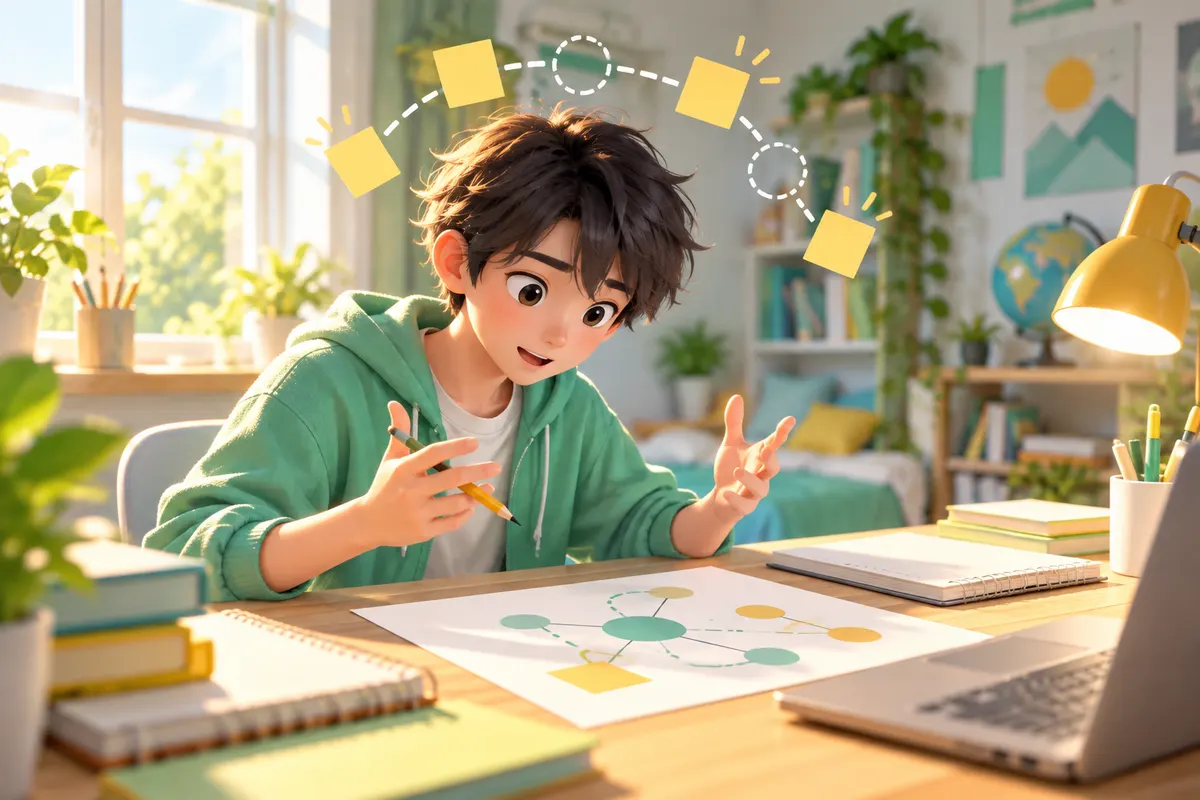
03ファインマン流・4ステップ
04「専門用語禁止」が一番のミソ
ファインマン流で大事なのは、専門用語を使わずに説明することです。
専門用語は便利ですが、ときに「分かっていない部分」を隠すフタにもなります。たとえば「光合成は葉緑体で行われる」と言えても、葉緑体が何をしているのか説明できなければ、理解はまだ途中。用語を使えないと、その中身を自分の言葉で言い直すしかなくなり、穴があぶり出されます。
たとえ話を考えるのも効果的です。「電流は水の流れ、電圧は水を押す力」のように身近なものに置き換えると、知識が日常の経験と結びつき、思い出す手がかりも増えます。ただし、たとえはあくまでたとえ。どこまで正しく、どこからずれるのかも一緒に考えると、理解がさらに深まります。
05まとめ
「分かった!」という感覚は、ときどきウソをつきます。本当に分かっているかを確かめる一番の方法は、何も見ずに、やさしい言葉で説明してみること。
説明に詰まったら、それは失敗ではなく、伸びしろが見つかった合図です。
この研究を英語で読もう原田英語の English CornerThe Feynman Technique is named after the Nobel Prize-winning physicist Richard Feynman, who was famous for… 音声
音声 4択クイズ9問A2・B1・B2タップして開く
原田英語の English Corner
この研究を英語で読もう
Richard Feynman was a famous scientist. He could explain difficult ideas in very simple words. A study method uses his name. You try to explain what you learned so that a child can understand it.
Why might this help? We often think we understand something, but we cannot explain it. When you try to explain, you find the parts you do not know. Then you can study those parts again.
70 words ・ CEFR A2
和訳を見る
リチャード・ファインマンは有名な科学者でした。彼はむずかしい考えをとてもかんたんな言葉で説明することができました。ある勉強法には彼の名前がついています。学んだことを、子どもでも分かるように説明してみるのです。
なぜこれが役に立つのでしょうか。私たちは何かを理解していると思っていても、説明できないことがよくあります。説明しようとすると、分かっていない部分が見つかります。そうすれば、その部分をもう一度勉強できるのです。
4択リーディングクイズ
Q1. What is the passage mainly about?
ファインマンの名前がついた「やさしい言葉で説明する」勉強法がテーマなので A。
Q2. What happens when you try to explain something?
When you try to explain, you find the parts you do not know. とあるので D。
Q3. In this passage, "explain" means ...
explain は「説明する」。相手に分かるように話すことなので B。
The Feynman Technique is named after the Nobel Prize-winning physicist Richard Feynman, who was famous for explaining hard ideas simply. The idea is to explain a topic in words a young child could understand. It may help because we often suffer from an "illusion of explanatory depth." In a 2002 study at Yale University, students rated how well they understood everyday objects such as zippers.
After they tried to explain how the objects worked step by step, they lowered their ratings. In another study, eighth-grade students who explained each sentence to themselves while reading about the heart understood it better than students who just read it twice. Note that Feynman himself did not publish this method. Others named it later.
120 words ・ CEFR B1
和訳を見る
ファインマン・テクニックは、むずかしい考えを簡単に説明することで有名だった、ノーベル賞受賞の物理学者リチャード・ファインマンにちなんで名付けられています。その考え方は、ある話題を小さな子どもでも分かる言葉で説明するというものです。これが役に立ちそうなのは、私たちがしばしば「説明深度の錯覚」に陥っているからです。イェール大学の2002年の研究で、学生たちはファスナーなどの身近な物をどのくらい理解しているかを自己評価しました。
その仕組みを一歩ずつ説明しようとしたあと、彼らは評価を下げました。別の研究では、心臓についての文章を読みながら1文ごとに自分に説明した8年生は、ただ2回読んだだけの生徒より内容をよく理解しました。なお、ファインマン本人がこの方法を発表したわけではなく、後に他の人たちが名付けたものです。
4択リーディングクイズ
Q1. What is the "illusion of explanatory depth"?
説明しようとすると自己評価が下がった例から、実際より理解していると思い込む錯覚だと分かるので C。
Q2. What happened after the students tried to explain how zippers worked?
After they tried to explain ... they lowered their ratings. とあるので B。
Q3. Which statement is true according to the passage?
最後の2文 Feynman himself did not publish this method. Others named it later. とあるので D。
In 2002, Rozenblit and Keil at Yale asked students to rate how well they understood everyday devices such as zippers and flush toilets. Then the students had to explain, step by step, how each device worked. Many stumbled and lowered their ratings, and the authors named the effect the illusion of explanatory depth. The finding supports the logic of the Feynman Technique, named after the physicist Richard Feynman, who was famous for making difficult physics accessible.
The method asks learners to explain a topic in words simple enough for a child and to go back to the source wherever they get stuck. Feynman himself never published it as a method. Research on self-explanation points the same way. In a 1994 study of 24 eighth-graders reading about the circulatory system, those prompted to explain each sentence to themselves understood the material better, and a 2018 meta-analysis of 64 studies found a moderate benefit across subjects.
But almost no controlled experiments have tested the Feynman Technique itself, so its support is borrowed from related work, and the 1994 study involved few students. The illusion is also strongest for causal knowledge about mechanisms and weaker for simple facts or procedures.
197 words ・ CEFR B2
和訳を見る
2002年、イェール大学のローゼンブリットとカイルは、学生にファスナーや水洗トイレなどの身近な装置をどのくらい理解しているか評価させました。次に学生たちは、それぞれの装置がどう動くのかを一歩ずつ説明しなければなりませんでした。多くが言葉に詰まって評価を下げ、著者たちはこの効果を「説明深度の錯覚」と名付けました。この発見は、ファインマン・テクニックの理屈を支えるものです。
この方法は、難しい物理を分かりやすくすることで有名だった物理学者リチャード・ファインマンにちなんで名付けられました。学習者にある話題を子どもでも分かるほどやさしい言葉で説明させ、詰まったところがあればそのたびに元の資料に戻らせる方法です。ファインマン自身は、これを方法として発表したことはありません。自己説明に関する研究も同じ方向を示しています。循環器系についての文章を読む8年生24人を対象とした1994年の研究では、1文ごとに自分に説明するよう促された生徒の方が内容をよく理解し、64の研究をまとめた2018年のメタ分析は、さまざまな教科にわたって中程度の効果を見いだしました。
しかし、ファインマン・テクニックそのものを検証した統制実験はほとんどないため、その裏付けは関連研究から借りたものであり、1994年の研究も生徒の数が少ないものでした。また、この錯覚は仕組みについての因果的な知識で最も強く、単純な事実や手順では弱くなります。
4択リーディングクイズ
Q1. What did the 2002 Yale study reveal?
一歩ずつ説明しようとすると Many stumbled and lowered their ratings とあり、理解を過大評価していた(説明深度の錯覚)ので B。
Q2. Why does the author say the technique's support is "borrowed"?
almost no controlled experiments have tested the Feynman Technique itself, so its support is borrowed from related work とあるので A。
Q3. For which kind of knowledge is the illusion of explanatory depth strongest?
The illusion is also strongest for causal knowledge about mechanisms とあるので C。事実や手順では弱い。
重要単語
- explanationB1名詞説明Try to give a simple explanation without notes.
 動詞 explain とつづりが変わる(explai-n → expla-nation、i が消える)点に注意。give an explanation for ~「~の説明をする」。
 - illusionB2名詞錯覚、思い込みRereading can create an illusion of understanding. be under the illusion that ~「~と思い込んでいる」。optical illusion(目の錯覚)も頻出。
- self-explanationC1名詞自己説明Self-explanation helps you find gaps in your knowledge. self-+名詞で「自分自身への~」(self-control・self-esteem)。学習科学の重要語。
- jargonC1名詞専門用語Explain the idea without using jargon. 仲間内だけで通じる言葉、という少し否定的なニュアンス。technical terms はより中立的な言い方。
- analogyC1名詞たとえ、類推An analogy links new ideas to familiar ones. draw an analogy between A and B「A と B を比べてたとえる」。形容詞 analogous。
- accessibleB2形容詞分かりやすい・利用しやすいFeynman made physics accessible to ordinary people. access(接近)+-ible。「近づきやすい」から「理解しやすい」「バリアフリーの」まで広く使う。
- falterC1動詞口ごもる・つまずくMany students faltered when they tried to explain. 声や足取りが「よろめく」イメージ。His voice faltered.「声が震えた」。
 入試に出る順の単語帳を印刷する →
 全5903語の「科学英単語カード」で復習する →
 公式・一次情報をチェック
- Concrete Examples(The Learning Scientists)learningscientists.org
このネタ、誰かに教えたくなった?
「ファスナーの仕組み、分かる?」と聞かれると多くの人が「分かる」と自己評価するのに、説明させると言葉に詰まるという実験がある。“分かったつもり”を壊すファインマン流勉強法は、「自分に説明する」学び方の研究とも合っている。
押すと「マジかリスト」に保存されます
出典・参考文献(4件)タップで表示
- Rozenblit & Keil (2002) The misunderstood limits of folk science: An illusion of explanatory depth, Cognitive Sciencedoi.org
- Chi, de Leeuw, Chiu & LaVancher (1994) Eliciting self-explanations improves understanding, Cognitive Sciencedoi.org
- Bisra, Liu, Nesbit, Salimi & Winne (2018) Inducing self-explanation: A meta-analysis, Educational Psychology Reviewdoi.org
- Dunlosky, Rawson, Marsh, Nathan & Willingham (2013) Improving students' learning with effective learning techniques, Psychological Science in the Public Interestdoi.org

※本記事は上記の研究・公開資料をもとに、原田英語が独自の言葉で解説したものです。引用は著作権法第32条の範囲で行い、出典を明記しています。画像はすべてオリジナルのイメージです。研究結果には限界や個人差があります。誤りのご指摘は原田英語のお問い合わせフォームから。
 これも「マジか!?」
 学習ハック
学習ハック
暗記がつらい人へ。覚える前に「なぜ?」と自分に聞いて答えを考えると記憶に残りやすくなる
 学習ハック
学習ハック
自信満々で間違えた問題ほど、直したあとは忘れにくい。「ハイパーコレクション効果」の不思議

 学習ハック
学習ハック
【読み返すより思い出す】短い文章を4回勉強するより「1回勉強+テスト3回」の方が1週間後によく覚えていた
 学習ハック
学習ハック
数学の問題は「単元ごと」より「ごちゃ混ぜ」で解け。米国の中学生787人の実験でも1か月後のテストに大差

 学習ハック
学習ハック
習う前にテストを解くと、ほぼ全問まちがえても、あとでその内容をよく覚えられる「事前テスト効果」

 学習ハック
学習ハック