
 語学・英語学習ビミョー
「イラスト付き単語帳」は覚えやすい? 実験では訳語に勝てなかった。原因は「分かったつもり」
 2026.10.02
 English Corner(A2〜B2・4択クイズ)

 読む前に予想してみよう!
外国語の単語は、絵と一緒に覚えれば、訳語で覚えるよりいつも記憶に残る
絵で覚えた方が成績が上がらなかった実験もある。絵があると「覚えた」と過信しやすく、それを防ぐと絵の効果が出た。
 研究カード(どんな研究?)
- 対象
- オランダ人・アメリカ人の大学生など
- 規模
- 数十〜100人規模の実験が複数
- 研究の種類
- 実験研究
- 確かさ
- ★★★☆☆
外国語の単語を絵で覚える方法は、訳語で覚える方法より成績が上がらなかった実験がある。原因は「絵があると覚えた気になる」過信。過信をなくすと、絵の効果が現れた。
ひとことで言うと絵つき単語帳は「覚えたつもり」になりやすい。テストで確かめれば絵が味方になる!
かわいいイラスト付きの英単語帳、ついつい手に取りたくなりますよね。「絵があると覚えやすい」は、なんとなく当たり前のように思えます。
ところが、心理学の実験では絵で覚えた単語が、訳語で覚えた単語に勝てなかったという結果が出ています。いったいなぜでしょうか?
01絵より「訳語」のほうがよかった実験
すでに母語をしっかり持っている大人にとって、外国語の単語は母語の単語に「ひもづける」ほうが効率がよい、という解釈ができます。
02原因は「絵があると覚えた気になる」こと
この謎に、さらに踏み込んだのがカーペンターとオルソンの2012年の研究です。
そこで研究者たちは、別々の実験で過信を取り除く工夫をしました。①学習中に一度テストして、実際に思い出せるか体験させる。②「絵があっても過信しないで」と注意をうながす。すると今度は、絵で覚えたほうが訳語より成績がよくなったのです。
論文のタイトルはずばり、「絵は外国語の単語学習に役立つか?——役立たないと思っている場合に限る」。

03「分かったつもり」は勉強をやめさせる
なぜ過信が問題なのでしょうか。それは、「もう覚えた」と感じると、人は練習をやめてしまうからです。
コーネルとビョークの2008年の研究では、「覚えた」と思った単語カードを練習から外してよいことにすると、学生は早めにカードを外し、そのせいで成績が少し下がりました。
絵は分かりやすく、見た瞬間にスッと意味が入ってくる。カーペンターらの実験でも、絵と一緒のほうが「頭に入りやすい」と感じられていました。その「すらすら感」が、「覚えた」という錯覚につながると考えられます。
心理学では、この「処理のしやすさ」を流暢性(fluency)と呼びます。読みやすい・分かりやすいものほど「覚えやすい」と感じてしまうのですが、感じ方と実際の記憶は別物。絵付き単語帳の落とし穴は、まさにこのズレにありました。
04まとめ
イラスト付き単語帳は、それだけで覚えやすくなる魔法ではありません。むしろ「覚えた気」になりやすいという落とし穴がありました。
でも、自分でテストして過信をなくせば、絵はちゃんと味方になる。絵付きの単語帳を使うなら、「見る」で終わらず「隠して思い出す」までセットにしましょう。
この研究を英語で読もう原田英語の English CornerDo pictures help you remember foreign words? 音声
音声 4択クイズ9問A2・B1・B2タップして開く
原田英語の English Corner
この研究を英語で読もう
Word books with pictures look fun and easy. But do pictures really help you learn new words? In a 2012 study, American students learned foreign words with pictures or with English translations. The pictures did not help more.
But the students felt more sure that they knew the words with pictures. This feeling was wrong. When the students tested themselves during study, the pictures started to help. So after you look at a picture, cover it and test yourself.
79 words ・ CEFR A2
和訳を見る
絵のついた単語帳は楽しくて簡単そうに見えます。でも、絵は本当に新しい単語を覚えるのに役立つのでしょうか。2012年のある研究で、アメリカの学生が外国語の単語を、絵か英語の訳語と一緒に覚えました。絵のほうがよく覚えられたわけではありませんでした。
しかし学生たちは、絵と一緒の単語のほうをわかっていると強く感じていました。この感覚は間違っていました。学生が学習中に自分でテストすると、絵が役立つようになりました。だから絵を見たら、それを隠して自分をテストしましょう。
4択リーディングクイズ
Q1. What is the passage mainly about?
絵があると覚えた気になるが実際はそうでない、という内容が中心なので A。
Q2. When did the pictures start to help?
When the students tested themselves during study, the pictures started to help. とあるので C。
Q3. In this passage, "cover" in "cover it" means ...
絵を「隠して」自分をテストする、という意味なので B。
Do pictures help you remember foreign words? In 1998, two researchers taught 80 Italian words to 56 Dutch adults. Some adults learned with Dutch translations, and others learned with pictures. The translation group did better. In 2012, Carpenter and Olson had American students learn Swahili words with pictures or with English translations. Again, pictures did not lead to better scores.
But the students who saw pictures felt more sure that they would remember the words. The pictures gave them a feeling of knowing that was not real.
Then the researchers removed this overconfidence, for example by giving a test during study. After that, the group with pictures finally did better than the translation group. Pictures can help, as long as you do not trust them too much.
127 words ・ CEFR B1
和訳を見る
絵は、外国語の単語を覚える助けになるのでしょうか。1998年、2人の研究者が56人のオランダ人の大人に、80個のイタリア語の単語を教えました。オランダ語の訳語で学んだ人もいれば、絵で学んだ人もいました。訳語のグループのほうが成績がよかったのです。2012年、カーペンターとオルソンは、アメリカの学生にスワヒリ語の単語を、絵か英語の訳語と一緒に覚えさせました。ここでも、絵はよりよい点数につながりませんでした。
しかし、絵を見た学生たちは、その単語を覚えていられるとより強く思っていました。絵は、実際にはない「わかった感覚」を学生に与えていたのです。
そこで研究者たちは、たとえば学習中にテストをすることで、この過信を取り除きました。すると、絵のグループがようやく訳語のグループを上回りました。絵は、信用しすぎないかぎり役に立つのです。
4択リーディングクイズ
Q1. What happened in the 1998 Dutch study?
The translation group did better. とあるので D。
Q2. How did students who saw pictures feel?
the students who saw pictures felt more sure that they would remember the words とあるので A。
Q3. What does the writer mean by "Pictures can help, as long as you do not trust them too much"?
過信を取り除く(学習中にテストする)と絵のグループが上回った、という流れからの結論なので C。
Illustrated vocabulary books assume that a picture of a word will stick better than its translation. The evidence is less tidy. Lotto and de Groot taught 80 Italian words to 56 Dutch adults who knew no Italian.
Learning with Dutch translations produced better results than learning with pictures, and scores were also higher when the test used the same format as the learning. Carpenter and Olson later offered an explanation. American students who learned Swahili words with pictures did no better than those who learned with English translations, but they judged their own learning more highly.
The images had inflated their confidence. Once that overconfidence was removed, either by letting learners experience a test during study or by warning them about it, pictures came out ahead. The likely mechanism is processing fluency.
An image is understood without effort, and that ease feels like durable learning. This has a real cost, because learners who feel they have mastered an item tend to stop studying it, as Kornell and Bjork showed with flashcards. These were all short laboratory studies, and some used only a few learning trials. Within those limits, the experiments point to a simple pairing of pictures plus self-testing.
199 words ・ CEFR B2
和訳を見る
イラスト付きの単語帳は、単語の絵のほうが訳語よりも記憶に残るはずだと考えています。しかし証拠はそれほどすっきりしていません。ロットとデ・フロートは、イタリア語をまったく知らない56人のオランダ人の大人に、80個のイタリア語の単語を教えました。
オランダ語の訳語で学習するほうが絵で学習するよりもよい結果を生み、テストが学習と同じ形式のときのほうが点数も高くなりました。その後、カーペンターとオルソンがその説明を示しました。絵と一緒にスワヒリ語の単語を学習したアメリカの学生は、英語の訳語で学習した学生より成績がよいわけではありませんでしたが、自分の学習の度合いをより高く見積もっていました。
絵が自信をふくらませていたのです。学習中にテストを体験させたり、過信について警告したりしてその過信を取り除くと、絵のほうが上回りました。考えられるしくみは処理の流暢性です。画像は苦労なく理解され、その楽さが長持ちする学習のように感じられるのです。
これには現実の損失があります。コーネルとビョークが単語カードで示したように、ある項目を習得したと感じた学習者はその勉強をやめがちだからです。これらは短期間の実験室研究で、学習試行が数回しかないものもありました。その範囲内で言えば、実験が示しているのは、絵と自己テストを組み合わせるという単純な方法です。
4択リーディングクイズ
Q1. What is the main point of the passage?
絵は過信を生むが、過信を取り除くと絵が上回り、最終文でも pictures plus self-testing とまとめられているので B。
Q2. According to the passage, what is "processing fluency"?
An image is understood without effort, and that ease feels like durable learning. と説明されているので D。
Q3. Which limitation does the author mention?
These were short laboratory studies, and some used only a few learning trials. とあるので C。
重要単語
- overconfidenceC1名詞過信Overconfidence makes you stop studying too early.
 over-(過度の)+ confidence。形容詞 overconfident。メタ認知研究のキーワード。
 - judgment of learningC1名詞(句)学習判断(覚えたかどうかの自己評価)Our judgments of learning are often wrong. 心理学の専門用語で JOL と略される。「後でどのくらい思い出せそうか」を学習者自身が予測したもの。
- translationB1名詞訳・訳語The translation was easier to remember than the picture. 動詞 translate A into B「A を B に訳す」。trans-(向こうへ)+ late(運ぶ)。
- fluencyC1名詞(心理学)処理の流暢性、すらすら感Easy processing, or fluency, can feel like learning. ふつうは「(言語の)流暢さ」。認知心理学では「処理のしやすさ」の意味で使い、わかりやすい=覚えた、という錯覚の原因になる。
- self-testB2動詞・名詞自分でテストする(こと)Self-test before you decide you know a word. self- は「自分で・自分を」。self-study(独学)、self-check(自己点検)も同じ仲間。
- inflateC1動詞ふくらませる・(実際より)大きくするPictures can inflate your confidence. 本来は「空気でふくらませる」。inflation(物価上昇)の動詞形。inflated confidence「実態以上の自信」。
- intuitiveC1形容詞直感的なIt is intuitive to think pictures help memory. 名詞 intuition「直感」。counterintuitive「直感に反する」は研究紹介の長文で頻出。
 入試に出る順の単語帳を印刷する →
 全5903語の「科学英単語カード」で復習する →
 この話題を TED で聞く
同じテーマの TED・TED-Ed を、 TED HACK で。英語の見どころ・使える表現・学習ミッションつきの日本語ガイドです。(運営:原田英語)

 4コマでわかる
このネタ、誰かに教えたくなった?
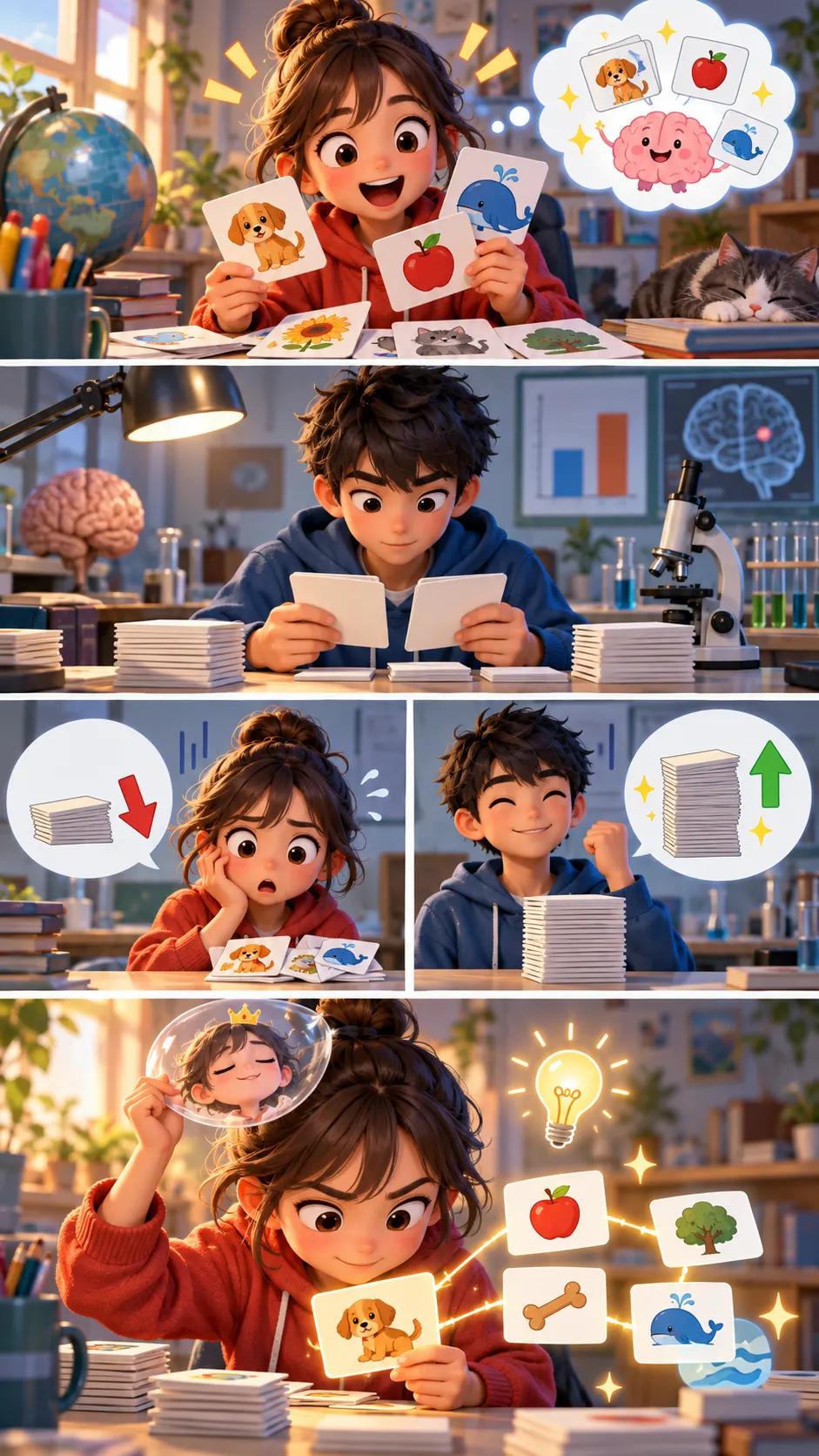
イラスト付き単語帳、実験では訳語で覚えるのと比べて成績が上がらなかったらしい。原因は「絵があると覚えた気になる」こと。ところが過信をなくす工夫をしたら、絵で覚えた単語のほうがちゃんと勝った。絵は使い方しだい。
押すと「マジかリスト」に保存されます
 出典・参考文献(3件)タップで表示
- Carpenter & Olson (2012) Are pictures good for learning new vocabulary in a foreign language? Only if you think they are not. Journal of Experimental Psychology: Learning, Memory, and Cognitiondoi.org
- Lotto & de Groot (1998) Effects of learning method and word type on acquiring vocabulary in an unfamiliar language. Language Learningdoi.org
- Kornell & Bjork (2008) Optimising self-regulated study: The benefits—and costs—of dropping flashcards. Memorydoi.org

※本記事は上記の研究・公開資料をもとに、原田英語が独自の言葉で解説したものです。引用は著作権法第32条の範囲で行い、出典を明記しています。画像はすべてオリジナルのイメージです。研究結果には限界や個人差があります。誤りのご指摘は原田英語のお問い合わせフォームから。

別館
マジか!?ことばで読む、ことばの雑学
英語と日本語の「えっ、マジか!?」を辞書と論文でウラ取りする別館
 これも「マジか!?」
 語学
語学
単語帳は「英→日」だけでいい? 研究では「日→英」で覚えたほうが“使える単語”が増えていた
 語学
語学
単語帳 vs 文脈で覚える、勝つのはどっち? 研究をまとめた答えは「両方」だった

 語学
語学
英単語は「頭の中の発音」で覚えている? それを邪魔したら外国語の単語が覚えにくくなった
 語学
語学
英単語を「10回書いて覚える」は逆効果? 書き写しが記憶をジャマした実験と、上手な使い方

 語学
語学
寝る前の単語暗記は効く? 新しい単語は「ひと晩寝ると」脳の辞書に入っていた
 語学
語学