
 脳と心理ビミョー
左右の脳をつなぐ神経の束を切ったら、心は2つになる? 分離脳研究60年の論争
 2026.10.02
 English Corner(A2〜B2・4択クイズ)

 読む前に予想してみよう!
脳梁を切った人の左の脳は、自分の左手がした行動に"もっともらしい理由"を、その場で作ってしまうことがある
ガザニガはこの働きを「インタープリター(解釈装置)」と呼んだ。
 研究カード(どんな研究?)
- 対象
- 脳梁を切断した患者
- 規模
- 数人規模の症例研究の積み重ね
- 研究の種類
- 症例研究
- 確かさ
- ★★☆☆☆
左右の脳をつなぐ脳梁を切った人では、左右が別々に情報を処理する。でも「心が2つになる」とまでは言えない、という研究も。
ひとことで言うと右の脳と左の脳が話せなくなっても、「自分」は1人のままかも。
私たちの脳は、左右2つの半球に分かれています。そのあいだを結んでいるのが脳梁(のうりょう)です。約2億本ともいわれる神経線維が集まった、太い束です。
もし、この"橋"を切ってしまったら?
これは空想の話ではありません。1960年代のアメリカでは、実際に脳梁を切る手術が行われました。薬で抑えられない、重いてんかんの治療のためです。発作が脳の片側からもう片側へ広がるのを防ぐねらいでした。
01右の脳は「見えた」のに、口では「見えない」
手術を受けた人たちは、ふだんの生活では、ほとんど変わった様子がありませんでした。ところが、神経科学者スペリーと大学院生ガザニガが特別な実験をすると、思いがけないことが起きました。
右の脳は、ちゃんと「見て」いました。ただ、その情報が左の脳に渡らないので、言葉にできなかったのです。スペリーは、この一連の研究で1981年のノーベル生理学・医学賞を受賞しました(ほかの2人との共同受賞)。
02左の脳は"それっぽい言い訳"を作る
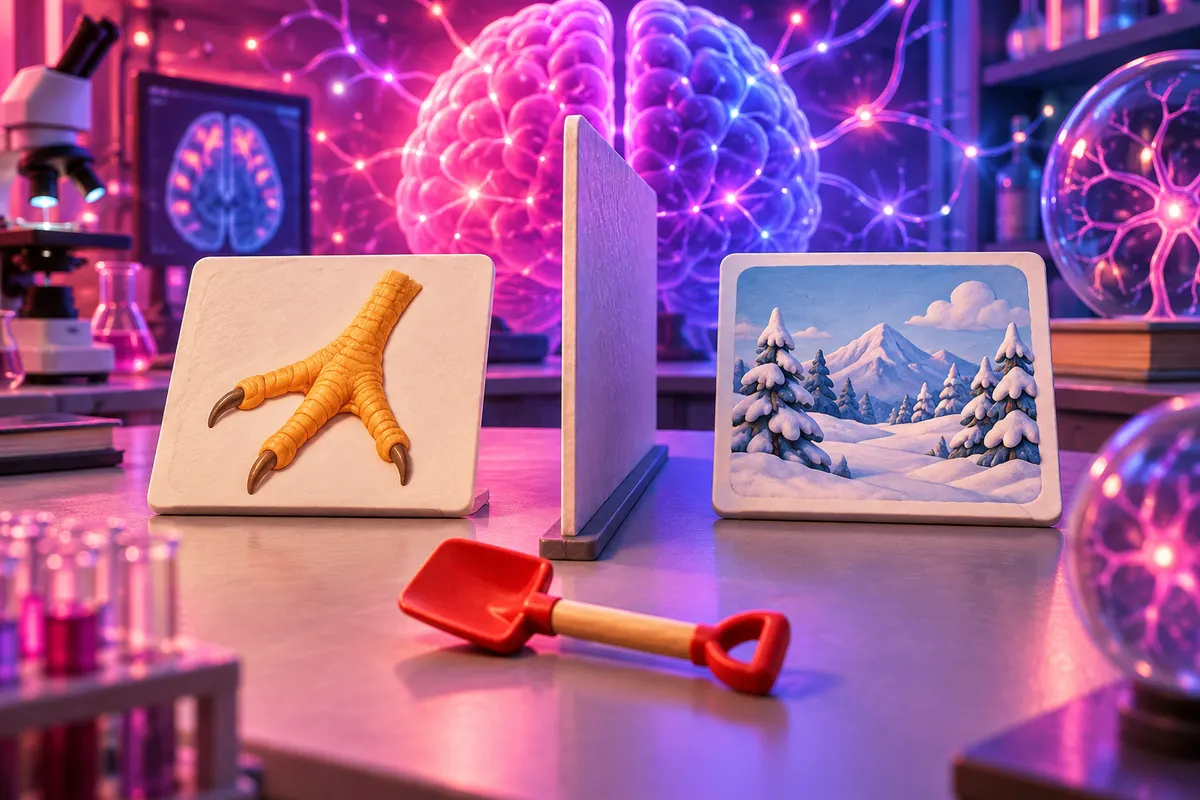
ガザニガは、さらに有名な実験を行いました。左の脳にはニワトリの足の絵を、右の脳には雪景色の絵を見せます。そして、それぞれの絵に合う絵を選んでもらいました。
右手はニワトリを、左手は雪かき用のシャベルを選びました。理由を聞かれた患者さんは、こう説明しました。「ニワトリの足だからニワトリ。それで、ニワトリ小屋の掃除にはシャベルがいるでしょう」。
話している左の脳は、雪景色を見ていません。それでも、左手がシャベルを選んだ理由を、その場で"それっぽく"作り上げたのです。ガザニガは、この働きを「インタープリター(解釈装置)」と名づけました。
03では、心は2つになったのか?
スペリー自身は、左右の脳がそれぞれ別々の意識を持っているように見える、と論じました。ここから、「分離脳の人の頭の中には2人いる」という話が広まりました。
ところが2017年、オランダのピント(Pinto)らが、脳梁を完全に切った2人の患者さんを詳しく調べ直しました。
左右どちらの側に見せた絵や図形についても、2人は偶然よりはるかに高い正答率で答えられました。答え方が左手でも、右手でも、言葉でも同じでした。
一方で、「左側に見せたものと右側に見せたものが同じかどうか」を比べることはできませんでした。研究チームの結論はこうです。見たものの処理は左右で分かれていても、それを意識している"自分"は1人のままではないか。
04まとめ
脳梁を切ると、左右の脳は別々に見て、別々に動くことがあります。でも、それで「心が2つになる」のかは、60年たった今も決着していません。
分離脳の研究からは、もう一つ見えてきたことがあります。脳には、自分の行動に、あとから"もっともらしい理由"をつける働きがあるらしい、ということです。あなたが今日した選択の理由、本当にそれで合っていますか?
この研究を英語で読もう原田英語の English CornerThe two halves of the brain are joined by a thick bundle of nerve fibers called the corpus callosum. 音声
音声 4択クイズ9問A2・B1・B2タップして開く
原田英語の English Corner
この研究を英語で読もう
Our brain has a left half and a right half. A thick bridge of nerves connects them. In the 1960s, some patients had this bridge cut to stop serious seizures.
In one test, a picture was shown only to the right half of the brain. The patient said, "I saw nothing," because the left half controls speech. But the patient's left hand picked the correct object. So the two halves can work separately.
73 words ・ CEFR A2
和訳を見る
私たちの脳には左半分と右半分があります。太い神経の橋が両者をつないでいます。1960年代、重い発作を止めるために、この橋を切った患者たちがいました。
ある実験では、脳の右半分にだけ絵が見せられました。言葉を担当するのは左半分なので、患者は「何も見えなかった」と言いました。ところが、患者の左手は正しい物を選んだのです。つまり、左右の脳は別々に働くことがあるのです。
4択リーディングクイズ
Q1. What is the passage mainly about?
左右の脳をつなぐ橋を切った患者の実験が中心なので C。
Q2. Why did the patient say "I saw nothing"?
because the left half controls speech とある。絵は右半分にしか届かず、話す側の左半分は見ていないので A。
Q3. In this passage, "separately" means ...
separately は「別々に」。左右がそれぞれ単独で働く、という意味なので D。
The two halves of the brain are joined by a thick bundle of nerve fibers called the corpus callosum. In the 1960s, some people with severe epilepsy had it cut so that seizures could not spread from one side to the other. The neuroscientist Sperry and his graduate student Gazzaniga then tested these patients.
When a picture was flashed only to the right hemisphere, patients said they saw nothing, yet their left hand chose the correct object. In another test, the left hemisphere saw a chicken foot and the right saw a snowy scene. The left hand picked a shovel, and the patient explained that it was for cleaning the chicken house. Gazzaniga called this storytelling system the "interpreter."
119 words ・ CEFR B1
和訳を見る
脳の左右の半分は、脳梁と呼ばれる神経線維の太い束でつながっています。1960年代、重いてんかんを持つ人の中には、発作が片側からもう片側へ広がらないように、脳梁を切った人たちがいました。神経科学者スペリーと大学院生ガザニガは、その後これらの患者を調べました。
右半球にだけ絵を一瞬見せると、患者は何も見えなかったと言いましたが、左手は正しい物を選びました。別の実験では、左半球にニワトリの足を、右半球に雪景色を見せました。左手はシャベルを選び、患者はそれをニワトリ小屋の掃除のためだと説明しました。ガザニガはこの「話を作る仕組み」を「インタープリター(解釈装置)」と呼びました。
4択リーディングクイズ
Q1. Why was the corpus callosum cut in some patients?
so that seizures could not spread from one side to the other とあるので B。
Q2. In the chicken-and-snow test, what did the left hand choose?
The left hand picked a shovel とあるので D。ニワトリを選んだのは右手。
Q3. What does the "interpreter" probably do?
左半球は雪景色を見ていないのに、シャベルを選んだ理由を作り上げた。この働きが interpreter なので A。
Split-brain research became famous in the 1960s, when the corpus callosum, the bundle of fibers linking the two hemispheres, was cut in patients with severe epilepsy. Sperry and Gazzaniga showed that information presented to only one hemisphere stayed there: patients denied seeing an object flashed to the right hemisphere, while their left hand could still identify it.
The left hemisphere also invented plausible reasons for actions it had not planned, a process Gazzaniga named the "interpreter." This work earned Sperry a share of the 1981 Nobel Prize and encouraged the popular claim that such patients have two minds. A 2017 study, however, challenged that view. Re-examining two patients, Pinto and colleagues found that both could respond to stimuli in either visual field far above chance, whether they answered with the left hand, the right hand or speech.
But they could not judge whether two stimuli on opposite sides were the same. The authors concluded that perception may be divided while consciousness remains unified. Because the evidence comes from very few patients who differ in surgery and history, neither conclusion is final, and the findings certainly do not support simple "right-brain" or "left-brain" personality types.
194 words ・ CEFR B2
和訳を見る
分離脳研究が広く知られるようになったのは1960年代です。当時、重いてんかんの患者で、左右の半球をつなぐ線維の束である脳梁が切断されたのです。スペリーとガザニガは、片方の半球だけに示した情報はそこにとどまることを示しました。
患者は右半球に一瞬見せた物を見たことを否定しましたが、左手ではその物を言い当てることができたのです。さらに左半球は、自分が計画していない行動に対してもっともらしい理由を作り出しました。ガザニガはこの過程を「インタープリター」と名づけました。この研究によりスペリーは1981年のノーベル賞を共同受賞し、こうした患者には心が2つあるという俗説が広まるきっかけにもなりました。しかし2017年の研究がその見方に異議を唱えました。
2人の患者を調べ直したピントらは、左手・右手・言葉のどれで答えても、2人がどちらの視野の刺激にも偶然をはるかに上回る精度で反応できることを発見しました。ただし、左右反対側に出た2つの刺激が同じかどうかは判断できませんでした。著者らは、知覚は分かれていても意識は1つのままかもしれないと結論づけました。証拠は手術内容や病歴の異なるごく少数の患者から得られたものなので、どちらの結論も確定的ではなく、またこれらの知見が単純な「右脳型」「左脳型」の性格分類を支持しないことは確かです。
4択リーディングクイズ
Q1. What is the passage mainly about?
分離脳の発見から「心は2つか1つか」の論争、2017年の再検討までが全体の流れなので A。
Q2. What could the patients in the 2017 study NOT do?
But they could not judge whether two stimuli on opposite sides were the same. とあるので C。他の3つはできた。
Q3. What does the author suggest about "right-brain" and "left-brain" personality types?
最終文で the findings certainly do not support simple "right-brain" or "left-brain" personality types と述べているので B。
重要単語
- hemisphereB2名詞(脳の)半球The left hemisphere usually controls language.
 hemi-(半分)+sphere(球)。地理の the Northern Hemisphere「北半球」でも頻出。
 - corpus callosumC1名詞(句)脳梁The corpus callosum connects the two halves of the brain. ラテン語で「硬い体」の意。入試では bundle of nerve fibers と言い換えられることが多い。
- severC1動詞切断するThe surgeons severed the nerve fibers. separate と同語源。sever ties with ~「~と関係を断つ」の比喩用法も。severe(厳しい)と混同注意。
- consciousnessB2名詞意識Scientists still debate what consciousness is. conscious(意識している)+-ness。lose consciousness「意識を失う」。sc の綴りに注意。
- interpretB2動詞解釈するWe interpret our own actions all the time. 名詞 interpreter は「通訳者」だが、本文では「解釈装置」。interpret A as B「AをBと解釈する」。
- seizureB2名詞発作The medicine reduced the number of seizures. seize(つかむ)の名詞形。「押収」の意味もある。have a seizure「発作を起こす」。
 入試に出る順の単語帳を印刷する →
 全5903語の「科学英単語カード」で復習する →
 この話題を TED で聞く
同じテーマの TED・TED-Ed を、 TED HACK で。英語の見どころ・使える表現・学習ミッションつきの日本語ガイドです。(運営:原田英語)


 公式・一次情報をチェック
- Roger W. Sperry – Facts(NobelPrize.org)nobelprize.org
 4コマでわかる
このネタ、誰かに教えたくなった?
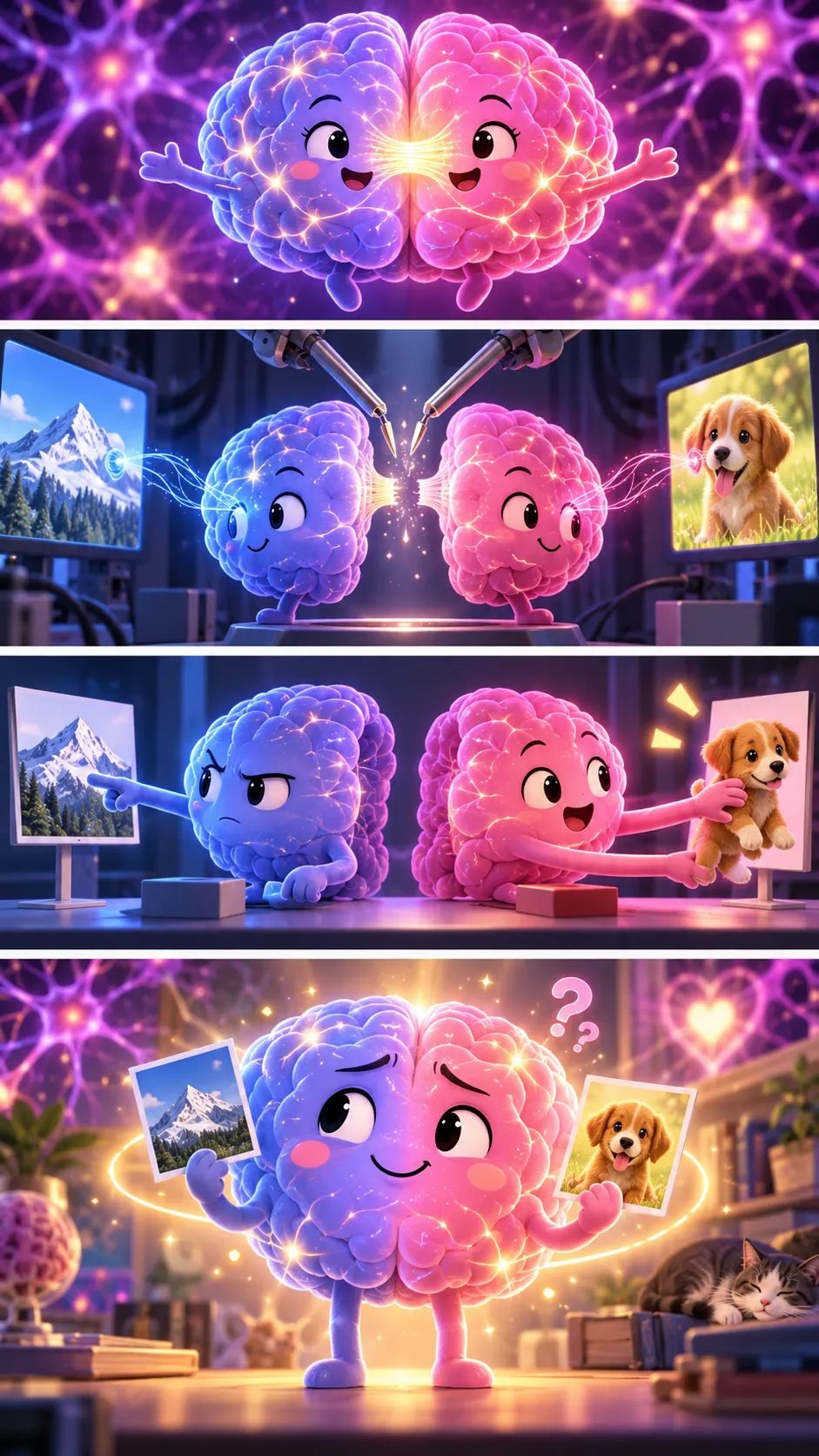
左右の脳をつなぐ神経の束を切った人に、右の脳だけに絵を見せると「何も見えない」と答える。なのに左手は、ちゃんとその物を選ぶ。じゃあ心は2つ? 60年続く論争に、2017年の研究は「意識は1つのままかも」という答えを出している。
押すと「マジかリスト」に保存されます
 出典・参考文献(4件)タップで表示
- Gazzaniga, Bogen & Sperry (1962) Some functional effects of sectioning the cerebral commissures in man, PNASdoi.org
- Sperry (1968) Hemisphere deconnection and unity in conscious awareness, American Psychologistdoi.org
- Gazzaniga (2005) Forty-five years of split-brain research and still going strong, Nature Reviews Neurosciencedoi.org
- Pinto et al. (2017) Split brain: divided perception but undivided consciousness, Braindoi.org

※本記事は上記の研究・公開資料をもとに、原田英語が独自の言葉で解説したものです。引用は著作権法第32条の範囲で行い、出典を明記しています。画像はすべてオリジナルのイメージです。研究結果には限界や個人差があります。誤りのご指摘は原田英語のお問い合わせフォームから。
 これも「マジか!?」
 脳・心理
脳・心理
「動こう」と決める前に、脳はもう準備を始めていた? リベットの実験と"自由意志"論争のその後
 脳・心理
脳・心理
脳の中に"GPS"のような細胞があった。部屋のどこにいるかで反応する、ノーベル賞の発見
 脳・心理
脳・心理
記憶の「分けると残る」は腎臓の細胞にも? 薬を一気より4回に分けると遺伝子が長く働いた
 脳・心理
脳・心理
麻酔がかかると、ヒトもマウスも魚も線虫も、脳の各部分がバラバラに動くようになった。6種の脳を比べた研究

 脳・心理
脳・心理
絶対音感は大人になってからでも身につく? 中国や日本の音大生に多い理由と、大人の訓練実験
 脳・心理
脳・心理