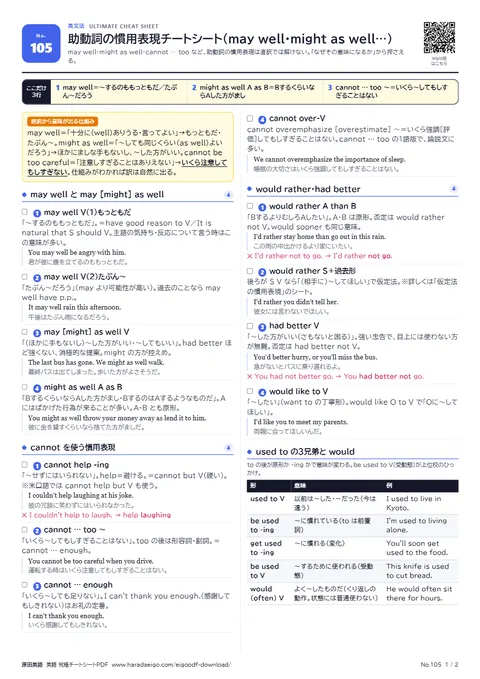
まずはこの3つ
- may well=〜するのももっともだ/たぶん〜だろう
- might as well A as B=BするくらいならAした方がまし
- cannot … too 〜=いくら〜してもしすぎることはない
直訳から意味が出る仕組み
may well=「十分に(well)ありうる・言ってよい」→もっともだ・たぶん〜。might as well=「〜しても同じくらい(as well)よいだろう」→ほかにましな手もないし、〜した方がいい。cannot be too careful=「注意しすぎることはありえない」→いくら注意してもしすぎない。仕組みがわかれば訳は自然に出る。
may well と may [might] as well4
- 1may well V(1)もっともだ「〜するのももっともだ」。=have good reason to V/It is natural that S should V。主語の気持ち・反応について言う時はこの意味が多い。You may well be angry with him.君が彼に腹を立てるのももっともだ。
- 2may well V(2)たぶん〜「たぶん〜だろう」(may より可能性が高い)。過去のことなら may well have p.p.。It may well rain this afternoon.午後はたぶん雨になるだろう。
- 3may [might] as well V「(ほかに手もないし)〜した方がいい・〜してもいい」。had better ほど強くない、消極的な提案。might の方が控えめ。The last bus has gone. We might as well walk.最終バスは出てしまった。歩いた方がよさそうだ。
- 4might as well A as B「BするくらいならAした方がまし・BするのはAするようなものだ」。A にはばかげた行為が来ることが多い。A・B とも原形。You might as well throw your money away as lend it to him.彼に金を貸すくらいなら捨てた方がましだ。
cannot を使う慣用表現4
- 1cannot help -ing「〜せずにはいられない」。help=避ける。=cannot but V(硬い)。※米口語では cannot help but V も使う。I couldn't help laughing at his joke.彼の冗談に笑わずにはいられなかった。✕I couldn't help to laugh. → help laughing
- 2cannot … too 〜「いくら〜してもしすぎることはない」。too の後は形容詞・副詞。=cannot … enough。You cannot be too careful when you drive.運転する時はいくら注意してもしすぎることはない。
- 3cannot … enough「いくら〜しても足りない」。I can't thank you enough.(感謝してもしきれない)はお礼の定番。I can't thank you enough.いくら感謝してもしきれない。
- 4cannot over-Vcannot overemphasize [overestimate] 〜=いくら強調[評価]してもしすぎることはない。cannot … too の1語版で、論説文に多い。We cannot overemphasize the importance of sleep.睡眠の大切さはいくら強調してもしすぎることはない。
would rather・had better4
- 1would rather A than B「BするよりむしろAしたい」。A・B は原形。否定は would rather not V。would sooner も同じ意味。I'd rather stay home than go out in this rain.この雨の中出かけるより家にいたい。✕I'd rather not to go. → I'd rather not go.
- 2would rather S+過去形後ろが S V なら「(相手に)〜してほしい」で仮定法。※詳しくは「仮定法の慣用表現」のシート。I'd rather you didn't tell her.彼女には言わないでほしい。
- 3had better V「〜した方がいい(さもないと困る)」。強い忠告で、目上には使わない方が無難。否定は had better not V。You'd better hurry, or you'll miss the bus.急がないとバスに乗り遅れるよ。✕You had not better go. → You had better not go.
- 4would like to V「〜したい」(want to の丁寧形)。would like O to V で「Oに〜してほしい」。I'd like you to meet my parents.両親に会ってほしいんだ。
used to の3兄弟と would
to の後が原形か -ing かで意味が変わる。be used to V(受動態)が上位校のひっかけ。
| 形 | 意味 | 例 |
|---|---|---|
| used to V | 以前は〜した・〜だった(今は違う) | I used to live in Kyoto. |
| be used to -ing | 〜に慣れている(to は前置詞) | I'm used to living alone. |
| get used to -ing | 〜に慣れる(変化) | You'll soon get used to the food. |
| be used to V | 〜するために使われる(受動態) | This knife is used to cut bread. |
| would (often) V | よく〜したものだ(くり返しの動作。状態には普通使わない) | He would often sit there for hours. |
上位層の差がつく助動詞の決まり文句6
- would not V(過去)★★★どうしても〜しようとしなかった物にも使う(拒絶の would)The door wouldn't open.ドアがどうしても開かなかった。
- will(習性・固執)★★★〜するものだ・どうしても〜するAccidents will happen.(事故は起こるものだ)Boys will be boys.男の子はやっぱり男の子だ(いたずらは仕方ない)。
- might have p.p.★★★〜してくれてもよかったのに(非難)「〜したかもしれない」の意味もある。文脈で判断You might have told me earlier!もっと早く言ってくれてもよかったのに。
- How should I know?★★★私が知るわけがない修辞疑問の should。=I don't know at all.
- How dare you 〜!★★★よくも〜できるねdare=あえて〜する。怒りを表すHow dare you speak to me like that!よくも私にそんな口がきけるね。
- That will be 〜★★★(たぶん)〜だろう現在の推量の will。玄関のチャイムに That will be the delivery.
ここでハマる!助動詞の慣用表現のひっかけ5
- ✕You may well to be surprised.○You may well be surprised.may well の後は原形
- ✕You cannot be too much careful.○You cannot be too careful.too の後は形容詞をそのまま(too much は不可)
- ✕I'm used to get up early.○I'm used to getting up early.慣れている→to は前置詞
- ✕I would rather to walk than take a bus.○I would rather walk than take a bus.would rather の後は原形
- ✕There would be a cinema here, but it closed.○There used to be a cinema here, but it closed.過去の状態は used to(would は状態に普通使わない)
確認テスト
- 1You well be angry with him. He broke his promise.正解は may。may well=〜するのももっともだ
- 2There's nothing to do here. We might well go home.正解は as。might as well=〜した方がいい
- 3You as well throw your money away as lend it to him.正解は might。might as well A as B
- 4You cannot be careful when you climb a mountain.正解は too。cannot … too
- 5I couldn't help when I heard the joke.正解は laughing。cannot help -ing
- 6I would rather stay home go out in this rain.正解は than。would rather A than B
- 7You had better late again.正解は not be。had better not+原形
- 8This tool is used holes in wood.正解は to make。be used to V=〜するのに使われる
- 9I pushed the door hard, but it open.正解は wouldn't。拒絶の would not
- 10I can't thank you .正解は enough。cannot … enough
助動詞の慣用表現を一覧にまとめ、A4 2枚で印刷できる無料PDFにしました。Web版は赤シート・覚えたチェック・カード・4択テストつき。