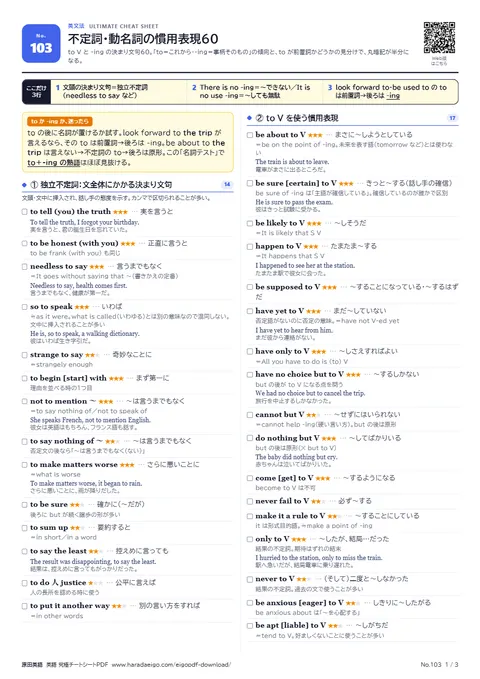
まずはこの3つ
- 文頭の決まり文句=独立不定詞(needless to say など)
- There is no -ing=〜できない/It is no use -ing=〜しても無駄
- look forward to・be used to の to は前置詞→後ろは -ing
to か -ing か、迷ったら
to の後に名詞が置けるか試す。look forward to the trip が言えるなら、その to は前置詞→後ろは -ing。be about to the trip は言えない→不定詞の to→後ろは原形。この「名詞テスト」で to+-ing の熟語はほぼ見抜ける。
1独立不定詞:文全体にかかる決まり文句14
文頭・文中に挿入され、話し手の態度を示す。カンマで区切られることが多い。
- to tell (you) the truth★★★実を言うとTo tell the truth, I forgot your birthday.実を言うと、君の誕生日を忘れていた。
- to be honest (with you)★★★正直に言うとto be frank (with you) も同じ
- needless to say★★★言うまでもなく=It goes without saying that 〜(書きかえの定番)Needless to say, health comes first.言うまでもなく、健康が第一だ。
- so to speak★★★いわば≒as it were。what is called(いわゆる)とは別の意味なので混同しない。文中に挿入されることが多いHe is, so to speak, a walking dictionary.彼はいわば生き字引だ。
- strange to say★★★奇妙なことに=strangely enough
- to begin [start] with★★★まず第一に理由を並べる時の1つ目
- not to mention 〜★★★〜は言うまでもなく=to say nothing of/not to speak ofShe speaks French, not to mention English.彼女は英語はもちろん、フランス語も話す。
- to say nothing of 〜★★★〜は言うまでもなく否定文の後なら「〜は言うまでもなく(ない)」
- to make matters worse★★★さらに悪いことに=what is worseTo make matters worse, it began to rain.さらに悪いことに、雨が降りだした。
- to be sure★★★確かに(〜だが)後ろに but が続く譲歩の形が多い
- to sum up★★★要約すると=in short/in a word
- to say the least★★★控えめに言ってもThe result was disappointing, to say the least.結果は、控えめに言ってもがっかりだった。
- to do 人 justice★★★公平に言えば人の長所を認める時に使う
- to put it another way★★★別の言い方をすれば=in other words
2to V を使う慣用表現17
- be about to V★★★まさに〜しようとしている=be on the point of -ing。未来を表す語(tomorrow など)とは使わないThe train is about to leave.電車がまさに出るところだ。
- be sure [certain] to V★★★きっと〜する(話し手の確信)be sure of -ing は「主語が確信している」。確信しているのが誰かで区別He is sure to pass the exam.彼はきっと試験に受かる。
- be likely to V★★★〜しそうだ=It is likely that S V
- happen to V★★★たまたま〜する=It happens that S VI happened to see her at the station.たまたま駅で彼女に会った。
- be supposed to V★★★〜することになっている・〜するはずだ
- have yet to V★★★まだ〜していない否定語がないのに否定の意味。=have not V-ed yetI have yet to hear from him.まだ彼から連絡がない。
- have only to V★★★〜しさえすればよい=All you have to do is (to) V
- have no choice but to V★★★〜するしかないbut の後が to V になる点を問うWe had no choice but to cancel the trip.旅行を中止するしかなかった。
- cannot but V★★★〜せずにはいられない=cannot help -ing(硬い言い方)。but の後は原形
- do nothing but V★★★〜してばかりいるbut の後は原形(✕ but to V)The baby did nothing but cry.赤ちゃんは泣いてばかりいた。
- come [get] to V★★★〜するようになるbecome to V は不可
- never fail to V★★★必ず〜する
- make it a rule to V★★★〜することにしているit は形式目的語。≒make a point of -ing
- only to V★★★〜したが、結局…だった結果の不定詞。期待はずれの結末I hurried to the station, only to miss the train.駅へ急いだが、結局電車に乗り遅れた。
- never to V★★★(そして)二度と〜しなかった結果の不定詞。過去の文で使うことが多い
- be anxious [eager] to V★★★しきりに〜したがるbe anxious about は「〜を心配する」
- be apt [liable] to V★★★〜しがちだ=tend to V。好ましくないことに使うことが多い
3動名詞を使う慣用表現21
- There is no -ing★★★〜できない=It is impossible to V。There is no telling 〜(〜はわからない)There is no telling what will happen.何が起こるかわからない。
- It is no use -ing★★★〜しても無駄だ=It is useless to V。no good も同じIt is no use crying over spilt milk.覆水盆に返らず。
- There is no point (in) -ing★★★〜しても意味がない
- cannot help -ing★★★〜せずにはいられない=cannot but V。help=避けるI couldn't help laughing.笑わずにはいられなかった。
- feel like -ing★★★〜したい気がするfeel like to V は不可
- be worth -ing★★★〜する価値がある主語が -ing の目的語→後ろに it を置かないThis museum is worth visiting.この博物館は訪れる価値がある。
- on -ing★★★〜するとすぐに=as soon as。in -ing(〜する時に)と区別On arriving at the airport, he called me.空港に着くとすぐ彼は電話をくれた。
- in -ing★★★〜する時に・〜する点で
- be busy -ing★★★〜するのに忙しいbusy to V は不可
- spend 時間 [お金] (in) -ing★★★〜して時間を過ごす・〜にお金を使う
- have trouble [difficulty] (in) -ing★★★〜するのに苦労するhave a hard time -ing も同じ型
- It goes without saying that 〜★★★〜は言うまでもない=Needless to say, 〜
- never 〜 without -ing★★★〜すると必ず…する二重否定。=Whenever 〜, S always …I never see this photo without thinking of my grandmother.この写真を見ると必ず祖母を思い出す。
- be on the point of -ing★★★まさに〜しようとしている=be about to V
- make a point of -ing★★★必ず〜するようにしている≒make it a rule to V
- go -ing★★★〜しに行く場所は in・at などで表す:go shopping in Ginza(to Ginza は不可)
- end up -ing★★★結局〜することになるWe ended up staying home all day.結局、一日中家にいることになった。
- be in the habit of -ing★★★〜する習慣がある
- prevent [keep / stop] O from -ing★★★Oが〜するのを妨げるkeep O -ing(Oに〜させ続ける)と from の有無で意味が変わる
- be capable of -ing★★★〜する能力があるbe able to V と形が違う(✕ be capable to V)
- How [What] about -ing?★★★〜するのはどう?
4to+-ing:この to は前置詞8
4択で to+原形を選ばせるのが定番のひっかけ。
- look forward to -ing★★★〜を楽しみに待つI'm looking forward to hearing from you.お返事を楽しみに待っている。
- be used [accustomed] to -ing★★★〜に慣れているused to V(以前は〜した)と区別
- object to -ing★★★〜に反対する=be opposed to -ing
- when it comes to -ing★★★〜のこととなるとWhen it comes to cooking, he is the best.料理のこととなると、彼が一番だ。
- What do you say to -ing?★★★〜するのはどう?
- with a view to -ing★★★〜する目的で=for the purpose of -ing
- be devoted [dedicated] to -ing★★★〜に打ち込んでいる
- come close to -ing★★★もう少しで〜しそうになる=nearly V
書きかえの定番ペア
不定詞の形と動名詞の形を行き来させるのが書きかえ問題の定番。
| A | = B |
|---|---|
| Needless to say, S V | It goes without saying that S V |
| cannot help -ing | cannot but V(※米口語では cannot help but V も) |
| There is no -ing | It is impossible to V |
| It is no use -ing | It is useless to V |
| be about to V | be on the point of -ing |
| make it a rule to V | make a point of -ing |
| have only to V | All you have to do is (to) V |
| On -ing, S V | As soon as S V, S V |
| He is sure to win. | I'm sure that he will win. |
| not to mention 〜 | to say nothing of 〜/not to speak of 〜 |
ここでハマる!慣用表現のひっかけ6
- ✕This book is worth reading it.○This book is worth reading.主語が reading の目的語。it を重ねない
- ✕We had no choice but cancel the game.○We had no choice but to cancel the game.no choice but to V
- ✕He did nothing but to complain.○He did nothing but complain.do nothing but+原形
- ✕I feel like to cry.○I feel like crying.feel like の like は前置詞
- ✕She became to like him.○She came to like him.〜するようになる=come to V
- ✕I object to be treated like a child.○I object to being treated like a child.object to の to は前置詞
確認テスト
- 1to say, he was late again.正解は Needless。needless to say=言うまでもなく
- 2There is no what she will say next.正解は telling。There is no -ing=〜できない
- 3It is no use about the past.正解は worrying。It is no use -ing
- 4I have to meet anyone as kind as her.正解は yet。have yet to V=まだ〜ない
- 5He studied hard, to fail the exam.正解は only。only to V=〜したが結局…(残念な結果)
- 6entering the room, she turned on the light.正解は On。on -ing=〜するとすぐに
- 7I'm not used in front of many people.正解は to speaking。be used to -ing
- 8We were on the point when it started to rain.正解は of leaving。be on the point of -ing
- 9She speaks Chinese, not to English.正解は mention。not to mention=〜は言うまでもなく
- 10This old temple is well worth .正解は visiting。be worth -ing(it を置かない)
- 11We had no choice to wait for the next bus.正解は but。have no choice but to V
- 12When it comes English, Mai is the best in our class.正解は to speaking。when it comes to -ing
- 13書きかえ:As soon as he heard the news, he ran out. = hearing the news, he ran out.
- 14誤りを直せ:What do you say to go for a walk?
不定詞・動名詞の慣用表現を一覧にまとめ、A4 3枚で印刷できる無料PDFにしました。Web版は赤シート・覚えたチェック・カード・4択テストつき。