 ワークシート
 ぬりえ
 迷路
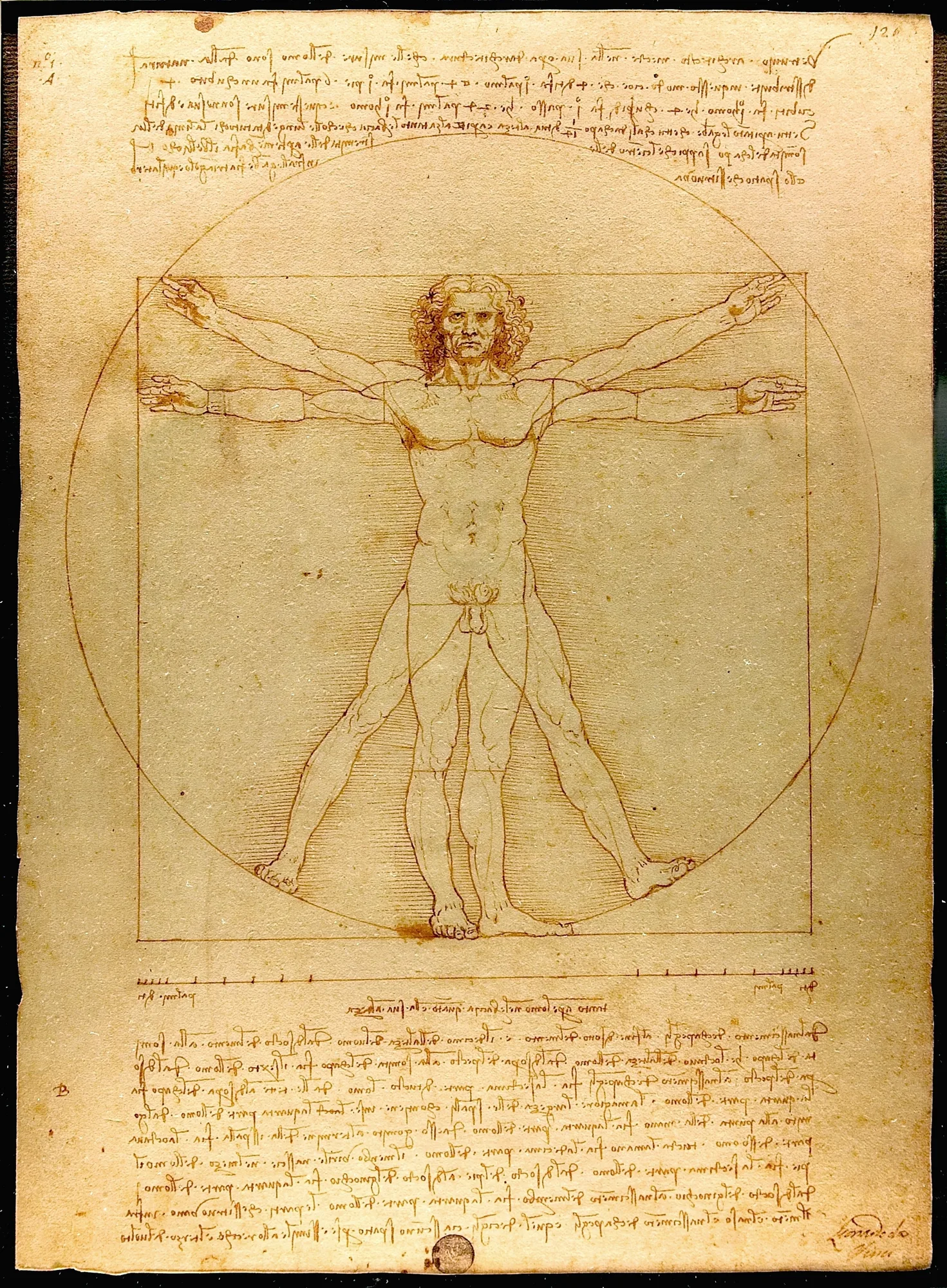
理想の人体では、両手を広げた長さ=身長!人体の比率を探った一枚。In an ideal body, arm span equals height! A drawing that explores human proportions.
 美術館アンテナ:レオナルド・ダ・ヴィンチの作品に会える展覧会
この作品のお話
Storyウィトルウィウス的人体図は、レオナルド・ダ・ヴィンチが1490年ごろに描いたペン画です。一人の男性が、腕と脚の位置をかえて2つのポーズで重ねて描かれ、円と正方形の中にぴったりおさまっています。今はイタリアのヴェネツィアにあるアカデミア美術館が所蔵しています。
The Vitruvian Man is a pen drawing by Leonardo da Vinci from around 1490. One man is drawn in two poses at once, with his arms and legs in different positions. He fits exactly inside a circle and a square. It belongs to the Gallerie dell'Accademia in Venice, Italy.
題名のウィトルウィウスは、古代ローマの建築家の名前です。彼は「美しい建物は、人の体のようにつりあいがとれていなければならない」と書き、両腕を広げた長さは身長と同じ、などの体の比率を記しました。レオナルドはその文章を読み、自分で人の体を測って確かめながらこの図を描きました。
Vitruvius was an architect in ancient Rome. He wrote that a beautiful building must be balanced like the human body. He also listed body proportions, such as arm span being equal to height. Leonardo read his book. He measured real people and drew this picture to test the ideas.
この図は、芸術と科学を一つに結びつけたレオナルドを象徴する作品になりました。人の体の調和を表すシンボルとして、医学や科学の本、ロゴ、硬貨などに広く使われています。縦35センチほどの小さな紙一枚のデッサンですが、今では世界でもっとも有名なデッサンの一つです。
This drawing became a symbol of Leonardo, who joined art and science together. As a symbol of the balanced human body, it appears in medical and science books, logos and coins. It is only a small sheet of paper, about 35 cm tall, but today it is one of the most famous drawings in the world.
これはレオナルド・ダ・ヴィンチの絵です。男の人が円と正方形の中に立っています。腕が4本、脚が4本あります!両腕を広げた長さは、身長とだいたい同じです。ためしてみよう!
This is a drawing by Leonardo da Vinci. A man stands in a circle and a square. He has four arms and four legs! Your arm span is about the same as your height. Try it!
英語のレベルは上の「やさしい/ふつう」で切りかえられます。
えっ!?な裏ネタ
Secretsイタリアで作られる1ユーロ硬貨の表には、この人体図がきざまれています。ユーロ硬貨の裏のデザインは国ごとにちがい、イタリアは「人間の体の調和」を表すこの絵を選びました。
Italy's one-euro coin shows the Vitruvian Man. Each euro country has its own coin designs, and Italy chose this picture of human harmony.
上と下にびっしり書かれた文字は、右から左へ書く「鏡文字」です。左ききだったレオナルドは、ノートのほとんどをこの書き方で書きました。鏡に映すと、ふつうのイタリア語として読めます。
The writing at the top and bottom goes from right to left. It is mirror writing. Leonardo was left-handed and wrote most of his notes this way. In a mirror, you can read it as normal Italian.
紙のデッサンは光でいたみやすいため、ふだんは美術館の保管庫で守られ、展示されることはめったにありません。2019年、パリのルーヴル美術館のレオナルド展に貸し出されたときは、イタリアで裁判にまでなりました。
Paper drawings fade in light, so it is usually kept in storage and rarely shown. In 2019, when it was lent to the Louvre for a Leonardo exhibition, the loan even went to court in Italy.
きびしい顔つきの男性はだれなのでしょうか。レオナルド自身の姿を理想化して描いた自画像ではないか、と考える研究者もいます。ただし、確かな証拠はなく、なぞのままです。
Who is this serious-looking man? Some researchers think it may be an idealised self-portrait of Leonardo. But there is no clear proof, so it is still a mystery.
ここを見て!
Look Closer1まっすぐ見つめる顔Staring face
長い巻き毛の男性が、こちらをまっすぐ見つめています。レオナルド本人だとする説もあります。
A man with long curly hair looks straight at us. Some think it is Leonardo himself.
2円と正方形Circle and square
円の中心はおへそのあたり。正方形の中心は、それより少し下になっています。
The center of the circle is near the navel. The center of the square is a little lower.
3鏡文字のメモMirror writing
体の比率についての説明が、右から左への鏡文字で書かれています。
Notes about body proportions are written backwards, from right to left.
4目もりMeasuring scale
下の線には目もりが入っていて、手のひらや指の幅の単位で長さを測れるようになっています。
The line at the bottom has marks for measuring, using units like palms and fingers.
英語で名画を語ろう
Talk about Art in EnglishThe man's arm span is equal to his height.
男性の両腕を広げた長さは、身長と等しいです。
💡 長さや量をくらべるときの表現。the same as と言いかえることもできます。
英語で説明すると… Describe it
これは古い紙にかかれた男の人の絵です。彼は円と正方形の中に立っています。腕が2組、脚が2組あります。上と下には文字が書かれています。
This is a drawing of a man on old paper. He stands inside a circle and a square. He has two pairs of arms and two pairs of legs. There is writing at the top and the bottom.
考えてみよう Think & Talk
- 自分の両腕を広げた長さと身長を測ってみよう。同じでしたか?Measure your arm span and your height. Are they equal?
- レオナルドはなぜ、男の人を2つのポーズで描いたのだと思いますか?Why do you think Leonardo drew the man in two poses?
この作品の英単語
WordsLeonardo studied the proportions of the body.
レオナルドは体の比率を研究しました。
He measured real people.
彼は実際の人々を測りました。
In the drawing, the man's arm span is equal to his height.
この図では、男性の両腕を広げた長さは身長と等しくなっています。
The man stands inside a circle and a square.
男性は円と正方形の中に立っています。
ミニクイズ
QuizQ. ウィトルウィウスとはだれ?Who was Vitruvius?
古代ローマの建築家で、建物と人体のつりあいについて本を書きました。
He was an ancient Roman architect who wrote about balance in buildings and the body.
ウソ?ホント? 絵のまわりの文字は、鏡にうつすと読みやすくなる。The writing becomes easier to read in a mirror.
右から左へ書かれた鏡文字だからです。
It is mirror writing, from right to left.
ウソ?ホント? この絵はいつでもアカデミア美術館で見ることができる。You can always see this drawing at the Accademia.
光でいたみやすいので、ふだんは保管庫にしまわれています。
Light can damage it, so it is usually kept in storage.
 画像の出典とライセンス / Image credit
- PDDa Vinci Vitruve Luc Viatour.jpg(Wikimedia Commons)
ライセンス:Public domain(パブリックドメイン)/作者・撮影者の表記:Leonardo da Vinci
この作品は、作者の死後長い年月がたち著作権の保護期間が終わった「パブリックドメイン」の作品です。画像は平面の作品を忠実に写したもので、新しい著作権は生じません(Wikimedia Commons の PD-Art の考え方)。 所蔵:アカデミア美術館(Gallerie dell'Accademia)。画像は表示のために縮小・WebP 形式に変換しています。
レオナルド・ダ・ヴィンチのほかの作品