

 PDF をダウンロード
Let's Look at Art!
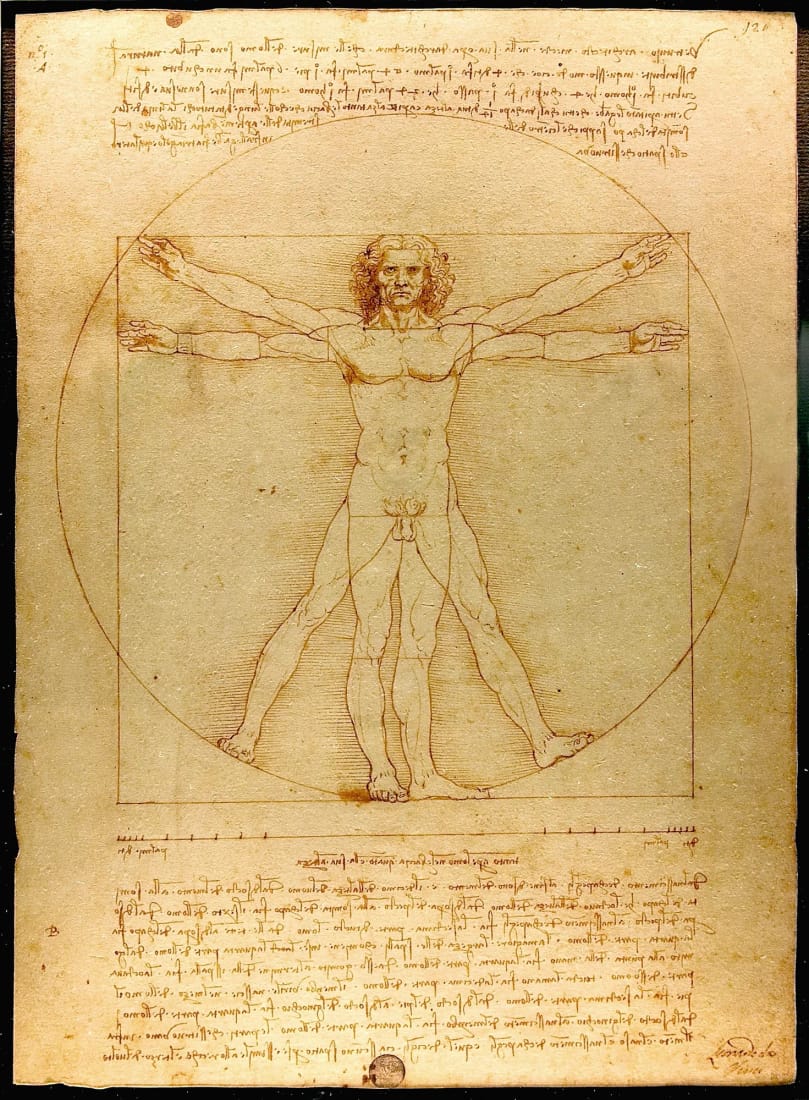
Title: Vitruvian Man
Artist: Leonardo da Vinci (1452–1519)
Year: c. 1490
Medium: Pen and ink on paper, over metalpoint
Museum: Gallerie dell'Accademia, Venice
1 Find it! 絵の中から見つけて、○でかこもう。
- ☐ Staring face
- ☐ Circle and square
- ☐ Mirror writing
- ☐ Measuring scale
2 First look 最初に見たときの感想を書こう。
When I first saw this painting, I felt ______________ because ______________________.
Three colors I can see: ①__________ ②__________ ③__________
3 Words — Match them. 英語と日本語を線で結ぼう。
- proportion ●
- measure ●
- equal ●
- circle ●
- ● 測る
- ● 比率・つりあい
- ● 等しい
- ● 円
Vitruvian Man
4 Fill in the blanks. 下の箱から選んで、( )に入れよう。形を変えるものもあります。
- Leonardo studied the of the body.
- He real people.
- In the drawing, the man's arm span is to his height.
- The man stands inside a and a square.
5 Read and answer — True or False? 英文を読んで、正しければ T、ちがえば F。
This is a drawing by Leonardo da Vinci. A man stands in a circle and a square. He has four arms and four legs! Your arm span is about the same as your height. Try it!
The Vitruvian Man is a pen drawing by Leonardo da Vinci from around 1490. One man is drawn in two poses at once, with his arms and legs in different positions. He fits exactly inside a circle and a square. It belongs to the Gallerie dell'Accademia in Venice, Italy.
- The writing becomes easier to read in a mirror. T / F
- You can always see this drawing at the Accademia. T / F
6 Quiz — Choose the best answer. 正しいものを選ぼう。
Who was Vitruvius?
- A Roman architect
- Leonardo's teacher
- A king of Venice
- A Greek god
Vitruvian Man
7 Put the words in order. 語を正しく並べかえて、文を書こう。
- The / span / is / his / equal / to / man's / arm / height .
- a / old / This / paper / a / is / man / on / of / drawing .
8 Complete the description. 箱の語を(1)〜(4)に入れて、絵の説明を完成させよう。
This is a drawing of a man on old paper. He (1) (2) a circle and a (3). He has two pairs of arms and two (4) of legs. There is writing at the top and the bottom.
9 Describe the painting in English. この絵を英語で説明しよう(3文以上)。
10 Think & Talk 考えて、ペアやグループで話し合おう。
Measure your arm span and your height. Are they equal?
Why do you think Leonardo drew the man in two poses?
11 My favorite part いちばん好きなところを英語で。
I like the ____________ because ____________________________.
Answers & Notes
1 Find it!
Staring face=まっすぐ見つめる顔/Circle and square=円と正方形/Mirror writing=鏡文字のメモ/Measuring scale=目もり
2 First look
自由に書けたら正解。I felt calm / surprised / happy … などの形容詞を使おう。
3 Words
1–b(proportion=比率・つりあい) 2–a(measure=測る) 3–c(equal=等しい) 4–d(circle=円)
4 Fill in the blanks
- proportions Leonardo studied the proportions of the body.
レオナルドは体の比率を研究しました。 - measured He measured real people.
彼は実際の人々を測りました。 - equal In the drawing, the man's arm span is equal to his height.
この図では、男性の両腕を広げた長さは身長と等しくなっています。 - circle The man stands inside a circle and a square.
男性は円と正方形の中に立っています。
5 Read — T / F
【本文の訳】これはレオナルド・ダ・ヴィンチの絵です。男の人が円と正方形の中に立っています。腕が4本、脚が4本あります!両腕を広げた長さは、身長とだいたい同じです。ためしてみよう!
【本文の訳】ウィトルウィウス的人体図は、レオナルド・ダ・ヴィンチが1490年ごろに描いたペン画です。一人の男性が、腕と脚の位置をかえて2つのポーズで重ねて描かれ、円と正方形の中にぴったりおさまっています。今はイタリアのヴェネツィアにあるアカデミア美術館が所蔵しています。
- T 絵のまわりの文字は、鏡にうつすと読みやすくなる。
解説:右から左へ書かれた鏡文字だからです。 - F この絵はいつでもアカデミア美術館で見ることができる。
解説:光でいたみやすいので、ふだんは保管庫にしまわれています。
6 Quiz
A 問:ウィトルウィウスとはだれ?
選択肢:A 古代ローマの建築家/B レオナルドの先生/C ヴェネツィアの王/D ギリシャの神
解説:古代ローマの建築家で、建物と人体のつりあいについて本を書きました。
7 Put the words in order
- The man's arm span is equal to his height.
男性の両腕を広げた長さは、身長と等しいです。 - This is a drawing of a man on old paper.
これは古い紙にかかれた男の人の絵です。
💡 is equal to(〜と等しい):長さや量をくらべるときの表現。the same as と言いかえることもできます。
8 Complete the description
(1) stands (2) inside (3) square (4) pairs
9 Describe(模範解答)
This is a drawing of a man on old paper. He stands inside a circle and a square. He has two pairs of arms and two pairs of legs. There is writing at the top and the bottom.
これは古い紙にかかれた男の人の絵です。彼は円と正方形の中に立っています。腕が2組、脚が2組あります。上と下には文字が書かれています。
10 Think & Talk(問いの訳)
- Measure your arm span and your height. Are they equal?
自分の両腕を広げた長さと身長を測ってみよう。同じでしたか? - Why do you think Leonardo drew the man in two poses?
レオナルドはなぜ、男の人を2つのポーズで描いたのだと思いますか?
正解のない問いです。理由をつけて話せたら◎。
Fun Fact(訳)
イタリアの1ユーロ硬貨の絵 イタリアで作られる1ユーロ硬貨の表には、この人体図がきざまれています。ユーロ硬貨の裏のデザインは国ごとにちがい、イタリアは「人間の体の調和」を表すこの絵を選びました。
