 ワークシート
 ぬりえ
 迷路
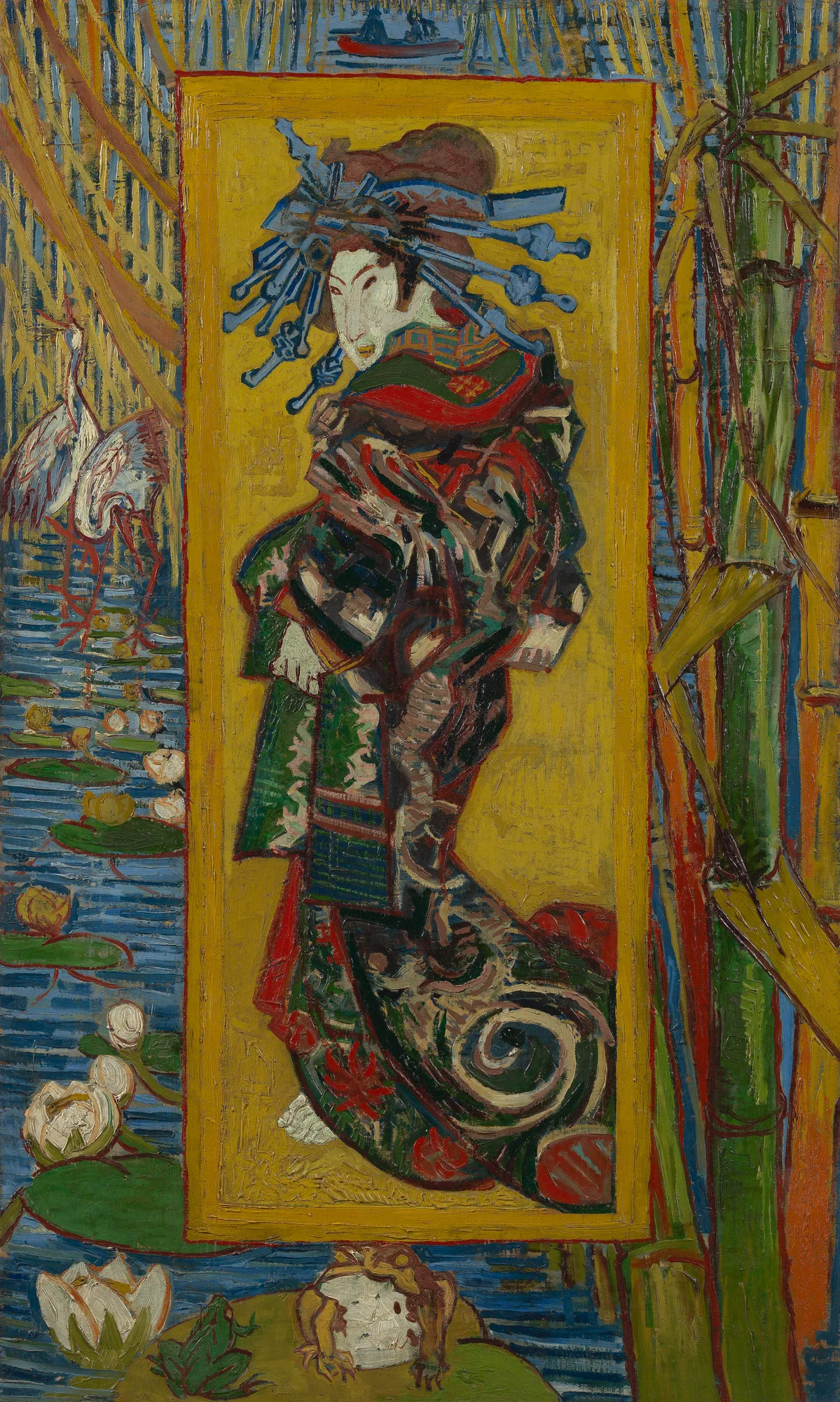
ゴッホが浮世絵の花魁を拡大して写した!まわりにはカエルと鶴。Van Gogh enlarged a courtesan from a Japanese print! Frogs and cranes all around.
 美術館アンテナ:フィンセント・ファン・ゴッホの作品に会える展覧会
この作品のお話
Story1887年、パリに住んでいたゴッホが描いた油絵です。真ん中の黄色い四角の中に立つのは、豪華な着物を重ね、髪にたくさんのかんざしをさした江戸の花魁(遊郭でいちばん位の高い女性)。そのまわりを池・すいれん・竹・鶴・カエルが取りかこみ、まるで浮世絵の掛け軸を池のほとりに飾ったような、ふしぎな画面になっています。
Van Gogh painted this in 1887, while he was living in Paris. In the yellow panel stands an oiran, a top-ranking courtesan from Edo-period Japan. She wears layers of rich robes and many hairpins. Around her, Van Gogh added a pond, water lilies, bamboo, cranes and frogs. It looks like a Japanese hanging scroll set beside a pond.
元になったのは、1886年5月に出たフランスの雑誌『パリ・イリュストレ』の日本特集号の表紙です。そこには渓斎英泉の浮世絵「雲龍打掛の花魁」が、左右反転して印刷されていました。ゴッホはそれを薄い紙になぞり、方眼を引いて約2倍に拡大してキャンバスに写しました。まわりの鶴やカエル、竹は、手もとのほかの浮世絵から借りて組み合わせたものです。
The model was the cover of a French magazine, Paris Illustré, from May 1886. This special issue was about Japan. The cover showed a print of a courtesan by Keisai Eisen, but it was printed in reverse. Van Gogh traced it, drew a grid on the tracing and enlarged it to about twice the size. He borrowed the cranes, frogs and bamboo from other Japanese prints.
英泉の原画の着物は落ち着いた色が中心でしたが、ゴッホは赤と緑をぶつけ、太い輪郭線とはっきりした色面で描きました。ここで身につけた浮世絵の感覚は、翌年南フランスのアルルで描いたひまわりや果樹園の絵へとつながっていきます。この絵は今、アムステルダムのファン・ゴッホ美術館にあり、ゴッホのなぞった下絵も残っています。
Eisen's robe was mostly in quiet colors, but Van Gogh used bold reds and greens, thick outlines and flat areas of color. What he learned from Japanese prints soon shaped his paintings of sunflowers and orchards in Arles the next year. The painting is now in the Van Gogh Museum in Amsterdam, and his tracing still survives.
これは昔の日本の女性です。ゴッホはパリに住んでいましたが、日本の絵が大好きでした。雑誌の表紙で彼女を見つけて、写して描きました。雑誌は左右を逆に印刷していたので、彼女は反対を向いています!ゴッホはまわりにカエルや鳥も描き足しました。
This is a woman from old Japan. Van Gogh lived in Paris, but he loved Japanese pictures. He found her on a magazine cover and copied her. The magazine printed her the wrong way, so she faces the other way! He also added frogs and birds around her.
英語のレベルは上の「やさしい/ふつう」で切りかえられます。
えっ!?な裏ネタ
Secrets英泉の原画の花魁は右を向いていますが、雑誌の表紙では左右が反転して印刷されていました。ゴッホはその表紙を写したので、この絵の花魁も原画とは逆向きです。この特集号には、パリで活躍した日本の美術商・林忠正が関わっていました。
In Eisen's original print, the courtesan faces right. The magazine printed it in reverse, and Van Gogh copied the magazine. So his courtesan faces the other way. Hayashi Tadamasa, a Japanese art dealer in Paris, worked on this special issue.
当時のパリの俗語では、「鶴(グリュ)」も「カエル(グルヌイユ)」も、花魁のような女性を指すことばでした。ゴッホがわざわざ鶴とカエルを描き足したのは、フランス語のことば遊びだと考えられています。
In Paris slang of the time, grue (crane) and grenouille (frog) were both words for women like a courtesan. Experts think Van Gogh added the cranes and frogs as a French word joke.
ゴッホと弟テオは、パリで600枚以上の浮世絵を集めました。ゴッホは1887年、パリのカフェ「ル・タンブラン」で浮世絵の展覧会まで開いています。コレクションの多くは今もファン・ゴッホ美術館にあります。
Van Gogh and his brother Theo collected more than 600 Japanese prints in Paris. In 1887, Vincent even held an exhibition of prints at Le Tambourin, a café in Paris. Many of the prints are still in the Van Gogh Museum.
ゴッホは1888年、弟への手紙に「ぼくの仕事はどれも、いくらか日本の絵をもとにしている」という意味のことを書いています。アルルへ移った理由のひとつも、南フランスの明るい光の中で、日本の画家のように自然を見たいという願いでした。
In a letter to his brother in 1888, Van Gogh wrote that all his work was based to some extent on Japanese art. He had several reasons for moving to Arles. One was his hope that the bright southern light would help him see nature like a Japanese artist.
ここを見て!
Look Closer1花魁の顔とかんざしFace and hairpins
白い顔と、青いかんざしがたくさん。原画を写したので、顔の形は浮世絵そっくりです。向きは原画と左右逆になっています。
A white face and lots of blue hairpins. The face looks just like the print, but it faces the opposite way.
22羽の鶴Two cranes
左上の水辺に立つ鶴。ほかの浮世絵から借りてきたモチーフで、フランス語のことば遊びが隠れているとも言われます。
Two cranes stand by the water. Van Gogh borrowed them from another print, perhaps for a word joke.
3カエルたちFrogs
いちばん下のはすの葉の上に、緑のカエルと茶色いカエル。こちらもほかの浮世絵から借りて描き足したものです。
At the bottom, a green frog and a brown frog sit on lily pads. These were also borrowed from other prints.
4着物の渦もようSwirl on the robe
すその大きな渦は、原画の「雲と龍」の打掛のもよう。ゴッホは赤と緑の強い色で塗り直しました。
This big swirl comes from the cloud-and-dragon robe in the print. Van Gogh painted it in strong reds and greens.
英語で名画を語ろう
Talk about Art in EnglishThe magazine printed the courtesan in reverse, so she faces left.
雑誌は花魁を左右逆に印刷したので、彼女は左を向いています。
💡 左右反転や逆順に。印刷や写真の説明で便利。back to front(前後逆)も覚えよう。
英語で説明すると… Describe it
真ん中に、色あざやかな長い着物の女性がいます。髪には青いかんざしがたくさんあります。左には、すいれんの池と2羽の鶴がいます。右には背の高い緑の竹があり、いちばん下には2匹のカエルがいます。
In the middle, there is a woman in a long, colorful robe. She has many blue pins in her hair. On the left, there is a pond with water lilies and two cranes. On the right, there is tall green bamboo, and at the bottom there are two frogs.
考えてみよう Think & Talk
- ゴッホはなぜ花魁のまわりにカエルや鶴を描き足したと思いますか?Why do you think Van Gogh added frogs and cranes around the courtesan?
- ほかの画家の絵を写すことは、よい勉強になると思いますか?それはなぜ?Is copying another artist's picture a good way to learn? Why?
この作品の英単語
WordsVan Gogh traced the courtesan from a magazine cover.
ゴッホは雑誌の表紙から花魁をなぞって写した。
The picture was printed in reverse.
その絵は左右逆に印刷された。
The border is full of frogs, cranes and bamboo.
ふちの部分は、カエルや鶴や竹でいっぱいだ。
He used bold reds and greens.
彼は大胆な赤と緑を使った。
ミニクイズ
QuizQ. ゴッホが写した元の絵は、どこに載っていた?Where did Van Gogh find the picture he copied?
1886年の雑誌『パリ・イリュストレ』日本特集号の表紙に載った英泉の浮世絵がもとです。
It was Eisen's print on the cover of the 1886 Japan issue of Paris Illustré.
ウソ?ホント? 絵の中の花魁は、英泉の原画と左右が逆向きになっている。The courtesan faces the opposite way from Eisen's original print.
雑誌が左右反転して印刷したものを写したからです。
The magazine printed it in reverse, and Van Gogh copied the magazine.
ウソ?ホント? ゴッホは日本へ行って、本物の花魁を見ながら描いた。Van Gogh went to Japan and painted a real courtesan.
ゴッホは一度も日本へ行っていません。パリで浮世絵を写して描きました。
Van Gogh never went to Japan. He copied a print in Paris.
 画像の出典とライセンス / Image credit
- PDCourtisane (naar Eisen) - s0116V1962 - Van Gogh Museum.jpg(Wikimedia Commons)
ライセンス:Public domain(パブリックドメイン)/作者・撮影者の表記:Vincent van Gogh/提供元:Van Gogh Museum
この作品は、作者の死後長い年月がたち著作権の保護期間が終わった「パブリックドメイン」の作品です。画像は平面の作品を忠実に写したもので、新しい著作権は生じません(Wikimedia Commons の PD-Art の考え方)。 所蔵:ファン・ゴッホ美術館(Van Gogh Museum)。画像は表示のために縮小・WebP 形式に変換しています。
フィンセント・ファン・ゴッホのほかの作品