 ワークシート
 ぬりえ
 迷路
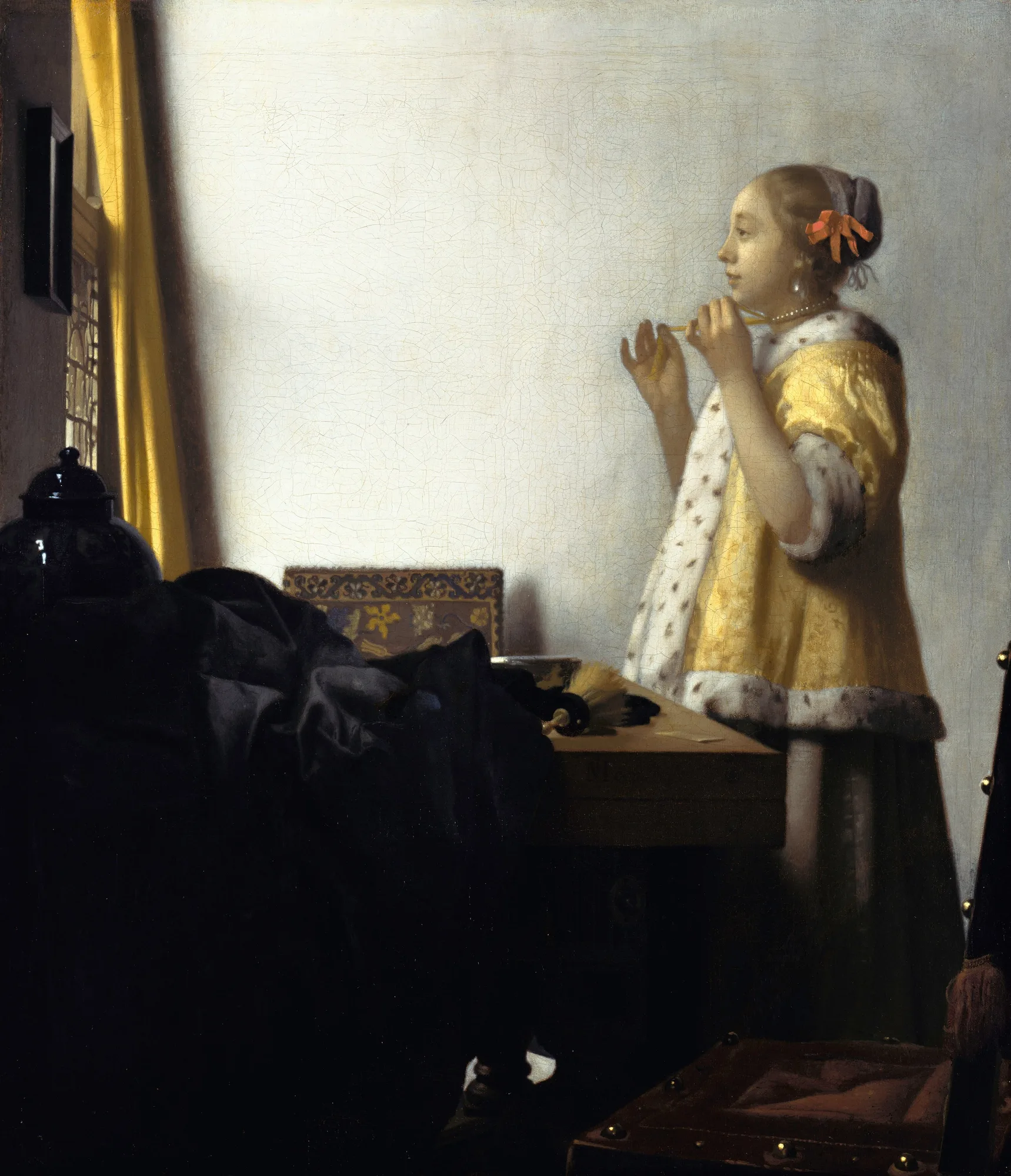
鏡の前でうっとり。消された地図とリュートが見つかった!Dreaming at the mirror. A hidden map and lute were found!
この作品のお話
Story窓辺の女性が、真珠の首飾りのリボンを持ち上げ、左の壁の小さな鏡を見つめています。黄色い上着には白い毛皮のふち取り。テーブルには化粧用のブラシや洗面器、大きなつぼが置かれています。フェルメールが1664年ごろに描いた作品で、今はベルリン絵画館にあります。
A woman by a window lifts the ribbons of her pearl necklace. She gazes at a small mirror on the left wall. Her yellow jacket has white fur trim. On the table are a makeup brush, a basin and a large jar. Vermeer painted this around 1664. It is now in the Gemäldegalerie in Berlin.
この絵でいちばん目をひくのは、女性と鏡のあいだに広がる、何もない白い壁です。窓から入る光が壁をなでるように照らし、時間が止まったような静けさが流れます。手前のテーブルとつぼをわざと暗く描いたことで、光を浴びた女性の姿がぐっと浮かび上がります。黄色いカーテンも、明るさを引き立てています。
The most striking part of this picture is the empty white wall between the woman and the mirror. Light from the window moves softly across the wall, and time seems to stand still. The table and jar in front are painted dark on purpose, so the woman in the light stands out. The yellow curtain also adds to the brightness.
1874年、ドイツの銀行家バルトルト・ズエルモントのコレクションとまとめて、ベルリンの美術館が買い入れました。のちの調査で、フェルメールが描く途中で壁の地図やいすの上の楽器を消すなど、大きく絵を変えていたことがわかりました。名画がどのように生まれたのかを知る、貴重な手がかりになっています。
In 1874, the Berlin museum bought it together with the collection of the banker Barthold Suermondt. Later studies showed that Vermeer made big changes while painting it, such as removing a map from the wall and an instrument from the chair. These changes give us valuable clues about how a masterpiece was made.
女性が窓のそばに立っています。真珠の首飾りを持っています。小さな鏡をのぞいています。後ろの壁は真っ白です。フェルメールははじめそこに地図を描きましたが、上からぬって消しました。
A woman stands by a window. She holds her pearl necklace. She looks into a small mirror. The wall behind her is white. Vermeer first painted a map there, but he painted over it.
英語のレベルは上の「やさしい/ふつう」で切りかえられます。
えっ!?な裏ネタ
Secrets調査によると、女性の後ろの壁には、はじめ大きな地図が描かれていたと考えられています。フェルメールはそれを消して、何もない壁にしました。地図があったら、絵の雰囲気はまったくちがっていたはずです。
Studies suggest that a large map was first painted on the wall behind the woman. Vermeer painted it out and left the wall empty. With a map, the mood of the picture would have been very different.
手前のいすの上には、はじめリュートのような弦楽器が置かれていました。ベルリンの美術館は、見る人の目を女性と、その視線に集めるために消したのだろうと説明しています。
At first, a string instrument like a lute lay on the chair in front. The Berlin museum explains that Vermeer probably removed it to draw our eyes to the woman and where she is looking.
1981年のアメリカ映画『ミスター・アーサー』には、この絵が「真珠に見とれる女」という題名で登場します。本物そっくりの複製が、映画の小道具として使われたのです。
In the 1981 American film Arthur, this painting appears with the title Woman Admiring Pearls. A copy was used as a prop in the movie.
黒い枠の鏡は、高価な黒檀でできているようです。昔の絵では、鏡や真珠は「見た目を気にしすぎること」をいましめる印として描かれることがありました。でも、この絵の女性はとても清らかに見え、どう読むかは研究者の間でも意見が分かれます。
The black mirror frame seems to be made of expensive ebony. In old paintings, mirrors and pearls could warn against caring too much about looks. But this woman looks very pure, and experts still disagree about the meaning.
ここを見て!
Look Closer1真珠の首飾りPearl necklace
リボンを両手で持ち上げて、首飾りの具合を確かめています。
She holds up the ribbons with both hands to check the necklace.
2壁の鏡The mirror
窓のそばの小さな鏡。女性の視線の先にあります。
A small mirror by the window. This is where she is looking.
3何もない白い壁The empty white wall
はじめは地図があった場所。消したことで、光と静けさが主役になりました。
A map was here at first. Without it, light and silence became the stars.
4大きなつぼThe large jar
ふたつきの大きなつぼ。東洋から来た焼き物はぜいたく品でした。
A large jar with a lid. Pottery from Asia was a luxury at the time.
英語で名画を語ろう
Talk about Art in EnglishShe is trying on a pearl necklace in front of a mirror.
彼女は鏡の前で真珠の首飾りをつけてみています。
💡 服や靴、アクセサリーを試すときの定番。try it on のように it は間に入れます。
英語で説明すると… Describe it
若い女性が左の窓のそばに立っています。黄色い上着を着て、真珠の首飾りを持ち上げています。壁の小さな鏡を見ています。手前には、大きなつぼがのった暗いテーブルがあります。
A young woman is standing by a window on the left. She is wearing a yellow jacket and holding up a pearl necklace. She is looking at a small mirror on the wall. In the foreground, there is a dark table with a big jar.
考えてみよう Think & Talk
- 鏡を見ている彼女は、どんな気持ちだと思いますか?What do you think she is feeling as she looks in the mirror?
- 壁は何もないほうがいいと思いますか、地図があったほうがいいと思いますか?それはなぜ?Is the picture better with an empty wall or with a map? Why?
この作品の英単語
WordsShe is wearing a pearl necklace.
彼女は真珠の首飾りをつけています。
She is looking into a small mirror.
彼女は小さな鏡をのぞきこんでいます。
The wall behind her is almost empty.
彼女の後ろの壁は、ほとんど何もありません。
Vermeer removed a map from the wall.
フェルメールは壁から地図を取りのぞきました。
ミニクイズ
QuizQ. 調査でわかった、女性の後ろの壁にはじめ描かれていたものは?What was first painted on the wall behind the woman?
大きな地図があったと考えられています。フェルメールが消して、白い壁にしました。
A large map was probably there. Vermeer painted it out and left a white wall.
ウソ?ホント? 手前のいすの上には、はじめ楽器が描かれていた。A musical instrument was first painted on the chair in front.
リュートのような弦楽器が描かれていましたが、のちに消されました。
A string instrument like a lute was there, but it was later painted out.
ウソ?ホント? 女性は窓の外の恋人に手をふっている。The woman is waving to her boyfriend outside the window.
手を上げているのは、首飾りのリボンを持ち上げているからです。見ているのは鏡です。
She raises her hands to lift the ribbons of her necklace. She is looking at the mirror.
 画像の出典とライセンス / Image credit
- PDJan Vermeer van Delft - Young Woman with a Pearl Necklace - Google Art Project.jpg(Wikimedia Commons)
ライセンス:Public domain(パブリックドメイン)/作者・撮影者の表記:Johannes Vermeer
この作品は、作者の死後長い年月がたち著作権の保護期間が終わった「パブリックドメイン」の作品です。画像は平面の作品を忠実に写したもので、新しい著作権は生じません(Wikimedia Commons の PD-Art の考え方)。 所蔵:ベルリン絵画館(Gemäldegalerie, Berlin)。画像は表示のために縮小・WebP 形式に変換しています。
ヨハネス・フェルメールのほかの作品