 ワークシート
 ぬりえ
 迷路
A4の紙より小さい!フェルメール屈指の小品に、手仕事の集中がつまっている。Smaller than a sheet of A4 paper! One of Vermeer's tiniest paintings is full of quiet focus.
この作品のお話
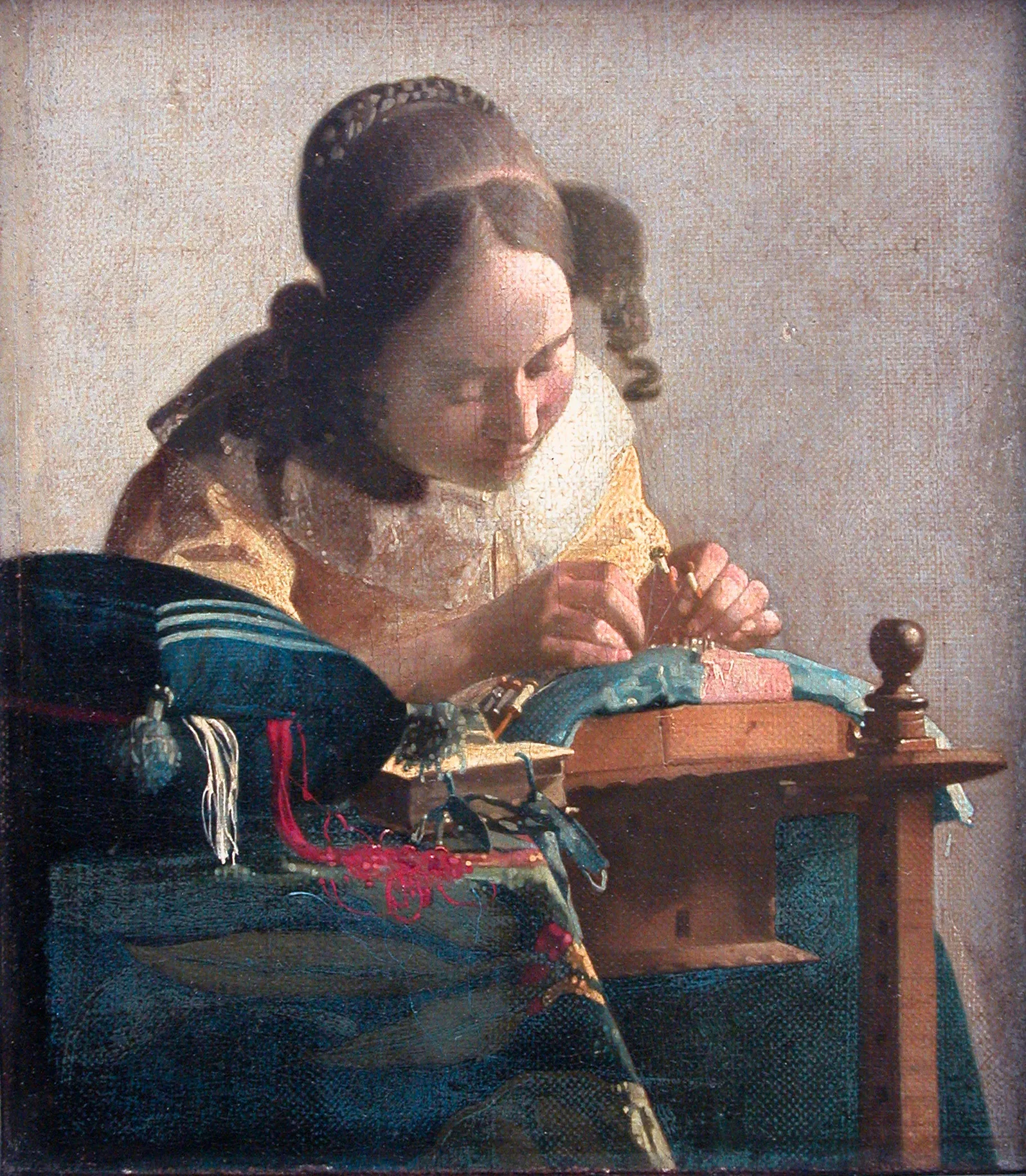
Story黄色い服の若い女性が、うつむいて手もとに集中しています。細い糸を巻いた小さな棒(ボビン)と針を使って、レースを編んでいるところです。オランダの画家フェルメールが1669〜70年ごろに描いた作品で、たて24.5センチ、横21センチ。フェルメールの作品の中でも特に小さな絵のひとつです。今はパリのルーヴル美術館にあります。
A young woman in yellow bends over her work. She is making lace with small sticks wound with thread, called bobbins, and pins. The Dutch painter Johannes Vermeer made this around 1669 to 1670. It is only 24.5 centimeters tall and 21 centimeters wide, making it one of Vermeer's smallest paintings. It is now in the Louvre in Paris.
背景はうす茶色の壁だけで、窓も地図も描かれていません。そのぶん、見る人の目は女性の指先へまっすぐ引きよせられます。手前のクッションからこぼれる赤と白の糸は、ぼやけて、まるで流れる液体のように描かれています。いっぽう、ピンと張った糸は細い線でくっきり。ぼかしとくっきりの差で、目の焦点がどこにあるかを表しているのです。
The background is only a plain wall, with no window and no map. So our eyes go straight to her fingertips. The red and white threads spilling from the cushion in front are blurry, almost like flowing liquid. But the tight threads she is working with are sharp, thin lines. The difference between blurry and sharp shows where our eyes are focused.
この絵は1870年にルーヴル美術館が買い入れました。20世紀には、スペインの画家サルバドール・ダリがこの絵に夢中になり、ルーヴルで模写をしたり、この絵をもとにした不思議な作品を作ったりしました。小さな画面にこめられた集中力は、今も多くの人を引きつけています。
The Louvre bought this painting in 1870. In the 20th century, the Spanish painter Salvador Dalí became obsessed with it. He copied it in the Louvre and made strange new works based on it. The deep focus packed into this tiny picture still draws many people today.
若い女性がレースを編んでいます。手もとを見下ろしています。とても集中しています。この絵はとても小さいです。フェルメールの絵の中でも、特に小さな一枚なのです!
A young woman is making lace. She looks down at her hands. She is concentrating very hard. This painting is very small. It is one of Vermeer's smallest paintings!
英語のレベルは上の「やさしい/ふつう」で切りかえられます。
えっ!?な裏ネタ
Secretsシュルレアリスムの画家ダリは、子どものころ父の書斎にこの絵の複製がかかっていたといわれ、生涯この絵を愛しました。1955年ごろにはルーヴルで模写をし、さらに「この絵はサイの角の形でできている」と言い出して、レースを編む女をサイの角のような形で描いた作品まで作りました。
A copy of this painting is said to have hung in the study of the Surrealist painter Salvador Dalí's father, and Dalí loved it all his life. Around 1955, he copied it in the Louvre. He even claimed that the picture was made of rhinoceros horn shapes, and he painted a version of the lacemaker built from horn-like forms.
クッションからたれる赤い糸は、線ではなく、絵の具のしずくのように描かれています。ピントの合っていない写真のようなぼやけ方です。フェルメールが、暗い箱や部屋の中に外の景色を映し出す装置「カメラ・オブスクラ」の映像を参考にしたのでは、という説もあります。
The red threads hanging from the cushion are not painted as lines. They look like drops of paint, blurry like an out-of-focus photo. Some people think Vermeer was inspired by images from a camera obscura, a dark box or room that projects an image of the outside world.
絵の中の机は、私たちのすぐ目の前。まるで向かいの席にすわって、作業をのぞきこんでいるような近さです。フェルメールのほかの室内画のように少し離れて部屋を見わたすのではなく、ぐっと寄った「アップ」の構図になっています。
The table in the picture is right in front of us. It feels as if we are sitting across from her and watching her work. Unlike many of Vermeer's other interiors, which show a whole room from a distance, this one is a close-up.
クッションのそばには、小さな本が置かれています。聖書や祈りの本だと考えられ、まじめに働き、信仰を大切にする女性の姿を表しているという見方があります。レース編みは当時、女性のよい手仕事とされていました。
A small book lies near the cushion. It is thought to be a Bible or prayer book. Some say it shows a hard-working woman who cares about her faith. In those days, lacemaking was seen as a good and proper skill for women.
ここを見て!
Look Closer1指先とボビンFingertips and bobbins
両手でボビンとピンをあやつる指先。ピンと張った糸は、とても細い線で描かれています。
Her fingers handle bobbins and pins. The tight threads are painted as very thin lines.
2こぼれる糸The spilling threads
クッションからたれる赤と白の糸。とけて流れるように、ぼかして描かれています。
Red and white threads hang from the cushion. They are painted blurry, as if melting.
3うつむく顔Her face
まぶたをふせ、手もとだけを見つめる顔。光が左からやわらかく当たっています。
Her eyes are lowered, looking only at her hands. Soft light falls from the left.
4小さな本The small book
クッションの下にある小さな本。聖書や祈りの本だと考えられています。
A small book under the cushion. It is thought to be a Bible or prayer book.
英語で名画を語ろう
Talk about Art in EnglishThe young woman bends over her lace.
若い女性はレースの上にかがみこんでいます。
💡 bend down は「下にかがむ」、bend over は「何かの上に身をのり出してかがむ」感じです。
英語で説明すると… Describe it
これは働く若い女性を近くから描いた絵です。黄色い服を着て、クッションの上にかがみこんでいます。小さなボビンとピンを持っています。手前には、赤と白の糸がのった青い布があります。
This is a close-up of a young woman at work. She wears a yellow dress and bends over a cushion. She is holding small bobbins and pins. In the foreground, there is a blue cloth with red and white threads.
考えてみよう Think & Talk
- フェルメールはなぜ手前の糸をぼかして描いたと思いますか?Why do you think Vermeer made the threads in front blurry?
- あなたがこの女性のように集中するのはどんなとき?何をしているとき?When do you concentrate like this woman? What are you doing?
この作品の英単語
WordsShe is making lace by hand.
彼女は手でレースを編んでいます。
Red thread spills from the cushion.
クッションから赤い糸がこぼれています。
She concentrates on her work.
彼女は作業に集中しています。
The threads in front are blurry.
手前の糸はぼやけています。
ミニクイズ
QuizQ. この絵の大きさに近いのはどれ?Which is closest to the size of this painting?
たて24.5センチ、横21センチ。A4の紙より少し小さいくらいです。
It is 24.5 cm tall and 21 cm wide, a little smaller than A4 paper.
ウソ?ホント? この絵の背景には、窓と大きな地図が描かれている。The background of this painting shows a window and a big map.
背景は何もない壁だけ。だから女性の手もとに目が集まります。
The background is just a plain wall, so our eyes go to her hands.
ウソ?ホント? 画家のダリは、ルーヴルでこの絵を模写した。The painter Dalí copied this painting in the Louvre.
1955年ごろに模写し、この絵をもとにした作品も作りました。
He copied it around 1955 and also made works based on it.
 画像の出典とライセンス / Image credit
- PDJohannes Vermeer - The lacemaker (c.1669-1671).jpg(Wikimedia Commons)
ライセンス:Public domain(パブリックドメイン)/作者・撮影者の表記:Johannes Vermeer
この作品は、作者の死後長い年月がたち著作権の保護期間が終わった「パブリックドメイン」の作品です。画像は平面の作品を忠実に写したもので、新しい著作権は生じません(Wikimedia Commons の PD-Art の考え方)。 所蔵:ルーヴル美術館(Musée du Louvre)。画像は表示のために縮小・WebP 形式に変換しています。
ヨハネス・フェルメールのほかの作品