

 脳と心理ビミョー
脳の半分を取り除く手術を受けた子どもたち。その後、残った半分の脳で何が起きていた?
 2026.10.02
 English Corner(A2〜B2・4択クイズ)

 読む前に予想してみよう!
脳の半球を取り除く手術を受けた人は、必ず話すことができなくなる
子どものころの手術では、話す力が保たれたり回復したりする例が多く報告されている。ただし原因の病気や手術側で結果は異なる。
 研究カード(どんな研究?)
- 対象
- 半球切除を受けた子ども・大人
- 規模
- 6人〜71人
- 研究の種類
- 追跡研究・症例比較
- 確かさ
- ★★☆☆☆
重いてんかんの治療で、脳の片側を切除・切り離す手術がある。発作が止まる子は多く、大人になって脳の半分で暮らす人も。ただし後遺症や個人差も大きい。
ひとことで言うと脳が半分でも、残った脳ががんばって働くことがあるんだ!
「脳の半分を取り除く」。そう聞くと、とても生きていけないように思えます。
でも実際に、そうした手術を受けて、学校に通い、大人になり、日常生活を送っている人たちがいます。脳は、私たちが思っている以上にしなやかなのかもしれません。
01なぜ、脳の半分を?
この手術は半球切除術と呼ばれます(取り除かずに切り離す方法は半球離断術)。主に、薬で抑えられない、とても重いてんかんの子どもに行われます。
原因になるのは、たとえば——
- 片側の脳に炎症が広がっていくラスムッセン脳炎
- 生まれつき片側の脳の形成に異常がある皮質形成異常
- 脳卒中や血管の異常
片側の脳から一日に何度も発作が起きると、子どもの発達そのものが妨げられてしまいます。そこで、その半球を取り除く(切り離す)ことで、残った健康な半球を守るのです。
02発作は止まった。では、その後は?
2004年には、同じ病院で手術を受けた71人について、手術から平均約5年後の様子が報告されました。
- 65%が発作ゼロ、49%は薬もいらなくなった
- 回答者のうち、「手術前より生活の質が悪くなった」と評価した人はいなかった
- 知能や言葉の力は、手術前と比べて大きくは変わらないことが多かった
- ただし、知能検査の点数(IQ)の平均は、原因の病気によって大きく違った。ラスムッセン脳炎や血管の病気では平均70台、皮質形成異常では30台

03大人になった「半分の脳」を調べたら
2019年、アメリカ・カリフォルニア工科大学のクリーマン(Kliemann)さんらが、6人の大人の脳をMRIで調べました。6人とも子どものころに半球切除を受け、今は社会生活を送っています。会話や日常生活に大きな問題はありません。
ここでいう「ネットワーク」とは、いっしょに働く脳の部位のグループのことです。見る、注意を向ける、体を動かすなど、仕事ごとにグループがあります。分かったのは、次の2つです。
- 残った半球の中では、各ネットワークが、ふつうの人と同じようにまとまって働いていた
- 一方で、異なるネットワーク同士のつながりは、ほとんどの人でふつうより強かった
研究チームの考えはこうです。半分の脳で多くの役割をこなすために、ネットワーク同士がより密に協力し合っているのかもしれない。
04「脳は半分でも大丈夫」ではない
ただし、この話を「脳は半分でも問題ない」と受け取るのは間違いです。
- 多くの場合、手術した側と反対側の手足にまひが残る
- 視野の半分が見えにくくなることが多い
- 結果は原因の病気・手術の年齢・残った半球の健康状態で大きく変わる
- 大人になってからの手術では、回復はずっと難しいと考えられている
05まとめ
脳の半分を取り除く手術を受けた子どもたち。その多くは発作から解放され、残った半分の脳で成長していきました。残った脳では、ネットワーク同士のつながりが強くなっているようです。
ただしそれは、重い病気と向き合うための大きな決断があってこその話。脳のしなやかさと、その限界の両方を知っておきたいですね。
この研究を英語で読もう原田英語の English CornerHemispherectomy is an operation that removes or disconnects one half of the brain. 音声
音声 4択クイズ9問A2・B1・B2タップして開く
原田英語の English Corner
この研究を英語で読もう
Some children have very serious seizures that medicine cannot stop. For some of them, doctors remove or disconnect one half of the brain. It sounds impossible, but many of these children stop having seizures. Some grow up and go to school.
However, most of them cannot move one side of the body well, and results are very different for each child. Half a brain is not "no problem."
68 words ・ CEFR A2
和訳を見る
薬では止められない、とても重い発作がある子どもたちがいます。そのうちの一部の子に対して、医師は脳の半分を取り除いたり切り離したりします。不可能なことのように聞こえますが、こうした子どもの多くは発作が起きなくなります。成長して学校に通う人もいます。
しかし、ほとんどの子は体の片側をうまく動かせず、結果も子どもによって大きく違います。脳が半分でも「問題なし」というわけではないのです。
4択リーディングクイズ
Q1. What is the passage mainly about?
重い発作の治療として脳の半分を取り除く手術が話題なので B。
Q2. What happens to many of these children after surgery?
many of these children stop having seizures とあるので A。
Q3. What does the last sentence, "Half a brain is not 'no problem,'" mean?
直前に体の片側が動かしにくい・結果に個人差がある、とあるので「問題が残ることもある」の D。
Hemispherectomy is an operation that removes or disconnects one half of the brain. It is mainly used for children whose severe epilepsy cannot be controlled with medicine. At Johns Hopkins Hospital in the United States, 71 children who had the surgery were followed for about five years on average. Sixty-five percent no longer had seizures, and nobody reported a worse quality of life than before.
In 2019, researchers scanned the brains of six adults who had the surgery as children and now function well. Networks for vision, attention and movement worked normally in the half that was left, but in most of the six, different networks were more strongly connected than usual, perhaps to share the extra work.
118 words ・ CEFR B1
和訳を見る
半球切除術は、脳の半分を取り除く、または切り離す手術です。主に、重いてんかんを薬で抑えられない子どもに行われます。アメリカのジョンズ・ホプキンス病院では、この手術を受けた71人の子どもが平均約5年間追跡されました。65%はもう発作が起きなくなり、手術前より生活の質が悪くなったと答えた人はいませんでした。2019年、研究者たちは、子どものころにこの手術を受け、今はうまく暮らしている6人の大人の脳をスキャンしました。
残った半分の中で、視覚・注意・体の動きのネットワークはふつうに働いていましたが、異なるネットワーク同士のつながりが、ほとんどの人で通常より強くなっていました。増えた仕事を分担するためかもしれません。
4択リーディングクイズ
Q1. Who mainly receives this operation?
children whose severe epilepsy cannot be controlled with medicine とあるので B。
Q2. What percentage of the 71 children no longer had seizures?
Sixty-five percent no longer had seizures とあるので C。71は人数。
Q3. Why might different networks be more strongly connected in these adults?
perhaps to share the extra work とあり、半分の脳で多くの役割をこなすためと考えられるので A。
Between 1968 and 1996, surgeons at Johns Hopkins Hospital removed or disconnected half of the brain in 58 children. The operation, called hemispherectomy, is an established last resort for children whose severe epilepsy does not respond to medication. Causes include Rasmussen encephalitis, malformations of the cortex and strokes.
Four of the 58 children died around the time of surgery, but 54 percent of the survivors became seizure-free. A 2004 follow-up of 71 children, on average about five years after surgery, found that 65 percent were seizure-free and none reported a worse quality of life.
Their intelligence and language often changed little from pre-surgical levels, although average IQ differed sharply by cause. The operation has real costs. Most patients have weakness on the opposite side of the body and partial vision loss. These figures come from single-center studies without control groups.
In 2019, Caltech researchers scanned six adults who had the operation as children. The six were high-functioning volunteers, so they were not a representative sample. Within the remaining hemisphere, networks for vision, attention and movement were organized much as in typical brains. Connections between different networks were stronger in most of the six, possibly a sign of closer cooperation.
199 words ・ CEFR B2
和訳を見る
1968年から1996年までに、ジョンズ・ホプキンス病院の外科医たちは、58人の子どもの脳の半分を取り除くか切り離しました。半球切除術と呼ばれるこの手術は、重いてんかんが薬に反応しない子どもに対する、確立した最終手段です。原因には、ラスムッセン脳炎、皮質の形成異常、脳卒中などがあります。
58人のうち4人が手術前後の時期に亡くなりましたが、生存者の54パーセントは発作がなくなりました。71人の子どもを手術から平均約5年後に調べた2004年の追跡調査では、65パーセントが発作ゼロで、生活の質が悪くなったと答えた人はいませんでした。
知能や言葉の力は手術前の水準から大きく変わらないことが多かったものの、平均IQは原因によって大きく異なりました。この手術には現実の代償があります。ほとんどの患者には、体の反対側の筋力低下と部分的な視野の喪失が残ります。これらの数字は対照群のない単一施設の研究によるものです。
2019年、カリフォルニア工科大学の研究者たちは、子どものころにこの手術を受けた6人の大人の脳をスキャンしました。6人は高い機能を保った志願者だったので、代表的な標本ではありませんでした。残った半球の中では、視覚・注意・体の動きのネットワークがふつうの脳とほぼ同じように組織されていました。異なるネットワーク間のつながりは、6人のうちほとんどで強くなっており、より緊密な協力のしるしかもしれません。
4択リーディングクイズ
Q1. Which statement best summarizes the passage?
発作が止まることが多く、残った半球が適応する一方、後遺症(The operation has real costs.)や研究の限界もある、というまとめなので D。
Q2. What did the 2019 Caltech study find in the remaining hemisphere?
networks ... were organized much as in typical brains とあり、Connections between different networks were stronger と続くので B。
Q3. Why may the six adults not represent all patients?
The six were high-functioning volunteers, so they were not a representative sample とあるので C。選択バイアスの指摘。
重要単語
- hemispherectomyC1名詞半球切除術Hemispherectomy is used for severe epilepsy.
 hemisphere(半球)+-ectomy(切除)。appendectomy(虫垂切除)と同じ型。
 - seizureB2名詞(てんかんの)発作She has been seizure-free for five years. -free は「~のない」。seizure-free「発作のない」、sugar-free と同じ作り。
- epilepsyC1名詞てんかんMany people with epilepsy live normal lives. 形容詞 epileptic。ギリシャ語で「襲われること」。
- compensateC1動詞補うThe healthy side may compensate for the lost side. compensate for ~「~を補う・埋め合わせる」。名詞 compensation(補償)。
- outcomeB2名詞結果、予後The outcome depended on the cause of the illness. result より「最終的な成り行き」のニュアンス。医療では「予後・転帰」。
- last resortC1名詞(句)最終手段Surgery is a last resort when medicine fails. resort は「頼みの綱」。as a last resort「最後の手段として」の形で頻出。
 入試に出る順の単語帳を印刷する →
 全5903語の「科学英単語カード」で復習する →
 4コマでわかる
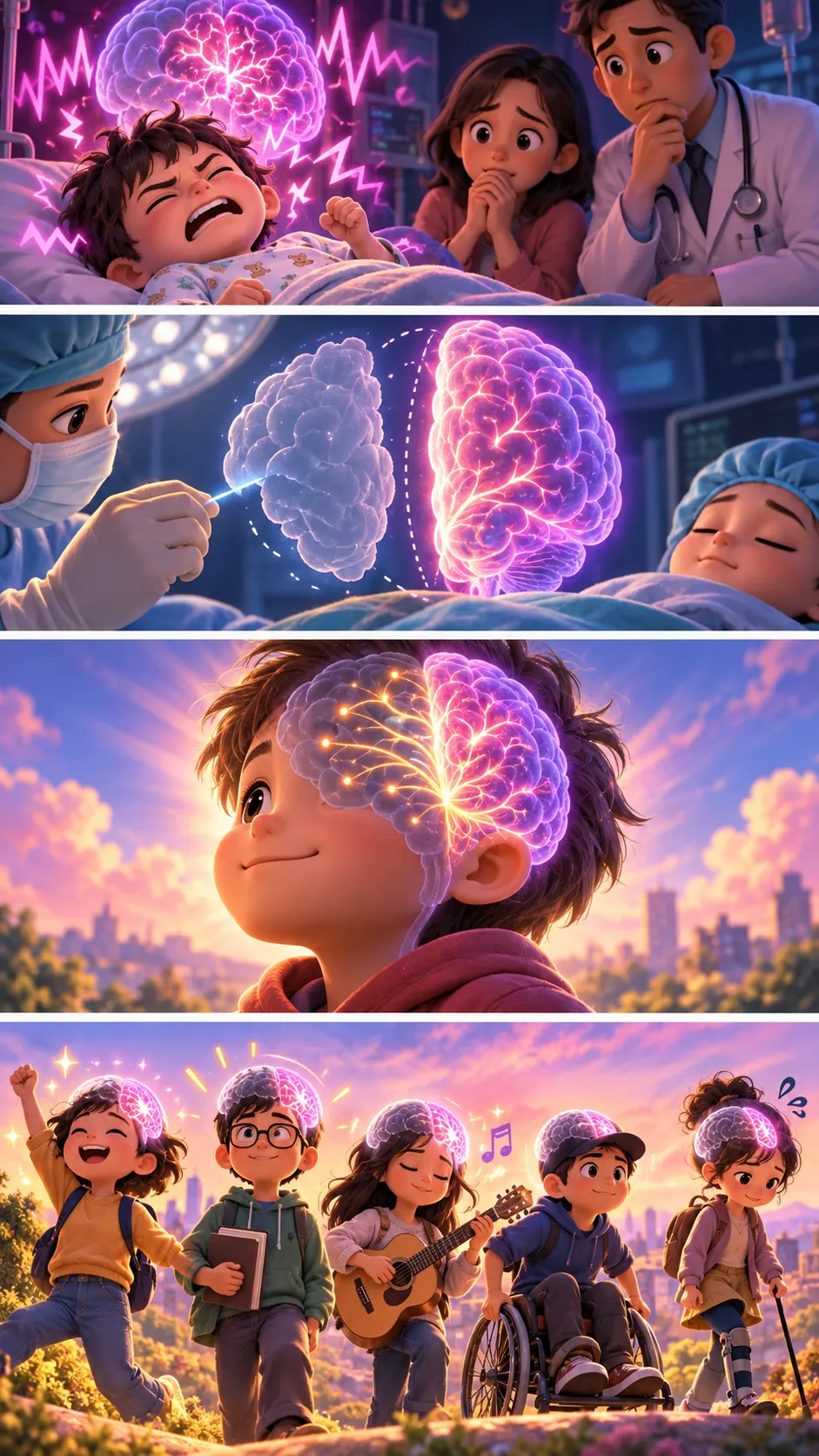
このネタ、誰かに教えたくなった?
薬が効かない重いてんかんの子どもに、脳の片側を取り除く手術がある。米国の病院の71人の追跡では65%が発作ゼロに。大人になって社会で暮らす人もいる。ただし後遺症や個人差も大きい。
押すと「マジかリスト」に保存されます
 出典・参考文献(3件)タップで表示
- Vining et al. (1997) Why would you remove half a brain? The outcome of 58 children after hemispherectomy—the Johns Hopkins experience: 1968 to 1996, Pediatricsdoi.org
- Pulsifer et al. (2004) The cognitive outcome of hemispherectomy in 71 children, Epilepsiadoi.org
- Kliemann et al. (2019) Intrinsic functional connectivity of the brain in adults with a single cerebral hemisphere, Cell Reportsdoi.org

※本記事は上記の研究・公開資料をもとに、原田英語が独自の言葉で解説したものです。引用は著作権法第32条の範囲で行い、出典を明記しています。画像はすべてオリジナルのイメージです。研究結果には限界や個人差があります。誤りのご指摘は原田英語のお問い合わせフォームから。
 これも「マジか!?」

 脳・心理
脳・心理
文字を読めるようになると、脳に「文字を担当する場所」が育つ。大人になってから学んでも変わっていた
 脳・心理
脳・心理
ロンドンのタクシー運転手は、海馬の後ろ側が大きかった。訓練生を約3年追跡して分かった"脳が育つ"証拠
 脳・心理
脳・心理
ジャグリングを3か月練習したら脳の一部が大きくなった。でも、やめたら縮んでいった
 脳・心理
脳・心理
バイオリンなど弦楽器を弾く人の脳は、左手の指を担当する場所が大きかった。でも"音楽で頭が良くなる"は別の話

 脳・心理
脳・心理
記憶の「分けると残る」は腎臓の細胞にも? 薬を一気より4回に分けると遺伝子が長く働いた
 脳・心理
脳・心理