


 体と健康・食ホント
あなたの身長、朝と夜で1cm以上違うかも。犯人は背骨の「クッション」だった
 2026.10.02
 English Corner(A2〜B2・4択クイズ)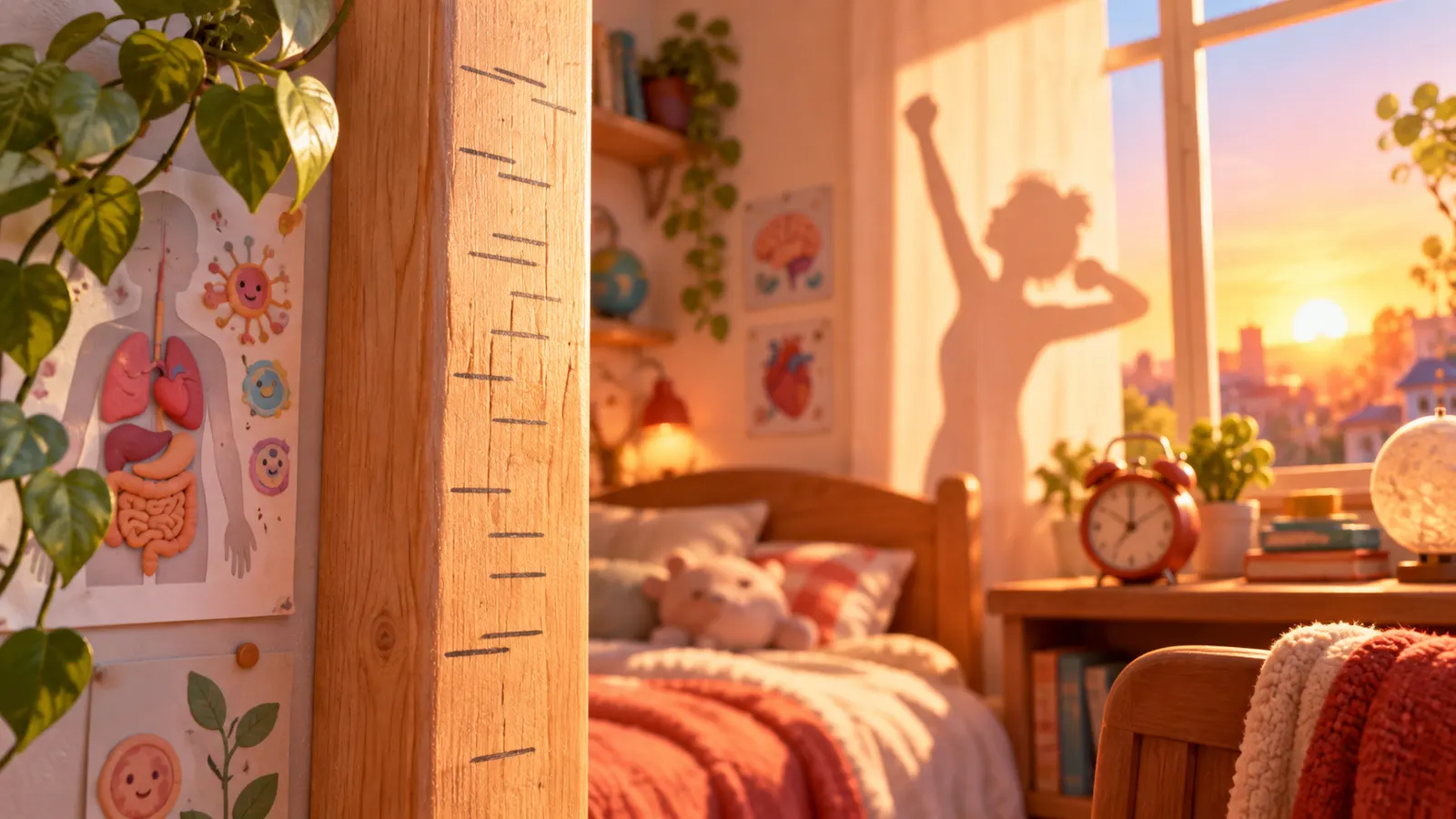
 読む前に予想してみよう!
身長を少しでも高く測りたいなら、夜より朝に測るほうがいい
寝ている間に背骨のクッションが水分を取り戻すため、朝のほうが高く出やすい。
 研究カード(どんな研究?)
- 対象
- イギリスの若い成人
- 規模
- 8人
- 研究の種類
- 実験研究(1日の反復測定)
- 確かさ
- ★★★☆☆
背骨の間のクッション(椎間板)は、日中の重力で押されて水分が抜け、夜には縮む。身長の1%前後、変化することがある。
ひとことで言うと朝がいちばん背が高い! 夜は背骨のクッションがつぶれて少し縮む。
健康診断で身長を測ったら、去年より1cm低かった……。「え、もう縮み始めた!?」とショックを受けた人、ちょっと待ってください。
それ、測った時間のせいかもしれません。
実は人の身長は、朝がいちばん高く、夜に向かって少しずつ縮んでいくんです。その差は、平均で2cm近くあったという測定もあります。犯人は、背骨の中にある「クッション」でした。
01背骨は「積み木+クッション」
背骨は、椎骨(ついこつ)という小さな骨が、首からおしりまで積み木のように積み重なってできています。
その骨と骨の間にはさまっているのが椎間板(ついかんばん)。中心はゼリーのようにやわらかく、水分をたっぷり含んだクッションです。歩いたりジャンプしたりしたときの衝撃を吸収してくれています。
02日中、椎間板はスポンジのように押しつぶされる
起きて立ったり座ったりしている間、椎間板には体の重さがずっとのしかかっています。
すると、水を含んだスポンジを押したときのように、椎間板から少しずつ水分がしみ出して、ほんの少し薄くなります。椎間板は背骨に20個以上あるので、1つ1つはわずかな変化でも、合計すると身長に表れるわけです。
そして夜、横になって眠ると重さから解放され、椎間板は水分を吸い戻してふくらみ、朝にはまた元の高さに戻ります。

身長160cmの人なら、1%で約1.6cm。けっこう大きいですよね。
03縮むのは「朝のうち」が多い
身長の減り方は、1日中同じペースではないのです。1984年の測定では、1日に縮む分の半分以上が起きてから1時間以内、約8割が3時間以内に起きていました。その後はゆっくりになります。逆に夜は、眠りの前半で取り戻す分が大きかったそうです。
スポンジをぎゅっと押すと、最初にたくさん水が出て、だんだん出にくくなるのと似ていますね。つまり「朝に測った」といっても、起きてすぐと登校・出勤後では、もう数mm違っているかもしれません。
04宇宙では背が伸びる!?
重力が椎間板を押しているなら、重力がない場所ではどうなるでしょう?
答えは「伸びる」。国際宇宙ステーションに長く滞在した宇宙飛行士は、背骨が伸びて数cm背が高くなることが知られています。ただし地球に帰ってくると、また重力で元に戻ります。
宇宙では腰痛を訴える宇宙飛行士も多く、椎間板がふくらみすぎることとの関係が考えられてきました。ただ、半年滞在した6人をMRIで調べた2016年の研究では、帰還直後の腰の椎間板の高さに目立った変化はありませんでした。一方で、背骨を支える腰の筋肉がやせていました。宇宙での腰痛の原因は、まだ研究の途中です。
05まとめ
人の身長は、朝がいちばん高く、夜には少し縮む。その主役は、背骨の間で毎日ふくらんだりしぼんだりしている椎間板というクッションでした。
健康診断の数字にがっかりする前に、「何時に測った?」を思い出してみてください。
この研究を英語で読もう原田英語の English CornerYour height is not the same all day. 音声
音声 4択クイズ9問A2・B1・B2タップして開く
原田英語の English Corner
この研究を英語で読もう
Are you taller in the morning? Yes, you probably are! Between the bones of your back, there are soft cushions called discs. They contain a lot of water. During the day, your body weight pushes on them, and some water comes out.
So you get a little shorter. At night, when you lie down, the discs take in water again. Adults can be about 1 percent taller in the morning.
70 words ・ CEFR A2
和訳を見る
あなたは朝のほうが背が高いでしょうか?そう、たぶん高いのです!背中の骨と骨の間には、椎間板というやわらかいクッションがあります。椎間板には水分がたくさん含まれています。日中は体の重さがそれを押すので、水分が少し出ていきます。
だから、少し背が低くなるのです。夜、横になると、椎間板はまた水分を取りこみます。大人は朝のほうが約1%背が高いことがあります。
4択リーディングクイズ
Q1. What is the passage mainly about?
1日の中で身長が変わる理由がテーマなので B。
Q2. When do the discs take in water again?
At night, when you lie down, the discs take in water again. とあるので C。
Q3. In this passage, "cushions" are ...
cushion は「クッション」。骨と骨の間で押す力を受け止めるやわらかいものなので D。
Your height is not the same all day. The spine is made of small bones stacked on top of each other, and between them are discs, soft cushions full of water. While you stand or sit during the day, your body weight presses on these discs, and they slowly lose water, like a sponge being squeezed.
In the 1980s, British researchers measured eight adult men nine times a day very precisely. They found that people were about 19 millimeters, or about 1.1 percent, shorter at night than in the morning. More than half of this loss happened within an hour of getting up. At night, the discs absorb water again.
110 words ・ CEFR B1
和訳を見る
あなたの身長は1日中同じではありません。背骨は小さな骨が積み重なってできていて、その間には水分をたっぷり含んだやわらかいクッション、椎間板があります。日中に立ったり座ったりしている間、体の重さがこの椎間板を押すので、しぼられるスポンジのように、椎間板は少しずつ水分を失います。
1980年代、イギリスの研究者たちは成人男性8人の身長を1日9回、とても精密に測りました。その結果、夜は朝より約19mm、つまり約1.1%背が低くなっていることがわかりました。この縮みの半分以上は、起きてから1時間以内に起きていました。夜になると、椎間板はまた水分を吸収します。
4択リーディングクイズ
Q1. What is the main idea of the passage?
日中、体重で椎間板が水分を失い、身長が縮むという内容なので C。
Q2. How much shorter were people at night than in the morning?
about 19 millimeters, or about 1.1 percent, shorter at night とあるので B。単位と小数点に注意。
Q3. If you want to compare your height accurately, what should you do?
身長は1日の中で変わり、とくに起きてすぐ大きく変化するので、毎回同じ時間に測るべきだと推論できる。正解は A。
Human height fluctuates over the course of a day, and the explanation lies in the spine. Between the vertebrae sit intervertebral discs, water-rich cushions that absorb shock. Under the constant load of body weight while we stand and sit, these discs gradually lose fluid and become slightly thinner; when we lie down at night, they take water back in. Because there are more than twenty such discs, tiny changes add up.
In the 1980s, Tyrrell, Reilly and Troup measured eight young men nine times a day to within a hundredth of a millimeter and found an average daily difference of about 19 millimeters, roughly 1.1 percent of height. The loss was not steady: more than half occurred within an hour of rising and about 80 percent within three hours, and carrying heavy loads increased the shrinkage. Astronauts show the opposite, growing several centimeters taller in weightlessness and often reporting back pain. These classic studies, however, involved only about eight young adults, and the daily variation may differ with age, so the figures may not apply to everyone.
177 words ・ CEFR B2
和訳を見る
人の身長は1日のうちに変動しており、その理由は背骨にあります。椎骨と椎骨の間には、衝撃を吸収する水分の多いクッション、椎間板があります。立ったり座ったりしている間、体の重さという一定の負荷を受けて、椎間板は少しずつ水分を失ってわずかに薄くなり、夜に横になると、また水分を取りこみます。こうした椎間板は20個以上あるので、小さな変化が積み重なるのです。
1980年代、ティレルさん、ライリーさん、トゥループさんは、若い男性8人の身長を1日9回、0.01mm単位で測定し、1日の差が平均約19mm、身長のおよそ1.1%であることを発見しました。縮み方は一定ではなく、半分以上が起きてから1時間以内に、約8割が3時間以内に起こり、重い荷物を運ぶと縮みが大きくなりました。宇宙飛行士はその逆で、無重力の中で数cm背が伸び、腰痛を訴えることも多くあります。ただし、これらの古典的な研究の対象は若い大人8人ほどにすぎず、1日の変動は年齢によって違うかもしれないため、この数字がすべての人に当てはまるとは限りません。
4択リーディングクイズ
Q1. Why do small changes in each disc affect overall height?
Because there are more than twenty such discs, tiny changes add up とあるので C。
Q2. According to the 1980s measurements, when did most of the daily height loss occur?
more than half occurred within an hour of rising and about 80 percent within three hours とあるので B。
Q3. Which limitation does the author mention?
最終文で、対象が若い大人8人ほどで、年齢によって変動が違うかもしれず全員には当てはまらないかもしれないと述べているので D。
重要単語
- spineB2名詞背骨Your spine supports the weight of your upper body.
 backbone とも言う。spine-chilling「背筋が凍るような」も覚えておくと便利。
 - intervertebral discC1名詞(句)椎間板Each intervertebral disc works like a cushion. inter-(間)+vertebral(椎骨の)。vertebra(椎骨)の複数形は vertebrae。
- compressC1動詞圧縮する、押しつぶすGravity compresses the discs during the day. com-(共に)+press(押す)。ファイルの「圧縮」も compress。名詞は compression。
- gravityB2名詞重力/重大さAstronauts grow taller without gravity. grave(重大な)と同語源。the gravity of the situation「事態の重大さ」という意味も入試頻出。
- statureC1名詞身長/(社会的な)地位Stature changes slightly over the day. height の硬い言い方。a man of great stature は「大物」の意味にもなる。
- fluctuateC1動詞変動するPrices fluctuate from day to day. ラテン語 fluctus(波)から。波のように上下するイメージ。名詞 fluctuation も頻出。
- add upB1動詞(句)積み重なる、合計されるSmall savings add up over time. 小さなものが集まって大きくなるイメージ。It doesn't add up.「つじつまが合わない」という意味もある。
 入試に出る順の単語帳を印刷する →
 全5903語の「科学英単語カード」で復習する →
 この話題を TED で聞く
同じテーマの TED・TED-Ed を、 TED HACK で。英語の見どころ・使える表現・学習ミッションつきの日本語ガイドです。(運営:原田英語)

このネタ、誰かに教えたくなった?
身長は朝がいちばん高くて、夜には平均で2cm近く縮んでいたという測定があるらしい。背骨の間の「クッション」が重力で押されて水分が抜けるから。宇宙飛行士は無重力で数cm伸びることも。
押すと「マジかリスト」に保存されます
 出典・参考文献(4件)タップで表示
- Reilly, Tyrrell & Troup (1984) Circadian variation in human stature, Chronobiology Internationaldoi.org
- Tyrrell, Reilly & Troup (1985) Circadian variation in stature and the effects of spinal loading, Spinedoi.org
- Sayson & Hargens (2008) Pathophysiology of Low Back Pain during Exposure to Microgravity, Aviation, Space, and Environmental Medicinedoi.org
- Chang et al. (2016) Lumbar Spine Paraspinal Muscle and Intervertebral Disc Height Changes in Astronauts After Long-Duration Spaceflight on the International Space Station, Spinedoi.org

※本記事は上記の研究・公開資料をもとに、原田英語が独自の言葉で解説したものです。引用は著作権法第32条の範囲で行い、出典を明記しています。画像はすべてオリジナルのイメージです。研究結果には限界や個人差があります。誤りのご指摘は原田英語のお問い合わせフォームから。
 これも「マジか!?」


 宇宙
宇宙
宇宙に行くと背が最大3%伸びる。でも地球に帰ると“元通り”になるワケ


 検証
検証
「年をとると骨が縮んで背が低くなる」は半分ホント。80歳までに女性は平均8cm低くなっていた

 体・健康
体・健康
カロリーも栄養もそろえた2つの朝食。ゆで卵やバナナより、超加工食品のほうがインスリンが多く出た

 体・健康
体・健康
同じパンでも、1人より恋人と一緒に食べたほうが血糖値の上がり方が小さかった。若い108人の実験

 体・健康
体・健康
101歳の人の血の細胞を実験室で作りかえたら、細胞の年齢が10歳くらいまで若返った

 体・健康
体・健康