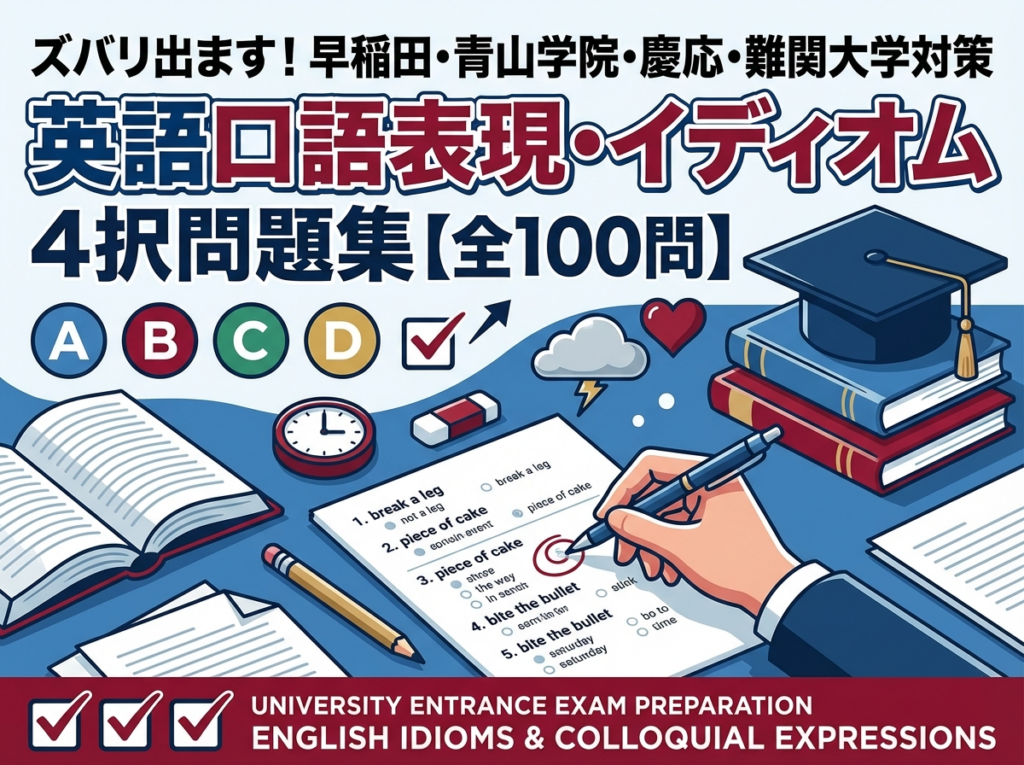
早稲田・青山学院・慶応・難関大学対策
英語口語表現・イディオム
4択問題集【全100問】
原田英語.com「差がつくイディオム・ことわざ・口語表現365」より厳選
早慶・青学レベルの英語口語・イディオムを完全制覇! 差がつく100問で、ライバルに打ち勝つ実践力を。
難関大学の英語入試で合否を分ける、口語表現・イディオム問題。定番の表現はもちろん、少しひねりのある応用的な知識まで問われるため、多くの受験生が対策に苦労しています。
この問題集は、早稲田大学、慶應義塾大学、青山学院大学といったトップレベルの大学で実際に出題される可能性の高い口語表現・イディオムを100問厳選した、実践的な4択問題集です。
本問題集の3つの特長
1. 難関大レベルに特化した厳選100問
豊富な用例で定評のあるウェブサイト「原田英語.com」の365表現の中から、過去の出題傾向を分析し、特に重要な100の表現をピックアップ。”a blessing in disguise”(不幸中の幸い)のような基本表現から、”the elephant in the room”(誰もが気づいているが触れたがらない問題)といった、知っているかどうかで差がつくハイレベルな表現まで、バランス良く網羅しています。
2. 実践的な4択形式と詳細な解説
すべての問題が実際の入試で問われる空所補充の4択形式。問題を解くだけで、自然と文脈の中での使い方をマスターできます。さらに、解答解説では正解と日本語訳だけでなく、各表現が持つニュアンスや由来、類義表現との違いまで丁寧に解説。表面的な暗記にとどまらない、深い理解へと導きます。
3. 選べる3つのフォーマットで学習を効率化
力試しに最適な「問題編」、じっくり復習できる「解答・解説編」、そして両方を一冊にまとめた「完全版」の3つのファイルをご用意。自分の学習スタイルや目的に合わせて、最適な方法で取り組むことができます。
「なんとなく意味は知っている」というレベルから、「自信を持って正解を選べる」レベルへ。この問題集で、あなたのイディオム知識を盤石なものにし、志望校合格をその手につかんでください。
【出典】日常英会話・GMARCH・早慶上智・難関国公立大で“差がつく”英語イディオム・ことわざ・口語表現365一覧PDF
Q1. He is the ( ) of the family, always causing trouble.
a) black sheep b) white lie c) hot potato d) couch potato
Q2. Missing the last bus turned out to be a ( ); I discovered a wonderful café on the way home.
a) pain in the neck b) blessing in disguise c) piece of cake d) fish out of water
Q3. He became a ( ) during the holidays, watching TV all day long.
a) black sheep b) hot potato c) couch potato d) night owl
Q4. I felt like a ( ) at the formal dinner party.
a) fish out of water b) bull in a china shop c) piece of cake d) hot potato
Q5. The topic of salary cuts is a ( ) that nobody wants to discuss.
a) white lie b) piece of cake c) hot potato d) black sheep
Q6. I told her a ( ) to avoid hurting her feelings.
a) big deal b) white lie c) hot potato d) tall tale
Q7. Stop beating ( ) the bush and tell me what happened.
a) around b) about c) behind d) beside
Q8. To ( ) insult to injury, it started raining after my car broke down.
a) put b) make c) add d) give
Q9. Don’t be scared of him; he’s all ( ) and no bite.
a) talk b) bark c) shout d) noise
Q10. We had many troubles, but ( ) well that ends well.
a) it’s b) all’s c) that’s d) what’s
Q11. His daughter is the ( ) of his eye.
a) star b) light c) apple d) pearl
Q12. Are you ( ) my leg, or is that really true?
a) pushing b) pulling c) kicking d) holding
Q13. After the plan failed, we had to go back to ( ) one.
a) circle b) point c) base d) square
Q14. If you think I did it, you’re barking up the wrong ( ).
a) road b) tree c) path d) alley
Q15. These prices are ( ) to change without notice.
a) object b) subjected c) subject d) objective
Q16. I decided to bite the ( ) and apologize first.
a) dust b) tongue c) bullet d) lip
Q17. His joke helped ( ) the ice at the party.
a) melt b) crack c) break d) cut
Q18. He burned the midnight ( ) to finish his thesis.
a) candle b) oil c) lamp d) fire
Q19. He bought a used car but it turned out to be a ( ).
a) peach b) cherry c) lemon d) plum
Q20. “Can I use your phone?” “( ) all means.”
a) With b) By c) In d) Of
Q21. She is ( ) no means a bad student.
a) in b) at c) by d) with
Q22. The news spread quickly by word of ( ).
a) hand b) mouth c) ear d) eye
Q23. “Can I borrow your notes?” “Sorry, but can I take a rain ( )?”
a) ticket b) date c) check d) card
Q24. She can’t see the ( ) for the trees.
a) wood b) forest c) mountain d) field
Q25. He ( ) out at the last minute and didn’t go bungee jumping.
a) backed b) chickened c) freaked d) dropped
Q26. I ( ) across an old friend at the supermarket yesterday.
a) ran b) came c) got d) went
Q27. It took her a long time to come to ( ) with the loss of her pet.
a) ways b) words c) terms d) ends
Q28. She remained as cool as a ( ) during the emergency.
a) lettuce b) melon c) tomato d) cucumber
Q29. The new smartphone cost an arm and a ( ).
a) foot b) hand c) leg d) finger
Q30. “Does the name ring a ( )?” “No, I’ve never heard of it.”
a) tone b) bell c) chime d) note
Q31. Don’t ( ) a book by its cover.
a) read b) see c) judge d) take
Q32. Don’t put the cart before the ( ).
a) donkey b) ox c) horse d) cow
Q33. She is very ( ) to earth despite being famous.
a) close b) near c) down d) back
Q34. Easier ( ) than done.
a) told b) spoken c) talked d) said
Q35. Every cloud has a silver ( ).
a) edge b) side c) lining d) light
Q36. “( ) me in on what happened at the meeting.”
a) Put b) Fill c) Let d) Bring
Q37. She built the business from ( ).
a) zero b) nothing c) scratch d) ground
Q38. I’m starting to get the ( ) of this new software.
a) hold b) grip c) hang d) catch
Q39. ( ) me a break! I’ve been working all day.
a) Take b) Make c) Give d) Cut
Q40. It goes ( ) saying that health is important.
a) beyond b) without c) above d) past
Q41. ( ) in there! The exam is almost over.
a) Hold b) Stay c) Hang d) Keep
Q42. ( ) makes waste.
a) Speed b) Rush c) Hurry d) Haste
Q43. You hit the nail on the ( ) with that comment.
a) top b) spot c) point d) head
Q44. “( ) come?” “Because I overslept.”
a) What b) Why c) How d) Who
Q45. I can’t ( ) it. I always cry at sad movies.
a) stop b) help c) avoid d) prevent
Q46. I couldn’t ( ) more. That’s exactly what I think.
a) say b) agree c) think d) believe
Q47. I have butterflies in my ( ).
a) heart b) chest c) stomach d) head
Q48. Don’t try to fool me. I wasn’t born ( ).
a) today b) yesterday c) recently d) then
Q49. I’ve ( ) up my mind. I’m going to study abroad.
a) set b) put c) made d) taken
Q50. I’ll keep my fingers ( ) for you.
a) together b) tight c) locked d) crossed
Q51. I’m all ( ). Tell me what happened.
a) eyes b) ears c) hands d) feet
Q52. I’m all ( ). I can’t even hold a cup properly.
a) fingers b) hands c) thumbs d) palms
Q53. ( ) a nutshell, we need to cut costs by 20%.
a) On b) At c) In d) By
Q54. In the long ( ), this investment will pay off.
a) way b) time c) run d) term
Q55. All our efforts were in ( ).
a) vain b) waste c) loss d) empty
Q56. It’s no use crying over spilt ( ).
a) water b) wine c) milk d) juice
Q57. It ( ) you right. I warned you not to do that.
a) does b) serves c) gives d) makes
Q58. I’m sorry I forgot. It completely slipped my ( ).
a) head b) brain c) mind d) thought
Q59. The instructions were all ( ) to me.
a) Latin b) Greek c) Chinese d) French
Q60. This noise is getting on my ( ).
a) brain b) mind c) nerves d) temper
Q61. It’s not my cup of ( ).
a) coffee b) tea c) water d) wine
Q62. The answer is on the ( ) of my tongue, but I just can’t remember it.
a) end b) edge c) tip d) top
Q63. Our vacation plans are still up in the ( ).
a) sky b) air c) clouds d) space
Q64. You should know better ( ) to trust strangers online.
a) enough b) much c) than d) more
Q65. The traffic jam was the last ( ). I decided to take the train from now on.
a) drop b) straw c) blow d) push
Q66. ( ) alone learning French, he can’t even speak English well.
a) Let b) Leave c) Not d) Set
Q67. She accidentally let the cat out of the ( ).
a) box b) house c) bag d) hat
Q68. Let’s call it a ( ) and go home.
a) night b) time c) day d) break
Q69. They are like two peas in a ( ).
a) bag b) basket c) shell d) pod
Q70. To make a long story ( ), we got lost and missed the concert.
a) brief b) simple c) quick d) short
Q71. She could barely make ( ) meet on her salary.
a) ways b) ends c) sides d) parts
Q72. We should make the ( ) of this opportunity.
a) best b) most c) top d) peak
Q73. I’ll try to make ( ) for the trouble I caused.
a) out b) off c) up d) over
Q74. We missed the ( ) by not investing earlier.
a) ship b) bus c) boat d) train
Q75. My ( ) are sealed. I won’t tell anyone.
a) words b) mouth c) lips d) teeth
Q76. No ( ), no gain.
a) risk b) pain c) work d) sweat
Q77. That’s a ( )-brainer. Of course we should accept the offer.
a) zero b) half c) no d) non
Q78. He gave the speech on ( ) of the entire team.
a) account b) behalf c) charge d) part
Q79. She was on cloud ( ) after hearing the good news.
a) seven b) eight c) nine d) ten
Q80. The country is on the ( ) of a major economic crisis.
a) edge b) border c) verge d) brink
Q81. Such opportunities come once in a blue ( ).
a) sky b) star c) moon d) sun
Q82. The announcement came completely out of the ( ).
a) red b) blue c) green d) black
Q83. Going on vacation now is out of the ( ).
a) answer b) problem c) question d) matter
Q84. Let’s just play it by ( ) and see what happens.
a) heart b) hand c) ear d) eye
Q85. ( ) makes perfect.
a) Training b) Practice c) Exercise d) Effort
Q86. You will pass the exam ( ) that you study hard.
a) supposed b) providing c) given d) provided
Q87. It was raining cats and ( ) yesterday.
a) horses b) birds c) dogs d) mice
Q88. You need to read between the ( ) to understand what she really means.
a) words b) pages c) lines d) letters
Q89. As a rule of ( ), you should arrive 10 minutes early.
a) hand b) thumb c) finger d) fist
Q90. They don’t always see eye to ( ) on political issues.
a) face b) eye c) nose d) ear
Q91. Those new sneakers are selling like hot ( ).
a) pies b) cakes c) buns d) bread
Q92. ( ) of the devil! We were just talking about you.
a) Talk b) Word c) Speak d) Tell
Q93. Who spilled the ( )? The surprise party is ruined!
a) rice b) milk c) beans d) soup
Q94. Strike while the ( ) is hot.
a) steel b) metal c) iron d) fire
Q95. I take it for ( ) that everyone knows the rules.
a) sure b) certain c) granted d) given
Q96. He threw in the ( ) after losing the first set.
a) glove b) hat c) towel d) flag
Q97. The teacher turned a blind ( ) to the students’ chatting.
a) face b) eye c) side d) ear
Q98. I’m feeling a bit under the ( ) today.
a) cloud b) rain c) weather d) sky
Q99. When ( ) Rome, do as the Romans do.
a) at b) in c) to d) for
Q100. Where there’s a ( ), there’s a way.
a) wish b) hope c) will d) want
解答・解説・例文和訳
【解答一覧】
| No. | 1 | 2 | 3 | 4 | 5 | 6 | 7 | 8 | 9 | 10 |
|---|---|---|---|---|---|---|---|---|---|---|
| 1-10 | a | b | c | a | c | b | a | c | b | b |
| 11-20 | c | b | d | b | c | c | c | b | c | b |
| 21-30 | c | b | c | b | b | b | c | d | c | b |
| 31-40 | c | c | c | d | c | b | c | c | c | b |
| 41-50 | c | d | d | c | b | b | c | b | c | d |
| 51-60 | b | c | c | c | a | c | b | c | b | c |
| 61-70 | b | c | b | c | b | a | c | c | d | d |
| 71-80 | b | b | c | c | c | b | c | b | c | c |
| 81-90 | c | b | c | c | b | d | c | c | b | b |
| 91-100 | b | c | c | c | c | c | b | c | b | c |
【詳細解説】
Q1. 正解: a) black sheep(厄介者・問題児)
He is the black sheep of the family, always causing trouble.
訳: 彼は家族の厄介者で、いつも問題を起こしている。
解説: a black sheep は集団の中の問題児。b) a white lie は「善意の嘘」、c) a hot potato は「厄介な問題」、d) a couch potato は「怠け者」。
Q2. 正解: b) blessing in disguise(災い転じて福となす)
Missing the last bus turned out to be a blessing in disguise.
訳: 終バスに乗り遅れたのは結果的に良い巡り合わせだった。
解説: 一見不運な出来事が実は幸運をもたらすこと。a) a pain in the neck は「面倒な事」、c) a piece of cake は「簡単なこと」、d) a fish out of water は「場違いな人」。
Q3. 正解: c) couch potato(怠け者)
He became a couch potato during the holidays, watching TV all day long.
訳: 休暇中、彼は一日中テレビを見ている怠け者になった。
解説: ソファに座ってだらだらテレビを見る怠け者のこと。d) a night owl は「夜更かしの人」。
Q4. 正解: a) fish out of water(場違いな人)
I felt like a fish out of water at the formal dinner party.
訳: 正式なディナーパーティーで場違いな気分だった。
解説: 水から出た魚のように慣れない環境で居心地が悪い様子。
Q5. 正解: c) hot potato(厄介な問題)
The topic of salary cuts is a hot potato that nobody wants to discuss.
訳: 給与カットの話題は誰も話したがらない厄介な問題だ。
解説: 熱いジャガイモのように扱いにくい問題・話題のこと。
Q6. 正解: b) white lie(善意の嘘)
I told her a white lie to avoid hurting her feelings.
訳: 彼女を傷つけないように、罪のない嘘をついた。
解説: 相手を傷つけないための小さな嘘。d) a tall tale は「大げさな話」。
Q7. 正解: a) around(beat around the bush=遠回しに言う)
Stop beating around the bush and tell me what happened.
訳: 遠回しに言わないで、何が起こったか教えてよ。
解説: 藪(bush)の周りを叩いて核心を避けるイメージ。前置詞は around が正解。
Q8. 正解: c) add(add insult to injury=追い打ちをかける)
To add insult to injury, it started raining after my car broke down.
訳: 追い打ちをかけるように、車が故障した後に雨まで降り出した。
解説: 「傷に侮辱を加える」の動詞は add が正しい。
Q9. 正解: b) bark(all bark and no bite=口だけの人)
Don’t be scared of him; he’s all bark and no bite.
訳: 彼のことを怖がる必要はない。口先だけだから。
解説: 「吠えるだけで噛まない」=口だけで行動が伴わない人。
Q10. 正解: b) all’s(All’s well that ends well.=終わりよければすべてよし)
We had many troubles, but all’s well that ends well.
訳: 多くの問題はあったが、終わりよければすべてよしだ。
解説: シェイクスピアの喜劇のタイトルでもある有名なことわざ。All’s = All is。
Q11. 正解: c) apple(apple of one’s eye=大切な人)
His daughter is the apple of his eye.
訳: 彼の娘は、彼にとって大切な存在だ。
解説: apple は古英語で「瞳」を意味していたことに由来する表現。
Q12. 正解: b) pulling(pull someone’s leg=からかう)
Are you pulling my leg, or is that really true?
訳: からかっているの、それとも本当なの?
解説: 直訳は「足を引っ張る」だが、日本語の意味とは異なり「冗談を言う・からかう」の意。
Q13. 正解: d) square(back to square one=振り出しに戻る)
After the plan failed, we had to go back to square one.
訳: 計画が失敗して、振り出しに戻らざるを得なかった。
解説: ボードゲームのスタート地点(square one)に戻ることから。
Q14. 正解: b) tree(barking up the wrong tree=見当違い)
If you think I did it, you’re barking up the wrong tree.
訳: 私がやったと思っているなら、それは見当違いだよ。
解説: 猟犬が獲物のいない木に向かって吠えるイメージ。
Q15. 正解: c) subject(be subject to=〜の対象となる)
These prices are subject to change without notice.
訳: これらの価格は予告なく変更される場合があります。
解説: 形容詞の subject が正解。b) subjected は動詞の過去形で文法的に不可。
Q16. 正解: c) bullet(bite the bullet=覚悟を決める)
I decided to bite the bullet and apologize first.
訳: 覚悟を決めて、先に謝ることにした。
解説: 麻酔なしの手術で弾丸を噛ませたことに由来。a) bite the dust は「死ぬ」。
Q17. 正解: c) break(break the ice=緊張をほぐす)
His joke helped break the ice at the party.
訳: 彼のジョークがパーティーの緊張をほぐしてくれた。
解説: 「氷を砕く」→初対面の堅い雰囲気を壊すイメージ。
Q18. 正解: b) oil(burn the midnight oil=夜遅くまで勉強する)
He burned the midnight oil to finish his thesis.
訳: 彼は論文を仕上げるために夜遅くまで頑張った。
解説: 電気のない時代に油のランプで夜遅くまで勉強したことに由来。
Q19. 正解: c) lemon(buy a lemon=欠陥品をつかまされる)
He bought a used car but it turned out to be a lemon.
訳: 中古車を買ったが、欠陥品だった。
解説: lemon は英語で「不良品・欠陥品」を意味するスラング。特に車についてよく使われる。
Q20. 正解: b) By(By all means.=もちろん)
“Can I use your phone?” “By all means.”
訳:「電話を使ってもいい?」「もちろんどうぞ。」
解説: by no means(決して〜ない)と対で覚えよう。
Q21. 正解: c) by(by no means=決して〜ない)
She is by no means a bad student.
訳: 彼女は決して悪い生徒ではない。
解説: 文頭に置くと倒置が起こる(By no means is she…)。入試超頻出。
Q22. 正解: b) mouth(by word of mouth=口コミで)
The news spread quickly by word of mouth.
訳: そのニュースは口コミで素早く広まった。
解説: 「口伝えで・口コミで」の意。SNS時代でもよく使われる表現。
Q23. 正解: c) check(take a rain check=また今度にする)
Can I take a rain check?
訳: また今度でもいいですか?
解説: 雨天中止の際にもらう振替券(rain check)に由来。
Q24. 正解: b) forest(Can’t see the forest for the trees.=木を見て森を見ず)
She can’t see the forest for the trees.
訳: 彼女は木を見て森を見ていない。
解説: 細部にこだわりすぎて全体像が見えないこと。
Q25. 正解: b) chickened(chicken out=怖気づいてやめる)
He chickened out at the last minute.
訳: 最後の瞬間に怖気づいてバンジージャンプをしなかった。
解説: chicken(臆病者)から派生した口語表現。
Q26. 正解: b) came(come across=偶然出会う)
I came across an old friend at the supermarket yesterday.
訳: 昨日スーパーで旧友に偶然出会った。
解説: come across=「偶然出会う」。run into も同義。a) ran across も正しい表現だが、ここでは come across の過去形 came が正解。
Q27. 正解: c) terms(come to terms with=〜を受け入れる)
It took her a long time to come to terms with the loss of her pet.
訳: ペットを失ったことを受け入れるのに長い時間がかかった。
解説: 「〜と折り合いをつける・〜を受け入れる」。
Q28. 正解: d) cucumber(cool as a cucumber=冷静な)
She remained as cool as a cucumber during the emergency.
訳: 緊急事態の間、彼女はキュウリのように冷静だった。
解説: キュウリの内部が外気より涼しいことに由来する比喩表現。
Q29. 正解: c) leg(cost an arm and a leg=非常に高価)
The new smartphone cost an arm and a leg.
訳: その新しいスマートフォンはとても高価だった。
解説: 「腕と脚を犠牲にするほど高い」→非常に高価。
Q30. 正解: b) bell(ring a bell=心当たりがある)
Does the name ring a bell?
訳: その名前に心当たりある?
解説: 「ベルを鳴らす」→聞き覚えがある・ピンとくる。
Q31. 正解: c) judge(Don’t judge a book by its cover.=人は見かけによらない)
Don’t judge a book by its cover.
訳: 表紙(見かけ)で本(人)を判断するな。
解説: 「外見で判断するな」という定番の格言。
Q32. 正解: c) horse(Don’t put the cart before the horse.=順序を間違えるな)
Don’t put the cart before the horse.
訳: 荷車を馬の前に置くな(本末転倒になるな)。
解説: 馬車の順番を逆にする→物事の順序を間違える。
Q33. 正解: c) down(down to earth=現実的な・気さくな)
She is very down to earth despite being famous.
訳: 有名にもかかわらず、とても気さくだ。
解説: 「地に足がついている」→現実的・飾らない。
Q34. 正解: d) said(Easier said than done.=言うは易く行うは難し)
Easier said than done.
訳: 口で言うほど簡単ではない。
解説: 定型表現。said が正解。
Q35. 正解: c) lining(Every cloud has a silver lining.=不幸中にも救いあり)
Every cloud has a silver lining.
訳: どの雲にも銀の裏地がある(不幸の中にも希望はある)。
解説: 暗い雲の裏にも太陽で銀色に輝く部分がある→どんな困難にも希望がある。
Q36. 正解: b) Fill(Fill me in.=詳しく教えて)
Fill me in on what happened at the meeting.
訳: 会議で何があったか詳しく教えて。
解説: fill someone in は「情報を詳しく教える」。
Q37. 正解: c) scratch(from scratch=一から)
She built the business from scratch.
訳: 彼女はビジネスをゼロから立ち上げた。
解説: scratch はスタートラインの意味。料理でも「手作りで」の意味で使われる。
Q38. 正解: c) hang(get the hang of=コツをつかむ)
I’m starting to get the hang of this new software.
訳: この新しいソフトのコツをつかみ始めている。
解説: 「〜のコツをつかむ・要領を得る」。
Q39. 正解: c) Give(Give me a break.=勘弁してよ)
Give me a break! I’ve been working all day.
訳: 勘弁してよ!一日中働いてるんだから。
解説: 口語で非常によく使われる定番表現。
Q40. 正解: b) without(go without saying=言うまでもない)
It goes without saying that health is important.
訳: 健康が大切なのは言うまでもない。
解説: It goes without saying that 〜は入試超頻出の構文。
Q41. 正解: c) Hang(Hang in there.=がんばって)
訳: がんばって!試験はもうすぐ終わるよ。
解説: 「持ちこたえて・頑張って」という励ましの表現。
Q42. 正解: d) Haste(Haste makes waste.=急がば回れ)
訳: 急ぐと無駄が生じる。
解説: haste と waste で韻を踏んだことわざ。
Q43. 正解: d) head(hit the nail on the head=的確に言い当てる)
訳: その発言はまさに的を射ている。
解説: 「釘の頭を正確に打つ」→的確に言い当てる。
Q44. 正解: c) How(How come?=どうして?)
訳:「どうして?」「寝坊したんだ。」
解説: Why? と同義だが、後ろに平叙文の語順が続く(How come you were late?)。
Q45. 正解: b) help(can’t help it=しかたがない)
訳: しかたがない。悲しい映画ではいつも泣いてしまう。
解説: can’t help ~ing「〜せずにはいられない」の形も重要。
Q46. 正解: b) agree(I couldn’t agree more.=全くその通り)
訳: 全くその通りです。
解説: 「これ以上同意できないほど同意する」→最上級の同意表現。
Q47. 正解: c) stomach(have butterflies in one’s stomach=緊張する)
訳: お腹の中に蝶がいるみたい(緊張している)。
解説: 緊張で胃がそわそわする様子を蝶に例えた表現。
Q48. 正解: b) yesterday(I wasn’t born yesterday.=そう甘くない)
訳: だまそうとしないで。そんなに甘くないよ。
解説: 「昨日生まれたわけじゃない」→世間知らずじゃない。
Q49. 正解: c) made(make up one’s mind=決心する)
訳: 決心がついた。留学する。
解説: make up one’s mind は「決心する・心を決める」。
Q50. 正解: d) crossed(keep one’s fingers crossed=幸運を祈る)
訳: あなたの幸運を祈っているよ。
解説: 指を交差させる欧米の縁起担ぎに由来。
Q51. 正解: b) ears(I’m all ears.=しっかり聞いている)
訳: しっかり聞いてるよ。何があったか話して。
解説: 「全身が耳」→注意深く聞いている。
Q52. 正解: c) thumbs(I’m all thumbs.=不器用)
訳: 不器用でカップもちゃんと持てない。
解説: 指が全部親指だったら何もつかめないイメージ。
Q53. 正解: c) In(in a nutshell=一言で言えば)
訳: 一言で言えば、コストを20%削減する必要がある。
解説: 「くるみの殻の中に収める」→要約すると。
Q54. 正解: c) run(in the long run=長い目で見れば)
訳: 長い目で見れば、この投資は報われるだろう。
解説: in the short run(短期的には)も合わせて覚えよう。
Q55. 正解: a) vain(in vain=むだに)
訳: 私たちの努力はすべて無駄だった。
解説: in vain は「むだに・甲斐なく」。入試頻出。
Q56. 正解: c) milk(It’s no use crying over spilt milk.=覆水盆に返らず)
訳: こぼれたミルクを嘆いても仕方がない。
解説: 過ぎたことを後悔しても無駄という有名なことわざ。
Q57. 正解: b) serves(It serves you right.=自業自得だ)
訳: 自業自得だよ。やるなって警告したのに。
解説: 「当然の報いだ」。serves が正解。
Q58. 正解: c) mind(It slipped my mind.=すっかり忘れていた)
訳: ごめん、すっかり忘れていた。
解説: 「心から滑り落ちた」→すっかり忘れていた。
Q59. 正解: b) Greek(It’s all Greek to me.=さっぱりわからない)
訳: その説明はさっぱりわからなかった。
解説: シェイクスピア『ジュリアス・シーザー』に由来。
Q60. 正解: c) nerves(get on one’s nerves=イライラさせる)
訳: この騒音にはイライラする。
解説: 「神経に障る」→イライラさせる。
Q62. 正解: c) tip(on the tip of one’s tongue=喉まで出かかっている)
訳: 答えが喉まで出かかっているのに思い出せない。
解説: 「舌の先に」→喉まで出かかっている。
Q63. 正解: b) air(up in the air=未定)
訳: 休暇の計画はまだ決まっていない。
解説: 「空中に浮いている」→未定・はっきりしない。
Q64. 正解: c) than(know better than to=〜するほど愚かではない)
訳: ネットで見知らぬ人を信用するほど愚かではないはず。
解説: 入試超頻出構文。「〜しないだけの分別がある」。
Q65. 正解: b) straw(the last straw=我慢の限界)
訳: 渋滞が決定打だった。これからは電車にする。
解説: the straw that broke the camel’s back(ラクダの背を折る最後の藁)の省略形。
Q66. 正解: a) Let(let alone=〜はおろか)
訳: フランス語はおろか、英語さえまともに話せない。
解説: 否定文の後に使い「まして〜はなおさら」を表す。入試頻出。
Q67. 正解: c) bag(let the cat out of the bag=秘密を漏らす)
訳: 彼女はうっかり秘密を漏らしてしまった。
解説: 「袋から猫を出す」→秘密を漏らす。spill the beans と同義。
Q68. 正解: c) day(call it a day=今日はここまで)
訳: 今日はここまでにして帰りましょう。
解説: 「今日の分はこれで終わり」という定番表現。
Q69. 正解: d) pod(like two peas in a pod=そっくり)
訳: 彼らはそっくりだ。
解説: 「さやの中の2粒の豆」→そっくり。pod(さや)が正解。
Q70. 正解: d) short(make a long story short=要するに)
訳: 手短に言えば、道に迷ってコンサートに間に合わなかった。
解説: 「長い話を短くする」→要するに。
Q71. 正解: b) ends(make ends meet=収支を合わせる)
訳: 彼女は給料でかろうじてやりくりしていた。
解説: 「両端を合わせる」→収支を合わせる・やりくりする。
Q72. 正解: b) most(make the most of=最大限活用する)
訳: この機会を最大限に活用すべきだ。
解説: make the best of(最善を尽くす)との違いに注意。
Q73. 正解: c) up(make up for=埋め合わせる)
訳: 迷惑をかけた分の埋め合わせをするよ。
解説: 「〜の埋め合わせをする・〜を補う」。
Q74. 正解: c) boat(miss the boat=機会を逃す)
訳: もっと早く投資しなかったために機会を逃した。
解説: 「船に乗り遅れる」→チャンスを逃す。
Q75. 正解: c) lips(My lips are sealed.=秘密は守る)
訳: 口は堅いよ。誰にも言わない。
解説: 「唇が封印されている」→秘密を守る。
Q76. 正解: b) pain(No pain, no gain.=苦労なくして成果なし)
訳: 痛みなくして得るものなし。
解説: 筋トレやスポーツでもよく使われる格言。
Q77. 正解: c) no(no-brainer=考えるまでもないこと)
訳: 考えるまでもないよ。もちろん受けるべきだ。
解説: 「脳を使う必要がない」→簡単な判断。
Q78. 正解: b) behalf(on behalf of=〜を代表して)
訳: チーム全体を代表してスピーチをした。
解説: 入試頻出表現。「〜を代表して・〜の代わりに」。
Q79. 正解: c) nine(on cloud nine=有頂天)
訳: 良い知らせを聞いて有頂天だった。
解説: 「第9の雲の上」→この上ない幸せ。
Q80. 正解: c) verge(on the verge of=〜の瀬戸際)
訳: その国は大きな経済危機の瀬戸際にある。
解説: on the brink of も類義表現。入試頻出。
Q81. 正解: c) moon(once in a blue moon=めったにない)
訳: そんな機会はめったに来ない。
解説: 実際に月が青く見える現象は稀であることに由来。
Q82. 正解: b) blue(out of the blue=突然)
訳: その発表は全くの突然だった。
解説: 「青空から(雷のように)」→突然・思いがけず。
Q83. 正解: c) question(out of the question=論外)
訳: 今バカンスに行くなど論外だ。
解説: out of question(疑いなく)と混同注意!
Q84. 正解: c) ear(play it by ear=臨機応変にやる)
訳: その場の状況で判断しよう。
解説: 「楽譜なしで耳で演奏する」→臨機応変にやる。
Q85. 正解: b) Practice(Practice makes perfect.=継続は力なり)
訳: 練習が完璧をもたらす。
解説: 定番のことわざ。
Q86. 正解: d) provided(provided that=〜を条件として)
訳: 一生懸命勉強すれば試験に受かるだろう。
解説: providing that も同義。入試頻出の接続詞的表現。
Q87. 正解: c) dogs(raining cats and dogs=土砂降り)
訳: 昨日は土砂降りだった。
解説: 英語で最も有名な天気のイディオムの1つ。
Q88. 正解: c) lines(read between the lines=行間を読む)
訳: 彼女の本当の意味を理解するには行間を読む必要がある。
解説: 「言外の意味を理解する」。
Q89. 正解: b) thumb(rule of thumb=経験則)
訳: 経験則として、10分早く着くべきだ。
解説: 「親指の法則」→大まかな目安・経験則。
Q90. 正解: b) eye(see eye to eye=意見が一致する)
訳: 政治的な問題では必ずしも意見が一致しない。
解説: 「目と目を合わせる」→意見が一致する。
Q91. 正解: b) cakes(sell like hot cakes=飛ぶように売れる)
訳: その新しいスニーカーは飛ぶように売れている。
解説: 「焼きたてのケーキのように売れる」。
Q92. 正解: c) Speak(Speak of the devil.=噂をすれば影)
訳: 噂をすれば!ちょうどあなたの話をしていたところ。
解説: 「悪魔の話をすると現れる」→噂をすれば影。
Q93. 正解: c) beans(spill the beans=秘密を漏らす)
訳: 誰が秘密を漏らしたの?サプライズパーティーが台無しだ!
解説: let the cat out of the bag と同義。
Q94. 正解: c) iron(Strike while the iron is hot.=鉄は熱いうちに打て)
訳: 鉄は熱いうちに打て。
解説: 鍛冶屋が鉄を熱いうちに叩く→好機を逃すな。
Q95. 正解: c) granted(take it for granted that=〜を当然と思う)
訳: 全員がルールを知っていて当然だと思っている。
解説: 入試超頻出表現。「〜を当たり前と見なす」。
Q96. 正解: c) towel(throw in the towel=諦める)
訳: 第1セットを落とした後、あきらめた。
解説: ボクシングでセコンドがタオルを投げ入れて試合を止めることに由来。
Q97. 正解: b) eye(turn a blind eye=見て見ぬふり)
訳: 先生は生徒たちのおしゃべりを見て見ぬふりをした。
解説: ネルソン提督の逸話に由来。
Q98. 正解: c) weather(under the weather=体調が悪い)
訳: 今日は少し体調が悪い。
解説: 船乗りが悪天候で船酔いしたことに由来する表現。
Q99. 正解: b) in(When in Rome, do as the Romans do.=郷に入っては郷に従え)
訳: ローマにいる時はローマ人がするようにせよ。
解説: 日本語の「郷に入っては郷に従え」に対応する有名なことわざ。
Q100. 正解: c) will(Where there’s a will, there’s a way.=意志あるところに道は開ける)
訳: 意志あるところに道は開ける。
解説: will(意志)が正解。wish(願い)やhope(希望)ではない。受験生への最高のメッセージ!