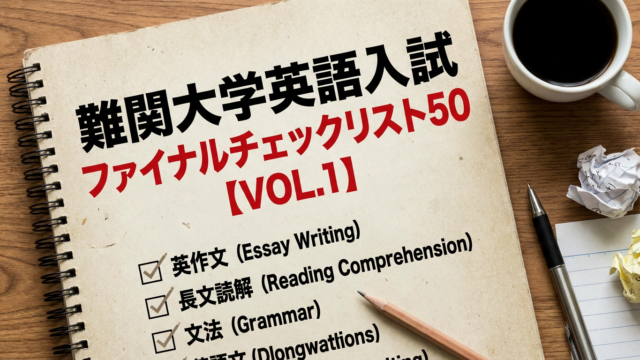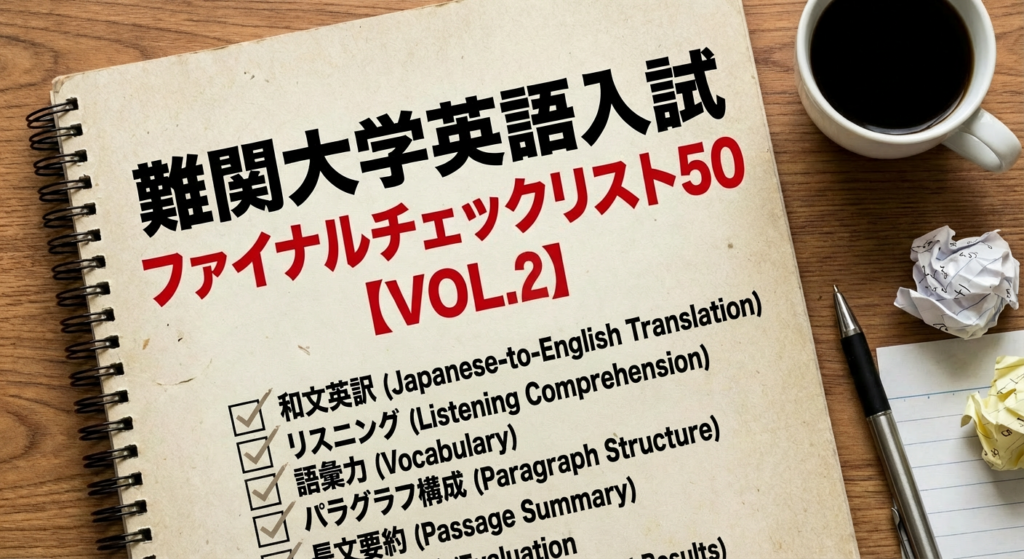
大学入試によく出題される、絶対に落としてはいけない文法・語法・イディオムを 50問×2に凝縮。
知っていれば解ける。知らなければ落とす。 それが入試英語の現実です。
「見たことある」「やったはずなのに…」そんな悔しい思いをしないために、今ここで完璧に仕上げよう。
【使い方】
- まず解く(各問30秒、答えを見ずに)
- 解説を読む(なぜその答えか理解する)
- 翌日もう一度(本番で即答できるまで反復)
さあ、始めよう。あなたの努力は、必ず報われる。
問題編
Q1. The sun ( ) in the east.
① raises ② rises ③ arises ④ is risen
Q2. Please ( ) seated until the plane comes to a complete stop.
① remain ② keep ③ stay ④ all of the above
Q3. She ( ) her husband by five years.
① survived ② outlived ③ passed ④ exceeded
Q4. He ( ) to be a doctor, but now he is a musician.
① used ② was used ③ is used ④ has used
Q5. I ( ) in Tokyo for three years when I was a child.
① have lived ② lived ③ had lived ④ was living
Q6. This time tomorrow, I ( ) on the beach in Hawaii.
① am lying ② will lie ③ will be lying ④ have lain
Q7. He ( ) have arrived by now; the flight landed an hour ago.
① must ② can ③ may ④ would
Q8. You ( ) such a rude thing to her.
① ought not to say ② ought not to have said ③ ought to not say ④ ought to have not said
Q9. The accident ( ) if you had been more careful.
① may be avoided ② might avoid ③ might have been avoided ④ may have avoided
Q10. He ( ) be rich; he drives a very old car.
① cannot ② must not ③ may not ④ should not
Q11. The window was ( ) open by the strong wind.
① blew ② blown ③ blowing ④ blow
Q12. She got her hair ( ) at the salon yesterday.
① cut ② to cut ③ cutting ④ cuts
Q13. I had my wallet ( ) on the train.
① steal ② stolen ③ stealing ④ to steal
Q14. The teacher made the students ( ) the classroom.
① clean ② to clean ③ cleaned ④ cleaning
Q15. The students were made ( ) the classroom.
① clean ② to clean ③ cleaned ④ cleaning
Q16. I saw a stranger ( ) into the building.
① enter ② to enter ③ entered ④ entering
Q17. I heard my name ( ) by someone.
① call ② to call ③ called ④ calling
Q18. She let her son ( ) whatever he wanted.
① do ② to do ③ doing ④ done
Q19. The novel is worth ( ).
① read ② to read ③ reading ④ being read
Q20. This house needs ( ).
① repair ② to repair ③ repairing ④ being repaired
Q21. ( ) his wealth, he is not happy.
① Despite of ② In spite ③ For all ④ Although
Q22. I stayed home ( ) I was feeling sick.
① because ② because of ③ due to ④ owing to
Q23. ( ) it rains tomorrow, the event will be postponed.
① If ② Unless ③ In case ④ Whether
Q24. He ran fast ( ) he might catch the train.
① so that ② in order to ③ for fear that ④ lest
Q25. ( ) you apologize, she won’t forgive you.
① If ② Unless ③ Once ④ While
Q26. It will not be long ( ) he comes back.
① before ② until ③ since ④ after
Q27. I have known him ( ) I was a child.
① for ② from ③ since ④ during
Q28. He is ( ) to none in mathematics.
① first ② best ③ second ④ equal
Q29. The train left ( ) schedule.
① in ② at ③ on ④ by
Q30. I’m not ( ) the idea of working overtime.
① fond with ② keen on ③ interested at ④ eager with
Q31. ( ) of the twins is suitable for the job.
① Both ② Either ③ Each ④ All
Q32. There is ( ) water left in the bottle.
① a few ② few ③ a little ④ little
Q33. I have two sons. One is a doctor, and ( ) is a lawyer.
① another ② the other ③ other ④ others
Q34. ( ) student has a different opinion.
① Every ② All ③ Most ④ Some
Q35. He is ( ) a fool.
① by far ② by no means ③ by all means ④ by the way
Q36. The result was ( ) from satisfactory.
① so ② too ③ far ④ much
Q37. She is ( ) beautiful than her sister.
① no more ② no less ③ nothing more ④ nothing less
Q38. He is ( ) than wise.
① cleverer ② more clever ③ more cleverer ④ most clever
Q39. I don’t like this book, and my sister doesn’t, ( ).
① too ② also ③ either ④ neither
Q40. He ( ) realized the importance of the matter.
① hard ② hardly ③ little ④ almost
Q41. He never fails ( ) his homework on time.
① submit ② submitting ③ to submit ④ submitted
Q42. ( ) your age, you should know better.
① At ② With ③ In ④ By
Q43. Not a day passes ( ) I think of my hometown.
① that ② but ③ when ④ which
Q44. He is ( ) what his father was.
① all ② just ③ quite ④ every inch
Q45. The news was ( ) good to be true.
① so ② very ③ too ④ much
Q46. I came ( ) an old friend at the station.
① across ② over ③ up ④ through
Q47. She takes ( ) her mother in appearance.
① after ② for ③ on ④ up
Q48. We must make ( ) for the delay.
① out ② off ③ up ④ over
Q49. He ( ) on me without any notice.
① dropped ② fell ③ came ④ ran
Q50. The meeting was put ( ) until next week.
① away ② off ③ out ④ down
【解答・解説編】
■ 動詞の語法・態(1-10)
Q1. 正解: ②make myself understood
「私の英語はなかなか通じなかった」
【make oneself + 過去分詞の構文】
| 表現 | 意味 | 構造 |
|---|---|---|
| make oneself understood | 自分の言うことを理解させる→通じる | 自分が「理解される」 |
| make oneself heard | 自分の声を届かせる | 自分が「聞かれる」 |
| make oneself known | 自分を知らせる | 自分が「知られる」 |
【なぜ過去分詞?】
oneself は「理解される」「聞かれる」側なので受動の意味 → 過去分詞。
【入試での引っかけ】
・make myself understood ⭕
・make myself understand ❌(自分が理解するのではなく、理解されるのだから)
【応用例文】
・I could hardly make myself heard above the noise.(騒音で声がなかなか届かなかった)
・She made herself known to the police.(彼女は警察に名乗り出た)
Q2. 正解: ③was caught
「彼は嵐に遭った」
【be caught in ~「~に遭う」】
「嵐・雨・交通渋滞などに巻き込まれる」という意味の受動態表現。
| 表現 | 意味 |
|---|---|
| be caught in a storm/shower | 嵐/にわか雨に遭う |
| be caught in traffic | 交通渋滞に巻き込まれる |
| be involved in ~ | ~に巻き込まれる |
| be engaged in ~ | ~に従事している |
| be interested in ~ | ~に興味がある |
| be absorbed in ~ | ~に夢中である |
【能動態では言わない!】
・The storm caught him. → あまり使わない
・He was caught in the storm. ⭕ → 自然な表現
Q3. 正解: ①is spoken
「英語は多くの国で話されている」
【基本的な受動態の確認】
能動態:People speak English in many countries.
受動態:English is spoken in many countries.
【by ~ が省略される場合】
・行為者が一般の人々(people, they, we など)
・行為者が不明・不要な場合
・行為者より行為自体が重要な場合
【in many countries の位置】
受動態では by ~ がない場合、場所・時間の副詞句が文末に来る。
Q4. 正解: ②was laughed at
「彼は皆に笑われた」
【群動詞(句動詞)の受動態】
群動詞(動詞 + 前置詞/副詞)を受動態にするとき、前置詞は動詞と一緒に残す。
| 能動態 | 受動態 |
|---|---|
| Everyone laughed at him. | He was laughed at by everyone. |
| They looked after the baby. | The baby was looked after. |
| Someone broke into the house. | The house was broken into. |
【絶対に前置詞を落とさない!】
・He was laughed at. ⭕
・He was laughed. ❌
【入試頻出の群動詞の受動態】
・be looked up to(尊敬される)
・be looked down on(軽蔑される)
・be taken care of(世話される)
・be spoken ill of(悪口を言われる)
・be spoken well of(褒められる)
Q5. 正解: ③to have been written
「この小説は約100年前に書かれたと言われている」
【It is said that ~ の書き換え】
| パターン | 例文 |
|---|---|
| 元の形 | It is said that this novel was written about 100 years ago. |
| S is said to do | This novel is said to have been written about 100 years ago. |
【完了不定詞を使う理由】
「言われている」のは現在、「書かれた」のは過去 → 時制のズレ → 完了不定詞(to have + 過去分詞)
【さらに受動態】
小説は「書く」のではなく「書かれる」→ to have been written
【頻出動詞】
・It is said that ~ = S is said to do
・It is believed that ~ = S is believed to do
・It is thought that ~ = S is thought to do
・It is reported that ~ = S is reported to do
・It is known that ~ = S is known to do
Q6. 正解: ②satisfied with
「彼女はその結果に満足しているようだ」
【感情を表す過去分詞 + 前置詞】
| 表現 | 意味 | 前置詞 |
|---|---|---|
| be satisfied with | ~に満足している | with |
| be pleased with | ~に喜んでいる | with |
| be disappointed with/at/in | ~にがっかりしている | with/at/in |
| be surprised at | ~に驚いている | at |
| be interested in | ~に興味がある | in |
| be excited about | ~にわくわくしている | about |
| be worried about | ~を心配している | about |
| be tired of | ~に飽きている | of |
【なぜ過去分詞?】
感情は「引き起こされる」もの → 受動的 → 過去分詞
【satisfying vs satisfied】
・The result was satisfying.(結果は満足のいくものだった)← 物が主語
・She was satisfied with the result.(彼女は結果に満足した)← 人が主語
Q7. 正解: ①to shake
「彼は私と握手するために手を差し出した」
【知覚動詞の受動態】
| 能動態 | 受動態 |
|---|---|
| I saw him cross the street. | He was seen to cross the street. |
| I heard her sing. | She was heard to sing. |
| I felt the house shake. | The house was felt to shake. |
【超重要】 知覚動詞の受動態では to が復活する!
【能動態では】
・知覚動詞 + O + 原形(動作全体を知覚)
・知覚動詞 + O + ~ing(動作の途中を知覚)
【受動態では】
・be + 過去分詞 + to do(原形に to が付く)
・be + 過去分詞 + ~ing(そのまま)
Q8. 正解: ②painted
「私は家を緑に塗ってもらった」
【使役動詞 have の構文】
| 構文 | 意味 | 例文 |
|---|---|---|
| have + O + 原形 | Oに~させる/してもらう | I had him paint my house. |
| have + O + 過去分詞 | Oを~してもらう/される | I had my house painted. |
| have + O + ~ing | Oを~している状態にする | I had the engine running. |
【本問のポイント】
my house は「塗る」のではなく「塗られる」側 → 過去分詞 painted
【have + O + 過去分詞の2つの意味】
・してもらう(依頼):I had my hair cut.(髪を切ってもらった)
・される(被害):I had my wallet stolen.(財布を盗まれた)
【get でも同じ構文】
get + O + 過去分詞:I got my car repaired.(車を修理してもらった)
Q9. 正解: ③marry
「彼は来月彼女と結婚する予定だ」
【marry の語法 ― 入試最頻出!】
| 正しい形 | 意味 | 誤った形 |
|---|---|---|
| marry + 人 | ~と結婚する | marry with 人 ❌ |
| be/get married to + 人 | ~と結婚している/する | be married with ❌ |
【詳しく】
・He will marry her. ⭕(他動詞)
・He will get married to her. ⭕(受動態)
・He will marry with her. ❌
【be married vs get married】
・be married:結婚している状態
・get married:結婚するという動作
【例文】
・They have been married for 10 years.(結婚して10年になる)← 状態
・They got married last year.(去年結婚した)← 動作
Q10. 正解: ②to
「彼らの結婚式に出席した人は誰もいなかった」
【attend vs participate / join】
| 動詞 | 意味 | 語法 |
|---|---|---|
| attend | 出席する | 他動詞(attend the meeting) |
| participate | 参加する | 自動詞 + in(participate in the game) |
| join | 参加する・加わる | 他動詞(join the club) |
【正解の理由】
この問題は present「出席している」という形容詞の語法を問うています。
・be present at ~:~に出席している ⭕
【入試での注意】
問題文をよく確認し、動詞 attend なのか形容詞 present なのかを見極める!
■ 接続詞・前置詞(11-20)
Q11. 正解: ③Although
「疲れていたけれども、彼は働き続けた」
【譲歩を表す接続詞の整理】
| 接続詞 | 意味 | 後ろに来るもの |
|---|---|---|
| although / though | ~だけれども | S + V(節) |
| even though | ~だけれども(強調) | S + V(節) |
| even if | たとえ~でも | S + V(節) |
| despite / in spite of | ~にもかかわらず | 名詞(句) |
| regardless of | ~に関係なく | 名詞(句) |
【絶対にやってはいけない間違い】
・Although he was tired, … (接続詞 + 節)⭕
・Despite his tiredness, … (前置詞 + 名詞)⭕
・Although his tiredness ❌
・Despite he was tired ❌
【though の特殊用法】
though は文末に副詞的に使える。
・It was difficult. I enjoyed it, though.(難しかったが、楽しかった)
Q12. 正解: ②Despite
「雨にもかかわらず、試合は行われた」
【前置詞 despite / in spite of】
前置詞なので、後ろには 名詞(句) が来る。
【書き換え】
・Despite the rain, the game was held.
= In spite of the rain, the game was held.
= Although it rained, the game was held.
= Though it rained, the game was held.
【despite vs in spite of】
意味は同じ。despite の方がフォーマルで、in spite of の方がやや口語的。
Q13. 正解: ①unless
「急がないと、電車に乗り遅れるよ」
【unless = if ~ not】
unless は「もし~しなければ」という条件を表す接続詞。
【書き換え】
・Unless you hurry, you will miss the train.
= If you don’t hurry, you will miss the train.
【unless が使えない場合】
unless は「~しない限り」という意味なので、仮定法とは一緒に使えない。
・Unless I were rich, I would buy it. ❌
・If I were rich, I would buy it. ⭕
【unless vs if not の微妙な違い】
・unless:条件(~しない限り)
・if not:条件 + 否定の感情を含むこともある
Q14. 正解: ③Once
「一度やり方を覚えれば、それは簡単だ」
【once の接続詞用法】
once は「いったん~すれば」「ひとたび~すれば」という意味の接続詞として使える。
【例文】
・Once you understand the rule, it’s easy.
・Once she makes up her mind, she never changes it.(いったん決心すると、絶対に変えない)
【once vs when】
・once:「いったん~したら(その後は)」という含意
・when:単に「~するとき」
Q15. 正解: ②while
「ローマにいる間、ローマ人のするようにせよ(郷に入っては郷に従え)」
【while の用法】
| 用法 | 意味 | 例文 |
|---|---|---|
| 時 | ~する間 | While I was studying, he was sleeping. |
| 対比 | 一方で~ | While he is rich, his brother is poor. |
| 譲歩 | ~だけれども | While I admit it’s difficult, I’ll try. |
【while vs during】
・while:接続詞(後ろに S + V)
・during:前置詞(後ろに名詞)
・While I was in Rome, … ⭕
・During my stay in Rome, … ⭕
・During I was in Rome ❌
Q16. 正解: ①by
「彼は5時までにここに来なければならない」
【by vs until の決定的な違い】
| 前置詞 | 意味 | 使う動詞の種類 |
|---|---|---|
| by | ~までに(期限) | 瞬間的動作(完了・到達) |
| until / till | ~まで(継続) | 継続的動作・状態 |
【例文で確認】
・I must finish this by 5 o’clock.(5時までに終えなければ)← 期限
・I will wait until 5 o’clock.(5時まで待つ)← 継続
・He must come here by 5 o’clock.(5時までに来なければ)← 到着は瞬間的
【覚え方】
by = deadline(締め切り)
until = duration(継続期間)
Q17. 正解: ③until
「暗くなるまで遊んでいた」
【until / till の使い方】
「暗くなるまで(ずっと)遊んでいた」→ 遊ぶという行為の継続 → until
【否定文での until】
not ~ until …:…して初めて~する
・I didn’t notice it until she pointed it out.(彼女に指摘されて初めて気づいた)
【強調構文】
・It was not until she pointed it out that I noticed it.
・Not until she pointed it out did I notice it.(倒置)
Q18. 正解: ②for
「私はこのコンピュータを5年間使っている」
【for vs since】
| 前置詞 | 意味 | 後ろに来るもの |
|---|---|---|
| for | ~の間 | 期間(five years, a long time, a week) |
| since | ~以来 | 起点(2020, last year, I was a child) |
【例文】
・I have lived here for ten years.(10年間)
・I have lived here since 2015.(2015年以来)
・I have lived here since I was a child.(子供の頃から)
Q19. 正解: ①during
「夏休みの間、私はずっと旅行していた」
【during vs for】
| 前置詞 | 意味 | 後ろに来るもの |
|---|---|---|
| during | ~の間(特定の期間中) | 特定の期間(the summer vacation, the war, my stay) |
| for | ~の間(長さ) | 期間の長さ(three days, a week, years) |
【例文】
・I traveled during the summer vacation.(夏休み中に)
・I traveled for three weeks.(3週間)
【覚え方】
during は「いつの間か」を示す(特定の期間名)
for は「どのくらいの間か」を示す(長さ)
Q20. 正解: ③within
「彼は1週間以内に戻ってくるだろう」
【within vs in】
| 前置詞 | 意味 | ニュアンス |
|---|---|---|
| within | ~以内に | その期間内のどこかで |
| in | ~後に | その期間が経過したら |
【例文】
・He will be back within a week.(1週間以内に戻る)
・He will be back in a week.(1週間後に戻る)
【重要】
・within a week = 7日間のどこかで(1日後かもしれないし、6日後かもしれない)
・in a week = 7日後に
■ 名詞・代名詞・冠詞(21-30)
Q21. 正解: ②baggage
「彼女は荷物をたくさん持っている」
【不可算名詞の代表例】
| 不可算名詞 | 意味 | 数える場合 |
|---|---|---|
| baggage / luggage | 荷物 | a piece of baggage |
| furniture | 家具 | a piece of furniture |
| information | 情報 | a piece of information |
| advice | 忠告 | a piece of advice |
| news | ニュース | a piece of news |
| homework | 宿題 | a piece of homework |
| equipment | 設備 | a piece of equipment |
| progress | 進歩 | — |
| knowledge | 知識 | — |
| work | 仕事・作品 | a work(作品)は可算 |
【入試での引っかけ】
・much baggage ⭕
・many baggages ❌
・a lot of baggage ⭕
Q22. 正解: ①is
「そのニュースは彼女をとても幸せにした」
【-s で終わるが単数扱いの名詞】
| 名詞 | 意味 | 扱い |
|---|---|---|
| news | ニュース | 単数 |
| mathematics | 数学 | 単数 |
| physics | 物理学 | 単数 |
| economics | 経済学 | 単数 |
| politics | 政治 | 単数/複数両方 |
| statistics | 統計学 | 単数(学問)/ 複数(統計データ) |
| means | 手段 | 単数/複数両方 |
| series | シリーズ | 単数/複数両方 |
| species | 種 | 単数/複数両方 |
【例文】
・The news is surprising.(単数)
・Mathematics is my favorite subject.(単数)
Q23. 正解: ③feet
「そのテーブルの長さは6フィートある」
【不規則な複数形】
| 単数 | 複数 | 意味 |
|---|---|---|
| foot | feet | 足、フィート |
| tooth | teeth | 歯 |
| man | men | 男性 |
| woman | women | 女性 |
| child | children | 子供 |
| mouse | mice | ネズミ |
| ox | oxen | 雄牛 |
| goose | geese | ガチョウ |
【数詞 + 名詞 が形容詞的に使われる場合】
・a six-foot table ⭕(ハイフンで繋ぐと単数形)
・The table is six feet long. ⭕(述語的に使うと複数形)
Q24. 正解: ②others
「生徒の何人かはテニスをして、残りの者たちはサッカーをしていた」
【other / another / the other / others の完全整理】
| 表現 | 意味 | 使い方 |
|---|---|---|
| another | もう一つの、別の | 単数・不特定 |
| other + 複数名詞 | 他の~ | 複数・不特定 |
| others | 他の人々/物 | 複数・不特定(代名詞) |
| the other | (2つのうち)もう一方 | 単数・特定 |
| the others | 残りのすべて | 複数・特定 |
【本問の構造】
Some students ~, and others ~.
= Some ~, and others ~.(一部は~、他の者たちは~)
【入試頻出パターン】
・Some ~, others ~, and still others ~.(~する者もいれば、~する者もいて、さらに~する者もいる)
・one ~, another ~, and the other ~.(3つのうち、1つは~、もう1つは~、残りの1つは~)
Q25. 正解: ①that
「東京の人口は大阪の人口よりも多い」
【代名詞 that / those の使い方】
同じ種類のものを比較するとき、繰り返しを避けるために that(単数)/ those(複数) を使う。
| 先行する名詞 | 代名詞 | 例文 |
|---|---|---|
| 単数名詞 | that | The climate of Japan is milder than that of Korea. |
| 複数名詞 | those | The students of this class are smarter than those of that class. |
【one / it との違い】
・that:特定のものの代わり(比較でよく使う)
・one:不特定の1つ
・it:前に出た特定のそのもの
【入試での引っかけ】
・The population of Tokyo is larger than that of Osaka. ⭕
・The population of Tokyo is larger than Osaka. ❌(人口と大阪を比較している)
Q26. 正解: ②a little
「砂糖を少しいただけますか」
【a few / a little / few / little の完全整理】
| 表現 | 意味 | 可算/不可算 | ニュアンス |
|---|---|---|---|
| a few | 少しはある | 可算・複数 | 肯定的 |
| few | ほとんどない | 可算・複数 | 否定的 |
| a little | 少しはある | 不可算 | 肯定的 |
| little | ほとんどない | 不可算 | 否定的 |
【本問のポイント】
sugar は不可算名詞 → little 系を使う。「少しいただけますか」は肯定的 → a little。
【覚え方】
・a が付く = ある(肯定)
・a が付かない = ない(否定)
Q27. 正解: ③the
「彼はバイオリンを弾くのがとても上手だ」
【楽器には the を付ける】
| 楽器 | 表現 |
|---|---|
| ピアノ | play the piano |
| ギター | play the guitar |
| バイオリン | play the violin |
| フルート | play the flute |
【スポーツには the を付けない】
| スポーツ | 表現 |
|---|---|
| テニス | play tennis |
| サッカー | play soccer |
| 野球 | play baseball |
【例外に注意】
楽器でも一般的に言及する場合は a を使うことも
・She bought a piano.(ピアノを1台買った)
・She plays the piano.(ピアノを演奏する)
Q28. 正解: ②the
「大西洋は太平洋ほど広くない」
【the を付ける固有名詞】
| 種類 | 例 |
|---|---|
| 海洋 | the Pacific (Ocean), the Atlantic (Ocean) |
| 川 | the Amazon, the Thames, the Nile |
| 山脈 | the Alps, the Rockies, the Himalayas |
| 砂漠 | the Sahara (Desert) |
| 半島 | the Korean Peninsula |
| 複数形の国名 | the United States, the Philippines, the Netherlands |
| 王国・共和国 | the United Kingdom, the Republic of Korea |
| 新聞 | the Times, the New York Times |
| 公共建造物 | the White House, the Eiffel Tower |
【the を付けない固有名詞】
| 種類 | 例 |
|---|---|
| 単独の山 | Mt. Fuji, Mt. Everest |
| 湖 | Lake Biwa, Lake Michigan |
| 大陸 | Asia, Europe, Africa |
| 公園 | Central Park, Hyde Park |
| 駅・空港 | Tokyo Station, JFK Airport |
Q29. 正解: ①the
「病院に行ってきた」
【the の有無で意味が変わる表現】
| 表現 | 意味 |
|---|---|
| go to school | (生徒として)学校に行く |
| go to the school | (用事で)その学校に行く |
| go to church | (礼拝のために)教会に行く |
| go to the church | (用事で)その教会に行く |
| go to bed | 寝る |
| go to the bed | (用事で)そのベッドに行く |
| go to hospital | 入院する(イギリス英語) |
| go to the hospital | 病院に行く(アメリカ英語) |
| in prison | 服役中で |
| in the prison | その刑務所の中に |
【本問の解釈】
go to the hospital は「(見舞いや用事で)病院に行く」という意味。
※アメリカ英語では「診察を受けに行く」場合も go to the hospital を使う。
Q30. 正解: ②a
「彼女の父はイギリス人だ」
【国籍を表す表現】
| 国 | 形容詞 | 「~人」 |
|---|---|---|
| England/Britain | English/British | an Englishman / a British person |
| France | French | a Frenchman / a French person |
| Japan | Japanese | a Japanese |
| China | Chinese | a Chinese |
| America | American | an American |
| Germany | German | a German |
【注意】
・English / French / Japanese / Chinese などは形容詞としても名詞としても使える
・「一人の~人」と言うときは a/an + 国籍名詞
【本問】
an Englishman = イギリス人(男性)1人
■ 形容詞・副詞(31-40)
Q31. 正解: ②high
「この建物は50メートルの高さがある」
【数詞 + 単位 + 形容詞の語順】
「数詞 + 単位 + 形容詞」で「~の高さ/長さ/幅がある」を表す。
| パターン | 例文 |
|---|---|
| S + be動詞 + 数詞 + 単位 + 形容詞 | The building is 50 meters high. |
| S + be動詞 + 数詞 + 単位 + in + 名詞 | The building is 50 meters in height. |
【形容詞と対応する名詞】
| 形容詞 | 名詞 |
|---|---|
| high | height |
| long | length |
| wide | width |
| deep | depth |
| old | age |
Q32. 正解: ③sleeping
「その赤ちゃんを起こさないで」
【分詞の限定用法:現在分詞 vs 過去分詞】
| 分詞 | 意味 | 例 |
|---|---|---|
| 現在分詞(~ing) | 能動・進行 | a sleeping baby(眠っている赤ちゃん) |
| 過去分詞(~ed等) | 受動・完了 | a broken window(壊れた窓) |
【名詞の前 vs 後ろ】
・1語の分詞:名詞の前に置く(a sleeping baby)
・分詞句(複数語):名詞の後ろに置く(a baby sleeping in the bed)
Q33. 正解: ①alike
「双子はとてもよく似ている」
【叙述用法のみの形容詞】
以下の形容詞は 補語としてのみ使用可能(名詞の前には置けない)。
| 形容詞 | 意味 | 正しい例 | 誤った例 |
|---|---|---|---|
| alike | 似ている | They are alike. | alike twins |
| alive | 生きている | He is alive. | an alive fish → a live fish |
| asleep | 眠っている | She is asleep. | an asleep baby → a sleeping baby |
| awake | 起きている | I am awake. | an awake child → a waking child |
| alone | 一人で | He was alone. | an alone man → a lonely man |
| afraid | 恐れて | She is afraid. | an afraid child → a frightened child |
【覚え方】 a- で始まる形容詞の多くは叙述用法のみ!
Q34. 正解: ②hard
「彼はとても熱心に働いている」
【hard vs hardly】
| 副詞 | 意味 | 例文 |
|---|---|---|
| hard | 一生懸命に、激しく | He works hard. |
| hardly | ほとんど~ない | He hardly works.(彼はほとんど働かない) |
【超重要】意味が全く違う!
| 形容詞/副詞 | 意味 | ~ly 形 | 意味 |
|---|---|---|---|
| hard | 激しく | hardly | ほとんど~ない |
| late | 遅く | lately | 最近 |
| near | 近くに | nearly | ほとんど |
| high | 高く | highly | 非常に |
| most | 最も | mostly | たいていは |
| pretty | かなり | prettily | 可愛らしく |
Q35. 正解: ③lately
「最近、彼女に会った?」
【late vs lately】
・late:遅く(He came late.)
・lately:最近(= recently)
【lately / recently と現在完了】
lately / recently は現在完了形とよく一緒に使われる。
・Have you seen her lately? ⭕
・I haven’t seen her recently. ⭕
Q36. 正解: ②almost
「ほとんどすべての学生がその試験に合格した」
【almost vs most】
| 語 | 品詞 | 意味 | 使い方 |
|---|---|---|---|
| almost | 副詞 | ほとんど | almost all / almost every / almost no |
| most | 形容詞 | 大部分の | most students / most of the students |
| most | 副詞 | 最も | the most beautiful |
【almost all vs most の違い】
・almost all the students:ほとんどすべての学生(99%くらい)
・most students:大部分の学生(過半数以上)
【almost の位置】
almost は副詞なので、修飾する語の直前に置く。
・Almost all the students passed. ⭕
・All almost the students ❌
Q37. 正解: ①already
「彼はもう宿題を終えてしまった」
【already / yet / still の使い分け】
| 語 | 意味 | 使う文 | 位置 |
|---|---|---|---|
| already | もう、すでに | 肯定文 | 動詞の前 or 文末 |
| yet | もう、まだ | 疑問文・否定文 | 文末 |
| still | まだ、依然として | 肯定文・否定文 | 動詞の前 |
【例文】
・He has already finished.(もう終えた)肯定文
・Has he finished yet?(もう終えた?)疑問文
・He hasn’t finished yet.(まだ終えていない)否定文
・He is still working.(まだ働いている)肯定文
Q38. 正解: ③such
「彼女がそんなに愚かなことをするとは驚きだ」
【so vs such の語順】
| 語 | 語順 | 例 |
|---|---|---|
| so | so + 形容詞 + a/an + 名詞 | so foolish a thing |
| such | such + a/an + 形容詞 + 名詞 | such a foolish thing |
【両方とも同じ意味】
・It was so foolish a thing.
・It was such a foolish thing.
【so / such の結果構文】
・He is so kind that everyone likes him.
・He is such a kind person that everyone likes him.
【注意】複数名詞・不可算名詞の場合
・such は使える:such beautiful flowers / such good news
・so は使えない:so beautiful flowers → such beautiful flowers
Q39. 正解: ②ever
「今まで北海道に行ったことがありますか」
【ever の用法】
| 用法 | 意味 | 例文 |
|---|---|---|
| 疑問文で | 今までに | Have you ever been to Paris? |
| 否定文で | 一度も~ない | I haven’t ever seen him. = I have never seen him. |
| 条件文で | もし今までに | If you ever go there, let me know. |
| 比較級 + than ever | 今まで以上に | He is busier than ever. |
| 最上級 + ever | 今まで一番 | This is the best movie I’ve ever seen. |
Q40. 正解: ①very
「まさにその瞬間、電話が鳴った」
【very の形容詞用法「まさにその」】
very は副詞「とても」だけでなく、形容詞として 「まさにその」 という意味がある。
【例文】
・At that very moment, the phone rang.(まさにその瞬間)
・This is the very book I was looking for.(まさにこの本)
・He came to the very end.(まさに最後まで)
・From the very beginning(まさに最初から)
the + very + 名詞の形で使うことが多い。
■ 重要構文・イディオム(41-50)
Q41. 正解: ②to say nothing of
「彼女はフランス語は言うまでもなく、英語も話せない」
【「~は言うまでもなく」の表現】
| 表現 | 意味 | 用法 |
|---|---|---|
| to say nothing of | ~は言うまでもなく | 否定文で使う |
| not to mention | ~は言うまでもなく | 否定文でも肯定文でも |
| not to speak of | ~は言うまでもなく | 否定文でも肯定文でも |
| let alone | まして~は(ない) | 否定文で使う |
| much less | まして~は(ない) | 否定文で使う |
| still less | まして~は(ない) | 否定文で使う |
【書き換え】
・She can’t speak English, to say nothing of French.
・She can’t speak English, let alone French.
・She can’t speak English, much less French.
Q42. 正解: ③case
「電車に乗り遅れるといけないから、早く出発しよう」
【in case / in case of の違い】
| 表現 | 後ろに来るもの | 意味 |
|---|---|---|
| in case + S + V | 節 | ~するといけないから |
| in case of + 名詞 | 名詞 | ~の場合には |
【例文】
・Take an umbrella in case it rains.(雨が降るといけないから)
・In case of fire, use the stairs.(火事の場合には)
【in case vs if の違い】
・in case:予防・準備(~するといけないから)
・if:条件(もし~なら)
Q43. 正解: ①as well as
「彼女は歌えるし踊れもする」
【A as well as B「BだけでなくAも」】
as well as は 前の要素を強調 する。「Bはもちろん、Aも」
【動詞の一致】
A as well as B が主語のとき、動詞は A に一致 する。
・He as well as I is going.(彼も私も行く予定だ)
・I as well as he am going.
【関連表現】
A as well as B = B だけでなく A も = not only B but also A
Q44. 正解: ②other
「言い換えれば、あなたは私が間違っていると言いたいのですか」
【in other words「言い換えれば」】
| 表現 | 意味 |
|---|---|
| in other words | 言い換えれば |
| in a word | 一言で言えば |
| in short | 要するに |
| in brief | 手短に言えば |
| to put it simply | 簡単に言えば |
| that is (to say) | すなわち |
Q45. 正解: ③the same
「君が何と言おうと、私の考えは変わらない」
【all the same「それでもやはり」】
all the same = nevertheless = still = yet
【例文】
・I know it’s difficult, but I’ll try all the same.
・Thank you all the same.(とにかくありがとう)← 断る時の丁寧表現
Q46. 正解: ②terms
「私たちは隣人と仲良くしている」
【be on good terms with ~「~と仲が良い」】
| 表現 | 意味 |
|---|---|
| be on good terms with | ~と仲が良い |
| be on bad terms with | ~と仲が悪い |
| be on speaking terms with | ~と口を利く仲だ |
| in terms of ~ | ~の点から見ると |
| come to terms with ~ | ~と折り合いをつける |
Q47. 正解: ①make
「その話は筋が通らない」
【make sense「意味をなす、道理にかなう」】
| 表現 | 意味 |
|---|---|
| make sense | 意味をなす、理解できる |
| make sense of ~ | ~を理解する |
| in a sense | ある意味では |
| in no sense | 決して~ない |
| common sense | 常識 |
| come to one’s senses | 正気に返る |
Q48. 正解: ③brought
「その光景は少年時代を思い出させた」
【bring back「思い出させる」】
bring back = remind of =「思い出させる」
| 表現 | 意味 |
|---|---|
| bring back | 思い出させる、持ち帰る |
| bring about | 引き起こす |
| bring up | 育てる、話題を持ち出す |
| bring in | 持ち込む、導入する |
| bring out | 発表する、明らかにする |
Q49. 正解: ②before long
「まもなく雨がやむでしょう」
【before long vs long before】
| 表現 | 意味 | 例文 |
|---|---|---|
| before long | まもなく(= soon) | It will stop raining before long. |
| long before | ずっと前に | I had met him long before. |
【覚え方】
・before long:長くなる前に → まもなく
・long before:長く前に → ずっと前に
Q50. 正解: ①far from
「この問題は簡単どころではない」
【far from ~「~どころではない、決して~ない」】
far from ~ = not ~ at all = anything but ~
【例文】
・The exam was far from easy.(試験は簡単どころではなかった)
・He is far from a fool.(彼は決して馬鹿ではない)
= He is anything but a fool.
| 表現 | 意味 |
|---|---|
| far from ~ | ~どころではない |
| so far | 今のところ |
| by far | はるかに(最上級強調) |
| as far as ~ | ~する限り |
| far from it | とんでもない |
📝 VOL.2 完全攻略チェックリスト
| 分野 | 最重要ポイント |
|---|---|
| 受動態 | 群動詞の受動態で前置詞を残す! |
| 使役・知覚動詞 | have + O + 過去分詞 / 知覚動詞の受動態で to が復活 |
| marry の語法 | marry 人 / be married to 人(with は ❌) |
| 接続詞 vs 前置詞 | although + 節 / despite + 名詞 |
| by vs until | by は期限、until は継続 |
| 不可算名詞 | baggage, furniture, information, advice, news |
| the の有無 | 楽器には the、スポーツには付けない |
| 叙述用法のみ | alike, alive, asleep, awake, alone, afraid |
| hard vs hardly | 意味が完全に異なる! |
| as well as | A as well as B → 動詞は A に一致 |