 ワークシート
 ぬりえ
 迷路
幅3.7メートル!人の一生を右から左へ描いた、ゴーギャン最大の大作。Almost 4 meters wide! A human life told from right to left.
 美術館アンテナ:ポール・ゴーギャンの作品に会える展覧会
この作品のお話
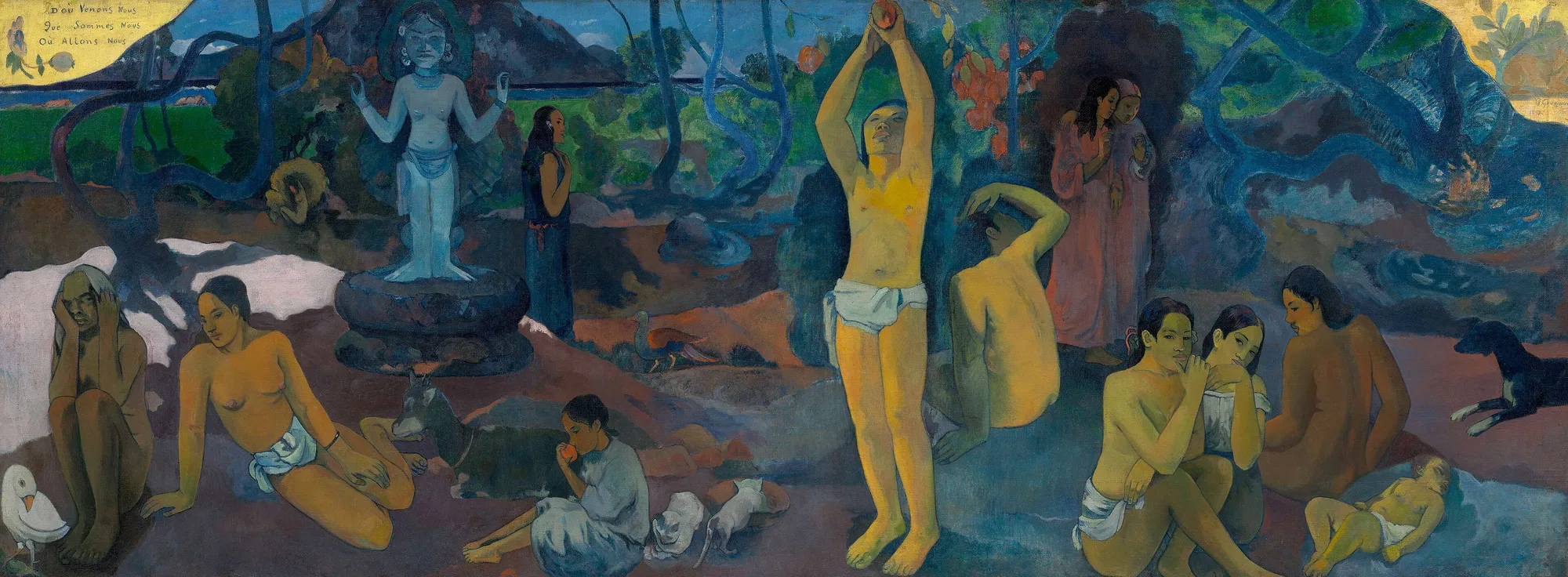
Story1897年から98年にかけて、南太平洋のタヒチでゴーギャンが描いた、横幅3.7メートルをこえる大作です。右はしで眠る赤ちゃんから、まん中で果物に手をのばす人物、左はしでうずくまる老女まで、人の一生が右から左へと描かれています。奥には両腕を上げた青い偶像が立っています。アメリカのボストン美術館にあります。
Gauguin painted this huge work, more than 3.7 meters wide, in Tahiti in the South Pacific in 1897–98. From a sleeping baby on the right, to a standing figure reaching for fruit in the middle, to an old woman on the left, it shows a human life from right to left. A blue idol with raised arms stands in the back. It is in the Museum of Fine Arts, Boston.
このころのゴーギャンは借金と病気に苦しみ、1897年にはかわいがっていた娘アリーヌの死の知らせも受けていました。友人への手紙によると、モデルも使わず、節だらけの粗い布に、1か月ほど昼も夜も熱にうかされたように描き続けたといいます。題名は画面左上の黄色いすみに、彼自身が書きこみました。
At this time, Gauguin was suffering from debt and illness, and in 1897 he heard that his dear daughter Aline had died. In a letter to a friend, he said he painted day and night for about a month, as if in a fever, without models, on rough cloth full of knots. He wrote the title himself in the yellow corner at the top left.
描き終えたあと、ゴーギャンは絶望して命を絶とうとしたと手紙に書いていますが、助かりました。絵は1898年にパリの画商ヴォラールの店で展示され、1936年にボストン美術館が買いました。「人はどこから来て、どこへ行くのか」という問いは、今も見る人の心をゆさぶっています。
After finishing it, Gauguin wrote that he had tried to end his life in despair, but he survived. The painting was shown at the gallery of the dealer Ambroise Vollard in Paris in 1898, and the Museum of Fine Arts, Boston bought it in 1936. Its questions about where we come from and where we are going still move people today.
これはとても横長の絵です。幅はおよそ3.7メートルもあります!ゴーギャンはタヒチという島でこの絵を描きました。右から左へ読むことができます。右には赤ちゃん、左にはおばあさんがいます。人の一生を表しているのです。
This is a very long painting. It is about 3.7 meters wide! Gauguin painted it on the island of Tahiti. You can read it from right to left. A baby is on the right, and an old woman is on the left. It shows the life of a person.
英語のレベルは上の「やさしい/ふつう」で切りかえられます。
えっ!?な裏ネタ
Secrets左上にゴーギャンが書いた題名は「D'où Venons Nous / Que Sommes Nous / Où Allons Nous」。日本語や英語の題名では疑問符をつけることが多いのですが、ゴーギャン自身の書きこみには疑問符がありません。
Gauguin wrote the title at the top left: 'D'où Venons Nous / Que Sommes Nous / Où Allons Nous'. English titles usually add question marks, but Gauguin's own writing has none.
左下の老女の足もとには、トカゲをつかんだふしぎな白い鳥がいます。ゴーギャンは手紙で、この鳥は「言葉のむなしさ」を表している、と説明しました。小さな鳥に、大きな意味がこめられているのです。
At the old woman's feet, there is a strange white bird holding a lizard. In a letter, Gauguin explained that it stands for the uselessness of words. A small bird carries a big meaning.
ゴーギャンはこの絵を、死ぬ前に残す遺言のような作品と考え、これまでのどの絵よりもすぐれていて、これ以上の絵はもう描けないだろう、と手紙に書きました。実際にはその後5年ほど生き、1903年にマルキーズ諸島で亡くなりました。
Gauguin thought of this painting as a kind of last will. He wrote that it was better than all his earlier works and that he would never paint anything better. In fact, he lived about five more years and died in the Marquesas Islands in 1903.
ゴーギャンは手紙で、この絵を節やでこぼこだらけの粗い布に描いたと書いています。お金に苦しんでいた時期の作品で、近くで見ると布の目がはっきりと分かります。タヒチでの暮らしの厳しさが、画面の手ざわりからも伝わってきます。
Gauguin wrote that he painted it on rough cloth full of knots and bumps. He was very poor at the time, and if you look closely, you can clearly see the texture of the cloth. The rough surface tells us how hard his life in Tahiti was.
ここを見て!
Look Closer1眠る赤ちゃんThe sleeping baby
右はしの赤ちゃんは「誕生」。物語はここから始まります。
The baby on the right stands for birth. The story begins here.
2果物に手をのばす人物The figure reaching for fruit
まん中で両手をのばす人物は「生きること」を表すと考えられています。画面でいちばん目立つ人物です。
The figure reaching up in the middle is often seen as a symbol of living. It is the most eye-catching figure.
3青い偶像The blue idol
両手を上げた青い偶像。ゴーギャンは、この像が「彼方の世界」を示している、と説明しました。
A blue idol with raised arms. Gauguin said that it points to the world beyond.
4うずくまる老女The old woman
左はしで頭をかかえる老女。死に近づいた人として描かれています。
On the far left, an old woman holds her head. She is near the end of her life.
英語で名画を語ろう
Talk about Art in EnglishThis painting tells a story from right to left.
この絵は右から左へと物語を語っています。
💡 絵や文字を読む向きの表現。日本の絵巻物も right to left。反対は left to right。
英語で説明すると… Describe it
これはとても横長の絵です。右では、赤ちゃんが地面で眠っています。まん中では、立っている人物が果物に手をのばしています。左には、老女と青い偶像があります。
This is a very long painting. On the right, a baby is sleeping on the ground. In the middle, a standing figure is reaching for fruit. On the left, there are an old woman and a blue idol.
考えてみよう Think & Talk
- 題名の3つの問いに、あなたならどう答えますか?How would you answer the three questions in the title?
- ゴーギャンはなぜ、題名に「?」をつけなかったのだと思いますか?Why do you think Gauguin did not use question marks?
この作品の英単語
WordsA blue statue stands in the back.
奥に青い像が立っています。
We all wonder where we are going.
私たちはみな、自分がどこへ行くのだろうと考えます。
The baby on the right means birth.
右の赤ちゃんは誕生を意味します。
The whole scene feels mysterious.
場面全体がなぞめいて感じられます。
ミニクイズ
QuizQ. ゴーギャンがこの絵を描いた場所は?Where did Gauguin paint this?
南太平洋のタヒチで、1897年から98年にかけて描きました。
He painted it in Tahiti in the South Pacific in 1897–98.
ウソ?ホント? この絵は、右から左へ人の一生を描いていると説明されることが多い。This painting is often explained as a human life from right to left.
右の赤ちゃんから左の老女へと、人生が進んでいきます。
Life moves from the baby on the right to the old woman on the left.
ウソ?ホント? ゴーギャンは何人ものモデルを雇い、何年もかけて描いた。Gauguin hired many models and took years to paint it.
手紙によると、モデルなしで1か月ほどで一気に描きました。
According to his letter, he painted it in about a month without models.
 画像の出典とライセンス / Image credit
- PDGauguin - Where Do We Come From? What Are We? Where Are We Going? (1897-98).jpg(Wikimedia Commons)
ライセンス:Public domain(パブリックドメイン)/作者・撮影者の表記:Paul Gauguin/提供元:Wildenstein Plattner Institute
この作品は、作者の死後長い年月がたち著作権の保護期間が終わった「パブリックドメイン」の作品です。画像は平面の作品を忠実に写したもので、新しい著作権は生じません(Wikimedia Commons の PD-Art の考え方)。 所蔵:ボストン美術館(Museum of Fine Arts, Boston)。画像は表示のために縮小・WebP 形式に変換しています。