 ワークシート
 ぬりえ
 迷路
パリを離れて太平洋の島へ!ゴーギャンが描いた、静かに座る2人の女性。He left Paris for a Pacific island! Two quiet women on the sand.
 美術館アンテナ:ポール・ゴーギャンの作品に会える展覧会
この作品のお話
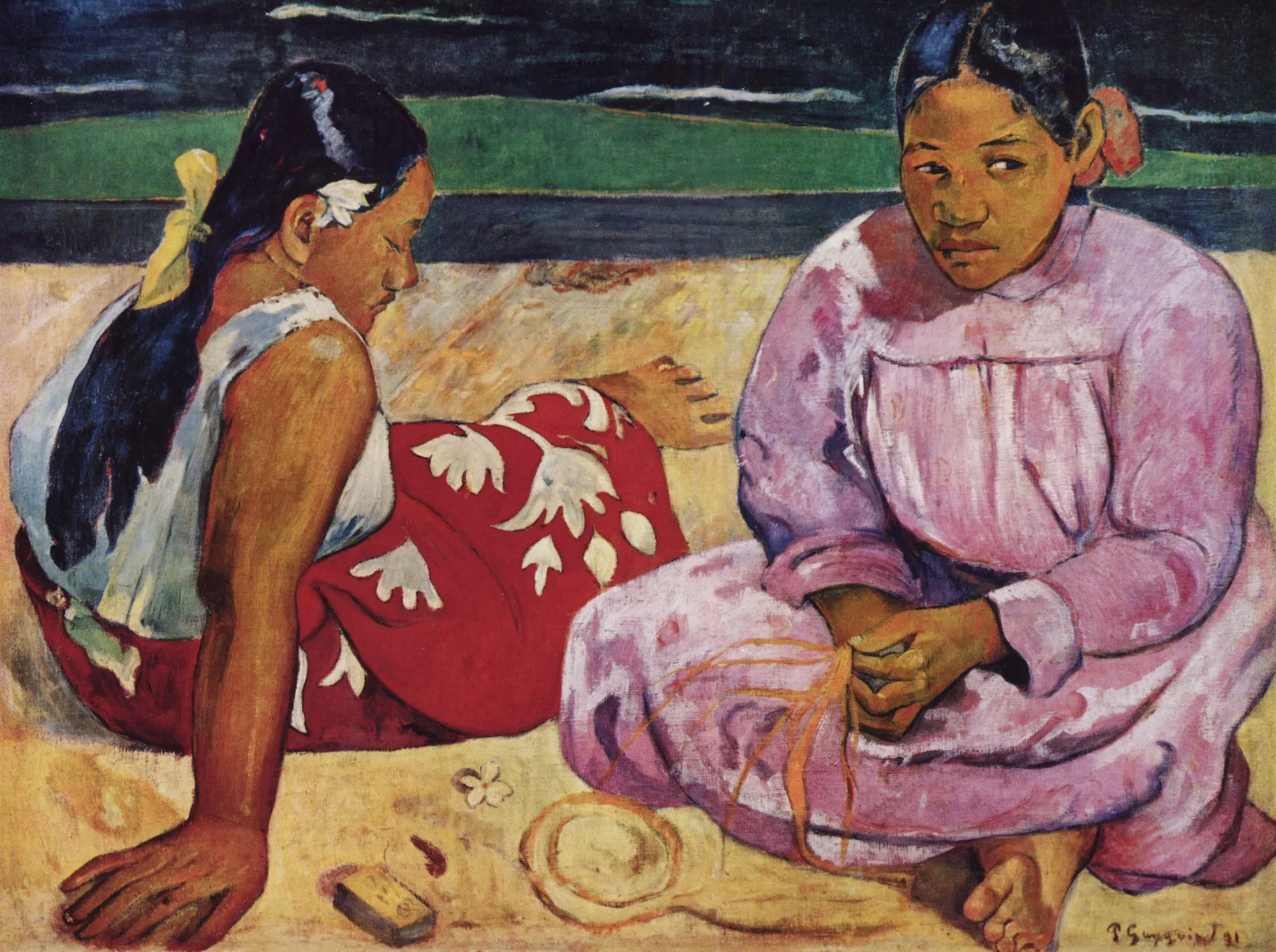
Story1891年、フランスの画家ゴーギャンが南太平洋の島タヒチで描いた絵です。砂の上に2人の女性が座っています。左の人は赤地に白い花もようの布「パレオ」を巻いて背を向け、右の人はピンクの長いワンピースを着て、手に植物の繊維のようなものを持ち、横目でわきの方を見ています。
Paul Gauguin painted this in 1891 on Tahiti, an island in the South Pacific. Two women sit on the sand. The woman on the left wears a red pareo with white flowers and turns away. The woman on the right wears a long pink dress. She holds some plant fibers and glances to the side.
ゴーギャンは「文明に汚されていない楽園」を求めて、1891年にタヒチへ渡りました。けれど島はすでにフランスの植民地で、キリスト教の宣教師が広めた長い服が着られていました。右の女性のワンピースはその「宣教師のドレス」です。ゴーギャンは影をほとんどつけず、平らな色の面とくっきりした輪郭で、2人を大きく画面いっぱいに描きました。
Gauguin sailed to Tahiti in 1891. He was looking for a paradise untouched by modern life. But the island was already a French colony. Christian missionaries had brought long dresses, like the pink one on the right. Gauguin used flat colors, strong outlines and almost no shadows. The two women fill the whole canvas.
ゴーギャンは翌1892年、同じ構図で「パラウ・アピ(何か新しいことは?)」という別の絵も描き、右の女性の服を花もようのパレオに変えました。そちらは今ドイツのドレスデンにあります。この絵はパリのオルセー美術館にあり、ゴーギャンの「タヒチの絵」の代表作として知られています。
In 1892, Gauguin painted a second version called Parau api (What News?). In that one, the woman on the right wears a flowered pareo instead of the dress. It is now in Dresden, Germany. This first version is in the Musée d'Orsay in Paris. It is one of his best-known Tahiti paintings.
タヒチの砂の上に、2人の女性が座っています。タヒチはフランスから遠くはなれた島です。ゴーギャンはパリを出て、絵を描くためにそこへ行きました。画家になる前、彼はパリでお金の仕事をしていたのです!彼は日の当たる島で新しい人生を始めたかったのです。
Two women sit on the sand in Tahiti. Tahiti is an island far from France. Gauguin left Paris and went there to paint. Before he became a painter, he worked with money in Paris! He wanted a new life on a sunny island.
英語のレベルは上の「やさしい/ふつう」で切りかえられます。
えっ!?な裏ネタ
Secretsゴーギャンは若いころ船乗りをしたあと、パリで株の仲買人として働き、日曜画家として絵を描いていました。1882年の株の大暴落のあと、画家一本で生きる道を選びます。
As a young man, Gauguin worked as a sailor. Then he became a stockbroker in Paris and painted on Sundays. After the stock market crash of 1882, he decided to live as a full-time artist.
タヒチへ行く3年前の1888年、ゴーギャンは南フランスのアルルでゴッホと約2か月いっしょに暮らしました。けんかが絶えず、最後はゴッホが自分の耳を傷つける事件が起きて、共同生活は終わりました。
In 1888, three years before Tahiti, Gauguin lived with Van Gogh in Arles for about two months. They argued often. It ended after Van Gogh hurt his own ear.
翌年描いた「パラウ・アピ」は、ほぼ同じポーズの2人を描いた別バージョンです。右の女性の服がパレオに変わり、色も黄色っぽくなっています。見くらべると「まちがいさがし」のように楽しめます。
Parau api, painted the next year, shows the same two women in almost the same poses. But the woman on the right wears a pareo, and the colors are more yellow. Comparing them is like a spot-the-difference game.
ゴーギャンの母方の祖母フロラ・トリスタンは、女性や労働者の権利をうったえたことで知られる作家です。ゴーギャン自身も幼いころの数年間を南米ペルーの首都リマで過ごしました。
Gauguin's grandmother, Flora Tristan, was a writer known for fighting for the rights of women and workers. Gauguin himself spent several years of his early childhood in Lima, Peru.
ここを見て!
Look Closer1横向きのまなざしA sideways glance
右の女性は横目でわきの方を見ています。うれしそうとも悲しそうとも言い切れない、読み取りにくい表情です。
The woman on the right glances to the side. Her face is hard to read: not clearly happy, not clearly sad.
2花もようのパレオFlowered pareo
赤い布に白い葉と花のもよう。影をつけず、平らな色でくっきり描いています。
A red cloth with white leaves and flowers. It is painted flat, with no shadows.
3宣教師のドレスMission dress
えりの詰まったピンクの長い服。キリスト教の宣教師が島に広めた服で、植民地の時代を伝えています。
A long pink dress with a high collar. Missionaries brought this style to the island.
4海と波The sea
上の方の緑と紺の帯は海。白い線は寄せる波です。遠近感をわざと弱め、模様のように描いています。
The green and dark blue bands at the top are the sea. The white lines are waves, painted almost like a pattern.
英語で名画を語ろう
Talk about Art in EnglishThe woman on the left turns away from us.
左の女性はこちらから顔をそむけています。
💡 人物の向きを言うときに便利。反対は look at us / face us(こちらを向く)。
英語で説明すると… Describe it
砂浜に2人の女性がいます。左の女性は、白い花もようの赤い布を身につけています。右の女性は、ピンクの長いワンピースを着ています。背景には、白い波の立つ緑と青の海があります。
There are two women on a sandy beach. The woman on the left is wearing a red cloth with white flowers. The woman on the right is wearing a long pink dress. In the background, there is a green and blue sea with white waves.
考えてみよう Think & Talk
- 2人の女性は何を考えていると思いますか?What do you think the two women are thinking about?
- ゴーギャンは遠くに楽園を探しました。完ぺきな場所は、どこかにあると思いますか?Gauguin looked for a paradise far away. Is there a perfect place anywhere?
この作品の英単語
WordsGauguin moved to an island in the South Pacific.
ゴーギャンは南太平洋の島へ移った。
He hoped to find a paradise in Tahiti.
彼はタヒチで楽園を見つけたいと思っていた。
Missionaries brought long dresses to the island.
宣教師が島に長い服をもちこんだ。
Gauguin painted with flat areas of color.
ゴーギャンは平らな色の面で描いた。
ミニクイズ
QuizQ. 右の女性のピンクの服は、だれが島に広めた?Who brought the style of the pink dress to the island?
宣教師たちが広めた、体をおおう長い服です。
Missionaries spread these long dresses that cover the body.
ウソ?ホント? ゴーギャンは、ほぼ同じ構図の絵をもう1枚描いている。Gauguin painted another picture with almost the same composition.
1892年の「パラウ・アピ」で、今はドレスデンにあります。
It is Parau api (1892), now in Dresden.
ウソ?ホント? ゴーギャンはタヒチで生まれ育った。Gauguin was born and grew up in Tahiti.
パリ生まれです。幼いころはペルーで育ち、40代でタヒチへ渡りました。
He was born in Paris and spent part of his childhood in Peru. He went to Tahiti in his forties.
 画像の出典とライセンス / Image credit
- PDPaul Gauguin 056.jpg(Wikimedia Commons)
ライセンス:Public domain(パブリックドメイン)/作者・撮影者の表記:Paul Gauguin/提供元:The Yorck Project (2002) 10.000 Meisterwerke der Malerei (DVD-ROM), distributed by DIRECTMEDIA Publishing GmbH. ISBN: 3936122202.
この作品は、作者の死後長い年月がたち著作権の保護期間が終わった「パブリックドメイン」の作品です。画像は平面の作品を忠実に写したもので、新しい著作権は生じません(Wikimedia Commons の PD-Art の考え方)。 所蔵:オルセー美術館(Musée d'Orsay)。画像は表示のために縮小・WebP 形式に変換しています。
ポール・ゴーギャンのほかの作品