 ワークシート
 ぬりえ
 迷路
点、点、点で描いたサーカス!31歳で亡くなったスーラ、未完の遺作。A circus made of dots! Seurat's last painting, left unfinished when he died at 31.
 美術館アンテナ:ジョルジュ・スーラの作品に会える展覧会
この作品のお話
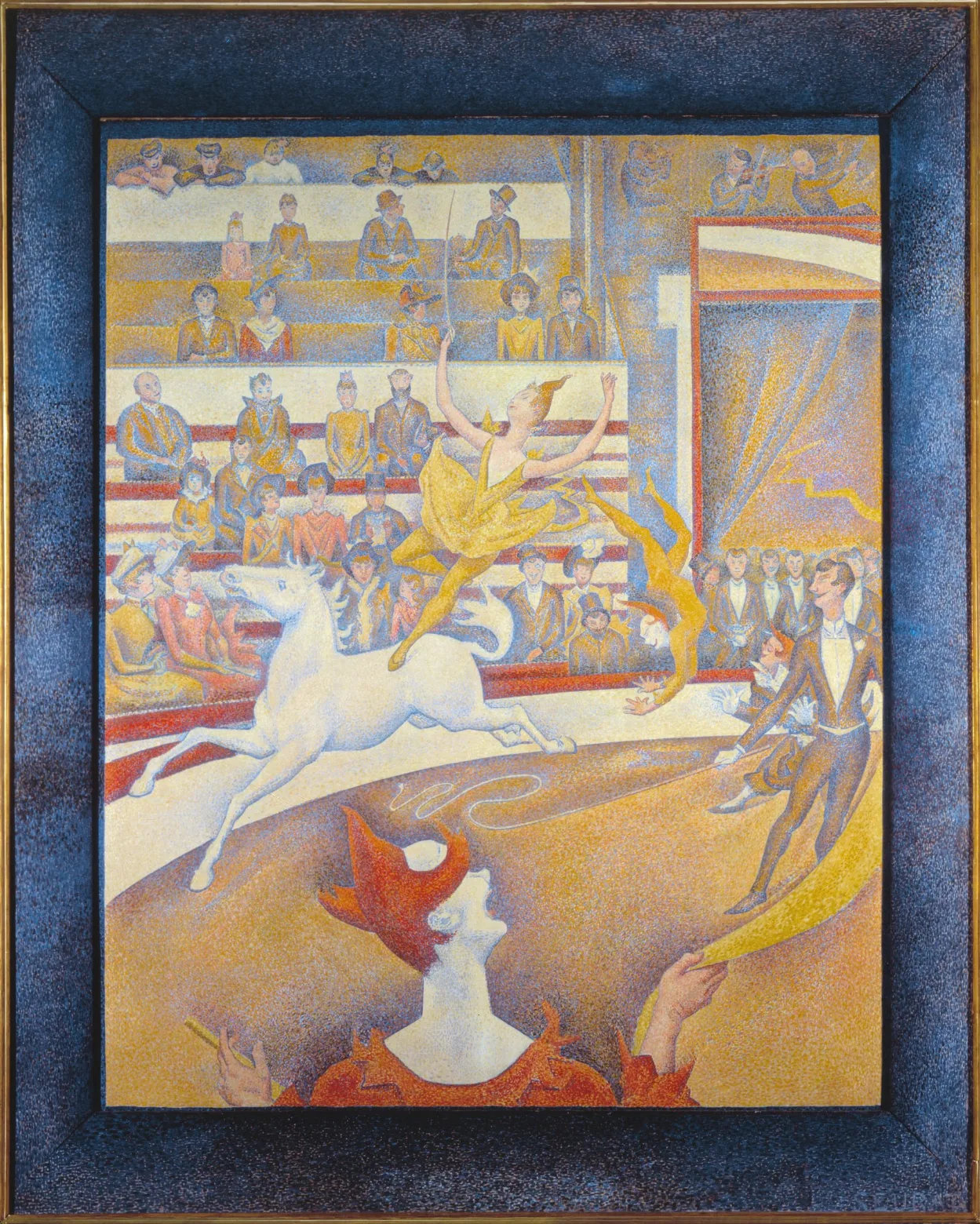
Story点描(小さな色の点をならべて描く方法)で知られるフランスの画家スーラの、最後の大作です。パリのモンマルトルにあったフェルナンド・サーカスの場面で、白い馬の背に立って踊る曲馬の女性、宙返りする曲芸師、むちを持った団長、そして手前には背中を向けた道化師が描かれています。
This is the last large painting by Georges Seurat, a French artist famous for pointillism. Pointillism means painting with tiny dots of color. The scene is the Cirque Fernando in Montmartre, Paris. A rider dances on a white horse, an acrobat flips in the air, and the ringmaster holds a whip. In the foreground, a clown turns his back to us.
スーラは科学者シャルル・アンリの理論を研究していました。「上に向かう線は楽しさを、下に向かう線は悲しさを感じさせる」という考えです。この絵では、馬の背の女性の腕、団長のひげ、道化の髪など、上に向かう線がたくさん使われています。色も黄・オレンジ・赤など明るい暖色が中心です。
Seurat studied the ideas of the scientist Charles Henry. Henry believed that lines going up feel happy and lines going down feel sad. In this painting, many lines go up: the rider's arms, the ringmaster's mustache and the clown's hair. The colors are mostly warm and bright, like yellow, orange and red.
1891年3月、スーラはこの絵を未完成のまま展覧会に出しましたが、その展示中に病気で急死しました。まだ31歳でした。絵のところどころには、下地の白や下描きの青い方眼が見えています。この絵は仲間の画家シニャックの手をへて、アメリカのコレクター、ジョン・クインの遺贈でルーヴルに入り、今はオルセー美術館にあります。
In March 1891, Seurat showed this painting at an exhibition, although it was not finished. During the show, he suddenly fell ill and died. He was only 31. In some places, you can still see the white ground and the blue grid he drew. The painting later belonged to his friend Paul Signac. It came to the Louvre through the American collector John Quinn and is now in the Musée d'Orsay.
これはパリのサーカスのショーです。女性が白い馬の上で踊っています。近くで見てください!絵は小さな点でできています。スーラは31歳で亡くなり、この絵を最後まで仕上げられませんでした。彼は額まで、絵のふちと同じ青色にぬったのです!
This is a circus show in Paris. A woman dances on a white horse. Look closely! The picture is made of tiny dots. Seurat died at 31, and he did not finish it. He even painted the frame the same blue as the edge of the picture!
英語のレベルは上の「やさしい/ふつう」で切りかえられます。
えっ!?な裏ネタ
Secretsスーラはカンヴァスのふちに濃い青の帯を点で描き、それに続く平らな額も同じ青にして、自分でサインまで入れました。絵と額をひとつながりのものとして考えていたのです。
Seurat painted a dark blue border of dots around the edge. He also made the flat frame the same blue and signed it. For him, the picture and the frame were one work.
スーラは「上向きの線=楽しい、下向きの線=悲しい」という科学的な理論を、絵にあてはめようとしました。曲芸の女性も団長のひげも、みんなピンと上を向いています。画面全体の「楽しさ」を計算して描いたのです。
Seurat tried to use a scientific theory: upward lines feel happy, downward lines feel sad. The rider's arms and the ringmaster's mustache all point up. He tried to plan the joy of the whole picture.
フェルナンド・サーカスは画家たちに大人気でした。ロートレックの「フェルナンド・サーカスにて」やルノワールの「フェルナンド・サーカスの曲芸師」も、同じサーカスを描いた作品です。
The Cirque Fernando was very popular with painters. Toulouse-Lautrec and Renoir also painted pictures of this same circus.
「点描(ポワンティイスム)」という呼び名は、もともと批評家たちが使ったものです。スーラ自身は、色と光の科学にもとづく方法として「クロモ・ルミナリスム(色光主義)」という名前を好んだと言われます。
The word "pointillism" was first used by critics. Seurat is said to have preferred the name "chromoluminarism," because his method was based on the science of color and light.
ここを見て!
Look Closer1馬の上の踊り子The rider
白い馬の背で、片足で立って両手を上げています。体じゅうの線が上へ向かい、楽しさを伝えます。
She stands on one foot on the horse and raises her arms. Every line goes up to show joy.
2白い馬White horse
前足と後ろ足を思いきりのばして駆ける馬。白も、よく見るとたくさんの色の点でできています。
The horse stretches its legs as it runs. Even the white is made of many colored dots.
3サーカスの団長Ringmaster
ぴんと上を向いたひげと、とがった体の線。むちを手に、ショーを仕切っています。
His mustache points up, and his body is sharp and angular. He leads the show with a whip.
4背中を向けた道化師Clown from behind
手前の道化師はこちらに背中を向け、私たちといっしょにショーを見ているようです。
The clown in the foreground has his back to us. He seems to watch the show with us.
英語で名画を語ろう
Talk about Art in EnglishSeurat built up the picture dot by dot.
スーラは点を一つずつ重ねて絵を作りあげました。
💡 同じ名詞を by の前後に置くと「一つずつ」の意味。dot by dot、step by step など。
英語で説明すると… Describe it
これはサーカスです。真ん中で、走る白い馬の上に女性が立っています。右には黒い服の団長がいます。手前には赤い髪の道化師がいます。奥の客席から、たくさんの人が見ています。
This is a circus. In the middle, a woman is standing on a running white horse. On the right, there is a ringmaster in a black suit. In the foreground, there is a clown with red hair. Many people are watching from the seats in the background.
考えてみよう Think & Talk
- 上向きの線は、本当に楽しく感じますか?それはなぜ?Do upward lines really feel happy to you? Why or why not?
- スーラはなぜ、背中を向けた道化師をいちばん手前に置いたのだと思いますか?Why do you think Seurat put a clown with his back to us in the front?
この作品の英単語
WordsThe whole picture is made of tiny dots.
絵全体が小さな点でできている。
Seurat died, and the painting was left unfinished.
スーラが亡くなり、絵は未完成のまま残された。
The ringmaster holds a long whip.
団長は長いむちを持っている。
An acrobat flips in the air.
曲芸師が宙返りしている。
ミニクイズ
QuizQ. スーラが参考にした理論では、上向きの線はどんな気持ちを表す?In the theory Seurat used, what feeling do upward lines show?
科学者シャルル・アンリの考えで、上向きの線は楽しさ・明るさを表すとされました。
According to Charles Henry, upward lines show happiness and cheer.
ウソ?ホント? スーラはこの絵を完成させてから、70歳まで長生きした。Seurat finished this painting and lived to be 70.
未完成のまま展示中に31歳で亡くなりました。
He died at 31, while the unfinished painting was on show.
ウソ?ホント? 絵のまわりの青いふちも、スーラが点で描いたもの。Seurat also painted the blue border around the picture with dots.
ふちと額まで、作品の一部として考えていました。
He thought of the border and frame as part of the work.
 画像の出典とライセンス / Image credit
- PDGeorges Seurat, 1891, Le Cirque (The Circus), oil on canvas, 185 x 152 cm, Musée d'Orsay.jpg(Wikimedia Commons)
ライセンス:Public domain(パブリックドメイン)/作者・撮影者の表記:Georges Seurat/提供元:Artsy
この作品は、作者の死後長い年月がたち著作権の保護期間が終わった「パブリックドメイン」の作品です。画像は平面の作品を忠実に写したもので、新しい著作権は生じません(Wikimedia Commons の PD-Art の考え方)。 所蔵:オルセー美術館(Musée d'Orsay)。画像は表示のために縮小・WebP 形式に変換しています。