 ワークシート
 ぬりえ
 迷路
顔のない兵士と、両手をあげる白いシャツの男。戦争の犠牲者を描いた衝撃作。Faceless soldiers and a man in white with raised arms: a powerful image of war's victims.
この作品のお話
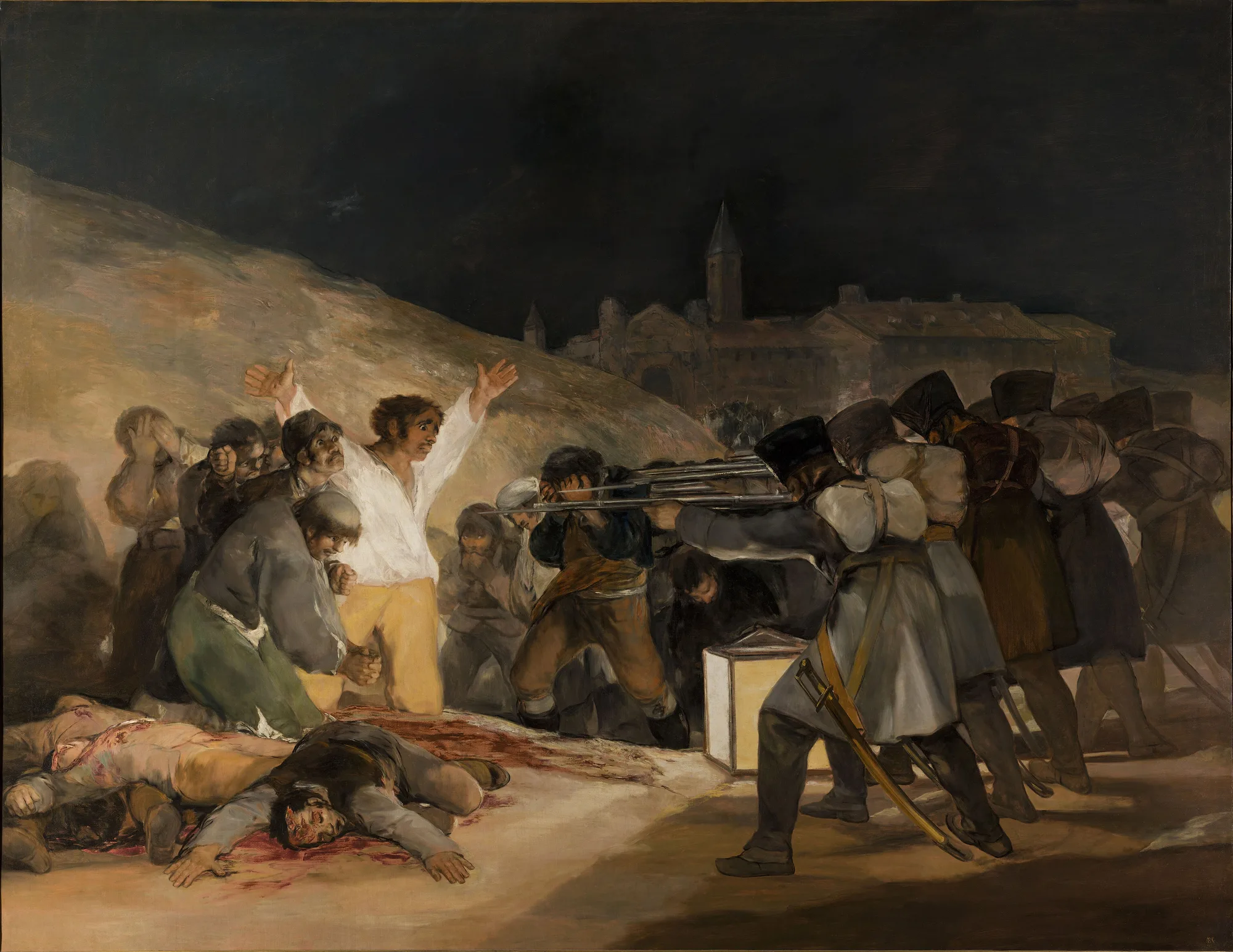
Story1808年5月2日、ナポレオンのフランス軍に占領されたマドリードで、市民が立ち上がりました。その翌日、フランス軍はつかまえた人々を処刑しました。ゴヤが描いたのは、その夜明け前の場面です。右には銃をかまえる兵士の列、左には白いシャツで両手を広げる男と、おびえる人々がいます。
On 2 May 1808, the people of Madrid rose up against Napoleon's French army, which had taken over the city. The next day, the French soldiers executed the people they had caught. Goya painted the scene before dawn. On the right is a line of soldiers aiming their guns. On the left is a man in a white shirt with his arms wide open, and frightened people around him.
1814年、フランス軍が去ったあと、ゴヤは自分から政府に申し出て、この出来事を記念する絵を描きました。地面に置かれた四角いランタンが、白いシャツの男を舞台のように照らします。兵士たちは背中しか見えず、まるで顔のない機械のよう。英雄ではなく、ふつうの人々が犠牲になる戦争を描いた点が、とても新しかったのです。
In 1814, after the French had left, Goya himself asked the government to let him paint this event. A square lantern on the ground lights the man in white like a stage light. We only see the soldiers' backs, so they look like faceless machines. It was very new to show war not through heroes, but through ordinary people who suffer.
この絵は、のちの画家たちに大きな影響をあたえました。マネは『皇帝マクシミリアンの処刑』で、ピカソは『朝鮮の虐殺』でこの構図を受けつぎ、『ゲルニカ』にもその影響が見られるといわれます。美術史家ケネス・クラークは「あらゆる意味で革命的と呼べる最初の偉大な絵」と評しました。
This painting had a huge influence on later artists. Manet used its design in The Execution of Emperor Maximilian, and Picasso did the same in Massacre in Korea. Its influence is also seen in Guernica. The art historian Kenneth Clark called it 'the first great picture which can be called revolutionary in every sense of the word.'
スペインのマドリードの夜です。兵士たちが人々に銃を向けています。白いシャツの男が両腕をあげています。地面のランタンが光を出しています。兵士たちの顔は見えません。ゴヤは、この悲しい日をわすれないでほしかったのです。
It is night in Madrid, Spain. Soldiers point their guns at people. A man in a white shirt raises his arms. A lantern on the ground gives light. You cannot see the soldiers' faces. Goya wanted us to remember this sad day.
英語のレベルは上の「やさしい/ふつう」で切りかえられます。
えっ!?な裏ネタ
Secrets両手を広げた男の右の手のひらには、十字架にかけられたキリストの手の傷のようなしるしが描かれています。広げた腕も、十字架のキリストを思わせるポーズです。名もない市民が、聖なる犠牲者のように見えてきます。
On the right palm of the man with open arms, there is a mark like the wounds of Christ on the cross. His open arms also remind us of the crucifixion. An unknown citizen comes to look like a holy victim.
1930年代のスペイン内戦のとき、この絵と対になる『1808年5月2日』は、守るためにマドリードからバレンシアへ運ばれました。1938年3月、そこからカタルーニャへ運ぶ途中で事故にあい、2点とも大きく傷ついてしまいました。
During the Spanish Civil War, this painting and its partner, The Second of May 1808, were sent from Madrid to Valencia for safety. In March 1938, both were badly damaged in an accident while being moved from Valencia toward Catalonia.
完成後、この絵はすぐには公開されず、何十年も倉庫にあったという説もあります。1834年のプラド美術館の目録には名前が出てきます。戦争の記憶がまだ生々しい時代だったのです。
Some accounts say the painting was not shown for decades and stayed in storage. It does appear in an 1834 list of the Prado's works. Memories of the war were still painful then.
「ゴヤは処刑を自分の目で見てスケッチした」という話がのちに広まりましたが、研究者たちは、ゴヤは現場にいなかった可能性が高いと考えています。それでもこの絵は、目撃した人の記憶のように生々しいのです。
A story later spread that Goya saw the executions and sketched them. But scholars think he was probably not there. Even so, the picture feels as real as an eyewitness memory.
ここを見て!
Look Closer1白いシャツの男The man in the white shirt
画面でいちばん明るい人物。両手を広げ、目を見開いて兵士を見つめています。
He is the brightest figure in the picture. His arms are open, and his eyes are wide as he faces the soldiers.
2ランタンThe lantern
地面の四角いランタン。この光が、暗い夜の中で一場面だけを強く浮かび上がらせます。
A square lantern on the ground. Its light makes one scene stand out in the dark night.
3顔の見えない兵士Soldiers without faces
兵士たちは同じ姿勢で背中を向け、だれの顔も見えません。人間らしさを消した描き方です。
The soldiers stand the same way with their backs to us. None of their faces can be seen. They seem to have no humanity.
4夜の町The town at night
奥には教会の塔と町並み。暗い空の下で、町は静まりかえっています。
In the background are a church tower and buildings. The town is silent under the dark sky.
英語で名画を語ろう
Talk about Art in EnglishThe man in the white shirt is lit by a lantern.
白いシャツの男は、ランタンに照らされています。
💡 is lit by +光源で「〜に照らされている」。lit は light の過去分詞。光の説明に必須です。
英語で説明すると… Describe it
これは暗い夜の場面です。右には、銃を持った兵士の列があります。左では、白いシャツの男が両腕をあげています。地面のランタンが彼を照らしています。奥には、教会の塔のある町があります。
This is a dark night scene. On the right, there is a line of soldiers with guns. On the left, a man in a white shirt is raising his arms. A lantern on the ground is lighting him. In the background, there is a town with a church tower.
考えてみよう Think & Talk
- ゴヤはなぜ兵士たちの顔を描かなかったのだと思いますか?Why do you think Goya did not show the soldiers' faces?
- 絵は、戦争の犠牲者を人々が忘れないための助けになるでしょうか?どのように?Can a painting help people remember the victims of war? How?
この作品の英単語
WordsA lantern lights up the man in white.
ランタンが白い服の男を照らしています。
The soldiers stand in a straight line.
兵士たちは一直線に並んでいます。
The soldiers aim their guns at the people.
兵士たちは人々に銃を向けています。
The people look helpless and afraid.
人々は無力で、おびえているように見えます。
ミニクイズ
QuizQ. 画面の中で、白いシャツの男を照らしているのは?What lights up the man in the white shirt?
地面に置かれた四角いランタンが、スポットライトのように彼を照らしています。
A square lantern on the ground lights him like a spotlight.
ウソ?ホント? ゴヤは、自分から政府に申し出てこの絵を描いた。Goya himself asked the government to let him paint this.
ゴヤは1814年2月24日に制作を申し出ました。政府が条件を認めたのは5月24日です。
Goya made his proposal on 24 February 1814. The government accepted his conditions on 24 May.
ウソ?ホント? 絵の中の兵士たちは、一人ひとり表情がくわしく描かれている。Each soldier's face is painted in detail.
兵士たちは背中を向け、顔はまったく見えません。
The soldiers turn their backs to us. We cannot see their faces at all.
 画像の出典とライセンス / Image credit
- PDEl Tres de Mayo, by Francisco de Goya, from Prado thin black margin.jpg(Wikimedia Commons)
ライセンス:Public domain(パブリックドメイン)/作者・撮影者の表記:El_Tres_de_Mayo,_by_Francisco_de_Goya,_from_Prado_in_Google_Earth.jpg: Francisco de Goya derivative work: Papa Lima Whiskey 2/提供元:This file was derived from: El Tres de Mayo, by Francisco de Goya, from Prado in Google Earth.jpg:
この作品は、作者の死後長い年月がたち著作権の保護期間が終わった「パブリックドメイン」の作品です。画像は平面の作品を忠実に写したもので、新しい著作権は生じません(Wikimedia Commons の PD-Art の考え方)。 所蔵:プラド美術館(Museo del Prado)。画像は表示のために縮小・WebP 形式に変換しています。
フランシスコ・デ・ゴヤのほかの作品