 ワークシート
 ぬりえ
 迷路
顔が見えないのに、美術史でとくに有名な「うしろ姿」。You never see his face, yet it is one of the most famous backs in art.
この作品のお話
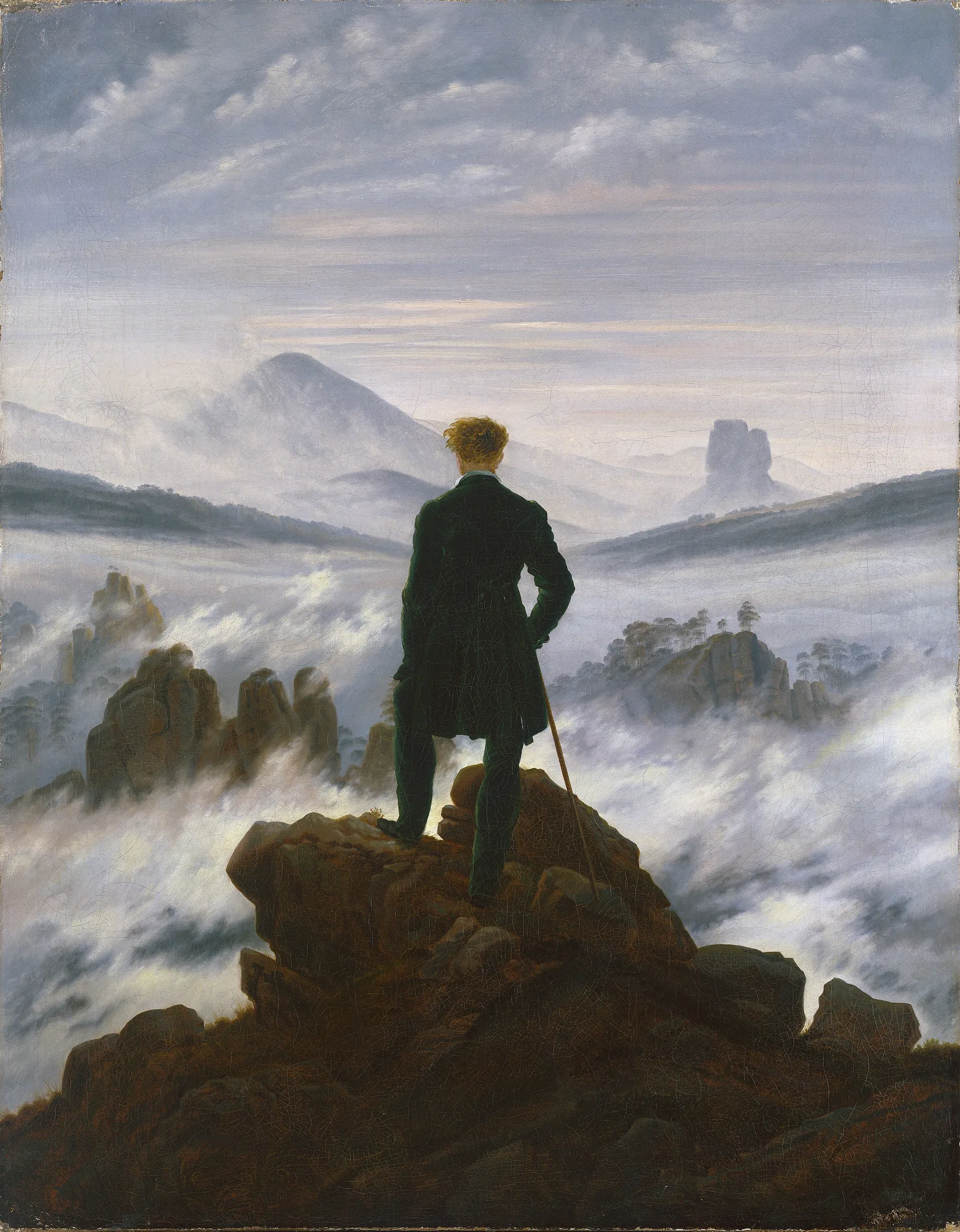
Story岩山の頂上に、黒っぽいコートの男がつえを持って立ち、霧の海を見下ろしています。こちらには背中しか見せません。霧の向こうには山々がつらなり、遠くの空まで続いています。ドイツ・ロマン主義の画家フリードリヒの、もっとも有名な作品のひとつです。見る人は、男と同じ向きから景色をながめることになります。
A man in a dark coat stands on top of a rocky peak with a walking stick. He looks down at a sea of fog and shows us only his back. Beyond the fog, mountains stretch away to the distant sky. This is one of the most famous paintings by Caspar David Friedrich, a German Romantic artist. We look at the view from the same direction as the man.
景色は、ドイツとチェコにまたがるエルベ砂岩山地の、実際の岩や山がもとになっています。でも1か所から見た風景ではありません。フリードリヒは各地で描いたスケッチをアトリエで組み合わせ、現実にはない景色をつくりました。人物をうしろから描く手法は「リュッケンフィグーア(背中の人物)」と呼ばれ、彼の代名詞です。
The view is based on real rocks and mountains in the Elbe Sandstone Mountains, between Germany and the Czech Republic. But it is not a view from one place. Friedrich combined sketches from different spots in his studio to create a landscape that does not exist. A figure shown from behind is called a Rückenfigur, and it became one of his trademarks.
フリードリヒは死後しばらく忘れられましたが、20世紀に再評価され、この絵は1970年にハンブルク美術収集財団が購入し、ハンブルク美術館に長期貸与されています。今では「自然と向き合う人間」や「人生の旅」のイメージとして、本の表紙、ポスター、マグカップ、さらにはゲームのパロディにまで使われています。
After his death, Friedrich was nearly forgotten, but he was rediscovered in the 20th century. In 1970, the Stiftung Hamburger Kunstsammlungen bought the painting, and it is on long-term loan to the Hamburger Kunsthalle. Today it is a symbol of a person facing nature, or of life's journey. It appears on book covers, posters, mugs and even in parodies in video games.
男の人が山の上に立っています。彼は白い霧の海を見ています。私たちには彼の背中しか見えません。顔はわからないのです!画家は本物の山々を、パズルのように組み合わせました。
A man stands on top of a mountain. He looks at a sea of white fog. We can only see his back. We do not know his face! The painter put real mountains together like a puzzle.
英語のレベルは上の「やさしい/ふつう」で切りかえられます。
えっ!?な裏ネタ
Secrets男が立つ岩はカイザークローネ、右奥の台形の岩山はツィルケルシュタインなど、それぞれ実在する場所がもとになっています。でもフリードリヒはそれらを自由に組み合わせました。
The rock under the man is based on the Kaiserkrone, and the flat-topped hill on the right is the Zirkelstein. These are real places, but Friedrich arranged them freely.
男の深緑のコートについては、ナポレオンと戦った時代のドイツの愛国的な「古ドイツ風」の服だという説や、狙撃兵の軍服だという説があり、研究者の意見が分かれています。
Experts disagree about his dark green coat. Some say it is an 'Old German' costume, a patriotic statement from the time of the wars against Napoleon. Others say it is a soldier's uniform.
この絵は、メアリー・シェリーの小説『フランケンシュタイン』の表紙に使われたことがあります。小説にもアルプスの山の場面があるためと考えられます。ほかにもゲームやテレビ番組で、たびたびパロディにされています。
This painting has been used on the cover of an edition of Mary Shelley's Frankenstein. This may be because the novel also has scenes in the Alpine mountains. It has also been parodied in video games and TV shows.
風になびく赤っぽい髪から、この男はフリードリヒ自身ではないかという説もあります。でも顔が見えないため、だれなのかは決められません。そこが見る人の想像をかき立てます。
Because of the man's reddish hair, some people think he is Friedrich himself. But we cannot see his face, so no one can be sure. That mystery invites us to imagine.
ここを見て!
Look Closer1うしろ姿の旅人The wanderer from behind
画面のまん中に立つ男。私たちは彼の肩ごしに、同じ景色を見ることになります。
The man stands in the very center. We see the view over his shoulder, just as he does.
2台形の岩山The flat-topped rock
右奥の四角い岩山はツィルケルシュタイン。霧の中にぽつんと浮かんで見えます。
The block-shaped rock on the right is the Zirkelstein. It seems to float in the fog.
3遠くの山The distant mountain
左奥の三角の山。霧でかすみ、遠さが感じられます。
A pointed mountain on the far left. The haze makes it feel very far away.
4足元の岩The rocks below
手前のごつごつした暗い岩。明るい霧との対比で、男が高い場所にいることがわかります。
Dark, rough rocks in the foreground. Against the bright fog, they show how high up he is.
英語で名画を語ろう
Talk about Art in EnglishThe man is painted from behind, so we can't see his face.
男はうしろから描かれているので、顔が見えません。
💡 from behind は「うしろから見た」。逆に正面からは from the front と言います。
英語で説明すると… Describe it
男の人が岩のてっぺんに立っています。私たちは彼をうしろから見ています。深緑のコートを着て、つえを持っています。彼の前には霧の海が広がっています。奥には山々とくもった空があります。
A man is standing on top of a rock. We can see him from behind. He is wearing a dark green coat and holding a stick. In front of him, there is a sea of fog. In the background, there are mountains and a cloudy sky.
考えてみよう Think & Talk
- この男の人は何を考えていると思いますか?What do you think the man is thinking about?
- フリードリヒはなぜ男の顔を描かなかったのだと思いますか?Why do you think Friedrich did not show the man's face?
この作品の英単語
WordsA sea of fog covers the valleys.
霧の海が谷をおおっています。
The wanderer stands alone on the rock.
旅人はひとりで岩の上に立っています。
He gazes at the mountains far away.
彼は遠くの山々をじっとながめています。
The landscape looks vast and quiet.
風景は広大で、静かに見えます。
ミニクイズ
QuizQ. この絵の景色はどうやってつくられた?How did Friedrich make this landscape?
実在の岩や山のスケッチを、アトリエで組み合わせてつくりました。写真はまだ発明されていません。
He combined sketches of real rocks and mountains in his studio. Photography had not been invented yet.
ウソ?ホント? 絵の中の男の顔は、はっきり描かれている。The man's face is clearly shown in the painting.
男はずっと背中を向けていて、顔は見えません。
He keeps his back to us, so we never see his face.
ウソ?ホント? 絵の中の岩や山は、実在する場所がもとになっている。The rocks and mountains are based on real places.
エルベ砂岩山地のカイザークローネやツィルケルシュタインなどがもとになっています。
They are based on places such as the Kaiserkrone and the Zirkelstein in the Elbe Sandstone Mountains.
 画像の出典とライセンス / Image credit
- PDCaspar David Friedrich - Wanderer above the Sea of Fog.jpeg(Wikimedia Commons)
ライセンス:Public domain(パブリックドメイン)/作者・撮影者の表記:Caspar David Friedrich
この作品は、作者の死後長い年月がたち著作権の保護期間が終わった「パブリックドメイン」の作品です。画像は平面の作品を忠実に写したもので、新しい著作権は生じません(Wikimedia Commons の PD-Art の考え方)。 所蔵:ハンブルク美術館(Hamburger Kunsthalle)。画像は表示のために縮小・WebP 形式に変換しています。
カスパー・ダーヴィト・フリードリヒのほかの作品