 ワークシート
 ぬりえ
 迷路
よろいを着たおばさんが地獄へ突撃!修復で年号まで見つかった!A woman in armor charges toward hell! Restoration even revealed the date!
この作品のお話
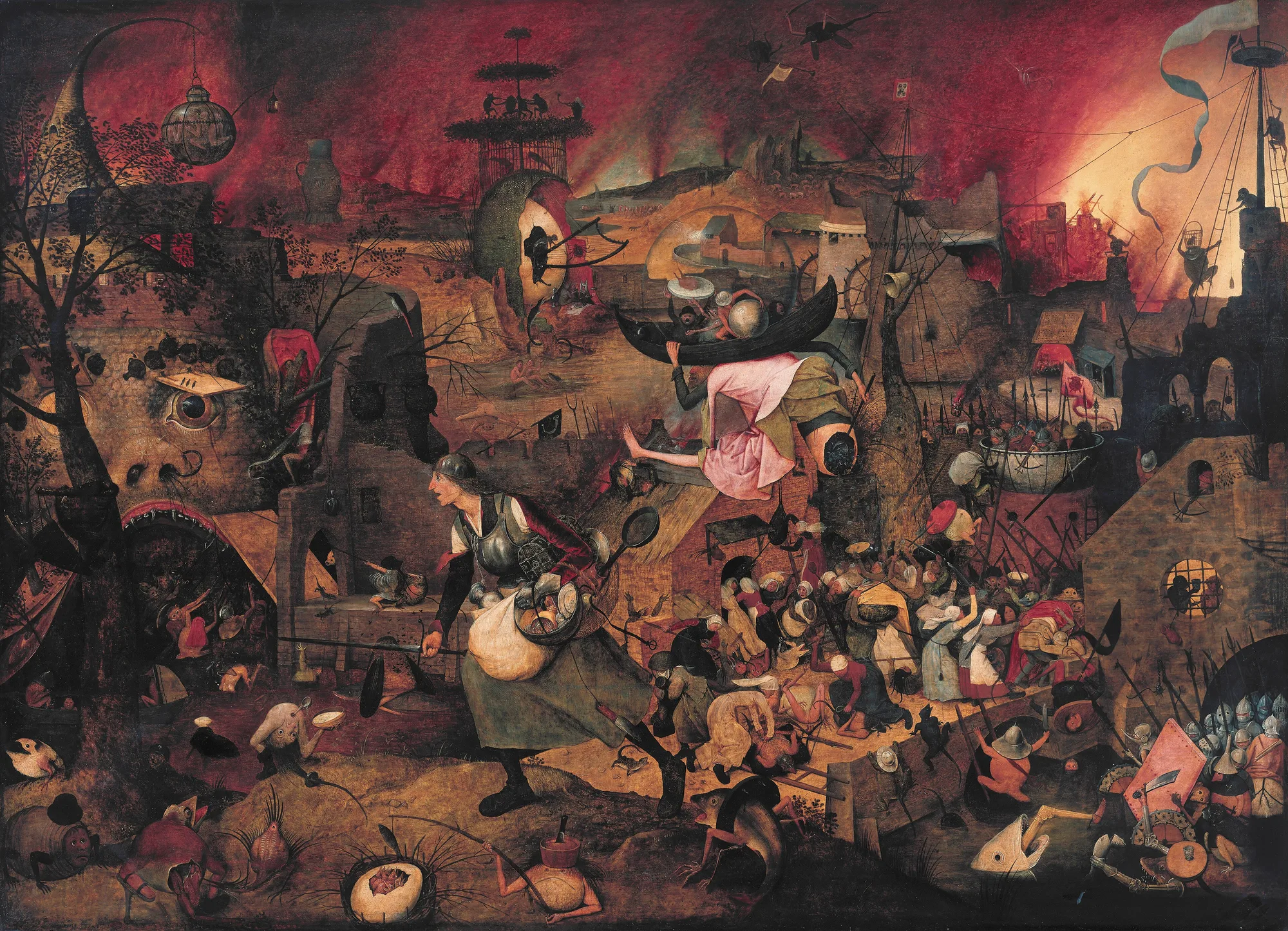
Story燃える赤い空の下、よろいの胸当てと鉄の帽子を身につけた女性が、剣を手に大またで進んでいきます。腕にはなべやかごなど、うばった品物をどっさり。行く先には、大きく口を開けた「地獄の入り口」があります。この女性が「悪女フリート」。ブリューゲルが1563年に描いた作品で、ベルギーのアントワープにあるマイヤー・ファン・デン・ベルフ美術館の所蔵品です(美術館の改修中は、近くのマーフデンハイスで公開)。
Under a burning red sky, a woman in a breastplate and an iron cap strides forward with a sword. Her arms are full of things she has grabbed, like pots and baskets. Ahead of her is the huge open mouth of hell. She is Dulle Griet, or Mad Meg. Bruegel painted this in 1563. It belongs to the Museum Mayer van den Bergh in Antwerp, Belgium. While the museum is being renovated, it is shown at the nearby Maagdenhuis.
16世紀のオランダ語で「ドゥル・フリート」は、怒りっぽい女性やけんか好きな女性を悪く言う呼び名でした。英語では昔から「マッド・メグ」とよばれています。後ろでは、女性たちが怪物と戦いながら物をうばっています。「地獄の前でも略奪して、無事に帰ってくる」という当時のことわざを絵にしたとも言われ、欲ばりや乱暴さへの風刺と考えられています。怪物たちの姿には、先輩の画家ボスの影響が見られます。
In 16th-century Dutch, 'Dulle Griet' was an insulting name for an angry or quarrelsome woman. In English, the painting is traditionally called Mad Meg. Behind her, women fight monsters and grab loot. The painting may show an old saying: 'She could go plundering in front of hell and come back unharmed.' It is thought to make fun of greed and violence. The monsters show the influence of the older painter Bosch.
この絵は、神聖ローマ皇帝ルドルフ2世のコレクションに入ったあと、1648年にスウェーデン軍に持ち去られたといわれ、1800年にストックホルムで再び姿をあらわしました。19世紀の終わりにケルンの競売でアントワープの収集家フリッツ・マイヤー・ファン・デン・ベルフが手に入れ、今も彼の名前の美術館の所蔵品です。
The painting entered the collection of Emperor Rudolf II. It is said that Swedish troops took it away in 1648, and it appeared again in Stockholm in 1800. At the end of the 19th century, the Antwerp collector Fritz Mayer van den Bergh bought it at an auction in Cologne. It still belongs to the museum named after him.
空は火のように赤いです。女性がよろいを着ています。剣とたくさんのなべを持っています。大きな口のほうへ歩いていきます。そこはこわい場所への入り口なのです!
The sky is red like fire. A woman wears armor. She has a sword and many pots. She walks to a big mouth. It is the door to a scary place!
英語のレベルは上の「やさしい/ふつう」で切りかえられます。
えっ!?な裏ネタ
Secrets以前は年号がよく読めず、この絵は1561年か1562年ごろの作品と考えられていました。2018年に終わった修復で、汚れたニスや古いぬり直しが取りのぞかれると、1563年という年号がはっきり読めるようになりました。ブリューゲルが結婚してブリュッセルへ移ったころの作品だったのです。
Before, the date was hard to read, and the painting was thought to be from about 1561 or 1562. A restoration finished in 2018 removed dirty varnish and old overpaint, and the date 1563 could be read clearly. Bruegel married and moved to Brussels around that time.
収集家フリッツ・マイヤー・ファン・デン・ベルフは、ケルンの競売でこの絵をとても安く手に入れました。そして数日後、ブリューゲル本人の作品だと気づいたといいます。目ききのコレクターの大当たりでした。
The collector Fritz Mayer van den Bergh bought this painting very cheaply at an auction in Cologne. A few days later, he realized it was by Bruegel himself. It was a huge win for a sharp-eyed collector.
フリッツは1901年、40代の若さで亡くなりました。母親のヘンリエッテは、息子のコレクションを守るために美術館を建て、1904年に開きました。この絵は、息子を思う母の気持ちとともに今も公開されているのです。
Fritz died young in 1901, in his forties. His mother, Henriëtte, built a museum to keep his collection together, and it opened in 1904. This painting is still shown there, along with a mother's love for her son.
ベルギーのヘント大学の研究で、フリートの服の青には、宝石からつくる高価なウルトラマリンではなく、コバルトをふくむガラスからつくる安い青い絵の具「スマルト」が使われていることがわかりました。スマルトは時間がたつと色があせることがあり、服はもとは今より青かったのかもしれません。
A study at Ghent University found that the blue of Griet's clothes is not expensive ultramarine made from a gemstone. It is smalt, a cheaper blue made from glass containing cobalt. Smalt can fade over time, so her clothes may once have looked bluer.
ここを見て!
Look Closer1フリートDulle Griet
よろいと鉄の帽子で剣をにぎり、うばった品物をかかえて突進中。
In armor and an iron cap, she grips a sword and rushes on with her loot.
2地獄の入り口The mouth of hell
巨大な顔が口を開けた地獄の入り口。フリートはここへ向かっています。
A giant face with an open mouth is the gate of hell. Griet is heading here.
3船を背負う巨人Giant with a boat
屋根の上にすわり、背中に船をのせた巨人。ブリューゲルらしい不思議な姿です。
A giant sits on a roof with a boat on his back. A strange figure typical of Bruegel.
4怪物と戦う女性たちWomen fighting monsters
女性たちの群れが、悪魔のような怪物と戦いながら、品物をうばい集めています。
A crowd of women fights devils and grabs loot.
英語で名画を語ろう
Talk about Art in EnglishDulle Griet marches toward the mouth of hell without fear.
フリートはこわがりもせず、地獄の入り口へ向かってずんずん進みます。
💡 march は「行進する」。迷わず力強く進む様子を生き生きと伝えられます。
英語で説明すると… Describe it
空は赤く、煙でいっぱいです。真ん中では、よろいを着た女性が剣を持って足早に歩いています。左には、口を大きく開けた巨大な顔があります。右では、たくさんの女性たちが怪物と戦っています。
The sky is red and full of smoke. In the center, a woman in armor is walking quickly with a sword. On the left, there is a huge face with an open mouth. On the right, many women are fighting with monsters.
考えてみよう Think & Talk
- フリートは勇かんだと思いますか、それともおろかだと思いますか?それはなぜ?Is Dulle Griet brave or foolish? Why do you think so?
- 今の時代の「欲ばり」を風刺する絵を描くなら、何を描きますか?If you painted a picture to make fun of greed today, what would you draw?
この作品の英単語
WordsGriet is wearing armor.
フリートはよろいを着ています。
The painting makes fun of greedy people.
この絵は欲ばりな人たちを風刺しています。
Strange monsters are everywhere.
そこらじゅうに不思議な怪物がいます。
She grabs pots and baskets.
彼女はなべやかごをひっつかんでいます。
ミニクイズ
QuizQ. 2018年に終わった修復で、はっきり読めるようになったものは?What could be read clearly after the restoration finished in 2018?
汚れたニスや古いぬり直しが取りのぞかれ、1563年という年号が読めるようになりました。
When dirty varnish and old overpaint were removed, the date 1563 could be read.
ウソ?ホント? フリートの青い服には、高価なウルトラマリンが使われている。Griet's blue clothes are painted with expensive ultramarine.
コバルトをふくむガラスからつくる、より安い青「スマルト」が使われていました。
They are painted with smalt, a cheaper blue made from glass.
ウソ?ホント? この絵は、スウェーデンにわたったことがある。This painting was once in Sweden.
1648年にスウェーデン軍に持ち去られたといわれ、1800年にストックホルムで再び姿をあらわしました。
Swedish troops are said to have taken it in 1648. It appeared again in Stockholm in 1800.
 画像の出典とライセンス / Image credit
- PDDulle Griet, by Pieter Brueghel (I).jpg(Wikimedia Commons)
ライセンス:Public domain(パブリックドメイン)/作者・撮影者の表記:Pieter Brueghel the Elder
この作品は、作者の死後長い年月がたち著作権の保護期間が終わった「パブリックドメイン」の作品です。画像は平面の作品を忠実に写したもので、新しい著作権は生じません(Wikimedia Commons の PD-Art の考え方)。 所蔵:マイヤー・ファン・デン・ベルフ美術館(Museum Mayer van den Bergh)。画像は表示のために縮小・WebP 形式に変換しています。
ピーテル・ブリューゲル(父)のほかの作品