 ワークシート
 ぬりえ
 迷路
青いチュチュが燃えるよう!目の弱ったドガがパステルで描いた舞台裏。Blue tutus that seem to blaze! A backstage scene in pastel by Degas, whose eyesight was failing.
 美術館アンテナ:エドガー・ドガの作品に会える展覧会
この作品のお話
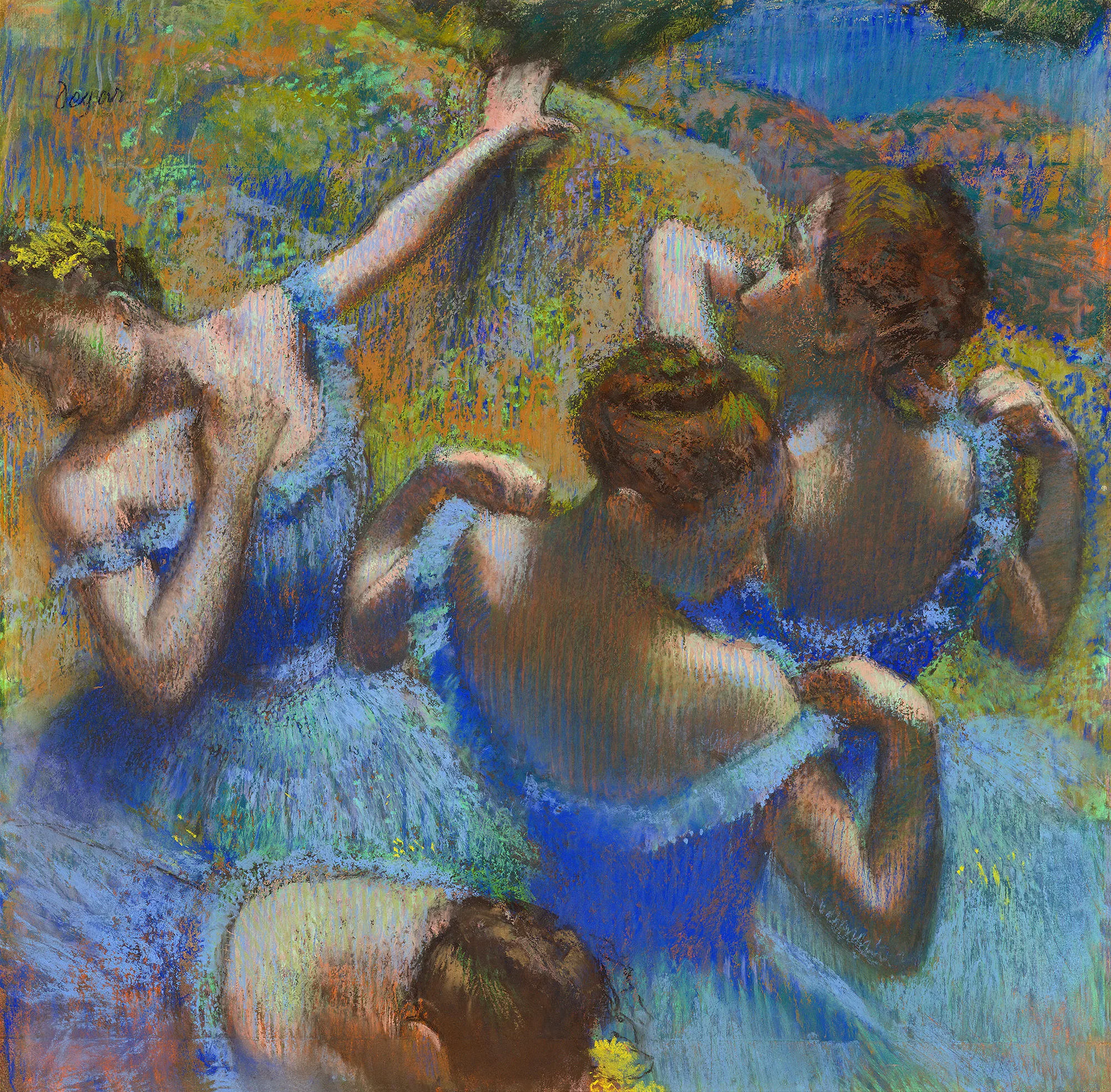
Story青い衣装のバレリーナ4人が、ぎゅっと集まっています。衣装を整えたり、上のほうに腕をのばしたり、下を向いてかがんだり。顔はほとんど見えず、ねじった背中や持ち上げた腕ばかりです。背景はオレンジや緑の色の線でうめつくされています。フランスの画家ドガが1898年ごろに描いたパステル画で、今はロシア・モスクワのプーシキン美術館にあります。
Four ballerinas in blue costumes crowd together. They seem to adjust their costumes, reach up high, or bend down. We can hardly see their faces, only twisted backs and raised arms. The background is filled with lines of orange and green. The French artist Degas made this pastel around 1898. It is now in the Pushkin Museum in Moscow, Russia.
ドガは1870年ごろから晩年まで、40年以上にわたってパリ・オペラ座の踊り子たちを描きました。晩年には視力がおとろえるなか、細かい描写よりも、パステルで太い線や色を重ねる描き方を多く用いるようになります。この絵も、近くで見ると線のあらいひっかき傷のようなのに、離れると青い衣装がかがやき、踊り子たちのにぎやかな気配が伝わってきます。
From around 1870 until his late years, Degas painted the dancers of the Paris Opera for more than 40 years. As his eyesight grew weaker, he often layered thick lines and colors of pastel instead of painting fine details. Up close, this picture looks like rough scratches. But from a distance, the blue costumes shine and we feel the lively mood of the dancers.
この絵は画商デュラン=リュエルの手をへて、モスクワの大収集家セルゲイ・シチューキンのものになりました。ロシア革命のあと、シチューキンのコレクションは国のものとなり、この絵は1948年にプーシキン美術館に移されました。今もモスクワで見ることができる、ドガ晩年のあざやかな色彩の作品です。
The picture passed through the art dealer Durand-Ruel and became part of the collection of Sergei Shchukin, a great collector in Moscow. After the Russian Revolution, his collection was taken over by the state, and in 1948 this work moved to the Pushkin Museum. It can still be seen in Moscow today, a vividly colored work from Degas's late years.
4人の踊り子が青い衣装を着ています。体を寄せ合っています。1人は衣装を直し、別の1人はかがんでいます。顔はよく見えません。ドガは色つきチョークのようなあざやかなパステルを使いました。
Four dancers wear blue costumes. They stand close together. One dancer fixes her costume, and another bends down. We cannot see their faces well. Degas used bright pastels, like colored chalk.
英語のレベルは上の「やさしい/ふつう」で切りかえられます。
えっ!?な裏ネタ
Secrets1895年ごろ、ドガは写真に熱中し、肩ひもを直す踊り子のポーズを撮ったガラス板の写真が残っています(フランス国立図書館所蔵)。そのポーズはこのころの踊り子のパステル画によく似ていて、作品づくりに写真を役立てたと考えられています。
Around 1895, Degas became very interested in photography. Glass plate photos he took of a dancer adjusting her shoulder strap still survive (National Library of France). The poses look very much like his dancer pastels from this time, so he probably used photos to help make his art.
シチューキンのコレクションは、革命後「国立近代西洋美術館」として公開されていました。ところが1948年、この美術館は閉鎖され、作品はモスクワのプーシキン美術館と、レニングラード(今のサンクトペテルブルク)のエルミタージュ美術館に分けられました。この絵はそのときモスクワに残ったのです。
After the Revolution, Shchukin's collection was shown as the State Museum of New Western Art. But in 1948, this museum was closed, and its works were split between the Pushkin Museum in Moscow and the Hermitage in Leningrad (now St. Petersburg). This picture stayed in Moscow.
ドガは「踊り子の画家」と呼ばれるほど、バレエの場面を数多く描きました。油絵、パステル、彫刻をあわせると、作品の半分以上が踊り子をテーマにしていると言われます。舞台の上だけでなく、練習や休けい、着がえなど、舞台裏の姿を好んで描いたのが特徴です。
Degas painted so many ballet scenes that he is called "the painter of dancers". It is said that more than half of his works, including oil paintings, pastels and sculptures, are about dancers. He especially liked to show them backstage, practicing, resting or changing, not only on stage.
4人とも顔はほとんど見えません。ドガがとらえたかったのは、だれかの肖像ではなく、腕をあげたり背中をねじったりする「体の動き」そのものでした。そのため、この4人は1人の踊り子の別々のポーズを組み合わせたものではないか、と見る人もいます。
We can hardly see any of the four faces. Degas wanted to capture not a portrait of someone, but movement itself: raising arms and twisting backs. So some people think these four may be different poses of a single dancer, put together.
ここを見て!
Look Closer1ドガのサインDegas's signature
左上に「Degas」のサイン。パステルの色の中に、さらりと書きこまれています。
The signature "Degas" is at the top left, written lightly among the pastel colors.
2腕をあげる踊り子Dancer raising her arm
左の踊り子は、片腕を高くのばしています。舞台装置のはしにつかまっているのかもしれません。のびた腕の線が画面を大きく横切ります。
The dancer on the left stretches one arm high. She may be holding the edge of the scenery. The line of her arm cuts across the picture.
3衣装を整える背中Back of a dancer adjusting her costume
背中を向け、肩のあたりで衣装を整えているような踊り子。ねじった背中に、パステルの光がのっています。
With her back to us, a dancer seems to adjust her costume at the shoulder. Pastel light rests on her twisted back.
4下の踊り子Dancer at the bottom
画面の下で、頭を下げてかがむ踊り子。体の一部だけが、画面のはしで切れています。
At the bottom, a dancer bends her head down. The edge of the picture cuts off most of her body.
英語で名画を語ろう
Talk about Art in EnglishOne dancer is adjusting her costume before the show.
1人の踊り子が、本番の前に衣装を整えています。
💡 adjust は「(ずれを)直す、整える」。adjust a strap(肩ひもを直す)とも使えます。
英語で説明すると… Describe it
これは青い衣装を着た4人のバレエの踊り子の絵です。体が重なり合い、顔のほとんどは見えません。左では、1人が腕を高くあげています。右では、背中を向けた1人が衣装を整えています。下では、もう1人が頭を下げています。
This is a picture of four ballet dancers in blue costumes. Their bodies overlap, and we cannot see most of their faces. On the left, one dancer is raising her arm high. On the right, a dancer with her back to us is adjusting her costume. At the bottom, another dancer is bending her head down.
考えてみよう Think & Talk
- ドガはなぜ、踊り子たちの顔を見せなかったのだと思いますか?Why do you think Degas did not show the dancers' faces?
- 本番の直前、踊り子たちはどんな気持ちだと思いますか?How do you think the dancers feel just before the show?
この作品の英単語
WordsDegas used pastels for this picture.
ドガはこの絵にパステルを使いました。
The dancers wear blue costumes.
踊り子たちは青い衣装を着ています。
The dancers are getting ready backstage.
踊り子たちは舞台裏で準備をしています。
Up close, the lines look rough.
近くで見ると、線はあらく見えます。
ミニクイズ
QuizQ. この絵は何で描かれている?What did Degas use to make this picture?
色のついたチョークのような画材、パステルで描かれています。
It is made with pastel, a material like colored chalk.
ウソ?ホント? この絵は今、モスクワのプーシキン美術館にある。This picture is now in the Pushkin Museum in Moscow.
シチューキンのコレクションから、1948年にプーシキン美術館に移りました。
It came from Shchukin's collection and moved to the Pushkin Museum in 1948.
ウソ?ホント? 踊り子たちは、舞台の上で観客におじぎをしている。The dancers are bowing to the audience on stage.
衣装を整えたりしている、舞台裏のような場面です。
They seem to be adjusting their costumes, like in a backstage scene.
 画像の出典とライセンス / Image credit
- PDEdgar Germain Hilaire Degas 076.jpg(Wikimedia Commons)
ライセンス:Public domain(パブリックドメイン)/作者・撮影者の表記:Edgar Degas
この作品は、作者の死後長い年月がたち著作権の保護期間が終わった「パブリックドメイン」の作品です。画像は平面の作品を忠実に写したもので、新しい著作権は生じません(Wikimedia Commons の PD-Art の考え方)。 所蔵:プーシキン美術館(Pushkin State Museum of Fine Arts)。画像は表示のために縮小・WebP 形式に変換しています。