原田英語の時事英語ジュニア|英語ニュース ワークシート(高校生レベル)
Class ____ No. ____ Name ____________________
ボイジャー1号が11月18日に「1光日」の遠さへ 返事まで2日、人が作った物で初めて
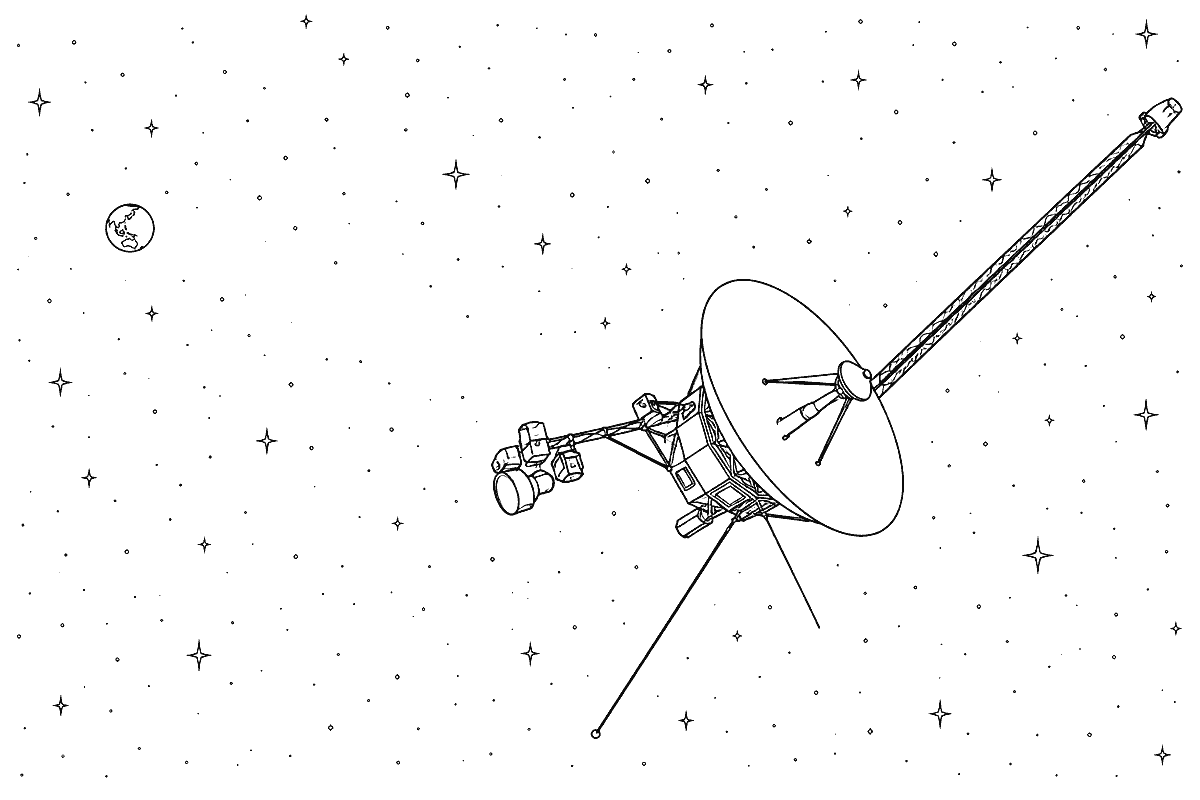
Signals to Voyager 1 Will Soon Take a Whole Day
1On November 18, NASA's Voyager 1 will become the first object built by people to be one light-day away from Earth. A light-day is the distance that light covers in 24 hours, or about 25.9 billion kilometers. NASA said the spacecraft will pass that point at 2:16 a.m. Pacific Standard Time, which is 7:16 p.m. in Japan.
2One light-day is about 173 times the distance between Earth and the Sun. Voyager 1 is already more distant from Earth than any other human-made object. It is now traveling through interstellar space, outside the bubble that the Sun creates around itself. NASA says Voyager 1 and Voyager 2 are the only two spacecraft that have worked there.
3Because radio signals move at the speed of light, every command from Earth will need a full day to reach the spacecraft. Any reply will take another day to return. Suzy Dodd of NASA's Jet Propulsion Laboratory gave an example in a CNN article in December 2025. She said a command sent at 8 a.m. on a Monday would get a response at about 8 a.m. on Wednesday.
4Voyager 1 was launched on September 5, 1977. It flew past Saturn in 1980 and has been traveling through space ever since. Today, it moves at about 61,000 kilometers per hour. After more than 49 years in space, it is still working.
5To save power, NASA has switched off many of the spacecraft's science instruments. According to NASA's records, its cameras were turned off in 1990. The most recent instrument was shut down in April 2026. Only two instruments, a magnetometer and a plasma wave detector, are still on. In the same CNN article, Dodd said she was confident that at least one of the two Voyagers could keep working for two to five more years.
Words 単語
| signalsB1 | 名 | 信号(signal の複数形)sounds, lights, or waves that carry information |
| distantB1 | 形 | 遠い、遠くはなれたfar away from here |
| interstellar外 | 形 | 恒星間の、星と星のあいだのbetween the stars in space |
| coversA1 | 動 | (ある距離を)進む(cover の3単現)goes a certain distance |
| shut downA2 | 句 | (機械などを)止める、電源を切るto stop a machine from working |
| commandB1 | 名 | 命令、指令an order that tells someone or something what to do |
| launchedB1 | 動 | 打ち上げられた(launch の過去分詞)sent up into the sky or space |
| instrumentsA2 | 名 | (観測の)機器、器具(instrument の複数形)tools used to measure or study things |
| detector外 | 名 | 検出器、(何かを)とらえる機器a machine that finds or notices something |
| confidentA2 | 形 | 自信がある、確信しているsure that something will happen or is true |
単語のレベル:CEFR-J(『CEFR-J Wordlist Version 1.6』 東京外国語大学投野由紀夫研究室. (URL: https://www.cefr-j.org/download.html より 2026年8月ダウンロード))
1. Reading Quiz 本文の内容に合うものを選ぼう
What time will Voyager 1 pass the one light-day point in Japan?
A. At 2:16 a.m.B. At 7:16 p.m.C. At 9:00 a.m.D. At midnight
How does one light-day compare with the distance between Earth and the Sun?
A. It is about half of it.B. It is about the same.C. It is about 173 times longer.D. It is about 24 times longer.
Why will every command need a full day to reach Voyager 1?
A. Because radio signals move at the speed of lightB. Because NASA sends commands only once a dayC. Because the spacecraft is sleepingD. Because the Sun blocks the signals
When were Voyager 1's cameras turned off?
A. In 1977B. In 1980C. In April 2026D. In 1990
What did Dodd say about the two Voyagers?
A. Both will stop working this year.B. At least one could keep working for two to five more years.C. Both will come back to Earth.D. Voyager 2 will turn its cameras on again.
2. True or False 正しければ T、違っていれば F
( ) Voyager 1 is traveling through interstellar space.
( ) A reply from Voyager 1 reaches Earth in a few minutes.
( ) Voyager 1 was launched on September 5, 1977.
( ) All of Voyager 1's science instruments are still on.
3. Fill in the Blanks 下の語から選んで空らんをうめよう(形を変えずに)
launchedcoverscommandinterstellarsignalsdistant
Voyager 1 was _____ on September 5, 1977.
Voyager 1 is already more _____ from Earth than any other human-made object.
It is now traveling through _____ space, outside the bubble that the Sun creates around itself.
She said a _____ sent at 8 a.m. on a Monday would get a response at about 8 a.m. on Wednesday.
Because radio _____ move at the speed of light, every command from Earth will need a full day to reach the spacecraft.
A light-day is the distance that light _____ in 24 hours, or about 25.9 billion kilometers.
4. Word Order 語を並べかえて正しい文にしよう
( to / day / take / another / return / reply / Any / will ) .
( Voyager / 1977 / 1 / 5, / on / launched / September / was ) .
( recent / in / most / down / The / 2026 / instrument / shut / April / was ) .
5. Think and Write 英語で答えてみよう
Voyager 1 has worked for more than 49 years. Why do you think NASA keeps it running instead of ending the mission?(ボイジャー1号は49年以上働いています。NASAが計画を終わらせずに動かし続けるのはなぜだと思いますか?)
Messages to Voyager 1 take a day to arrive. Do you think it is important for people to answer messages quickly? Why or why not?(ボイジャー1号へのメッセージは届くのに1日かかります。人どうしのメッセージは、すぐに返事をすることが大切だと思いますか?それはなぜ?)
Answers 解答
1. (1) B (2) C (3) A (4) D (5) B
2. (1) T (2) F (3) T (4) F
3. (1) launched (2) distant (3) interstellar (4) command (5) signals (6) covers
4.
- Any reply will take another day to return.
- Voyager 1 was launched on September 5, 1977.
- The most recent instrument was shut down in April 2026.
全文訳
111月18日、NASAのボイジャー1号が、人が作った物として初めて、地球から1光日はなれたところに着きます。1光日とは光が24時間で進む距離で、約259億キロメートルです。NASAによると、ボイジャー1号がそこを通るのはアメリカ太平洋標準時の午前2時16分、日本時間では午後7時16分です。
21光日は、地球と太陽のあいだの距離の約173倍です。ボイジャー1号は、すでに人が作った物の中でいちばん遠くにあります。今は、太陽が自分のまわりにつくる泡の外にある「恒星間空間」を進んでいます。NASAによると、そこで動いたことがある探査機は、ボイジャー1号と2号の2機だけです。
3電波は光の速さで進むので、地球からの命令はどれも、探査機に届くまでにまる1日かかります。返事がもどるのにも、もう1日かかります。NASAジェット推進研究所のスージー・ドッドさんは、2025年12月のCNNの記事で、例をあげました。月曜日の朝8時に送った命令の返事は、水曜日の朝8時ごろに届くというのです。
4ボイジャー1号は、1977年9月5日に打ち上げられました。1980年に土星のそばを通り、それからずっと宇宙を進み続けています。今は、時速約6万1000キロメートルで進んでいます。宇宙に出て49年以上たった今も、まだ動いています。
5電力を節約するため、NASAはボイジャー1号の科学観測の機器の多くを止めてきました。NASAの記録によると、カメラは1990年に止められました。いちばん最近、機器が止められたのは2026年4月です。今も動いているのは、磁力計と、プラズマの波をとらえる機器の2つだけです。同じCNNの記事でドッドさんは、2機のボイジャーのうち少なくとも1機は、あと2〜5年は動き続けられると自信を持っていると話しました。
文法ポイント:現在完了進行形(have been ~ing)
「(過去のある時から今まで)ずっと〜し続けている」を表す。本文の It flew past Saturn in 1980 and has been traveling through space ever since.(1980年からずっと宇宙を進み続けている)がその例。since や for といっしょによく使う。
出典:NASA、NASA、EarthSky、CNN(KVIA) ほか(記事は原田英語の時事英語ジュニアのオリジナル)|https://www.haradaeigo.com/jijieigo-junior/news/2026-10-29-voyager-1-light-day/